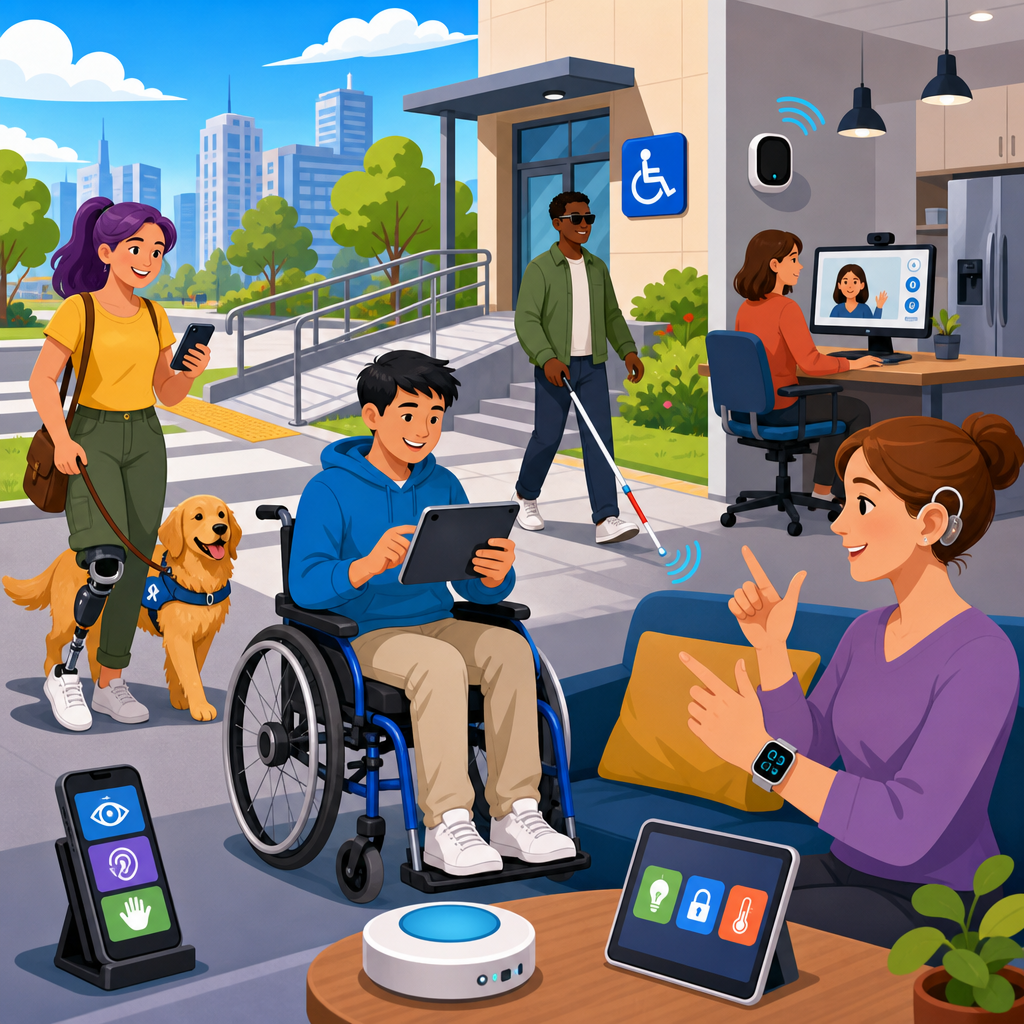
The latest in assistive technologies influenced by ADA is no longer limited to ramps, screen readers, and captioning; it now includes AI-driven communication tools, adaptive interfaces, smart mobility systems, and workplace platforms built around accessibility from the start. The Americans with Disabilities Act, or ADA, is a civil rights law that prohibits discrimination based on disability in employment, public services, public accommodations, transportation, and telecommunications. In practice, the ADA has done more than shape legal compliance. It has pushed manufacturers, software teams, employers, schools, and public agencies to treat accessibility as a product requirement, a procurement standard, and a design discipline. I have seen this shift directly in digital accessibility projects where teams that once added fixes late in development now begin with keyboard support, screen reader compatibility, and caption workflows as baseline requirements.
Assistive technology means any device, software, or system that helps a person maintain or improve functional capabilities. That includes familiar tools such as hearing aids, braille displays, speech recognition, and augmentative and alternative communication devices, but the category is expanding rapidly. Mainstream products now include features that originated in disability-focused design, such as live captions, voice control, eye tracking, haptic feedback, and predictive text. This matters because ADA-related expectations increasingly influence public procurement, risk management, user experience standards, and innovation roadmaps. Organizations want tools that serve disabled users well, reduce legal exposure, and work across mixed environments including offices, schools, transit systems, healthcare portals, and consumer apps.
As a hub for future trends and predictions in ADA developments, this article explains where assistive technology is heading and why those changes matter now. The biggest trend is convergence: disability-specific tools are blending with mainstream platforms, cloud services, and wearable devices. Another trend is personalization. Instead of one generic accommodation, newer systems adapt in real time to speech patterns, motor capabilities, visual preferences, cognitive load, and environmental conditions. A third trend is accountability. Courts, regulators, procurement teams, and users expect accessibility claims to be testable, documented, and maintained over time. Understanding these trends helps organizations make better technology decisions and helps readers evaluate which developments are likely to produce durable access rather than short-lived novelty.
How ADA pressure is shaping the next generation of assistive technology
The ADA does not prescribe a master list of devices, but its non-discrimination mandate strongly influences what gets designed, purchased, and improved. In employment, reasonable accommodation duties often drive adoption of speech-to-text software, ergonomic input devices, visual alerting systems, and accessible collaboration tools. In public accommodations and digital services, organizations increasingly align with Web Content Accessibility Guidelines, Section 508 practices, and platform accessibility APIs because they need defensible systems, not one-off patches. In my experience advising on accessibility remediation, the most durable improvements happen when compliance teams, procurement leaders, and product managers treat accessibility as operational infrastructure rather than a legal afterthought.
This pressure affects vendors in concrete ways. Software companies now compete on support for screen readers like JAWS, NVDA, and VoiceOver; hardware makers publish compatibility details for switch control, braille input, and hearing loop systems; and public kiosks increasingly include tactile controls, text-to-speech output, and wheelchair reach compliance. ADA influence also reaches contract language. Government agencies, universities, hospitals, and large employers frequently require accessibility conformance reports based on the Voluntary Product Accessibility Template, or VPAT. That procurement process changes product roadmaps because inaccessible features can block sales. The result is a market where accessibility features increasingly move from specialized add-ons into standard product development and release cycles.
AI-powered communication and sensory access tools
Artificial intelligence is accelerating some of the most visible advances in assistive technology. Automatic speech recognition now powers live captions in meetings, classrooms, telehealth sessions, and public events. The quality is not perfect, especially with accents, technical vocabulary, crosstalk, or poor audio, but it is materially better than it was five years ago. Platforms such as Zoom, Microsoft Teams, Google Meet, and Webex offer built-in captioning, and enterprise buyers now examine latency, speaker identification, punctuation accuracy, and export options because those details determine whether a feature is genuinely useful. ADA expectations make these questions practical, not theoretical, since access must work in real settings with real consequences.
For deaf and hard-of-hearing users, the next wave goes beyond basic captions. Real-time translation, customizable caption placement, personal vocabulary libraries, and environmental sound alerts are becoming more common. Smartphone-based sound recognition can identify alarms, doorbells, crying babies, and spoken names. Hearing technology is also converging with consumer audio. Bluetooth Low Energy Audio and Auracast broadcasting promise easier public venue audio streaming, potentially reducing friction in theaters, airports, lecture halls, and houses of worship. If implemented well, these systems could become as normal as Wi-Fi, though success depends on venue investment, device compatibility, and staff training.
Blind and low-vision users are also benefiting from AI-driven tools. Computer vision applications can describe scenes, read signage, identify products, and extract text from printed documents with greater speed than earlier OCR systems. Apps such as Seeing AI, Be My Eyes, and Envision already support daily tasks like reading menus, sorting mail, and locating objects. The key future trend is multimodal assistance: combining camera input, language models, GPS, and device sensors to provide context-aware guidance. That could mean a phone describing a transit platform, warning about a temporary barrier, then reading the arrival board aloud. These tools will improve independence, but they must be tested carefully to avoid overconfident errors in safety-critical situations.
Smarter mobility, navigation, and physical access systems
Mobility technology is moving from isolated devices to connected systems. Power wheelchairs, portable ramps, stair-climbing devices, robotic feeding supports, and exoskeleton research all reflect demand for better physical access, but the larger change is integration with buildings, sidewalks, vehicles, and public information systems. ADA-driven design reviews increasingly consider not just whether an entrance exists, but whether a person can find it, use it independently, and receive timely status information when conditions change. That is why accessible wayfinding is becoming a major development area in airports, hospitals, campuses, and transit hubs.
Indoor navigation tools now use Bluetooth beacons, ultra-wideband positioning, computer vision, and detailed digital maps to guide users through complex environments. Good systems do more than announce turn-by-turn directions. They identify accessible entrances, elevator locations, restroom features, service counters, and temporary closures. Public transit apps are starting to incorporate elevator outage data and station accessibility details, which matters because a technically accessible route can become unusable when one lift fails. Cities including New York, London, and Washington have all faced pressure to improve elevator information and station navigation because access depends on current operational data, not static promises.
| Technology area | Current use | Likely next development | Main ADA-related impact |
|---|---|---|---|
| Live captioning | Meetings, classes, events | Better accuracy and multilingual output | Improves communication access in public and work settings |
| Computer vision assistance | Reading text and describing scenes | Context-aware navigation and hazard detection | Expands independent access to physical spaces |
| Accessible wayfinding | Airports, hospitals, transit hubs | Real-time route adaptation | Connects legal access with practical usability |
| Adaptive workplace software | Voice input, screen readers, alerts | Personalized interfaces across devices | Supports reasonable accommodation at scale |
Vehicle access is another area to watch. Ride-share accessibility remains uneven, but ADA influence is pushing greater attention to wheelchair-accessible vehicle availability, app accessibility, and driver training. At the same time, advanced driver assistance systems and semi-autonomous vehicle features are prompting new questions about inclusive interface design. A future vehicle may support voice commands, tactile alerts, customizable display contrast, and transfer-assistance prompts, but those features will only matter if they are standardized and easy to use. Physical access technology succeeds when it reduces dependency without creating a new layer of technical complexity.
Workplace, education, and digital platform innovation
The future of ADA-related assistive technology will be shaped heavily by work and learning environments. Employers increasingly rely on cloud platforms for messaging, meetings, document creation, HR workflows, and training. If those systems are inaccessible, accommodations become fragmented and expensive. That is why major suites such as Microsoft 365, Google Workspace, Salesforce, ServiceNow, and Workday continue expanding accessibility features and documentation. In practical terms, this means better heading structures, keyboard navigation, alt text prompts, accessible templates, color contrast controls, and compatibility with screen readers and dictation tools. These are not cosmetic improvements. They determine whether someone can complete core job tasks independently.
Educational technology follows the same pattern. Learning management systems, testing platforms, digital textbooks, and classroom media have faced scrutiny because inaccessible content can exclude students despite formal legal protections. The stronger products now include read-aloud support, synchronized captioning, keyboard-operable assessments, dyslexia-friendly display options, and export formats compatible with braille devices or refreshable displays. Future development will likely focus on adaptive presentation, where the same content can shift intelligently across visual, auditory, simplified-language, and tactile-friendly formats without losing meaning. That would reduce the recurring problem of retrofitting course materials after students report barriers.
Another important shift is the move from individual accommodations to inclusive defaults. In workplaces, I increasingly see accessibility profiles that travel with the user across devices, preserving caption preferences, contrast settings, input methods, and notification choices. This approach is efficient because it reduces repetitive setup and makes hybrid work more sustainable. It also reflects a broader ADA trend: removing barriers systemically instead of waiting for each person to request an exception. Organizations that build accessible defaults usually spend less time in remediation and produce better experiences for everyone, including aging users, people with temporary injuries, and users in noisy or low-light environments.
What future ADA developments will likely demand from organizations
The most credible prediction is that accessibility expectations will become more measurable and more continuous. Organizations will not be able to rely on annual audits alone. They will need ongoing testing, documented issue tracking, accessible procurement, and governance that assigns responsibility to design, engineering, content, legal, and support teams. Automated scanning tools such as axe, WAVE, and Lighthouse help identify common failures, but they cannot replace manual testing with keyboards, screen readers, magnification, caption review, and real users with disabilities. That operational reality is already clear in mature accessibility programs, and ADA-related disputes continue to reinforce it.
Another likely development is deeper harmonization between disability law, technical standards, and procurement policy. Even when legal language remains principle-based, markets often move through standards. WCAG 2.2, ARIA authoring practices, EN 301 549, and platform-specific accessibility requirements already shape software design decisions. Hardware and built-environment technologies are moving in the same direction through interoperability standards, digital signage requirements, and data-sharing expectations for accessibility status. The organizations that adapt fastest will be the ones that maintain inventories of user journeys, vendor dependencies, and known accessibility risks, then connect those records to purchasing and release management.
Privacy and reliability will become defining issues as assistive technologies collect more personal data. Eye tracking, voiceprints, movement patterns, and health-adjacent information can improve access, but they also raise serious concerns about surveillance, consent, retention, and bias. AI systems that describe images or summarize speech may fail in ways that disproportionately affect disabled users because they are used in high-stakes contexts. The next phase of ADA-influenced innovation therefore requires strong quality assurance, transparent limitations, and feedback loops with disabled users. If your organization is evaluating future-ready accessibility tools, start with practical questions: Does the tool work with established assistive technologies, can users control it easily, and can your team maintain access as systems change?
The latest in assistive technologies influenced by ADA points to a clear future: accessibility is becoming embedded, intelligent, and measurable. AI is improving captioning, visual interpretation, and communication support. Connected mobility tools are making navigation and physical access more responsive to real conditions. Workplace and education platforms are shifting from reactive accommodations to inclusive defaults that scale. Across all of these areas, the strongest pattern is not novelty for its own sake. It is the steady conversion of civil rights expectations into product features, technical standards, and procurement requirements that affect everyday life.
For readers tracking future trends and predictions in ADA developments, the main lesson is simple. The most important advances will come from systems that combine legal awareness, user-centered design, interoperability, and rigorous testing. Fancy features do not create access on their own. Reliable compatibility, clear information architecture, strong caption quality, accurate navigation data, and maintainable accessibility practices do. I have seen organizations gain the most when they treat assistive technology as part of core service delivery rather than a side initiative owned by one department. That mindset produces better outcomes for users and better resilience for the organization.
If you are building an accessibility roadmap, use this hub article as your starting point. Review your digital platforms, procurement rules, workplace tools, customer touchpoints, and physical wayfinding systems through the lens of future ADA developments. Then prioritize technologies that solve recurring barriers with documented, testable access. The next generation of assistive technology is already here, and the organizations that evaluate it carefully today will be better prepared to deliver equitable access tomorrow.
Frequently Asked Questions
How has the ADA influenced the newest generation of assistive technologies?
The ADA has played a major role in shifting assistive technology from an afterthought to a core design priority. When the law established that people with disabilities must have equal access to employment, public services, transportation, telecommunications, and places of public accommodation, it created lasting pressure for organizations, software developers, product teams, and service providers to remove barriers instead of expecting individuals to work around them. That legal and cultural shift is one reason today’s assistive technologies are far more integrated, intelligent, and proactive than earlier tools.
In practical terms, ADA influence can be seen in products that are designed with accessibility from the beginning. Modern workplace platforms now include built-in captioning, keyboard navigation, screen reader compatibility, color contrast controls, and voice interaction rather than offering them as optional add-ons. Mobile devices support live transcription, personalized display settings, eye tracking, and voice control at the operating system level. Public kiosks, transportation apps, and customer service systems are increasingly expected to accommodate a wider range of physical, sensory, cognitive, and communication needs.
The latest wave of innovation goes beyond compliance checklists. AI-driven speech tools, adaptive interfaces that learn user preferences, smart wheelchairs, navigation systems for blind and low-vision users, and inclusive hiring platforms all reflect a broader understanding of access. The ADA did not invent these technologies, but it helped create the environment in which accessibility became a civil rights issue, a product requirement, and a competitive standard. That is why its influence shows up not only in legal policy but also in the everyday design decisions behind the newest assistive tools.
What are some of the most important new assistive technologies shaped by ADA-related accessibility standards?
Several categories stand out. One of the fastest-growing areas is AI-powered communication support. These tools include speech-to-text systems that generate highly accurate live captions, text-to-speech platforms with more natural voices, predictive communication apps for people with speech disabilities, and real-time translation tools that help users participate more fully in meetings, classrooms, medical appointments, and public life. Because equal communication access is central to ADA principles, these tools are increasingly being built into mainstream platforms rather than reserved for specialized use.
Another important category is adaptive user interface technology. Instead of presenting the same experience to every user, newer systems can adjust based on individual accessibility needs. That may include larger interactive targets, simplified layouts, customizable contrast, reduced motion, voice navigation, switch access, gaze-based controls, and interfaces that remember user preferences across devices. This approach reflects a major evolution in accessibility: rather than asking users to adapt to technology, technology adapts to users.
Smart mobility is also advancing quickly. Powered wheelchairs with improved obstacle detection, wearable navigation aids, indoor wayfinding systems, connected transit tools, and apps that identify accessible routes or entrances are expanding independence in both public and private spaces. In employment settings, accessible collaboration software, digital document remediation tools, AI-supported scheduling assistants, and recruitment platforms designed with accessibility in mind are helping employers align operations with ADA obligations while making work more usable for everyone. Together, these innovations show how accessibility standards have broadened the market for tools that support independent living, communication, transportation, and professional participation.
Are AI-driven assistive technologies replacing traditional tools like screen readers, captioning, and mobility aids?
No, and that is an important distinction. AI-driven assistive technologies are expanding the toolkit, not making traditional tools obsolete. Screen readers, captioning, braille displays, hearing aids, mobility devices, and keyboard-only navigation remain essential for millions of people. What AI is doing is making these tools more responsive, context-aware, and efficient. For example, a screen reader may now work alongside image description technology, while captioning systems can use AI to improve speed and accuracy in live settings. Mobility devices may incorporate sensors, navigation alerts, or connected controls without replacing the need for the device itself.
The best way to understand the current trend is as convergence. Established assistive technologies still provide the core access functions users rely on every day, but newer AI systems can enhance them by adding automation, personalization, and real-time support. Someone who is Deaf or hard of hearing may still rely on captioning, but now benefit from automatic speaker identification and transcription summaries. A blind user may still depend on a screen reader while also using AI to interpret photos, charts, or physical surroundings. A person with limited dexterity may continue using switch access, but with improved predictive input and voice-assisted controls.
This layered approach matters because no single technology meets every access need in every environment. ADA-influenced accessibility encourages flexibility, interoperability, and reasonable accommodation, which means organizations should not assume that one advanced tool solves everything. Instead, they should support a range of access methods and recognize that users often combine legacy and emerging technologies to create the most effective experience for work, education, travel, and daily life.
How are businesses and employers using ADA-influenced assistive technologies in the workplace?
Businesses are increasingly embedding accessibility into everyday workflows instead of treating it only as a human resources issue. In ADA-aware workplaces, assistive technology now shows up in hiring systems, collaboration platforms, training materials, customer-facing software, and office hardware. Employers are adopting meeting tools with automatic captioning and transcripts, document platforms that support screen readers and accessible PDFs, communication systems compatible with alternative input devices, and scheduling or productivity tools that can be navigated by keyboard, voice, or assistive software.
Recruiting and onboarding are also changing. Many employers are using accessible job application portals, AI-assisted interview platforms with captioning and transcription, digital assessments designed to reduce unnecessary barriers, and remote work technologies that support a wider variety of disability-related needs. These investments are often motivated by a combination of legal compliance, inclusion goals, talent acquisition, and improved employee experience. When workplace systems are built to be accessible from the outset, organizations reduce friction for both employees with disabilities and the people responsible for accommodations.
Just as important, modern assistive technology helps move the conversation from minimal compliance to effective participation. The goal is not simply allowing someone to access a login page or attend a meeting; it is enabling full contribution, communication, and advancement. That may mean integrating screen reader-friendly dashboards, offering AI note-taking paired with live captions, enabling customizable displays for neurodivergent workers, or supporting speech-generating tools in team interactions. Employers that understand the spirit of the ADA recognize that accessible technology is not only about avoiding discrimination claims; it is about creating workplaces where people can do their jobs well and independently.
What should organizations look for when evaluating new assistive or accessibility-focused technologies?
Organizations should begin by asking whether a technology genuinely improves access for real users, not just whether it advertises accessibility features. A strong solution should work with established assistive tools such as screen readers, magnification software, alternative keyboards, voice control systems, hearing technologies, and mobility-related interfaces. It should also support customization, because disability is not a one-size-fits-all category. Features like adjustable text size, color contrast options, multiple input methods, captioning, transcript generation, reduced motion settings, and clear navigation are all signs that a product was designed with diverse users in mind.
It is also important to evaluate accessibility throughout the full user journey. A tool may seem accessible in a demo but fail during setup, authentication, document sharing, updates, error handling, or mobile use. Organizations should look for evidence of accessibility testing, conformance documentation where appropriate, user feedback from people with disabilities, and a vendor willingness to address barriers over time. Because ADA-related expectations focus on meaningful access, decision-makers should assess not only technical claims but also whether users can complete critical tasks effectively and independently.
Finally, organizations should view accessibility as an ongoing operational commitment rather than a one-time purchase decision. The most useful assistive technologies are supported by training, responsive implementation, compatibility updates, and inclusive procurement practices. Teams should involve disabled users in testing and selection whenever possible, coordinate among legal, IT, HR, procurement, and design functions, and remember that accessibility benefits often extend far beyond a single group. When organizations choose tools that are flexible, interoperable, and built around inclusive design, they are more likely to meet ADA-related responsibilities while delivering better experiences for employees, customers, and the public.


