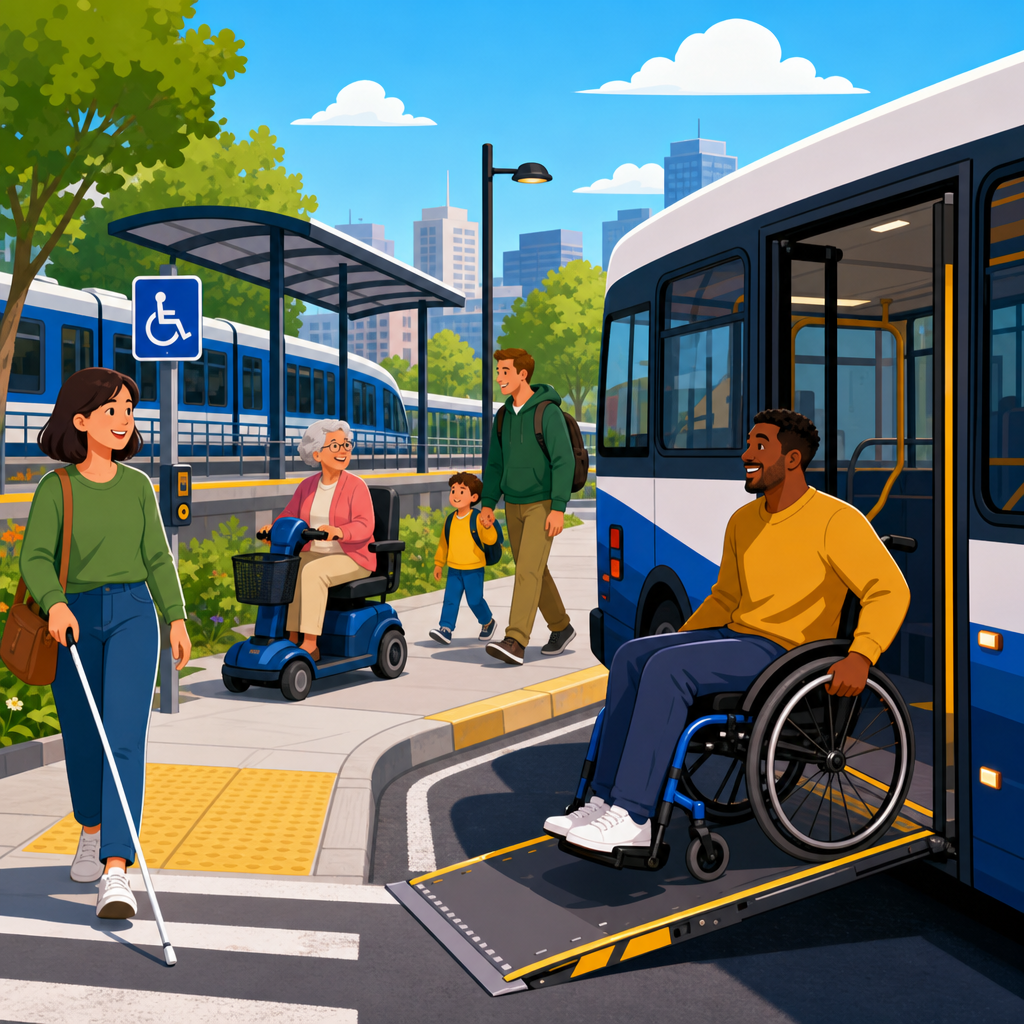
Recent developments in ADA transportation accessibility are reshaping how people with disabilities move through cities, suburbs, airports, and regional transit networks. In this context, transportation accessibility means the practical ability to use buses, rail systems, sidewalks, paratransit, ride-hailing connections, stations, and digital trip-planning tools with safety, dignity, and reasonable independence. The Americans with Disabilities Act established the baseline requirement that public transportation services, facilities, and communications must be accessible, but the law has never been static. Over the past several years, federal rulemaking, court decisions, enforcement actions, design guidance, and technology adoption have pushed agencies to update policies and infrastructure faster than at any point since the earliest implementation period.
This matters because accessibility failures are rarely isolated inconveniences. A broken elevator can block access to work, school, health care, or voting. An unreadable app can make a same-day trip impossible. A poorly maintained curb ramp can prevent a wheelchair user from reaching a bus stop that is technically compliant on paper. Having worked with transit teams reviewing stop inventories, complaint logs, and capital plans, I have seen the same pattern repeatedly: the biggest legal and operational risks come from gaps between written compliance and day-to-day usability. That is why the most important ADA transportation accessibility developments now focus not only on vehicle procurement and station design, but also on maintenance, communication access, equitable planning, and measurable service reliability.
Recent ADA updates and developments also matter because transportation systems are increasingly interconnected. A trip may involve a sidewalk managed by a city, a bus route operated by a transit authority, a commuter rail platform overseen by a state agency, and a real-time alert delivered through a mobile application built by a private vendor. Accessibility is only as strong as the weakest link in that chain. As a hub article under updates and developments, this guide explains the most significant shifts in ADA transportation accessibility, the operational questions agencies are asking now, and the standards, examples, and implementation issues that readers should follow across related articles in this topic cluster.
Federal rulemaking and guidance are expanding the scope of transportation accessibility
The most important recent shift is that accessibility obligations are being interpreted and enforced across the full travel path, not just inside vehicles. The Department of Transportation and the Department of Justice have continued to emphasize that accessible transportation includes facilities, communications, policies, and digital interfaces. Proposed and final rules affecting public rights-of-way, web content, self-service equipment, and service delivery are creating clearer expectations for agencies that previously focused mostly on lifts, securement areas, and key station upgrades.
One major area of attention is the public right-of-way. Sidewalks, pedestrian signals, curb ramps, and boarding areas often sit outside the transit agency’s direct control, yet they determine whether a rider can reach service at all. Public rights-of-way guidance has pushed agencies and municipalities to coordinate capital planning more closely, especially where bus stop accessibility depends on adjacent sidewalk condition, cross slope, detectable warnings, and safe street crossings. In practice, this means more stop-level audits, joint funding agreements, and phased remediation plans tied to pavement, signal, and streetscape projects.
Another important update is the increasing importance of digital accessibility in transportation. Trip planners, arrival boards, online fare systems, service alerts, and customer service portals are now part of the transportation experience. Recent federal focus on accessible web content has made it much harder for agencies to treat websites and mobile apps as secondary concerns. If a rider cannot independently check elevator outages, book paratransit, understand detours, or request assistance because digital tools are inaccessible to screen readers or keyboard navigation, the accessibility problem is real even if the station itself meets structural standards.
Paratransit service is under closer scrutiny for reliability, capacity, and eligibility practices
Complementary paratransit remains one of the most litigated and closely monitored parts of ADA transportation accessibility. The legal standard is not simply that a paratransit program exists. It must be comparable to the fixed-route service in the ways specified by regulation, including service area, response time, fares, trip purpose, days and hours of service, and capacity constraints. Recent enforcement trends show that agencies can no longer assume they are compliant if they meet basic reporting requirements while riders face chronic denials, long hold times, late pickups, or overly burdensome eligibility recertification.
Capacity constraints are a recurring issue. When I review complaint data with agencies, the strongest indicator of risk is not one dramatic incident but repeated patterns: negotiated pickup windows that expand excessively, return trips that become uncertain, or standing-order requests that are technically accepted but operationally unreliable. Federal oversight has increasingly focused on whether riders can actually use the service for spontaneous, everyday travel. A paratransit system that functions only for highly planned medical trips but fails for work shifts, classes, or social participation creates a comparability problem.
Eligibility has also evolved. Functional assessment tools are more common, and agencies are under pressure to make determinations based on actual ability to use fixed-route service under specific conditions, not broad assumptions about disability categories. Conditional eligibility, when properly administered, can improve service matching; when poorly administered, it becomes a source of confusion and complaints. The most effective agencies now pair clear eligibility letters with travel training, accessible appeal processes, and robust no-show policy review.
| Issue | What agencies are being asked to prove | Operational example |
|---|---|---|
| On-time performance | Trips are delivered within defined pickup windows consistently | Monthly dashboards tracking pickup adherence by contractor and time period |
| Capacity constraints | Riders are not facing excessive denials, waiting lists, or hidden trip limits | Audit of same-day trip requests and missed-trip complaints |
| Eligibility | Decisions are individualized, documented, and appealable | Conditional eligibility based on inaccessible snow conditions or steep terrain |
| Communication access | Booking, complaints, and notices are usable by all riders | Accessible web booking plus TTY, relay, and language support |
Station access, maintenance, and vertical circulation are now central compliance issues
For rail systems, recent ADA updates and developments have highlighted a practical truth: accessibility depends as much on maintenance as on design. Elevators, escalators connected to accessible routes, platform edge warnings, boarding bridges, public address systems, and accessible fare gates must work reliably, not merely exist. Across major transit systems, riders and advocacy groups have increasingly challenged agencies over repeated elevator outages, poor redundancy, and incomplete communication about alternative routes.
Elevator reliability has become particularly important because many legacy rail systems depend on a small number of vertical access points. If a station has one elevator and it fails, the station may effectively become unusable for wheelchair users and many others, including travelers with walkers, strollers, or limited stamina. Agencies are responding with stronger preventive maintenance schedules, remote condition monitoring, outage dashboards, and capital programs that add redundant elevators where feasible. New station modernization projects increasingly evaluate redundancy at the planning stage rather than treating it as a future enhancement.
Boarding interface design is another area where standards and operations intersect. Platform gaps and height differences can make independent boarding difficult even where vehicles and stations are nominally accessible. Transit operators have expanded bridge plate protocols, precision docking training, and platform-edge reconstruction to reduce horizontal and vertical gaps. These measures are especially significant on commuter rail and older rapid transit lines where mixed fleets and legacy infrastructure create inconsistent boarding conditions.
Communication during outages has also improved, though unevenly. The better practice now is multimodal communication: accessible mobile alerts, station signage, public announcements, website notices, and staff assistance protocols that explain detour options in plain language. Riders need to know not just that an elevator is out, but exactly how to complete the trip, what additional travel time to expect, and whether paratransit or shuttle accommodation is available.
Bus stop accessibility and the pedestrian network are receiving overdue attention
Bus systems serve the broadest portion of the public transit market, yet bus stop accessibility has historically lagged behind vehicle accessibility. Low-floor buses, ramps, kneeling features, and automated stop announcements improved onboard access, but many riders still encounter inaccessible landing pads, missing sidewalks, obstructed shelters, or stops located across dangerous crossings. Recent developments are forcing agencies and municipalities to address these conditions with greater precision.
The best stop accessibility programs begin with inventory data. Agencies are using GIS-based stop audits to record pad dimensions, slope, curb presence, connection to sidewalks, shelter clearance, bench placement, and ADA boarding area condition. This creates a defensible basis for prioritization. In one common scenario, an agency may discover that a stop technically has a concrete pad but no continuous path to the nearest intersection. That stop may be legal risk and service equity risk at the same time, especially if it serves a hospital, public housing, or a transfer corridor.
Coordination remains the hardest part. Responsibility for sidewalks, snow clearance, utility poles, drainage, and street resurfacing is often fragmented across departments. Recent ADA transportation accessibility practice therefore relies on interagency memoranda, shared capital queues, and standard stop design templates. Stronger agencies now tie bus stop remediation to corridor redesign, not isolated patchwork. That approach matters because a single accessible stop does little good if the crosswalk signal lacks audible features or the adjacent curb ramp has excessive cross slope.
Digital tools, fare systems, and real-time information must now be accessible by default
Transportation accessibility increasingly rises or falls on digital experience. Riders use trip-planning apps, QR-code fare media, online account management, demand-response scheduling, and service alert platforms before they ever reach a vehicle. Recent developments have made clear that accessibility in these systems is not optional customer service polish; it is a core civil rights obligation.
In practical terms, agencies are being pushed to follow recognized accessibility standards for web and mobile content, structure interfaces for screen reader compatibility, maintain color contrast, provide text alternatives, and ensure that core functions work without gestures that some users cannot perform. Kiosks and ticket vending machines are also under renewed scrutiny. Reach range, tactile controls, audio output, clear instructions, and payment workflows all matter. A fare machine that can technically be activated but cannot be navigated privately and independently by a blind rider is not providing equal access.
Real-time information is especially important during service disruption. If an accessible route is temporarily unavailable, the quality of the alert determines whether the rider can adapt. The strongest systems publish elevator status through open data feeds, integrate outage data into trip planners, and push alerts in formats that assistive technology can interpret. This is where transportation agencies are increasingly judged by actual rider outcomes rather than policy statements.
Enforcement trends show that documentation, complaint response, and transition planning are decisive
Another major development is that enforcement increasingly turns on evidence of process. Agencies that can show current self-evaluations, transition plans, stop inventories, maintenance logs, staff training records, and prompt complaint resolution are in a far stronger position than agencies relying on outdated plans and informal practices. Regulators and courts want to see that accessibility is managed systematically.
Complaint handling is particularly revealing. A mature ADA program does not treat complaints as isolated customer service cases. It categorizes them, identifies recurring barriers, and feeds them into maintenance and capital planning. If an agency receives repeated reports about a station elevator, inaccessible temporary bus stop placement, or operator failure to deploy ramps, the correct response is not only to close the complaint but to analyze the trend. That operational discipline reduces legal exposure and improves service quality.
Transition plans also matter because accessibility improvements often require multi-year capital commitments. The strongest plans identify barriers, rank priorities, estimate costs, assign responsibility, and update timelines publicly. They acknowledge limits honestly without using budget constraints as a blanket defense for inaction. For readers following recent ADA updates and developments, this is the key takeaway: compliance is increasingly evaluated as a living management system, not a one-time construction milestone.
Recent developments in ADA transportation accessibility show a clear direction of travel. Accessibility is no longer defined narrowly by whether a bus has a ramp or a station has an elevator. It now includes whether the stop can be reached safely, whether digital tools can be used independently, whether paratransit is reliably comparable, whether maintenance keeps critical features in service, and whether agencies document and improve performance over time. The practical standard is usability across the full trip chain.
For transit agencies, municipalities, advocates, consultants, and property owners connected to passenger transportation, the central lesson is straightforward: reactive compliance is no longer enough. The agencies making the most progress are auditing conditions with good data, coordinating across departments, modernizing digital platforms, strengthening complaint analytics, and treating accessibility as an operational metric alongside safety and on-time performance. Those steps do more than reduce legal risk. They expand access to employment, education, health care, and civic life.
Use this hub as the starting point for deeper articles on paratransit, bus stops, rail stations, digital accessibility, public rights-of-way, and enforcement trends. Then review your own policies, infrastructure, and customer information with the same question riders ask every day: can this trip actually be completed independently and reliably?
Frequently Asked Questions
What do “recent developments” in ADA transportation accessibility usually include?
Recent developments in ADA transportation accessibility typically go beyond basic legal compliance and focus on how people with disabilities actually experience travel from start to finish. That includes improvements to buses and rail vehicles, station design, curb ramps, sidewalks, pedestrian signals, airport circulation, paratransit service quality, and the digital tools people use to plan trips in real time. In practice, accessibility is no longer viewed only as whether a lift or ramp exists. It increasingly includes whether a rider can reach the stop safely, receive accurate service alerts in an accessible format, board without unreasonable delay, navigate transfers independently, and complete the full trip with dignity.
Many of the most important developments involve systemwide thinking. Transit agencies and transportation planners are paying more attention to the “first-mile and last-mile” barriers that can make an otherwise accessible route unusable, such as missing sidewalks, broken elevators, inaccessible wayfinding, or poor coordination between fixed-route transit and paratransit. There is also growing emphasis on maintenance and reliability. A station elevator that is frequently out of service, for example, can effectively deny access even if the station was designed to be compliant on paper.
Another major trend is the integration of digital accessibility into transportation planning. Mobile apps, trip-planning platforms, fare payment systems, and service disruption notifications are becoming central to how people navigate transit networks. As a result, agencies are under increased pressure to ensure these tools work with screen readers, provide usable visual contrast, offer captioned or text-based alerts, and communicate accessible route information clearly. Recent developments also include more public attention to equitable service design, stronger enforcement efforts, and broader recognition that accessibility is not a niche feature. It is a core element of modern transportation infrastructure.
How is ADA transportation accessibility changing public transit systems like buses, trains, and stations?
Public transit systems are changing in several visible and meaningful ways under the continued evolution of ADA transportation accessibility. On buses, accessibility improvements often include low-floor vehicle designs, ramps or lifts, priority seating, securement areas for mobility devices, stop announcement systems, and better driver training on boarding assistance and disability etiquette. These features matter because accessible equipment alone does not guarantee accessible service. Riders also need consistent operations, respectful treatment, and enough time and support to board and exit safely.
In rail systems and stations, current accessibility efforts often focus on platform access, elevator availability, tactile warning strips, audible and visual announcements, clearer signage, wider fare gates, and more intuitive navigation for passengers with mobility, vision, hearing, or cognitive disabilities. A station may technically meet minimum design criteria, but recent accessibility work increasingly looks at usability under real-world conditions such as crowding, reroutes, emergency disruptions, and maintenance outages. That shift is important because inaccessible detours or poorly communicated service changes can quickly undermine access for disabled riders.
Transit agencies are also paying more attention to accessible customer information. Real-time arrival boards, onboard displays, station announcements, and multilingual or multimodal communication tools can make transit more usable for a wider range of riders. In addition, there is growing recognition that staff training is part of accessibility infrastructure. Operators, station agents, security personnel, and customer service teams all influence whether a rider can use the system independently and confidently. Together, these changes reflect a broader move from checking compliance boxes to improving day-to-day rider experience.
What role does paratransit play in recent ADA accessibility developments?
Paratransit remains a central part of ADA transportation accessibility because it serves riders whose disabilities prevent them from using fixed-route transit in the same way as the general public, even when buses or trains are technically accessible. Recent developments in this area often focus on service quality, scheduling flexibility, trip length, on-time performance, reservation systems, and coordination with broader mobility networks. For many riders, the key question is not whether paratransit exists, but whether it is reliable enough to support work, school, medical appointments, and community life.
One important shift is the growing expectation that paratransit should be more user-centered and technologically current. Agencies are increasingly modernizing scheduling platforms, offering better trip status updates, improving customer communication, and exploring same-day or more flexible service models where feasible. At the same time, these upgrades must remain accessible themselves. If online booking tools, automated phone systems, or mobile notifications are not usable by people with different disabilities, the service can become harder to access rather than easier.
There is also greater attention to how paratransit fits into the larger transportation ecosystem. Some agencies are experimenting with partnerships involving taxis, microtransit, or ride-hailing providers, but these arrangements raise important ADA questions about vehicle accessibility, driver training, equivalent service, wait times, and nondiscrimination. Recent developments therefore include closer scrutiny of whether alternative service models truly meet ADA obligations. In practical terms, paratransit continues to be measured not just by availability, but by whether it offers comparable, dependable, and respectful mobility.
How do sidewalks, curb ramps, and pedestrian connections affect ADA transportation accessibility?
Sidewalks, curb ramps, crosswalks, and pedestrian connections are essential to ADA transportation accessibility because transit does not begin at the bus door or station platform. It begins where a person starts their trip. If the route to the stop is blocked by missing curb ramps, cracked sidewalks, steep grades, inaccessible pedestrian signals, or unsafe street crossings, then the transportation system is not meaningfully accessible. Recent developments increasingly recognize that accessible mobility depends on the full public right-of-way, not just transit vehicles and stations.
This broader understanding has led to more attention on street design, maintenance, and interagency coordination. In many communities, one public entity may operate transit while another controls sidewalks, signals, or curb infrastructure. That division can create gaps in responsibility, leaving riders with technically accessible transit service but no safe way to reach it. As accessibility standards and public expectations evolve, agencies are being pushed to coordinate planning, prioritize barrier removal, and address recurring obstacles such as utility poles in walkways, inaccessible construction detours, ponding water, or snow and debris that block usable paths.
These pedestrian elements are especially important for riders who use wheelchairs, walkers, canes, or service animals, as well as for older adults and people with low vision or balance limitations. A well-designed transportation network accounts for continuous travel, meaning every segment of the trip should be navigable, understandable, and safe. That is why recent ADA transportation accessibility discussions increasingly focus on complete travel chains. Accessibility succeeds when people can move from home to sidewalk to stop to vehicle to destination without preventable barriers interrupting the trip.
Why are digital tools and real-time transit information becoming such an important ADA accessibility issue?
Digital tools now shape nearly every part of the transportation experience, which is why they have become a major ADA accessibility issue. Riders often depend on websites, mobile apps, digital fare systems, elevator outage alerts, service advisory pages, and trip planners before they ever leave home. If those tools are not accessible, people with disabilities may be shut out from critical information needed to decide whether a trip is possible, safe, or worth attempting. Inaccessible digital systems can create barriers just as real as a broken ramp or blocked platform.
Recent developments emphasize that accessible information must be timely, accurate, and usable across different disability needs. For blind or low-vision users, that may mean compatibility with screen readers, properly labeled buttons, logical navigation, and text alternatives for maps or icons. For deaf or hard-of-hearing users, it may involve visual alerts, captions, and written versions of audio announcements. For people with cognitive disabilities, plain language, consistent layouts, and clear step-by-step guidance can make digital tools far more effective. Accessibility also matters during disruptions. A rider needs to know not only that a line is delayed, but whether the alternate route is accessible.
This issue is becoming more prominent because transportation agencies increasingly rely on digital-first communication. As that happens, the ADA conversation expands beyond physical infrastructure to include information access and independent decision-making. The most effective agencies now treat digital accessibility as a core transportation function rather than an optional technology feature. When trip-planning and service information are accessible, riders can travel with greater confidence, respond to changing conditions, and maintain more control over how they move through cities, suburbs, airports, and regional transit systems.


