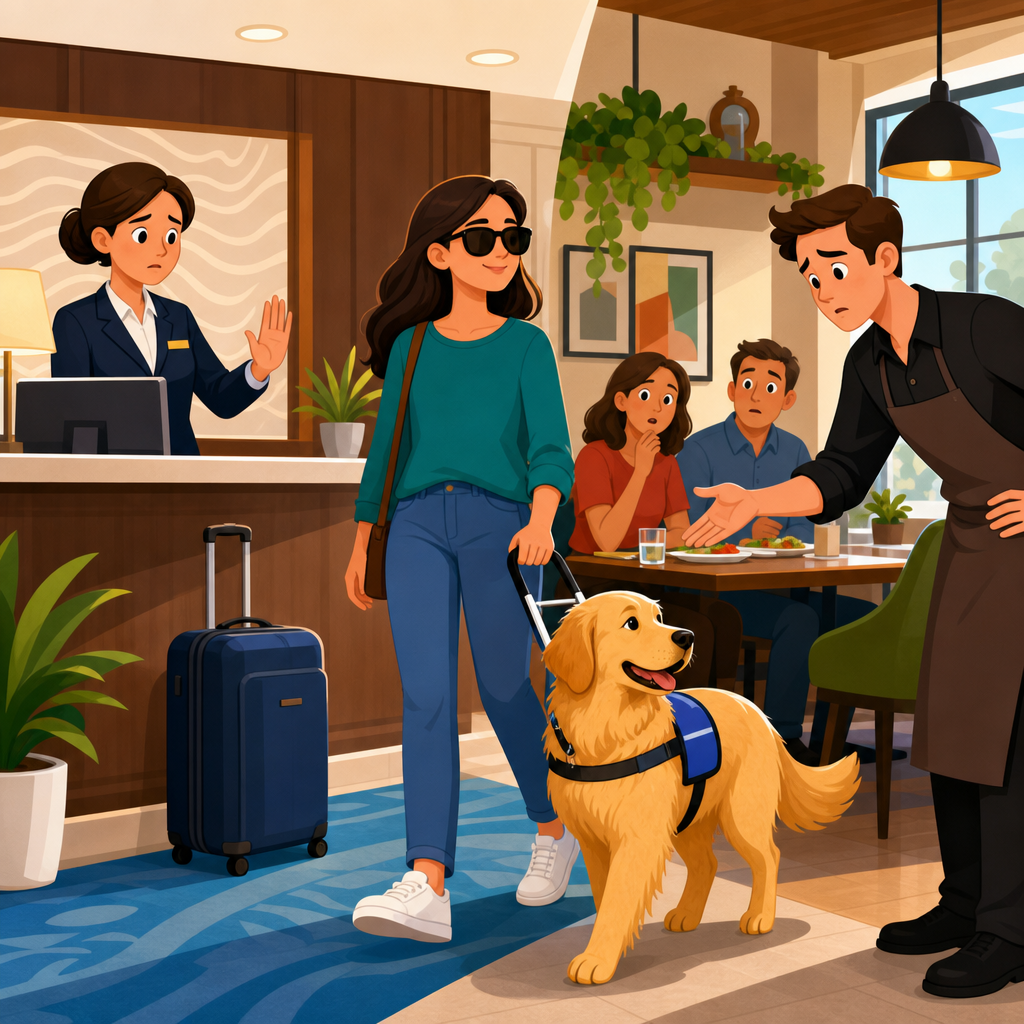
Service animals in hotels and restaurants create legal, operational, and customer-service questions that many hospitality teams still mishandle. In this guide, service animals means dogs individually trained to do work or perform tasks for a person with a disability, the standard used by the Americans with Disabilities Act for most lodging and food-service settings. Hospitality and food service includes hotels, resorts, inns, restaurants, bars, cafes, banquet venues, and quick-service operations that serve the public. I have helped operators rewrite front-desk scripts, retrain hosts, and resolve guest complaints after preventable mistakes, and the pattern is consistent: most problems come from confusion, not bad intent. That confusion is expensive. A poorly handled check-in can trigger refunds, chargebacks, brand damage, staff conflict, and formal complaints to regulators. A mishandled restaurant interaction can escalate into a public confrontation within minutes and spread online far faster than management can respond. Because this article serves as a hub for hospitality and food service, it covers the most common legal rules, frontline scenarios, documentation issues, sanitation concerns, and training practices that every property and venue should understand before a guest arrives with a service animal.
Know what qualifies as a service animal in hospitality settings
The first mistake to avoid is using the wrong definition. Under the ADA, a service animal is usually a dog trained to perform specific tasks directly related to a person’s disability. Examples include guiding a blind guest, alerting a deaf diner, pulling a wheelchair, reminding a person to take medication, interrupting self-harm behavior, or alerting to seizures or blood sugar changes. Emotional support, comfort, companionship, and therapy by themselves do not make an animal a service animal in public accommodations. That distinction matters in both hotels and restaurants because teams often import rules from housing or air travel and apply them incorrectly. Housing has different standards under the Fair Housing Act, and airline rules changed under the Air Carrier Access Act. Public-facing hospitality businesses should train staff on the public-accommodation standard first, then document any state-law additions separately.
A second mistake is assuming all disabilities are visible. Many legitimate service animal users have psychiatric, neurological, cardiovascular, or metabolic conditions that are not apparent at check-in or at the host stand. Frontline employees should not play detective. In practice, the cleanest approach is to train staff to focus on behavior and the permitted questions, not appearances. If the dog is under control and the handler states it is a service animal required because of a disability, most interactions should end there. Overinvestigating creates legal risk and undermines service. Good hospitality depends on consistent, repeatable standards, and the service-animal standard is simpler than many teams think when it is taught correctly.
The two questions staff may ask and the many questions they should not
One of the most common mistakes in hotels and restaurants is asking for proof. In most public-accommodation situations, staff may ask only two questions when the need for the dog is not obvious: is the dog a service animal required because of a disability, and what work or task has the dog been trained to perform. Staff may not demand documentation, require a special ID card, ask for a demonstration of the task, or press for a diagnosis. They also should not ask invasive follow-ups such as what medications the guest takes, whether the disability is “real,” or why the person cannot leave the dog elsewhere. I have seen well-meaning employees ask for vaccination records, doctor’s letters, registration papers, and online certificates sold by commercial websites. None of those documents reliably prove ADA status, and requiring them is a preventable compliance error.
Script discipline matters. A front-desk agent can say, “Welcome. If it is not obvious, I can ask only two questions: is this a service animal required because of a disability, and what task has it been trained to perform?” A host can use nearly the same language. This protects the guest’s privacy and protects the business by standardizing the interaction. Managers should also coach staff on what a sufficient answer sounds like. “He alerts me before I have a seizure” is enough. “She provides comfort” is not enough by itself. If the answer is vague, staff should not argue in public. Escalate calmly to a trained manager and keep the conversation short, private, and respectful.
Hotel access mistakes at check-in, during the stay, and at checkout
Hotels make avoidable errors at every stage of the guest journey. At check-in, a common mistake is assigning the guest to a pet-friendly room only. A service animal is not a pet, and the guest cannot be restricted to a pet floor or isolated wing because of the dog. Another mistake is charging a pet fee or cleaning fee automatically. Hotels may charge for actual damage caused by a service animal if they would charge any guest for comparable damage, but they may not impose a blanket surcharge. Properties also sometimes try to deny access to breakfast rooms, lounges, poolsides, meeting spaces, or shuttle loading areas. In general, a guest with a service animal must be allowed wherever guests are normally allowed, with narrow safety exceptions.
During the stay, teams often stumble over housekeeping and unattended animals. Staff may ask when it would be convenient to service the room if the guest and dog are present, or arrange a time when the dog is not there, but they should not refuse service entirely without discussion. If a guest leaves the dog alone in the room and it is barking repeatedly, scratching doors, or creating a disturbance, the issue is not that the animal is a service animal; the issue is control and conduct. Address it like any other operational problem using neutral language, documented observations, and a manager-led response. At checkout, billing must stay consistent. Charge for chewed furniture, deep odor remediation, or stained linens only if your standard damage policy would apply to any guest-caused damage, and document the facts carefully.
Restaurant and bar mistakes involving seating, food safety, and staff response
Restaurants and bars often make the mistake of citing health codes as a blanket reason to deny entry. In the United States, service animals are generally allowed in dining areas even where pets are not. The usual food-safety principle is straightforward: the dog may accompany the handler in customer areas, but the business does not have to allow the animal into spaces where customers are not permitted, such as a commercial kitchen. Hosts also go wrong when they try to seat guests with service animals outside only, at the “least busy” table, or away from other diners because someone might object. Segregated seating is poor service and can violate access rules.
Another recurring problem is staff interaction with the dog. Servers should not pet, feed, whistle at, or distract a working dog. A guide dog that misses a cue because a server clicks at it is not just inconvenienced; the handler’s safety can be affected. If another guest reports fear of dogs or allergies, the right response is usually to accommodate both parties through distance, alternate tables, timing, or ventilation where possible, not to remove the service animal user. Hospitality leaders should train teams to solve the conflict without assigning blame. In busy dining rooms, this requires a practiced manager script and floor-plan flexibility, especially during peak service and private events.
When exclusion is allowed and how to handle it correctly
Businesses sometimes think they must tolerate any behavior because the dog is a service animal. That is incorrect. A service animal can be excluded if it is out of control and the handler does not take effective action to control it, or if the animal is not housebroken. Direct threats to health or safety can also justify exclusion, but that standard is narrow and must be based on actual behavior, not assumptions about breed or size. The critical mistake is skipping the behavior analysis. A calm large dog is not a threat because it looks intimidating. A small dog lunging, barking continuously, or snapping at staff may be excluded if the handler cannot regain control.
How you do it matters as much as whether you do it. State the observed behavior, request corrective action, and offer continued service without the animal if feasible. For example: “Your dog has barked repeatedly at other diners and lunged at the aisle twice. If you cannot bring the dog under control, we will need to ask that the dog be removed. You are welcome to continue your meal without the dog, and we can package food to go if needed.” This approach is factual, neutral, and easier to defend later. Train managers to write incident notes immediately, including time, location, witnesses, and exact behavior. Vague reports such as “guest had aggressive dog” are much less useful than precise observations.
| Scenario | Wrong response | Correct response |
|---|---|---|
| Guest checks in with a dog | Demand ID, registration, or pet fee | Ask the two permitted questions if needed; do not charge a pet fee |
| Diner enters with a service animal | Seat outside because of health code concerns | Allow seating in regular dining areas where guests are permitted |
| Another guest has allergies | Remove the handler with the service animal | Try to separate parties and accommodate both |
| Dog barks continuously in lobby | Immediately eject the guest without explanation | Address behavior, ask handler to regain control, document facts |
| Room has animal-related damage | Apply automatic cleaning surcharge | Charge only actual damage under normal damage policy |
Training, policies, and hub topics every hospitality operator should build next
The strongest prevention tool is role-based training supported by a short written policy. Front desk, reservations, housekeeping, hosts, servers, bartenders, event staff, and managers each face different situations, so one generic slide deck is not enough. Reservations teams should know not to promise documentation requirements that are not allowed. Front desks need check-in scripts and fee rules. Housekeeping needs procedures for occupied-room service and incident reporting. Restaurant teams need seating, allergy, and disturbance protocols. Event and banquet staff need rules for buffets, dance floors, stages, and back-of-house boundaries. In my experience, annual training alone is too weak; micro-refreshers before peak travel seasons and holiday service periods work better.
As the hub page for Hospitality & Food Service, this article should connect your broader guidance into clear subtopics: hotel service animal policies, restaurant seating rules, staff scripts, damage and cleaning charges, handling allergies and fear of dogs, fraud indicators without unlawful screening, incident documentation, state-law variations, and service-animal etiquette for employees. Build internal resources around these topics and keep them aligned with current ADA guidance and any state or local requirements. Review guest-facing web copy too. Many properties accidentally publish illegal terms in FAQ pages, confirmation emails, or event contracts. A monthly compliance check of templates, PMS notes, and training materials catches these errors before a guest does.
Service animals in hotels and restaurants should not be a recurring crisis. The rules are narrower than many staff assume, and the operational fixes are practical: use the correct definition, ask only the permitted questions, avoid pet fees and segregated seating, focus on behavior instead of appearances, and document incidents with precision. For hotels, that means compliant check-in, fair room assignment, consistent damage billing, and thoughtful housekeeping coordination. For restaurants and bars, it means lawful seating, disciplined staff conduct, and calm problem solving when allergies, fear, or disruptions arise. The main benefit of getting this right is not only legal compliance. It is better hospitality. Guests feel respected, employees feel prepared, and managers spend less time defusing preventable conflicts.
Use this hub as the foundation for your Hospitality & Food Service program, then turn it into action. Audit your current policies, remove any documentation or fee language that does not belong, train every guest-facing role with short scenario-based scripts, and review one recent incident to see where your process failed. If your team can answer the two permitted questions correctly, explain when exclusion is allowed, and handle a busy lobby or dining room interaction without escalating tension, you are ahead of most operators. Start there, update your materials, and make compliant service-animal handling part of everyday operations rather than a rule employees only remember after a complaint.
Frequently Asked Questions
What questions can hotel or restaurant staff legally ask about a service animal?
In most hotel and restaurant situations covered by the Americans with Disabilities Act, staff should keep the conversation very limited. If it is not obvious that the dog is a service animal, employees may ask only two questions: whether the dog is required because of a disability, and what work or task the dog has been trained to perform. That is the basic rule, and one of the most common mistakes in hospitality is going beyond it. Staff should not ask the guest to disclose or describe a medical diagnosis, should not request medical documentation, should not demand a special service-animal identification card, and should not require proof of training or certification. The ADA does not require those documents for service dogs in these settings, so asking for them can create legal risk and an unnecessary confrontation at the front desk, host stand, or dining room entrance.
Another frequent mistake is framing the conversation in a way that sounds accusatory or personal. A better approach is calm, neutral, and brief. For example, staff can say, “If it is not obvious, we are allowed to ask whether the dog is required because of a disability and what task it has been trained to perform.” That keeps the exchange professional and consistent. Hospitality operators should train managers and frontline staff to avoid improvising, because ad hoc questioning often leads to requests for private information or blanket statements such as “we need papers,” which are not aligned with ADA standards for most lodging and food-service operations.
Can a hotel or restaurant refuse entry because the property has a no-pets policy or because food is served?
No. A service animal is not treated as a pet under the ADA, so a no-pets policy does not justify excluding a guest with a service dog from areas where customers are normally allowed. This is one of the most common operational mistakes in hospitality. Hotels, restaurants, bars, cafes, banquet venues, and quick-service locations often have strict pet rules, but those rules must be applied differently when a guest is accompanied by a service dog. In restaurants and other food-service spaces, the fact that food is prepared or served does not change that basic access rule. Health-code concerns are often cited by staff in error, but the ADA generally requires access for service dogs in customer areas even where state or local rules restrict animals more generally.
That said, access does not mean there are no boundaries. The dog must be under the handler’s control, typically by leash, harness, or tether unless those devices interfere with the dog’s work or the person’s disability prevents their use, in which case the handler must still maintain control through voice, signal, or other effective means. Staff also do not have to allow the dog into spaces where the public is not normally permitted, such as certain staff-only work areas. The practical takeaway for hospitality teams is simple: do not deny service because of a no-pets rule, and do not assume a food-service environment creates an automatic exception. Train staff to distinguish pets from service dogs and to focus on behavior and lawful access standards rather than personal assumptions.
When can a service animal be lawfully removed from a hotel, restaurant, or bar?
A service dog cannot be excluded just because another guest is uncomfortable, afraid of dogs, or claims to have allergies. Those situations need to be managed through accommodation and spacing when possible, not by automatically removing the handler and service animal. A lawful removal generally depends on behavior, not on the dog’s presence alone. Under ADA principles, a business may ask that a service animal be removed if the dog is out of control and the handler does not take effective action to control it, or if the dog is not housebroken. Those are the issues staff should be trained to identify. Common examples might include repeated barking that is not related to the dog’s trained task, lunging at patrons, running loose through a dining room, or elimination in the facility.
Even when removal is justified, the hospitality business should still offer the guest the opportunity to obtain goods or services without the animal present if that is feasible. For example, a restaurant could offer takeout or seating without the dog if the dog’s behavior created the problem; a hotel might continue serving the guest while addressing the conduct issue. A common mistake is escalating too fast or speaking in a way that suggests the disability itself is the problem. The correct focus is the animal’s specific conduct and the operator’s consistent safety and service standards. Staff should document what happened factually, including the behavior observed and the steps taken, because clear documentation can be important if the guest later disputes the incident.
Do hotels charge pet fees, cleaning fees, or deposits for guests with service animals?
As a general rule, hotels and similar lodging providers should not charge pet fees, pet deposits, or other upfront animal-related charges for a service dog. Because a service animal is not considered a pet for ADA access purposes, a standard pet fee policy should not be applied to that guest. This is another area where hospitality teams frequently make mistakes, especially when reservation systems automatically add pet charges or when staff assume every animal must trigger the same fee. Operators should review booking workflows, front-desk procedures, and folios to make sure service-animal stays are not treated as pet stays by default.
However, that does not mean the guest is exempt from paying for actual damage if the business normally charges other guests for similar damage they cause. The key distinction is between a prohibited automatic fee and a permitted charge for specific harm. If a service dog causes documented damage to a guest room or dining furniture and the property would charge any guest for comparable damage, the business can generally apply that same rule. What it should not do is impose a blanket cleaning surcharge just because a service dog was present. To avoid confusion and complaints, hospitality businesses should create clear written policies stating that there are no pet fees or deposits for service animals, while also preserving the right to charge for actual damage on the same basis applied to all guests.
How should hospitality staff handle emotional support animals, fake service animal claims, and customer complaints from other guests?
This is where many real-world mistakes happen, because staff often confuse service animals with emotional support animals or react to complaints from other customers without following a consistent standard. In the context described in this article, service animals means dogs individually trained to do work or perform tasks for a person with a disability, which is the ADA standard for most hotel and restaurant settings. Emotional support, comfort, companionship, or crime-deterrence alone do not meet that service-animal definition in these environments. That means staff should be trained to rely on the lawful two-question framework when the dog’s role is not obvious, rather than making decisions based on vests, online registrations, customer confidence, or social media myths about “papers.”
When another guest complains, the right response is usually to manage the experience of both parties without denying access to the handler with the service dog. Fear of dogs and allergies are not automatic reasons to exclude the service animal. Instead, staff can consider practical steps such as separate seating, alternate routes, or timing adjustments where possible. At the same time, employees should not accuse a guest of faking a disability or a service animal. If there is legitimate concern, the staff member should return to the legal basics: ask only the permitted questions if appropriate, observe whether the dog is under control, and address actual behavior problems if they arise. For hotels, that also means coordinating among reservations, front desk, housekeeping, security, and food-and-beverage teams so the guest does not face repeated challenges from different departments.
The most effective hospitality strategy is policy-driven consistency. Staff need scripts, escalation procedures, and examples of what counts as a trained task versus emotional support. They should also understand when to involve a manager and how to document incidents objectively. A calm, informed process protects guest dignity, reduces staff uncertainty, and lowers legal exposure. In short, do not rely on appearances, internet “certificates,” or assumptions. Focus on the ADA service-animal definition used in most lodging and food-service settings, apply the permitted questions carefully, and respond to behavior and access issues in a measured, professional way.