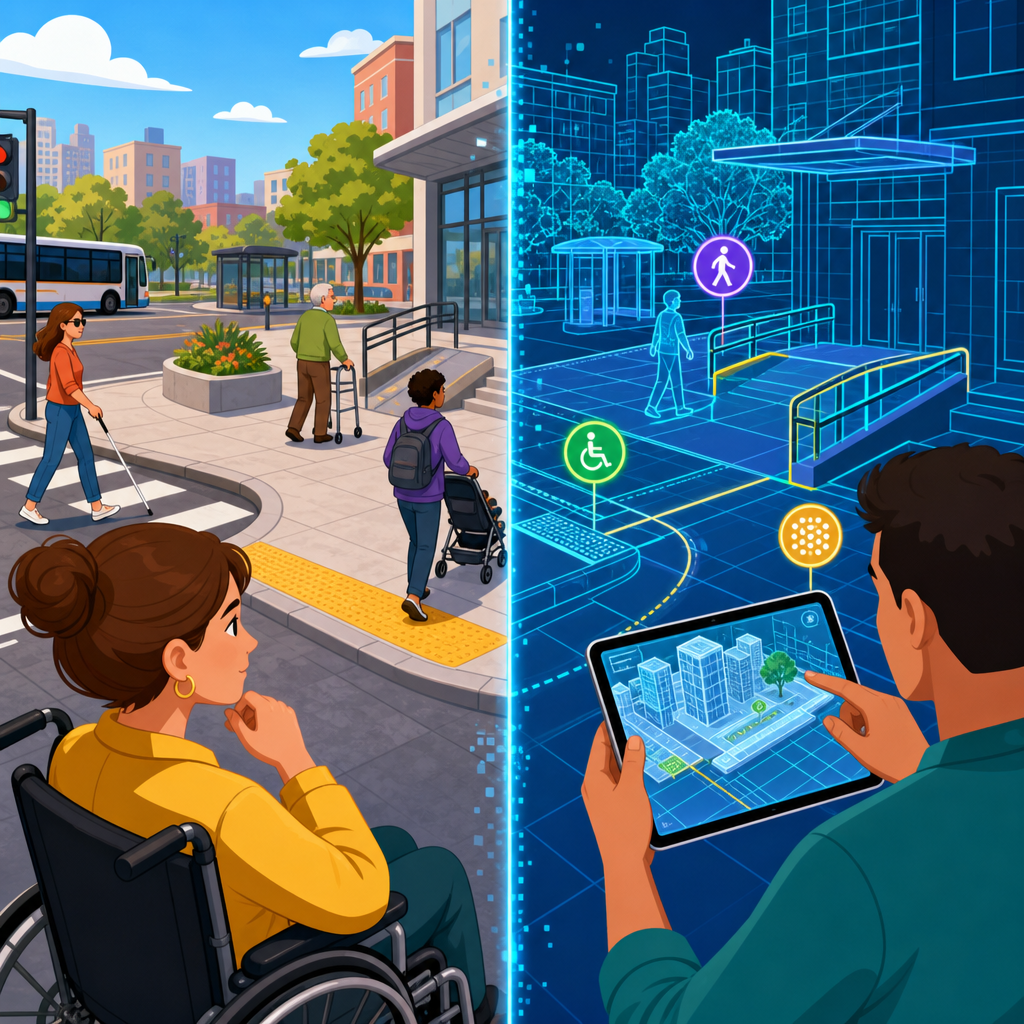
Digital twins for accessibility planning are no longer a futuristic concept reserved for airports, smart factories, or prestige real estate projects; they are becoming practical tools for cities, universities, hospitals, and transit agencies that need to understand how people actually move through space. A digital twin is a dynamic virtual representation of a physical environment, linked to data about layout, assets, conditions, and sometimes live activity. Accessibility planning is the process of designing, auditing, and improving places, services, and journeys so disabled people, older adults, and others with mobility, sensory, cognitive, or temporary limitations can use them safely and independently. Put together, the idea is simple: use a living digital model of a place to spot barriers before construction, prioritize retrofits, test policies, and communicate tradeoffs clearly.
This matters because accessibility failures are rarely caused by a single missing ramp or mislabeled door. In my work reviewing facilities, the real problems usually appear at the system level: a compliant entrance that leads to an inaccessible reception desk, an elevator that satisfies dimensional guidance but creates an impossible route during peak traffic, or a rail platform where tactile paving, signage, lighting, and crowd flow were never considered together. Traditional drawings, static BIM files, and spreadsheet audits help, but they often miss how conditions change over time. A digital twin can combine geometry, asset records, sensor data, maintenance history, pedestrian routing, and user feedback into one decision environment. That creates a stronger basis for planning that aligns with standards such as the ADA Standards for Accessible Design, ISO 21542, EN 17210, and local building codes while still reflecting lived experience.
As a hub article on emerging technologies within legal and technological frontiers, this page covers the big picture: what digital twins are, where they help accessibility planning, where the hype exceeds reality, what legal and ethical issues matter, and how related tools such as BIM, GIS, IoT sensors, computer vision, indoor positioning, and simulation fit together. The key question is not whether a digital twin is inherently good. The right question is whether it improves decisions for real users faster, more accurately, and more transparently than the methods an organization already uses.
What a digital twin actually includes in accessibility planning
In accessibility work, the term digital twin is often used loosely. A true twin is more than a 3D model. At minimum, it links a spatial model to operational data that can be updated and queried. For a campus building, that may include floor plans, door widths, slopes, lift dimensions, hearing loop locations, restroom layouts, emergency egress routes, maintenance tickets, occupancy schedules, and wayfinding information. In advanced deployments, the model also ingests sensor data on footfall, door open times, lift outages, air quality, lighting levels, and queue length. The point is not visual flair. The point is to answer practical questions: Can a wheelchair user reach every service point independently? Where does glare affect low-vision navigation at different times of day? Which route remains usable when one elevator is out of service?
The technology stack usually combines building information modeling platforms such as Autodesk Revit or Bentley OpenBuildings, GIS tools such as ArcGIS, reality capture from LiDAR or photogrammetry, asset databases, and analytics dashboards. Some organizations add indoor maps, Bluetooth beacons, Wi-Fi positioning, or computer vision to estimate movement patterns. When built well, the twin becomes a shared evidence base across estates teams, architects, compliance staff, transport planners, disability inclusion leads, and emergency managers. That shared model is valuable because accessibility is cross-functional by nature. A problem caused by procurement, cleaning schedules, security bollards, and signage governance will never be solved by an architectural drawing alone.
Digital twins also create a bridge between compliance and usability. Compliance asks whether a feature meets a standard. Usability asks whether people can complete tasks with dignity, safety, and reasonable effort. Both matter, and they do not always align. I have seen projects pass narrow checklist reviews while still producing exhausting travel paths, confusing acoustics, or inaccessible service interactions. A useful twin lets teams test user journeys from curb to destination, including interdependencies that are easy to miss in isolated audits.
Where digital twins deliver clear benefits
The strongest use cases appear in complex environments where many barriers interact. Large hospitals are a good example. Patients may arrive by car, taxi, or ambulance; move through drop-off zones, ramps, lifts, reception, diagnostics, and wards; and face variable conditions such as temporary closures or relocated services. A digital twin can map those journeys, identify choke points, and show how changes affect different users. If a lift is frequently offline, the twin can quantify who is affected, how far detours extend, and whether another route remains step-free. That is far more actionable than noting a generic elevator issue in a monthly report.
Transit is another strong fit. Rail stations, bus interchanges, and airports involve vertical circulation, queuing, wayfinding, dwell times, and real-time disruption. Transport for London, Network Rail, and airport operators have all invested in richer digital asset environments because passenger flow and operational resilience depend on them. For accessibility planning, the twin can test whether platform changes increase boarding difficulty, whether a temporary gate arrangement blocks a turning radius, or whether audio announcements and visual displays remain synchronized during disruption. In practice, that means fewer unpleasant surprises after a timetable change or refurbishment.
Urban public realm projects also benefit. Sidewalk crossfall, curb ramps, tactile surfaces, signal timing, street furniture placement, drainage, and construction detours create cumulative effects. A city-level twin built from GIS, street scans, and asset records can help planners prioritize interventions by impact rather than anecdote alone. If complaint data shows repeated issues on routes connecting housing, clinics, and transit stops, the twin can reveal whether the root cause is gradient, crossing delay, obstructions, or maintenance failures. That supports more defensible capital planning.
| Setting | Typical accessibility problem | How a digital twin helps | Main limitation |
|---|---|---|---|
| Hospital | Complex routes and service relocation | Tests patient journeys and outage scenarios | Needs frequent operational updates |
| Transit hub | Crowding, lifts, disruption management | Combines flow data with step-free routing | Real-time integration can be expensive |
| University campus | Mixed old and new buildings | Prioritizes retrofits across portfolios | Legacy drawings are often unreliable |
| City streets | Distributed barriers across routes | Links GIS, complaints, and asset condition | Street conditions change quickly |
How digital twins improve planning before money is spent
One of the most practical advantages is scenario testing before construction or retrofit budgets are locked in. In conventional design review, teams inspect plans, conduct code checks, and maybe run a walk-through with stakeholders. That catches obvious issues, but it often struggles with temporal questions. What happens during a fire alarm if one refuge space is already occupied? How does a new café queue affect circulation past an accessible toilet? Will a security checkpoint create noise conditions that undermine speech intelligibility for hearing aid users? A twin allows planners to model these interactions early, when changes are still affordable.
For example, a university considering a library refurbishment might compare two options for service counters, shelving layout, quiet rooms, and lift lobbies. In the twin, staff can measure reach ranges, turning spaces, and route lengths, then simulate peak occupancy and maintenance downtime. If one design creates repeated congestion near an assistive technology room, the issue is visible before procurement. That is where value appears: avoiding expensive fixes later, and preventing barriers from being designed in.
Digital twins can also sharpen prioritization across portfolios. Many organizations manage hundreds of buildings and cannot fix everything at once. A static audit may produce long defect lists with little sense of operational importance. A twin can layer building condition, service criticality, user volume, incident history, and route dependency. That helps answer difficult questions such as whether to upgrade one landmark entrance or several secondary routes that affect more daily users. In budget meetings, quantified tradeoffs carry more weight than generic statements about inclusion.
Why lived experience still matters more than elegant models
The biggest risk is mistaking representation for reality. A digital twin can model dimensions, routes, and outages, but it cannot fully capture fatigue, anxiety, sensory overload, stigma, or the improvisations disabled people make in difficult environments. If the data model is built without disabled users, it will reproduce the blind spots of the organization that commissioned it. I have seen sophisticated spatial platforms that tracked utilization perfectly yet omitted basic details like whether a door required excessive opening force or whether reception staff could communicate effectively with Deaf visitors.
That is why co-design is not optional. Accessibility planning should involve disabled users, advocacy groups, frontline staff, and maintenance teams from the start. The twin should include feedback loops, not just geometry. Some organizations now attach issue reporting to indoor maps so users can flag blocked routes, malfunctioning lifts, poor lighting, or confusing signage. Others run accompanied journey testing and convert findings into structured data attributes. Those practices matter because many barriers are operational and social rather than purely architectural.
There is also a measurement problem. If a model defines accessibility only through minimum code dimensions, it may understate barriers for larger power wheelchairs, people using walkers, neurodivergent visitors, or people managing multiple impairments at once. Good planning therefore uses standards as baselines, then tests against real user profiles and common tasks. The twin should answer, “Accessible for whom, under what conditions, and for which journey?” If it cannot answer that, it is probably a visualization project, not an accessibility tool.
Legal, ethical, and governance issues you cannot ignore
Accessibility planning sits close to legal risk, public accountability, and personal safety. A digital twin can help demonstrate due diligence, but it can also create new exposure if the data is wrong, stale, or used carelessly. In jurisdictions governed by the Americans with Disabilities Act, Equality Act 2010, disability discrimination law, public sector equality duties, or equivalent accessibility legislation, organizations remain responsible for the real environment, not the model. A twin does not replace inspections, maintenance, or reasonable accommodation processes. It supplements them.
Data governance is equally important. If the twin uses occupancy sensing, video analytics, badge access records, or mobile location data to understand movement patterns, privacy law becomes relevant. Teams must define purpose limitation, retention periods, data minimization, and access control. In Europe, GDPR principles apply. In healthcare settings, sector-specific confidentiality rules may also apply. The ethical standard should be higher than simple legal compliance: collect only what is needed to improve access, aggregate where possible, and avoid surveillance practices that would deter the very users the system is meant to support.
Procurement and accountability also matter. Vendors often market polished city models with broad claims about inclusion, but buyers should ask blunt questions. What standards are encoded? How are temporary barriers represented? Can the system track remediation status? Is there an audit trail for decisions? What happens when source data conflicts? Open standards such as IFC for building data and established GIS schemas reduce lock-in and make accessibility information easier to share across systems. Without that foundation, organizations may end up with expensive visual platforms that few operational teams trust.
How this hub connects emerging technologies beyond digital twins
Digital twins are best understood as a hub technology that brings other emerging tools together. BIM provides detailed building geometry and asset metadata. GIS adds geographic context, street networks, and neighborhood equity analysis. IoT sensors contribute live operational status, such as lift availability or occupancy. LiDAR and photogrammetry speed up reality capture in legacy estates where drawings are poor. Computer vision can estimate congestion or detect blocked paths, although it demands strict governance. Indoor positioning and navigation systems can support accessible wayfinding for blind and low-vision users when mapped carefully. Machine learning can help classify defects or predict where maintenance failures are likely to create access barriers.
For readers exploring the wider emerging technologies landscape, that broader ecosystem is the real sub-pillar. The planning question is not, “Should we buy a digital twin?” It is, “Which combination of spatial data, operational data, sensing, simulation, and user feedback will improve access outcomes in our context?” A small municipality may gain more from a strong GIS-based accessibility inventory than from a full live twin. A major airport may justify real-time integration because disruption costs are high and passenger flows are complex. Matching the tool to the problem is the disciplined approach.
The most successful programs start narrow. They choose one estate, one route family, or one service challenge, define measurable outcomes, and build from there. Examples include reducing step-free journey failures, improving clinic wayfinding, cutting lift outage response times, or increasing the percentage of classrooms reachable without staff assistance. Once those outcomes are tracked, the twin earns credibility as an operational instrument rather than a glossy innovation initiative.
Hype or helpful? The balanced verdict
Digital twins for accessibility planning are helpful when they are grounded in standards, maintained with current data, and shaped by disabled users’ lived experience. They are hype when they are treated as a marketing layer over incomplete asset records, a substitute for consultation, or a compliance shortcut. The technology is most valuable in complex, high-change environments where route quality depends on multiple systems working together. It is less compelling for simple sites where a competent audit and targeted remediation plan will solve the problem faster and more cheaply.
The clearest takeaway is that accessibility is dynamic. Doors break, services move, queues form, weather changes, and construction disrupts routes. Static documentation cannot fully keep pace. A well-governed digital twin can. It can reveal hidden barriers, test options before money is spent, support legal defensibility, and help teams prioritize work that makes daily life easier for real people. But the model only deserves trust if it reflects reality, acknowledges uncertainty, and leads to action.
If you are building an accessibility strategy within emerging technologies, start with a pilot that answers one hard operational question, involve disabled users from day one, and demand open, auditable data. That is how digital twins move from hype to genuinely helpful planning.
Frequently Asked Questions
What is a digital twin, and how does it apply to accessibility planning?
A digital twin is a living digital model of a real-world place. Unlike a static floor plan, PDF, or one-time 3D scan, a digital twin can connect spatial information with operational data such as entrances, elevators, ramps, door widths, signage, surface conditions, route changes, occupancy patterns, and maintenance status. In accessibility planning, that matters because accessibility is not just about whether a feature exists on paper. It is about whether people can reliably use a space in real conditions.
For cities, campuses, hospitals, and transit systems, a digital twin can help planners understand how people with different mobility, sensory, cognitive, and neurodivergent needs experience an environment. It can show where an accessible route technically exists but is impractical because of slope, congestion, long travel distance, poor wayfinding, or a frequently out-of-service lift. It can also help teams compare routes, test changes before construction, and identify where small design decisions create large usability barriers.
In practical terms, digital twins give accessibility planning a more complete evidence base. They allow organizations to move beyond compliance checklists and toward a user-centered view of access. That does not mean the model replaces site audits or direct input from disabled people. It means the model can support better planning, faster problem detection, and more informed investment decisions when combined with lived experience and on-the-ground validation.
Are digital twins genuinely helpful for accessibility, or are they mostly hype?
The honest answer is that they can be very helpful, but only when they are built and used for real accessibility outcomes rather than as a technology showcase. The hype comes from treating the digital twin itself as the solution. It is not. A highly detailed model is still of limited value if it lacks accurate accessibility data, is not updated when conditions change, or is never used by the teams making design, operations, and maintenance decisions.
Where digital twins become genuinely useful is in making accessibility issues visible, measurable, and easier to act on. For example, a transit agency can map the impact of elevator outages across an entire station network, not just one location at a time. A hospital can test how a patient using a wheelchair or mobility aid moves from parking to reception to diagnostics. A university can identify disconnected accessible routes between buildings, residence halls, classrooms, and public amenities. These are not abstract benefits. They directly affect whether people can participate independently and safely.
That said, digital twins are not magic. They can oversimplify human experience if organizations assume geometry alone explains accessibility. Factors such as lighting, acoustics, fatigue, crowd behavior, stress, wayfinding clarity, and cultural assumptions about who belongs in a space are harder to model but still central to access. So the balanced view is this: digital twins are helpful when treated as decision-support tools embedded in inclusive planning processes. They become hype when they are marketed as a standalone answer or when visual sophistication is mistaken for accessibility progress.
What kinds of accessibility problems can a digital twin help identify?
A well-structured digital twin can reveal a wide range of barriers that might be missed in conventional planning documents. At the most basic level, it can identify physical obstacles such as missing curb ramps, inaccessible entrances, narrow turning spaces, steep gradients, poor restroom access, inadequate lift coverage, or long route detours caused by level changes. Because the model can represent entire systems rather than isolated rooms or buildings, it is especially useful for finding breaks in accessible journeys between destinations.
It can also help uncover operational problems. A route may appear compliant during design, but fail in daily use because an automatic door is often disabled, a lift is frequently under repair, furniture blocks circulation, temporary construction changes are poorly communicated, or a service desk is consistently positioned in a way that excludes seated users. In healthcare and transit settings, the twin can support analysis of how timing, congestion, queuing, and service disruptions affect people who need step-free routes, quieter waiting areas, or clearer information.
Another major strength is comparative scenario testing. Teams can ask practical questions such as: What happens to campus access if one entrance closes? Which route remains usable during a renovation? How much additional travel distance does a wheelchair user face compared with an ambulatory pedestrian? Where do people with low vision encounter confusing decision points or inconsistent signage? While not every experience can be perfectly simulated, digital twins can make these patterns easier to examine systematically. That gives planners a stronger basis for prioritizing upgrades that improve everyday access instead of relying on assumptions.
Can digital twins replace accessibility audits, user testing, or input from disabled people?
No. Digital twins should strengthen those processes, not replace them. Accessibility is ultimately about human experience, and no model can fully capture the diversity of bodies, senses, cognitive styles, preferences, or the improvisations people make in real environments. A digital twin may show that a route exists, but only a site visit or lived-experience review may reveal that the route feels unsafe, confusing, exhausting, stigmatizing, or functionally unusable.
Accessibility audits remain essential because they verify actual conditions and evaluate details that may not be visible or current in a model. User testing and participatory engagement are just as important because disabled people often identify barriers that technical teams overlook. For example, a route that appears efficient in the model may involve too many decision points for someone with cognitive fatigue, poor acoustic conditions for someone relying on auditory cues, or excessive vibration and surface changes for wheelchair users. These issues are difficult to infer accurately without direct feedback.
The best approach is to use digital twins as part of a layered accessibility strategy. The model can help teams prepare audits, prioritize high-impact areas, test concepts, and monitor changes over time. Audits and community engagement then ground that analysis in reality. When these methods are combined, organizations are much better positioned to make improvements that are not only technically compliant but practically inclusive. In other words, digital twins are valuable because they expand the planner’s toolkit, not because they eliminate the need for human expertise and lived experience.
What should organizations consider before investing in a digital twin for accessibility planning?
Before investing, organizations should start with a clear question: what accessibility problems are we trying to solve? If the goal is vague, the project can become an expensive visualization exercise. Strong use cases are usually specific and operational, such as improving step-free navigation across a campus, understanding service gaps in a hospital, prioritizing public realm upgrades, coordinating accessibility data across departments, or evaluating the user impact of maintenance failures and temporary closures.
Data quality is another critical issue. A digital twin is only as useful as the information it contains and the process used to maintain it. Organizations need to decide what accessibility attributes matter, how they will be captured, who owns updates, how often conditions are validated, and whether the model reflects temporary as well as permanent barriers. They should also think carefully about interoperability, so accessibility information can connect with asset management, facilities systems, transit operations, emergency planning, and public-facing wayfinding tools rather than living in a silo.
Governance and inclusion matter just as much as technology. Accessibility specialists, facilities teams, planners, operators, and disabled stakeholders should all have a role in shaping requirements and evaluating outputs. Privacy and ethics may also be relevant if the system uses movement or occupancy data. Finally, organizations should define success in practical terms: fewer broken accessible journeys, faster issue resolution, better capital prioritization, improved communication about disruptions, or stronger user satisfaction. When those foundations are in place, a digital twin can be a highly effective accessibility planning tool. Without them, it risks becoming an impressive model with limited real-world impact.


