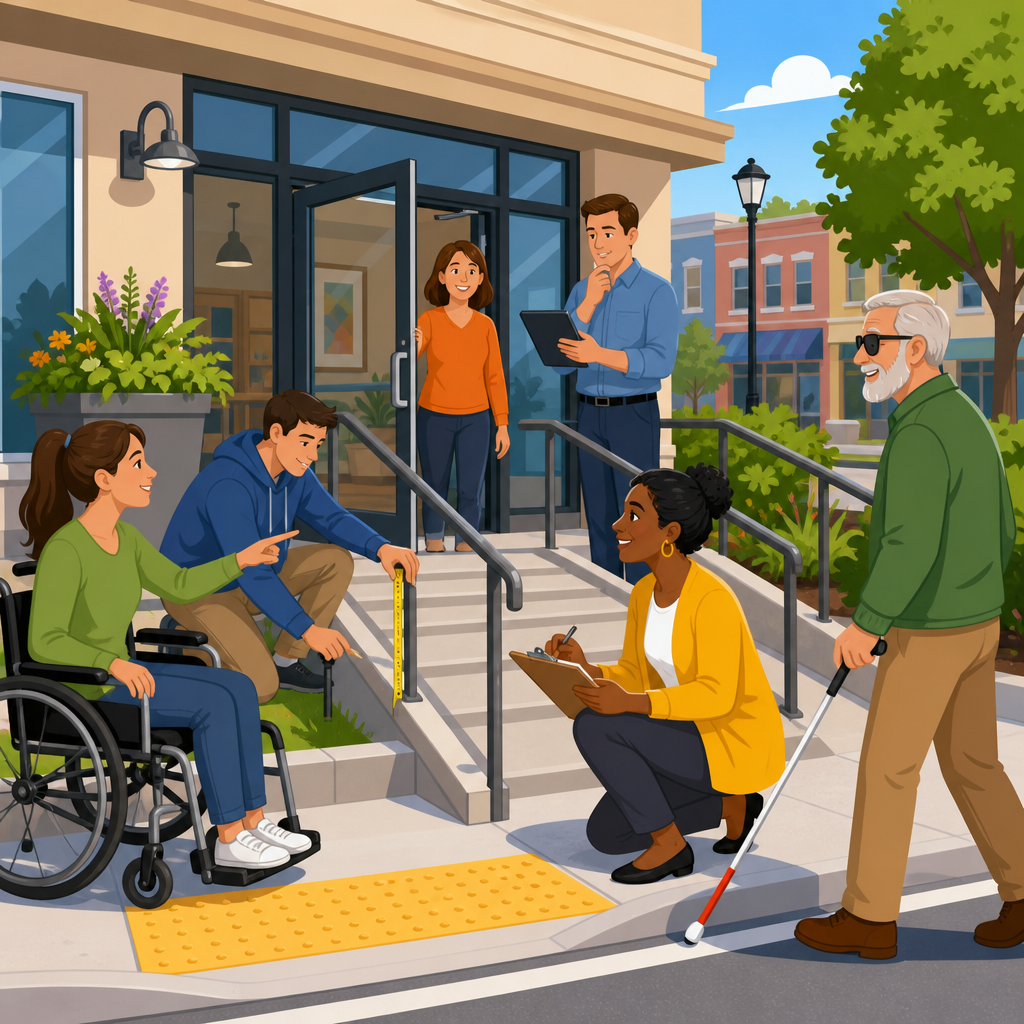
Title III “readily achievable” barrier removal is the practical core of ADA compliance for existing public accommodations, because it determines what businesses must fix now, what can be phased, and how courts evaluate whether removal is feasible without much difficulty or expense. Under Title III of the Americans with Disabilities Act, places of public accommodation include restaurants, hotels, retail stores, theaters, gyms, banks, professional offices, health care providers, museums, parks, private schools, and many other businesses open to the public. If you operate, lease, lease to, or own one of these properties, understanding barrier removal is not optional. It shapes renovation decisions, maintenance priorities, litigation exposure, customer experience, and brand trust.
The phrase “readily achievable” has a specific legal meaning. It does not require every existing building to be rebuilt to current new-construction standards overnight. Instead, it requires removal of architectural barriers in existing facilities when doing so is easily accomplishable and able to be carried out without much difficulty or expense. That standard comes from the ADA statute and is applied alongside Department of Justice regulations and the ADA Standards for Accessible Design. In practice, that means businesses must look at the nature and cost of the fix, the financial resources of the site and any parent organization, the impact on operations, legitimate safety requirements, and whether an alternative method of access can temporarily fill a gap while a permanent correction is planned.
I have worked through barrier-removal audits where owners assumed accessibility meant only wheelchair ramps, then discovered the real exposure involved parking slopes, heavy entry doors, inaccessible sales counters, restroom clearances, and policies that blocked effective use. That is why this topic matters. Title III public accommodations are judged not only by whether disabled customers can enter a building, but whether they can independently access goods, services, privileges, and advantages. This hub explains the factors that matter, how they are analyzed, and how barrier removal fits within the broader Title III compliance landscape.
What Title III Covers in Public Accommodations
Title III applies to private entities that own, lease, lease to, or operate places of public accommodation. The law lists twelve broad categories, including lodging, food service, exhibition and entertainment, public gathering, sales and rental, service establishments, transportation depots, places of recreation, education, social service centers, and places of exercise or recreation. Religious organizations and private clubs have important exemptions, but many businesses mistakenly assume those exemptions are broad when they are not. A nonprofit theater, for example, can still be covered if it is open to the public. A medical office in a leased suite is covered even if the landlord controls major common-area alterations.
For accessibility analysis, Title III distinguishes among existing facilities, altered areas, and new construction. New construction and alterations generally must comply with the applicable ADA Standards to the maximum extent feasible. Existing facilities have a different ongoing duty: remove architectural barriers where removal is readily achievable. This distinction matters because a coffee shop built in 1985 is not judged exactly like a coffee shop built last year, yet it still must address barriers that can be fixed without much difficulty or expense. Businesses often miss this point and either overestimate what the law demands immediately or underestimate what it requires now.
Barrier removal is broader than entry access. The Department of Justice has long emphasized priorities: first, access from arrival points such as parking, sidewalks, and public transportation; second, access to the area where goods and services are made available; third, access to restrooms when provided for customer use; and fourth, removal of remaining barriers such as drinking fountains and telephones. Those priorities are useful because they align legal risk with real customer impact. If a wheelchair user cannot travel from the parking space to the front door, excellent restroom signage will not solve the core problem.
The Meaning of “Readily Achievable” and the Factors Courts Weigh
The central question is not whether a barrier exists; it is whether removing that barrier is readily achievable under the circumstances. The statutory factors are concrete. Decision-makers look at the nature and cost of the action needed, the overall financial resources of the site involved, the number of persons employed there, the effect on expenses and resources, legitimate safety requirements necessary for safe operation, the impact on the facility’s operation, the overall financial resources of any parent entity, the number and type of its facilities, and the relationship between the site and the larger organization. These factors prevent a one-size-fits-all rule.
In practical compliance work, I separate fixes into low-cost, moderate-cost, and structural categories because that mirrors how businesses budget. Low-cost measures usually include restriping accessible parking, adjusting door closers, lowering paper towel dispensers, adding compliant signage, insulating hot water pipes under accessible lavatories, reconfiguring furniture, or moving merchandise that narrows accessible routes. Moderate-cost work may involve replacing hardware with lever handles, installing a short ramp, widening a route by relocating partitions, modifying service counters, or replacing noncompliant restroom accessories. Structural work can include regrading exterior routes, relocating walls, or redesigning toilet rooms. The easier and cheaper the fix, the harder it is to defend leaving it undone.
Courts also examine evidence. A business that has no survey, no budget history, and no documented consideration of alternatives looks unprepared. By contrast, a business that commissioned an accessibility assessment, prioritized barriers, fixed straightforward items promptly, and documented why a costly alteration would create serious operational or financial strain is in a stronger position. Readily achievable is a fact-specific standard, but it rewards disciplined analysis. It does not reward inaction.
Examples of Common Barriers and How Removal Is Evaluated
Most Title III claims involve recurring conditions. Parking is a leading example. An accessible space with the wrong width, excessive slope, missing access aisle, or no compliant sign is usually inexpensive to correct through restriping, signage, and surface repair. Because the cost is low and the benefit immediate, these fixes are often readily achievable. Exterior routes come next. A single step at an entrance may be addressed with a ramp if site conditions permit, while a steep site with drainage and property-line constraints may require a more complex solution. Door pressure, threshold height, and maneuvering clearance are similarly common and often solvable without major construction.
Inside the facility, sales counters, self-service areas, seating layouts, restrooms, and turning space drive many disputes. A bakery that places all point-of-sale equipment on a 44-inch-high counter may need a lowered accessible transaction surface. A clothing store that fills aisles with display racks may need only to maintain the required clear width consistently. A restroom with grab bars mounted incorrectly can often be corrected inexpensively, but a restroom too small to provide required clearances may demand substantial reconstruction. In those cases, the analysis turns on real cost, disruption, and available alternatives, such as making an accessible unisex restroom available if compliant customer restrooms cannot be achieved immediately.
| Barrier | Typical Fix | Why It Often Matters Legally |
|---|---|---|
| Missing accessible parking sign | Install compliant sign at correct height | Low cost and straightforward, so delay is hard to justify |
| Heavy entrance door | Adjust closer or add power-assist opener | Affects independent entry and can often be corrected quickly |
| Narrow merchandise aisles | Rearrange displays and maintain clear route | Policy and layout issue, not always a construction problem |
| Inaccessible service counter | Add lowered portion or adjacent accessible surface | Directly affects equal access to transactions |
| Restroom accessory mounted too high | Relocate dispenser, mirror, or hand dryer | Usually simple, inexpensive, and measurable |
How Barrier Removal Interacts With Alterations, Leases, and Operations
One of the most misunderstood issues in Title III public accommodations is the relationship between barrier removal and alterations. If you alter an area containing a primary function, additional path-of-travel obligations can be triggered, including accessible routes, restrooms, telephones, and drinking fountains serving that area, subject to disproportionality limits. That means a planned renovation can expand accessibility duties beyond what would be required under a barrier-removal analysis alone. I routinely advise clients to review accessibility before design documents are finalized, because retrofitting a design after permit submission is slower and more expensive.
Leasing adds another layer. Tenants often believe landlords hold all accessibility responsibility, while landlords assume interior barriers are the tenant’s problem. Title III does not let the public bear that confusion. Responsibility can be allocated by lease, but both landlord and tenant may face exposure depending on control and the nature of the barrier. A shopping-center owner may control parking and exterior routes, while a restaurant tenant controls dining layout, counters, and restroom maintenance. The smart approach is coordinated compliance: define responsibilities, share survey findings, and schedule corrections instead of waiting for a demand letter.
Operations matter as much as construction. An accessible route that is compliant on paper becomes inaccessible when delivery carts block it daily. An accessible table is meaningless if staff use it for storage. A pool lift installed to satisfy standards fails its purpose if batteries are dead and employees do not know how to operate it. This is why Title III is not purely a design issue. Maintenance, training, and policy enforcement are part of barrier removal in practice because customers experience the facility as it is actually run, not as it appeared on an architect’s plan set.
Proving Compliance: Surveys, Priorities, and Documentation
Businesses that manage Title III risk well usually follow the same sequence. First, they perform an accessibility survey using the current ADA Standards for Accessible Design and, when useful, state accessibility rules that may be stricter. Second, they distinguish technical violations from true barriers to use, while remembering that measurable noncompliance often becomes evidence in litigation. Third, they rank items by customer impact, cost, and ease of correction. Fourth, they fix the simple items immediately and budget the harder ones. Fifth, they document every step. This process creates momentum and credibility.
Documentation should be specific. Keep the survey, photographs, measurements, contractor proposals, internal approvals, completed work records, and reasons for deferring particular items. If a restroom reconfiguration would require moving plumbing walls and shutting down the only customer restroom during peak season, record that operational impact and obtain cost estimates. If a parent company funds corrections, note the approval path and timeline. If a temporary alternative is used, such as curbside service while an exterior route is rebuilt, document how customers are informed and assisted. Specific records show active compliance management, not passive awareness.
Recognized tools and references help. The 2010 ADA Standards for Accessible Design remain the technical baseline under federal law. Department of Justice guidance, ADA.gov resources, and the ADA National Network provide reliable explanations. For larger portfolios, digital facility-management platforms can track barriers by location, owner, budget, and completion status. None of these tools replaces legal judgment, especially in disputed cases, but they create the organized evidence that decision-makers and courts expect. Accessibility work is far easier to defend when it is measured, prioritized, and funded like any other operational risk.
Limits, Defenses, and Practical Strategy for Public Accommodations
Not every requested modification is readily achievable, and saying that plainly is important. Historic properties may face constraints if a proposed change would threaten or destroy historic significance, though alternative methods of access must still be considered. Steep topography, structural limitations, utility conflicts, and disproportionate cost can all affect what is feasible. Safety is also legitimate, but it must be real, not speculative. Businesses cannot rely on generalized assumptions about disabled patrons or vague fears about construction inconvenience. The analysis must be grounded in facts, engineering realities, operating conditions, and current resources.
The best strategy is neither denial nor overcorrection. Start with barriers that are obvious, inexpensive, and high impact. Parking, routes, hardware, signage, counters, and restroom accessories are common wins. Then address medium-complexity items through scheduled capital planning. For expensive structural barriers, obtain design input, explore alternatives, and revisit feasibility as resources change. Readily achievable is not frozen forever. A fix that was too burdensome for a single-location business three years ago may become achievable after expansion, refinancing, or a major renovation. Compliance is an ongoing obligation tied to present circumstances.
As the hub for Title III public accommodations, this article points to the larger rule: accessibility is achieved through informed prioritization, not guesswork. Barrier removal decisions should be based on the statutory factors, the ADA Standards, documented site conditions, and the resources of the business involved. When owners act early, keep records, and correct low-cost barriers quickly, they reduce legal exposure and create better access for everyone. Review your facility, map the barriers, and build a realistic removal plan now. That is the clearest path to meeting Title III expectations and serving the public fairly.
Frequently Asked Questions
What does “readily achievable” mean under Title III of the ADA?
Under Title III, “readily achievable” means barrier removal that is easily accomplishable and able to be carried out without much difficulty or expense. This standard applies primarily to existing facilities operated by places of public accommodation, such as restaurants, hotels, retail stores, theaters, gyms, banks, offices, health care providers, museums, and similar businesses that serve the public. It is the legal test used to decide whether a business must remove an architectural barrier now, rather than waiting for a major renovation or claiming that full accessibility can be deferred indefinitely.
The key point is that Title III does not treat every business the same way. The ADA recognizes that what is straightforward for a large national chain may not be realistic for a small independently owned shop with limited resources. That is why the analysis focuses on feasibility, cost, and practical burden in context. A modification may be readily achievable for one business and not for another, even if the barrier is similar.
In practice, this standard often covers common fixes such as installing grab bars, lowering a paper towel dispenser, adding accessible signage, rearranging furniture, adjusting door hardware, improving parking access, or creating an accessible route where doing so is not overly difficult or expensive. It is not limited to large construction projects. In fact, the law often expects businesses to start with lower-cost, high-impact changes that improve access quickly.
Courts evaluating whether removal is readily achievable generally look at the nature and cost of the fix, the overall financial resources of the site and the business, the number of employees, the effect on operations, legitimate safety concerns, and the relationship between the specific location and any larger parent entity. The result is a flexible, fact-driven standard. Businesses should understand it as an ongoing obligation to assess barriers, prioritize practical solutions, and remove those that can reasonably be addressed without significant difficulty or expense.
What factors do courts and businesses consider when deciding whether barrier removal is readily achievable?
The readily achievable analysis is highly fact specific, and several factors matter repeatedly in disputes, compliance reviews, and litigation. The first major factor is the nature and cost of the barrier removal. A business will need to consider what the fix actually involves: Is it a simple adjustment, a modest installation, or a substantial structural change? A low-cost correction that can be completed quickly with minimal disruption is far more likely to be considered readily achievable than a major reconstruction project.
The second important factor is financial capacity. Courts do not look only at the price tag in the abstract. They look at the resources of the facility involved and, where relevant, the resources of the overall business organization. That can include annual revenue, operating budget, number of employees, access to capital, and whether the location is part of a larger corporate structure. A defendant generally cannot make a credible argument based solely on inconvenience or preference; the issue is whether the burden rises to the level of much difficulty or expense.
Another major factor is the impact on operations. If a proposed change would significantly interrupt services, interfere with essential business functions, or create serious logistical complications, that may weigh against immediate removal. Safety is also relevant. The ADA does not require a business to implement measures that would create legitimate hazards or undermine building integrity. However, generalized speculation is usually not enough. A business should be able to support its position with concrete facts, documentation, and a realistic explanation of the burden involved.
Courts also consider whether there are alternative methods of improving access. Even if one proposed modification is too difficult or expensive, a different solution may still be readily achievable. For example, if a full restroom reconfiguration is not feasible immediately, a business may still need to make narrower improvements that increase usability in the meantime. This is why businesses should avoid taking an all-or-nothing approach. The better course is to analyze each barrier individually, document the reasoning, and address what can be done now while planning for more complex items over time.
Does a business have to remove every ADA barrier immediately?
No. Title III does not require every existing barrier in every public accommodation to be removed all at once, regardless of cost or practicality. Instead, it requires removal when doing so is readily achievable. That means some barriers may need to be corrected promptly because the fix is simple and inexpensive, while others may be deferred if they require major structural work or substantial expense that is not reasonable under the circumstances.
That said, businesses should not confuse flexibility with inaction. The ADA imposes an ongoing obligation, not a one-time review. If barrier removal is not readily achievable today, the analysis can change later as finances improve, business conditions change, renovations occur, or less expensive solutions become available. A business that ignores barriers year after year without reassessment can create legal exposure, especially where obvious low-cost improvements were available all along.
There is also a practical priority concept that often guides compliance efforts. Businesses commonly begin by addressing access from parking and public sidewalks, then entrances, then routes through the facility, then key service areas, and then restrooms and other amenities. This approach reflects how accessibility works in the real world: a customer first needs to get to the building, enter it, move through it, and use the goods or services offered. Addressing barriers in a logical sequence helps demonstrate good-faith compliance efforts.
Importantly, if complete physical removal is not readily achievable in the short term, a business may still need to consider alternative methods of providing access where appropriate. Those alternatives do not necessarily eliminate the duty to remove barriers later, but they can matter in day-to-day operations and in how a court views the business’s overall efforts. The strongest legal position usually comes from showing that the business actively evaluated barriers, removed what was feasible, planned for harder items, and did not simply wait for a complaint or lawsuit before acting.
Who has the burden of proving whether a barrier is readily achievable in an ADA Title III case?
In litigation, the burden is often described as shifting between the parties, although the exact formulation can vary by court. Generally, the plaintiff must first identify a specific architectural barrier and propose a plausible method of removal. The plaintiff does not usually need to present a full construction plan at the outset, but there should be enough detail to show that barrier removal is realistic rather than purely theoretical. This initial showing helps frame the dispute around a concrete accessibility problem and a potentially workable solution.
Once that threshold is met, the business typically must come forward with evidence showing that the proposed removal is not readily achievable. That is where documentation becomes extremely important. Courts often expect more than conclusory statements such as “it costs too much” or “it would be difficult.” A stronger defense usually includes estimates, financial information, photographs, building constraints, engineering concerns, operational impacts, and any safety issues tied to the proposed modification.
This burden structure matters because readily achievable cases are rarely won through broad generalizations. They are won or lost through specifics. A plaintiff who can point to a modest fix with an apparently limited cost often puts pressure on the business to explain, with real evidence, why the change still imposes much difficulty or expense. On the other hand, when a proposed remedy involves substantial structural alteration, complicated site conditions, or major financial burden, the business may have stronger grounds to argue that immediate removal is not required.
For business owners and operators, the practical lesson is simple: be prepared. Conduct accessibility reviews, keep records of what was evaluated, preserve bids and cost estimates, and document the reasons certain items were completed, deferred, or rejected. In many cases, the quality of a business’s documentation can significantly influence how persuasive its position will be if the readily achievable issue is challenged.
What should businesses do to evaluate and prioritize readily achievable barrier removal?
The best approach is systematic, documented, and realistic. A business should start with an accessibility assessment of the property, ideally focused on customer-facing areas and common barriers under Title III. This review should identify obstacles affecting parking, exterior routes, entrances, interior circulation, service counters, seating, restrooms, signage, and other features connected to public use. The goal is not just to create a list of technical deficiencies, but to understand which barriers most directly affect access to the goods and services the business provides.
After identifying barriers, the next step is prioritization. Businesses should generally focus first on changes that are low cost, easy to implement, and highly effective in improving access. That often includes restriping accessible parking, correcting signage, adjusting hardware, lowering or relocating dispensers, moving merchandise or furniture, modifying policies that interfere with access, or making similarly practical changes. These improvements are frequently the clearest examples of readily achievable measures and can reduce risk while making the property more usable immediately.
For more difficult items, businesses should gather reliable information before deciding that removal is not readily achievable. That may include contractor estimates, architectural input, maintenance evaluations, and budget analysis. It is important to distinguish between a preference not to spend money and a genuine legal argument that the work would involve much difficulty or expense. If a barrier cannot reasonably be removed now, the business should document why, identify any partial improvements or alternatives that are possible, and revisit the issue periodically.
Finally, businesses should treat accessibility as an ongoing compliance function rather than a one-time project. Conditions change, budgets change, and renovations can trigger additional obligations. A well-managed barrier removal


