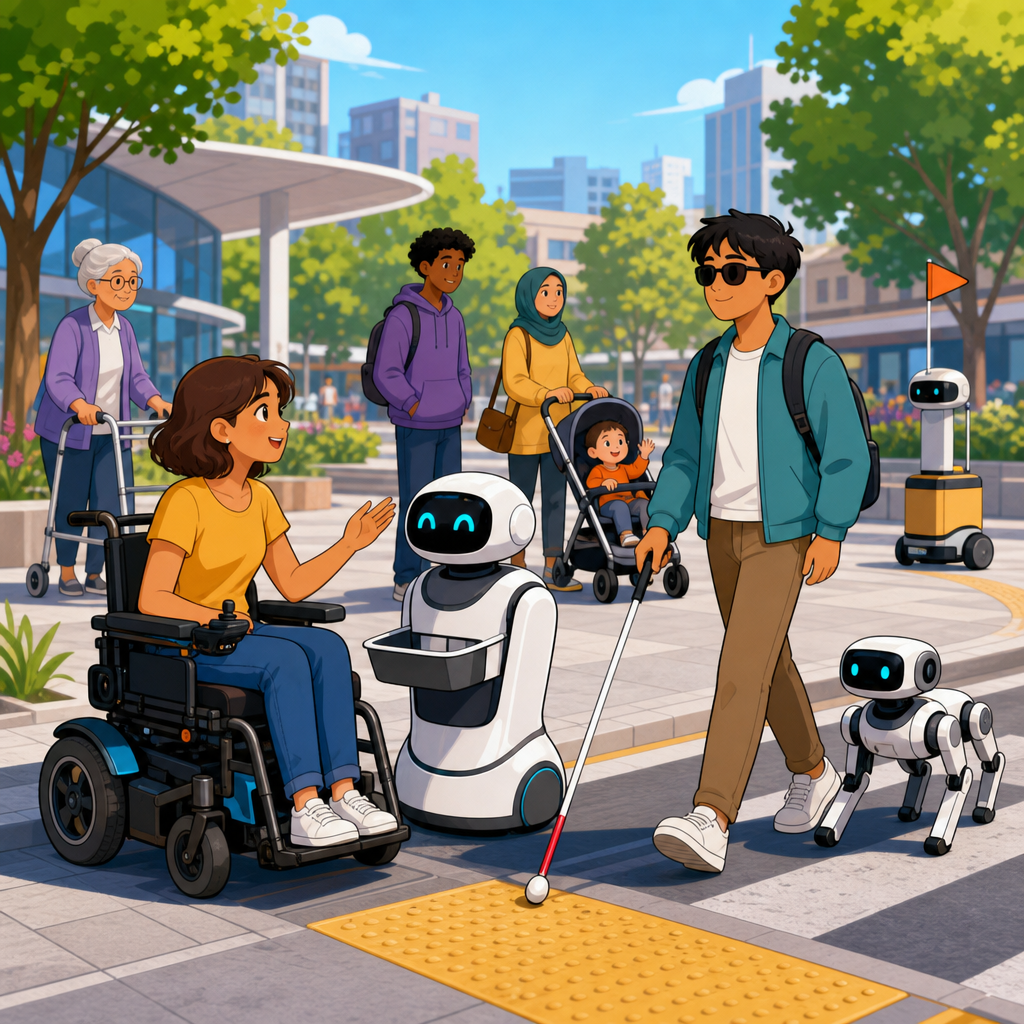
Robotics in public spaces is no longer a speculative policy issue; it is an everyday design, legal, and accessibility challenge that cities, transit agencies, hospitals, universities, retailers, and property owners must address now. Service robots patrol malls, delivery robots roll across sidewalks, cleaning robots move through airports, telepresence robots appear in clinics, and security robots monitor parking lots. In this context, public spaces means environments the public can enter or use, whether publicly owned, like sidewalks and libraries, or privately owned but open to the public, like shopping centers and hotels. Accessibility means people with disabilities can perceive, understand, navigate, interact with, and benefit from those environments on terms that are effective, safe, and comparable.
I have worked on technology governance and digital accessibility reviews long enough to know the core mistake organizations make: they treat robotics as a hardware procurement project instead of a human access system. A robot is never just a device. It is a moving interface, a data collection point, a source of physical risk, a software service, and often a gatekeeper to information or assistance. That combination raises questions that sit at the intersection of disability law, product safety, human factors, civil rights, privacy, cybersecurity, procurement, and operations. If any one of those pieces is ignored, the result can be exclusion that is expensive to fix and difficult to defend.
This article serves as a hub for emerging technologies within legal and technological frontiers by mapping the accessibility questions decision-makers cannot skip. The key terms matter. Autonomous means the robot can perform tasks with limited human input. Assistive functionality refers to features that support communication, mobility, orientation, or task completion. Reasonable accommodation, effective communication, universal design, and equivalent facilitation are not abstract phrases; they are practical standards that should shape specifications, testing, staff training, and incident response. The goal is not to block innovation. The goal is to make sure robotics improves access rather than creating a new layer of barriers in places that people rely on every day.
Why accessibility must be addressed at the start
Accessibility questions belong at the earliest planning stage because retrofitting robots in public spaces is far harder than retrofitting a website or replacing a sign. Once a robot fleet is purchased, navigation paths are configured, charging docks are installed, and vendor contracts are signed, changing the system becomes expensive. I have seen teams discover too late that a robot’s touchscreen was mounted above accessible reach ranges, that speech-only prompts excluded Deaf users, or that autonomous floor scrubbers repeatedly blocked curb cuts and elevator landings. Those are not edge cases. They are predictable failures caused by incomplete requirements.
Public-space robotics also changes the baseline of how services are delivered. If a hotel replaces staffed wayfinding desks with a roaming concierge robot, accessibility analysis must cover the service itself, not just the machine. Can a blind guest identify and summon it? Can a nonspeaking person communicate with it without relying on speech recognition? Does it provide directions in text, audio, and simple visual formats? If it cannot, the property may be reducing access even if the robot appears innovative. The same pattern applies to hospitals using transport robots, campuses using delivery robots, and transit agencies piloting robotic security or cleaning systems.
The legal exposure is equally practical. In the United States, organizations often need to consider the Americans with Disabilities Act, Section 504 or Section 508 in certain settings, state civil rights laws, building codes, and public procurement rules. In Europe, the European Accessibility Act, equality law, product safety obligations, and data protection rules may apply depending on the deployment. None of these frameworks was written solely for robots, but all can reach robotic systems when those systems provide services, mediate access, collect data, or alter how people move through space. The safest assumption is that if the public interacts with the robot, accessibility obligations follow.
Core accessibility risks in real public environments
The first category of risk is physical obstruction and navigation conflict. Sidewalk delivery robots can narrow clear pedestrian width, create trip hazards at crossings, or interfere with wheelchair turning space. Indoor robots can stop in front of doors, ramps, tactile maps, or payment counters. Standards such as ADA reach ranges and accessible routes are highly relevant here because a moving robot can temporarily make a compliant space noncompliant. Designers should model not only average traffic flow but also congestion, emergency detours, stroller use, white cane travel, service animal behavior, and low-vision wayfinding under glare or poor contrast.
The second category is interface exclusion. Many robots depend on touchscreens, voice interfaces, indicator lights, or app-based controls. Each of those can fail a different user group. Touchscreens may be unreadable in sunlight, impossible for some users with dexterity impairments, or mounted too high. Voice interfaces may not work for users with speech disabilities, hearing loss, strong accents, or in noisy transit hubs. Light-based alerts can miss blind users, while audio-only alerts can miss Deaf users. In practice, every critical function needs more than one input and more than one output mode.
The third category is algorithmic perception. Robots use cameras, lidar, ultrasonic sensors, microphones, and machine-learning models to detect people and predict movement. These systems may perform worse with mobility devices, unusual gaits, crouched posture, body size variation, dark clothing in low light, or sign language motion. A robot that consistently misclassifies wheelchair users as obstacles rather than people can behave unsafely and disrespectfully at the same time. Accessibility teams should insist on evidence that perception and navigation models were tested with diverse disability-related use cases, not just average pedestrian datasets.
| Deployment type | Common accessibility question | Best-practice control |
|---|---|---|
| Sidewalk delivery robot | Does it reduce clear path width or block curb ramps? | Geofence routes, set yielding rules, monitor obstruction incidents |
| Indoor service robot | Can all users communicate without speech or fine touch? | Provide tactile, visual, audio, and mobile alternatives |
| Security robot | Are alerts understandable to blind, Deaf, and cognitive-disabled users? | Use multimodal alerts and human backup response |
| Cleaning robot | Does it create slip, noise, or route blockage during peak use? | Schedule carefully and require safe stop behavior |
| Telepresence robot | Is remote interaction captioned and keyboard accessible? | Integrate captions, screen-reader support, and operator training |
Design principles that make robotics more accessible
The strongest robotics accessibility programs start with multimodal interaction. A public robot should not require speech, vision, hearing, or precise touch as the sole method for completing a task. In practice, that means large high-contrast text, clear iconography, speech output with adjustable volume, captioned audiovisual content, tactilely discoverable controls where feasible, and mobile handoff options that work with screen readers and switch access. When I review deployments, I also look for plain-language writing. If the robot explains itself poorly, people with cognitive disabilities, low literacy, or limited language proficiency are often excluded first.
Predictable movement is just as important as accessible interfaces. Humans need to anticipate what a robot will do next, especially in crowded environments. Good systems use conservative speeds, obvious yielding behavior, generous stopping distances, and status signals that are understandable from multiple angles. A robot should communicate whether it is approaching, waiting, turning, or requesting passage. For blind pedestrians, audible beacons can help when used carefully, but they should not create noise pollution. For low-vision users, motion contrast and lighting matter. For wheelchair users, docking and passing behavior must preserve turning space and access to controls, doors, and elevators.
Accessible robotics also depends on fallback design. There must always be a human-supported path when automation fails or is unsuitable. That path should be immediate, not hidden behind a QR code or a customer service maze. In hospitals, for example, autonomous check-in kiosks or guidance robots should have staff nearby who can step in without forcing a patient to disclose private medical details in public. In transit settings, if a robotic information point malfunctions, there should be visible signage and accessible remote assistance. Effective fallback is not an admission that the robot is weak; it is proof the service was designed responsibly.
Legal, policy, and procurement questions organizations should ask
Before deployment, organizations should ask a disciplined set of questions. What service is the robot replacing, supplementing, or controlling? Who could be excluded physically, sensorily, cognitively, linguistically, or economically? Which laws and internal policies apply? What evidence supports the vendor’s accessibility claims? Does the contract require remediation timelines, accessible documentation, assistive technology compatibility, and indemnity around misrepresentation? These questions sound basic, but they are routinely skipped when pilots are launched under innovation budgets rather than standard procurement channels.
Vendor due diligence is especially important because robotics companies often advertise safety and efficiency without providing mature accessibility documentation. Ask for conformance reports where relevant, human factors testing summaries, known limitations, and incident logs. Ask whether the mobile app works with VoiceOver, TalkBack, magnification, captions, and external keyboards. Ask whether speech recognition has alternatives. Ask whether remote operators are trained to interact respectfully with disabled people. If a vendor cannot answer clearly, that is itself a material risk. Procurement teams should write measurable acceptance criteria so accessibility is tested before payment milestones, not argued about after launch.
Policy should also address privacy and surveillance, because accessibility and privacy can clash if not handled carefully. Security robots and telepresence systems may capture video, audio, gait patterns, location data, and behavioral signals. Disabled people can be disproportionately affected when sensitive information is inferred from visible assistive devices or atypical movement patterns. Clear notices, retention limits, purpose limitations, and role-based access controls matter. So does avoiding unnecessary biometric processing. If a robot needs to detect that a person is present, it does not automatically need to identify who that person is. Data minimization is often the most accessible choice because it reduces downstream risk.
Testing, operations, and the future of emerging technologies
No robotics deployment in a public space should go live without in-situ accessibility testing. Lab demos are not enough. Real testing includes blind travelers using canes and guide dogs, wheelchair users navigating around parked and moving units, Deaf users assessing alerts, neurodivergent users evaluating sensory load, and people with limited dexterity or speech impairments completing tasks independently. Staff should capture not just pass-fail results but hesitation, confusion, congestion effects, and recovery from errors. In my experience, the most revealing findings come from routine moments: entering elevators, approaching crowded intersections, asking for help quickly, or dealing with a robot that has stopped mid-route.
Operations planning matters after launch just as much as prelaunch testing. Robots need maintenance protocols that include accessibility checks, not only battery health and uptime. If a sensor degrades, navigation behavior may become less safe for cane users before engineers notice a technical fault. Incident reporting should let the public describe access barriers in plain language and receive timely responses. Staff training should cover disability etiquette, accommodation procedures, and override authority. A frontline employee must be empowered to remove or disable a robot that is blocking access, even if the pilot team is proud of the technology.
As emerging technologies evolve, public-space robotics will converge with computer vision, ambient sensors, augmented reality, digital identity, and generative interfaces. That convergence can improve access if it is governed well. For example, indoor navigation robots could coordinate with accessible mapping systems to provide step-free routes and real-time elevator status. Delivery robots could share standardized curb-space data with city accessibility planners. Telepresence robots could integrate live captions and multilingual translation for public services. But these benefits appear only when accessibility is treated as a design requirement, contract term, and operational metric. If you are building an emerging technologies strategy under legal and technological frontiers, use this article as the hub: start with rights, map risks, demand evidence, test with disabled users, and keep a human path open at all times.
Robotics in public spaces can either widen participation or harden exclusion, and the difference usually comes down to choices made long before the first robot starts moving. The essential questions are straightforward. Does the robot preserve clear routes and safe navigation? Can people interact with it through more than one sense and more than one input method? Are privacy, surveillance, and data use constrained appropriately? Has the vendor provided evidence instead of marketing language? Are staff trained and empowered to help immediately when automation fails? When organizations answer those questions early, they reduce legal risk and build systems people can actually use.
The main benefit of getting accessibility right is not merely compliance. It is resilience. Accessible robotics performs better in crowded, noisy, unpredictable environments because it is designed around human variability. Multimodal interfaces help tourists, older adults, and people using the service for the first time. Conservative navigation reduces collisions for everyone. Clear fallback procedures improve customer service far beyond disability scenarios. In other words, accessibility is not a narrow checklist for edge cases; it is a quality standard for public technology. That is why the strongest deployments treat disabled users as expert testers and co-design partners, not as afterthoughts.
As a hub for emerging technologies, this topic should guide every related article, pilot, and procurement decision you publish next. Use it to connect deeper work on autonomous delivery, robotic security, AI perception, telepresence, smart-city infrastructure, and accessibility law. Build your evaluation process around documented requirements, field testing, incident review, and continuous improvement. If you are planning, buying, regulating, or deploying robots in spaces people share, make accessibility the first gate, not the last. Start your review now, involve disabled users early, and require evidence before any robot earns public trust.
Frequently Asked Questions
1. Why is accessibility a core requirement for robots in public spaces, not just an optional feature?
Accessibility is a baseline requirement because robots operating in public-facing environments affect how people move, communicate, receive services, and stay safe. Once a robot is deployed in a sidewalk corridor, hospital lobby, airport concourse, campus building, shopping center, or parking facility, it becomes part of the user experience of that space. That means it can either support equal access or create new barriers. For people with disabilities, even a well-intentioned robot can interfere with travel paths, block wayfinding cues, fail to provide usable communication, or behave unpredictably in ways that make a space harder to navigate.
Accessibility also cannot be separated from legal compliance and risk management. Public and quasi-public spaces often fall under disability access obligations that apply to the built environment, services, policies, and digital interfaces. If a robot becomes part of how a service is delivered, screened, monitored, or accessed, then the accessibility of that robot matters just as much as the accessibility of a kiosk, entrance, website, or customer service desk. Organizations that treat robotics as a technology pilot rather than an accessibility issue often discover too late that they have introduced exclusion, safety concerns, and liability exposure.
Just as importantly, accessibility improves usability for everyone. Clear audio and visual cues help people in noisy or low-visibility settings. Predictable movement benefits older adults, children, visitors unfamiliar with a space, and anyone carrying bags or pushing strollers. Adjustable interfaces, multilingual communication, and simple interaction pathways reduce confusion for all users. In practice, accessible robotics tends to be better robotics: easier to understand, safer to approach, and more reliable in real-world conditions. That is why accessibility should be built into procurement, design review, testing, and deployment from the start rather than patched in after complaints arise.
2. What accessibility risks do service, delivery, cleaning, and security robots create in everyday public environments?
The most immediate risk is interference with physical access. A robot that pauses in a narrow corridor, waits near an elevator call button, parks at the edge of a curb ramp, or travels unpredictably near a doorway can reduce clear passage for wheelchair users, blind pedestrians, people using canes or walkers, and others who rely on stable circulation routes. Even robots designed to avoid collisions can still create hesitation and confusion if their path planning does not account for the way people actually navigate public spaces. A technically collision-free robot is not automatically an accessible one.
Communication failures are another major issue. Many robots rely heavily on touchscreens, small displays, speech prompts, indicator lights, or app-based interactions. If information is available only through one sensory channel, the robot may be unusable for some people. For example, an audio-only alert may not reach a deaf or hard-of-hearing user, while a visual-only instruction may not serve a blind or low-vision user. Speech interfaces can also fail in noisy transit hubs or for users with speech disabilities, accents, or limited English proficiency. Accessibility requires layered communication, not a single preferred interface.
Wayfinding and cognitive accessibility also deserve attention. Public spaces are often already complex. A robot that unexpectedly approaches users, requests interaction, changes direction abruptly, or creates new procedural steps can increase cognitive load. That matters for people with intellectual disabilities, autism, dementia, brain injuries, anxiety, or anyone under stress in an unfamiliar environment. Security robots can add a further layer of concern if users do not understand whether the machine is recording them, following them, or making automated judgments about behavior.
There are also broader systems-level risks. If a robot becomes part of access control, customer assistance, inventory pickup, room delivery, visitor screening, or medical intake, an inaccessible robot can effectively deny participation in the underlying service. The issue is not only whether someone can physically avoid the robot, but whether they can use the environment on equal terms. That is why accessibility reviews should consider routes, interfaces, alerts, supervision, emergency behavior, and service alternatives together rather than treating robot movement as the only concern.
3. How should organizations evaluate whether a robot is actually accessible before deploying it in a public space?
The best approach is to evaluate the robot as part of the full service environment, not as an isolated device. A robot may perform well in a controlled demo and still fail in a crowded station, clinic, campus plaza, or retail setting. Organizations should begin with a task-based assessment: what exactly will the robot do, where will it operate, who will encounter it, and what happens if a user cannot interact with it in the intended way? That analysis should include travel routes, pinch points, lighting conditions, sound levels, weather exposure where relevant, elevator and doorway interactions, queue management, and emergency procedures.
Accessibility testing should involve people with disabilities early and directly. That means not just expert review, but observed testing with blind and low-vision users, wheelchair users, deaf and hard-of-hearing users, people with limited dexterity, neurodivergent users, people with speech disabilities, and older adults where applicable to the setting. Their feedback often reveals issues that conventional engineering tests miss, such as whether the robot’s sound profile is useful, whether its stopping distance feels safe, whether its language is understandable, or whether its presence disrupts cane travel and orientation cues.
Organizations should also review the robot’s interaction design in detail. Are instructions available visually, audibly, and in simple language? Can the robot be used without a smartphone? Is the screen readable from seated and standing positions? Are controls reachable and operable with limited dexterity? Does the robot provide enough notice before moving, turning, or entering a shared path? Can a user quickly summon human assistance if the interaction fails? These questions are as important as battery life or navigation accuracy.
Finally, evaluation should continue after deployment. Real accessibility performance depends on maintenance, software updates, staffing, supervision, and changing site conditions. A robot that is accessible on day one may become problematic if routes are reconfigured, messages are changed, or the machine begins operating during peak pedestrian periods. Strong deployment programs include incident reporting, accessibility complaint channels, periodic audits, retraining, and clear authority to pause use if the robot starts creating barriers. Accessibility is not a one-time checklist; it is an operational responsibility.
4. What design and policy practices make robots safer and more usable for people with disabilities?
Predictability is one of the most important design principles. Robots in public spaces should move in ways that are easy to anticipate, with conservative speed limits, smooth turning behavior, visible orientation cues, and consistent yielding rules near doors, elevators, ramps, intersections, and queues. They should avoid lingering in circulation paths and should be programmed to fail safely, meaning they stop or relocate in ways that do not trap, startle, or obstruct users. When people can quickly understand what a robot is doing, stress decreases and accessibility improves.
Multimodal communication is equally essential. Robots should provide status information, requests, and warnings through more than one channel, such as speech, text, symbols, and clearly distinguishable lights or tones. Interfaces should use plain language, adequate contrast, legible text, and reachable controls. Audio should be intelligible without being excessively loud, and visual cues should remain useful in bright or dim conditions. Where a robot is meant to interact directly with users, there should be alternatives to touchscreen-only or voice-only operation. A dependable path to human assistance should always be available.
From a policy standpoint, organizations should establish accessibility requirements in procurement documents and vendor contracts rather than trying to negotiate them after selection. Vendors should be asked to document interface options, route behavior, alert systems, data collection practices, emergency handling, and prior accessibility testing. Internal policies should define where robots can operate, when they must yield, how staff should intervene, what backup service methods exist, and how complaints are handled. If a robot is providing a public-facing function, there should always be a non-robot alternative that offers substantially equivalent access.
Training matters as much as hardware. Staff need to know how the robot works, what its accessibility limitations are, when to disable it, and how to assist users without delay. Clear signage and public communication can also reduce confusion, especially during initial rollout. In short, accessible robotics depends on a combination of thoughtful physical design, inclusive interaction design, operational discipline, and governance. No single feature solves accessibility on its own; it is the coordinated system that makes the difference.
5. What legal and ethical questions should cities, institutions, and property owners ask before introducing robots into public-facing spaces?
The first question is whether the robot changes access to a service, route, program, or facility in a way that could disadvantage people with disabilities. If the answer is yes, accessibility and nondiscrimination obligations are immediately in play. That includes not only the robot’s physical movement but also how it communicates, what information it collects, whether it screens or prioritizes users, and whether a person can obtain the same service through another accessible path. Organizations should not assume that because a robot is novel, experimental, or vendor-operated, ordinary access rules do not apply. If it affects public use, it deserves a serious compliance review.
Privacy and surveillance are also major concerns, especially with security, telepresence, and sensor-rich service robots. People in public spaces may not understand what data is being captured, how long


