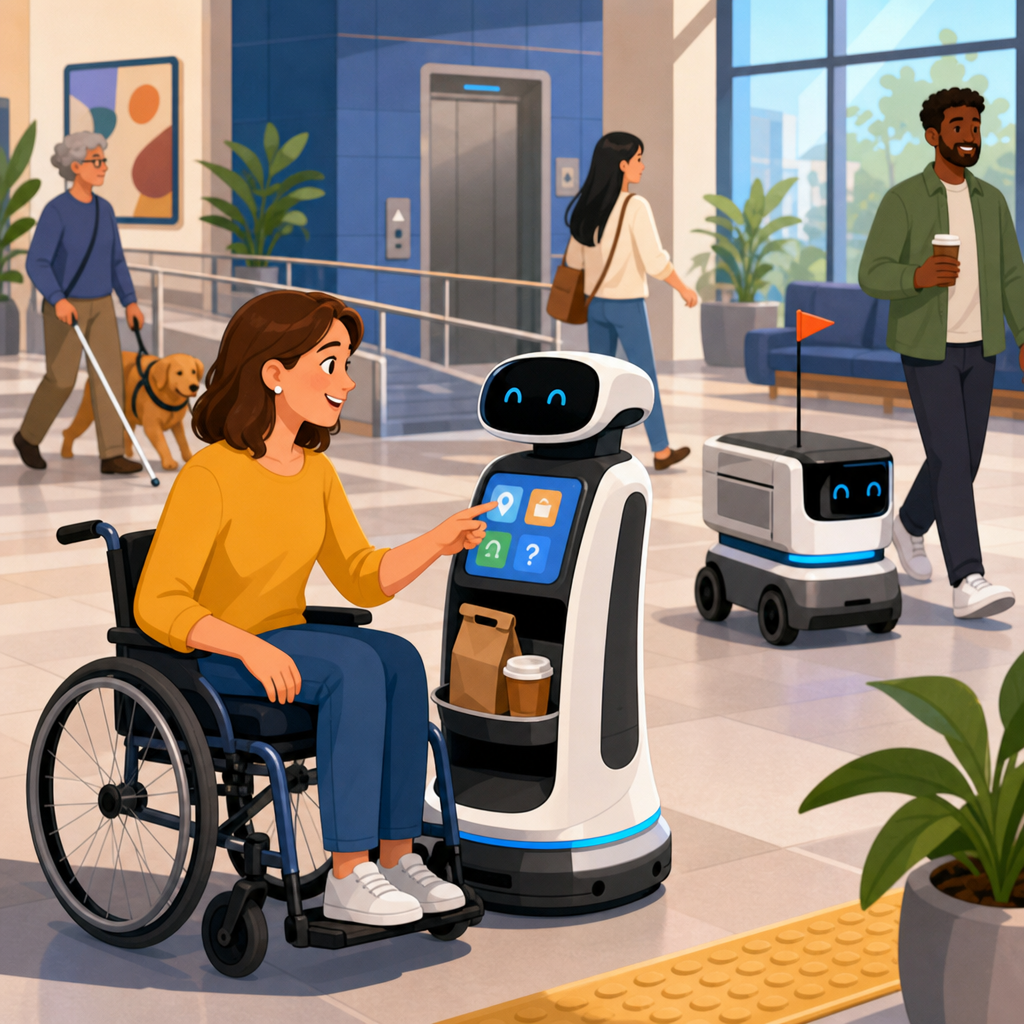
Autonomous service devices are moving from pilots to everyday operations, and the Americans with Disabilities Act now sits at the center of how these systems are designed, deployed, and governed. In this context, autonomous service devices include delivery robots, cleaning robots, self-driving wheelchairs, concierge kiosks with robotic mobility, sidewalk couriers, and AI-enabled machines that perform customer-facing tasks with limited or no direct human control. The ADA is the primary federal civil rights law that prohibits disability discrimination in public accommodations, state and local government services, employment, telecommunications, and many transportation settings. When a hotel uses a robotic bellhop, a hospital deploys an autonomous wayfinding unit, or a retailer sends inventory robots into customer aisles, the legal question is not whether innovation is permitted. The real question is whether innovation remains accessible, safe, and meaningfully equivalent for disabled people.
I have worked with organizations assessing technology rollouts in public-facing environments, and the pattern is consistent: teams focus heavily on uptime, security, and labor efficiency, then discover late in procurement that accessibility issues create the highest legal and reputational risk. A robot that blocks an accessible route, ignores screen-reader compatibility in its companion app, or requires speech input without a nonverbal alternative can trigger ADA concerns even if the machine performs its core function well. That matters because accessibility failures are rarely isolated technical bugs. They affect entrance routes, service policies, communication methods, staff training, incident response, and vendor contracts.
This hub article explains the emerging technology landscape around autonomous service devices and the ADA, defines the most important legal and technical concepts, and outlines the practical issues every operator should evaluate. It also serves as a foundation for related articles on robotic delivery, AI kiosks, self-service systems, public-right-of-way robotics, and disability-centered product design. The goal is straightforward: give decision-makers, counsel, product teams, and compliance leaders a clear framework for understanding where autonomy creates opportunity, where it creates friction, and how to reduce risk without slowing useful innovation.
What the ADA Requires When Services Become Autonomous
The ADA does not ban autonomous systems, and it does not require every machine to work identically for every person. It requires covered entities to provide equal access, effective communication, and reasonable modifications unless doing so would fundamentally alter the service or create an undue burden. For public accommodations under Title III, that means hotels, restaurants, retailers, banks, theaters, healthcare offices, and many digital extensions of those businesses must ensure that robots and related interfaces do not exclude disabled customers. For state and local governments under Title II, obligations are often broader because programs, services, and activities must be accessible when viewed in their entirety.
Applied to autonomous service devices, the legal analysis usually turns on function rather than branding. If a robot is part of the service pathway, the accessibility of that pathway matters. A delivery robot in an airport lounge may be novel, but if it becomes the default way food reaches customers, blind travelers, wheelchair users, Deaf users, and people with cognitive disabilities must still be able to order, receive, and correct the service effectively. The Department of Justice has repeatedly emphasized that businesses cannot avoid ADA duties by outsourcing operations to technology vendors. If the device is part of your customer experience, accessibility responsibility remains with you.
There is also an important distinction between accessible design and equivalent facilitation. In practice, some autonomous devices cannot yet support every interaction natively. A voice-only concierge robot, for example, may fail effective communication for Deaf users unless text interaction is robust and easy to discover. An organization may provide an alternate accessible method, but that alternative must be timely, dignified, and genuinely comparable. Telling disabled customers to wait for a manager while nondisabled users get immediate robotic service is a weak position both legally and operationally.
Core Accessibility Risks in Emerging Technologies
The most common ADA risks with autonomous service devices fall into five categories: mobility obstruction, interface exclusion, sensory mismatch, unreliable exception handling, and policy failure. Mobility obstruction occurs when robots occupy clear floor space, narrow turning areas, or pause in accessible routes. This is especially relevant in hospitals, grocery stores, warehouses with retail access, and campuses where mixed pedestrian traffic is constant. Under the 2010 ADA Standards for Accessible Design, route width, maneuvering clearance, protruding objects, and operable parts are already regulated. A moving device can create the same practical barrier as a badly placed fixture.
Interface exclusion appears when the control layer assumes a single mode of interaction. Many devices still over-rely on touchscreens mounted at standing height, app controls that fail mobile accessibility checks, QR code workflows that require fine motor precision, or speech recognition systems that perform poorly with atypical speech. Sensory mismatch involves alerts and status indicators delivered only through sound or only through light. If a robot announces “follow me” verbally without synchronized text, or flashes a visual error without an audio cue, users can miss essential information. In my experience, teams often treat these as usability defects rather than civil rights issues, which delays remediation.
Exception handling is where sophisticated systems often fail. The happy path may work, but what happens when the robot stalls, loses connectivity, misroutes an order, encounters a service animal, or receives an ambiguous command? Disabled users are disproportionately affected by weak fallback design because they are more likely to need consistent alternatives at the exact moment automation becomes uncertain. Policy failure completes the risk picture. Even an accessible machine can become noncompliant if staff do not know how to assist, if maintenance disables key accessibility features, or if procurement contracts assign no responsibility for updates, audits, and complaint resolution.
| Risk area | Typical failure | ADA concern | Practical mitigation |
|---|---|---|---|
| Physical navigation | Robot blocks aisle or curb ramp | Accessible route obstruction | Geofencing, route testing, stop rules |
| User interface | Touchscreen only, poor app labeling | Ineffective access to service | WCAG-aligned app design, multimodal input |
| Communication | Audio-only instructions | Failure of effective communication | Text, audio, haptics, captions, clear prompts |
| Operational fallback | No quick human override | Unequal or delayed service | Staff escalation within defined response times |
| Governance | No vendor accountability | Persistent noncompliance risk | Contract terms, audits, update obligations |
Physical Access, Public Space, and Robotic Movement
Physical access issues are often the easiest to visualize and the hardest to manage at scale. Sidewalk delivery robots, floor-cleaning machines, and indoor couriers operate in dynamic environments where ADA compliance depends on inches, timing, and edge cases. A robot that technically fits through a corridor can still impede a wheelchair user if it stops near a door maneuvering clearance or crowds an elevator call station. Devices navigating transit centers, campuses, or healthcare facilities must account for cane-detection behavior, service animal movement, low-vision wayfinding patterns, and the fact that people do not move predictably around machines.
Public-right-of-way deployments raise additional complexity because municipal rules, state accessibility obligations, and tort exposure intersect. Several cities have experimented with sidewalk robotics while disability advocates raised concerns about path obstruction and detectability. The central design question is simple: can a blind pedestrian, wheelchair user, or person with balance limitations move through the same space safely and independently? If the answer depends on exceptional caution from the pedestrian rather than reliable behavior from the robot, the deployment is badly designed.
Strong physical accessibility controls include speed caps, minimum passing clearance, automatic yielding protocols, curb-ramp exclusion zones, and remote monitoring with immediate intervention authority. I have also seen operators improve performance by testing with disabled users in real traffic conditions instead of relying only on lab simulations. That type of testing surfaces issues conventional engineering misses, such as how a robot’s wheel noise affects orientation for blind travelers or how sudden directional changes can startle people with vestibular disorders. These are not fringe concerns. They are foreseeable effects in mixed-use environments.
Digital Interfaces, Communication Access, and Companion Systems
Most autonomous service devices are not single products. They are ecosystems that combine onboard software, mobile apps, cloud dashboards, sensors, payment modules, and customer support channels. ADA analysis therefore extends beyond the robot’s physical shell to every companion interface that users rely on. If ordering requires an inaccessible app, the accessible hardware does not solve the access problem. If customer support is only available through an uncaptioned video link or speech bot, the service pathway remains incomplete.
For digital components, WCAG 2.1 AA remains the most practical technical benchmark even though the ADA itself does not codify every web requirement line by line for every private entity. In deployment reviews, the most common issues are unlabeled buttons, low color contrast, keyboard traps, inaccessible timeout warnings, and map-based interfaces that lack text alternatives. Autonomous wayfinding units in hospitals are a good example. A robot may guide patients physically, but appointment confirmations, route adjustments, consent forms, and help requests often live in the app. If those screens fail screen-reader testing in VoiceOver, TalkBack, JAWS, or NVDA, the user experience is still exclusionary.
Communication access also requires clarity about language, cognition, and emotional load. Simple prompts, consistent iconography, multilingual support, captioning, and confirmation screens reduce error rates for everyone, not only disabled users. In one retail review I participated in, a robotic pickup system improved completion rates after the team replaced abstract status phrases like “task exception” with plain language such as “Your order is delayed. Tap here for a staff member.” Accessibility improvements often produce measurable operational gains because they reduce confusion at scale.
Use Cases Across Healthcare, Hospitality, Retail, and Transportation
Healthcare is the highest-stakes environment because device errors can affect patient dignity, safety, and treatment access. Autonomous transport units moving supplies through clinics must not block accessible exam room paths or interfere with patients using mobility aids. Robotic wayfinding tools must support low vision, hearing loss, limited dexterity, and cognitive fatigue, especially in large hospitals where stress already impairs comprehension. Providers should also consider Section 1557 obligations, language access, infection control rules, and emergency procedures alongside ADA duties.
In hospitality, autonomous luggage delivery, room service robots, and lobby kiosks can streamline operations, but only if the service remains equivalent. If a guest cannot hear the robot announce arrival, cannot reach the controls from a seated position, or cannot use the app required to open the storage compartment, the convenience disappears. Best practice is to design accessible alternatives into the same workflow: text notification, reachable operable parts, tactile cues, and staff support triggered from the same interface without penalty or delay.
Retail deployments often involve inventory robots, customer assistance devices, and automated pickup systems. The challenge here is scale. A chain may deploy thousands of units across different store footprints, creating inconsistent accessibility outcomes. Transportation settings add one more layer because timing and navigation are mission critical. An airport or rail station robot that gives inaccessible instructions can cause a missed flight or unsafe rerouting. In each sector, the governing principle is the same: autonomy can support access, but only if disabled users are part of the design assumptions from the beginning.
Procurement, Testing, and Governance for Compliance
The most effective ADA strategy for autonomous service devices starts before purchase. Procurement documents should require accessibility conformance statements, testing evidence, update commitments, incident reporting, and indemnity language tied to accessibility failures. Ask vendors which standards they use, how they test with screen readers and alternative input methods, whether they have evaluated path-of-travel impacts, and how quickly they can remediate defects. If a vendor cannot answer these questions precisely, the product is not deployment ready.
Testing should combine technical audits, environmental walkthroughs, and moderated sessions with disabled participants. Automated accessibility scanners catch only a fraction of digital defects. Real users reveal operational barriers, especially around recovery flows and staff handoffs. Governance then turns findings into sustained practice: assign an owner, define escalation paths, document exceptions, train frontline teams, and review complaints for patterns. Accessibility should be included in change management because software updates, map revisions, and sensor recalibration can quietly introduce new barriers.
This emerging technologies hub connects those issues across every related article in the series. Use it as the starting point for deeper analysis of delivery robots, AI customer service tools, robotic mobility aids, smart building systems, and future public-space automation. The key takeaway is practical: autonomous service devices and the ADA are not separate subjects. Accessibility is a product requirement, a legal obligation, and a deployment discipline. Organizations that treat it that way build better systems, reduce complaints, and create services more people can use with confidence. Review your current pilots, audit every service pathway, and make accessibility part of the next procurement decision.
Frequently Asked Questions
1. How does the ADA apply to autonomous service devices?
The Americans with Disabilities Act applies whenever an autonomous service device affects how people with disabilities access goods, services, programs, facilities, transportation, or public spaces. In practical terms, that means the ADA is not just about whether a robot or AI-enabled machine is innovative or efficient. It is about whether the system, as deployed in the real world, creates barriers or removes them. If a delivery robot blocks a path of travel, if a concierge kiosk cannot be used by a blind customer, or if an autonomous wheelchair interface cannot be operated by someone with limited dexterity, ADA compliance concerns are immediately in play.
The specific ADA obligations depend on who is operating the device and where it is being used. Title II generally applies to state and local governments and public entities, while Title III generally applies to private businesses that are places of public accommodation. Employers using autonomous service devices may also trigger Title I obligations if those systems affect employees or job applicants with disabilities. In many cases, the analysis is not limited to the machine itself. Regulators and courts often look at the entire service model, including policies, staff assistance, communication methods, route design, emergency procedures, and whether an effective alternative is available when the device does not work for a user with a disability.
That is why organizations should think of ADA compliance as a system-level design and governance issue rather than a narrow product feature checklist. The legal question is often whether the deployment gives people with disabilities equal access and an equal opportunity to benefit, not simply whether the device can technically function. Autonomous systems may be cutting-edge, but under the ADA they are still part of a covered service environment, and that means accessibility has to be built into planning, procurement, testing, and day-to-day operations.
2. What accessibility risks do delivery robots, cleaning robots, and sidewalk couriers create?
These devices can create several common accessibility risks, especially when they operate in shared pedestrian environments. One of the biggest concerns is obstruction. A sidewalk courier that pauses across the accessible route, a cleaning robot that narrows a corridor, or a delivery unit that parks too close to an entrance can interfere with wheelchair travel, cane navigation, walker use, and safe passage for people with mobility, vision, or balance impairments. Even short-term blockages matter, because an accessible route under the ADA must remain usable in practice, not just on paper.
Another major issue is detectability and predictability. People who are blind or have low vision may have difficulty perceiving a quiet, low-profile device, especially if it approaches from an unexpected angle or changes direction abruptly. Individuals with hearing disabilities may miss audible warnings if the system relies only on sound. People with cognitive disabilities may be confused by unusual movements or unclear signals. The ADA’s broader emphasis on effective access means operators should evaluate how the robot communicates its presence, intent, and status through multiple channels, such as visual indicators, audible cues, and predictable operating behavior.
There are also safety and service-access concerns beyond basic navigation. For example, if a robotic delivery process replaces staffed service, customers with disabilities may lose the ability to ask for assistance, request a modification, or receive information in an accessible format. A building may technically have a robot-based service, but if the only way to interact with it is through a small touch screen, a complicated app, or a narrow pickup compartment, the overall experience may still be inaccessible. The most effective way to reduce ADA risk is to conduct route testing, human factors reviews, disability-inclusive usability evaluations, and operational policy reviews before and after deployment. That includes asking a simple but essential question: can a person with a disability use or safely navigate around this device independently and with dignity?
3. Do autonomous service devices themselves have to be accessible, or is staff assistance enough?
In many situations, the device itself should be designed to be as accessible as reasonably possible, and organizations should not assume that staff assistance alone will satisfy ADA obligations. The ADA generally favors equal and integrated access rather than separate or inferior alternatives. If an autonomous concierge kiosk, mobile check-in robot, or AI-powered customer service device is part of the main service experience, people with disabilities should be able to use that experience in a way that is comparable to other users whenever feasible. That may require accessible reach ranges, screen-reader compatibility, tactile controls, voice interaction, captioning, simple language prompts, sufficient color contrast, and interfaces that do not depend on fine motor precision or one sensory channel alone.
That said, staff assistance can still play an important role. The ADA does not always require every technology feature to work identically for every user in every context, but it does require effective access. In some cases, a prompt and meaningful human alternative may help close gaps. The problem arises when the alternative is slower, stigmatizing, unreliable, or available only after the person with a disability encounters a barrier. For example, telling users to “find an employee if the robot doesn’t work for you” may not be enough if no employee is nearby, if the user cannot easily request help, or if the service delay is substantial compared with what non-disabled users experience.
The strongest compliance posture is to combine accessible design with accessible backup procedures. Organizations should build devices and interfaces that work for the broadest possible range of users, train staff to support disability-related needs, and maintain clear escalation paths when technology falls short. This approach is not only more defensible under the ADA, but also more practical in real operations, where accessibility failures often stem from a mismatch between technology design and on-the-ground service delivery.
4. What should companies and public entities evaluate before deploying autonomous service devices?
Before deployment, organizations should conduct an accessibility review that is as serious as their safety, cybersecurity, and privacy reviews. The first step is to identify which ADA titles and related accessibility rules may apply based on the operator, setting, and function of the device. A city using sidewalk delivery robots, a hospital deploying autonomous transport units, and a retailer introducing mobile robotic customer service stations may all face different operational questions, but they share a common need to examine whether the technology changes access for people with disabilities.
From there, the review should cover physical access, communication access, operational access, and emergency access. Physical access includes route width, turning space, obstacle avoidance, docking locations, pickup and drop-off design, and whether the device interferes with accessible entrances, corridors, curb ramps, or waiting areas. Communication access includes whether instructions, alerts, and service options are available visually, audibly, and in formats usable by people with sensory, speech, cognitive, and dexterity-related disabilities. Operational access includes whether users can request assistance, seek a reasonable modification, report a problem, or choose an alternative service path without difficulty. Emergency access includes what happens if the device malfunctions, stops in an accessible route, loses connectivity, or behaves unpredictably in a crowded public setting.
Just as important, organizations should involve disabled users in testing. Accessibility cannot be reliably assessed from engineering assumptions alone. Real-world usability testing with people who have a range of disabilities often reveals barriers that technical teams miss, such as confusing prompts, inaccessible app dependencies, awkward interaction timing, or navigation conflicts in busy environments. Contracts with vendors should also address accessibility responsibilities, documentation, remediation timelines, software updates, and indemnity issues where appropriate. In short, a strong predeployment review treats ADA compliance as a procurement, design, policy, and operations issue all at once.
5. What are the legal and practical consequences of ignoring ADA issues in autonomous device deployments?
Ignoring ADA considerations can create both immediate operational problems and significant legal exposure. On the legal side, organizations may face complaints, demand letters, investigations, lawsuits, settlement obligations, and injunctive relief requiring redesign or changes to deployment practices. Because the ADA focuses on equal access, claims can arise even when a device is technologically sophisticated and generally safe. A system may perform well overall and still violate the law if it excludes or disadvantages people with disabilities in how services are delivered. That is especially true when the accessibility problem is foreseeable and the operator failed to assess or address it.
The practical consequences can be just as serious. An inaccessible autonomous deployment can disrupt customer trust, delay operations, trigger public criticism, and create internal friction between innovation teams, legal teams, facilities staff, and frontline personnel. Accessibility failures often become highly visible because they happen in public-facing environments: a robot blocks a wheelchair path, a kiosk cannot be used by a blind visitor, or a self-service workflow leaves a disabled customer stranded without assistance. Those incidents can quickly undermine the very efficiency and brand value the deployment was meant to create.
The better approach is to treat ADA compliance as part of responsible innovation. When accessibility is addressed early, organizations reduce legal risk, improve usability for everyone, and create more resilient service systems. Autonomous service devices are likely to become more common, not less, and that makes accessibility governance increasingly important. Companies and public entities that build disability access into device selection, system design, employee training, maintenance, and vendor oversight will be in a much stronger position than those that wait for complaints to reveal what they missed.


