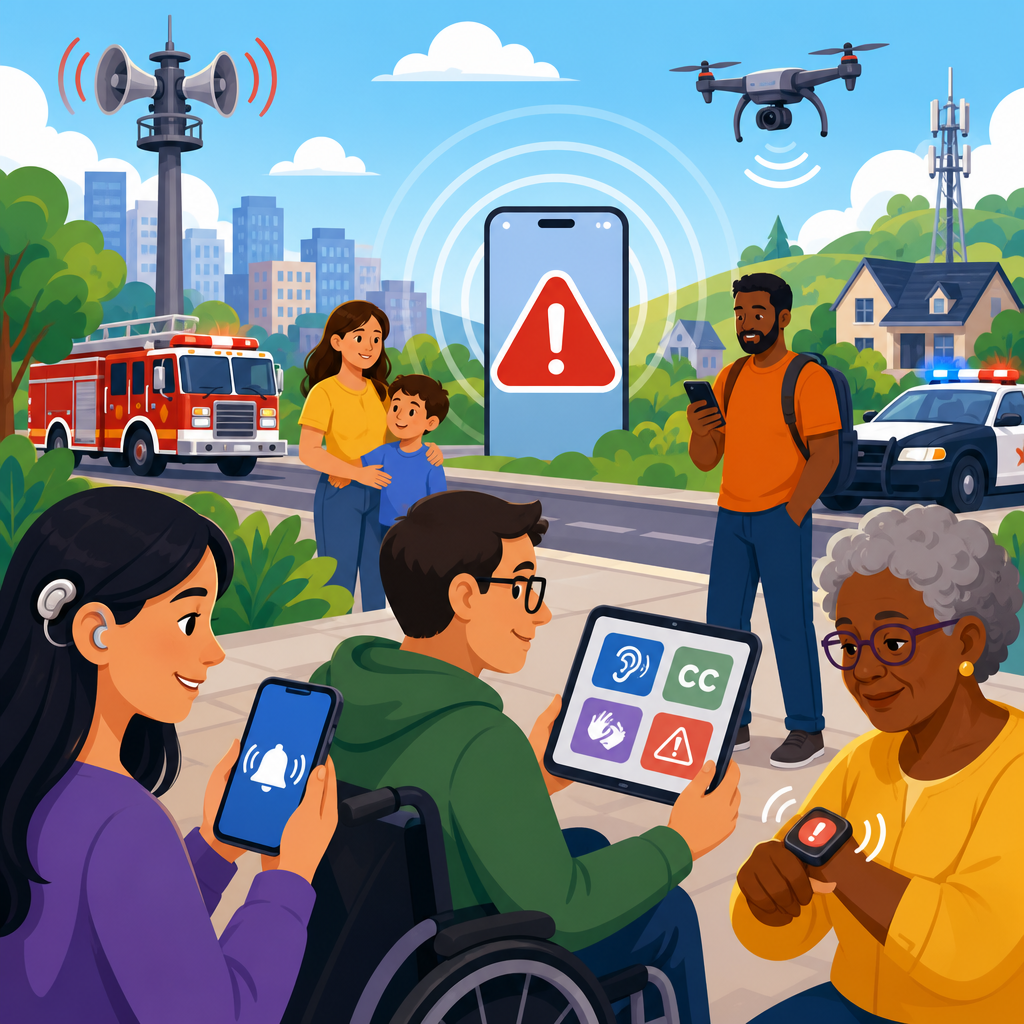
Public safety tech and accessible emergency alerts are now central to how cities, schools, hospitals, and transit systems protect people during fast-moving crises. Public safety tech includes the hardware, software, networks, standards, and operational procedures used to detect threats, verify information, communicate risk, coordinate responders, and guide the public toward safer choices. Accessible emergency alerts are warning messages designed so people with disabilities, older adults, limited English proficiency, or limited digital access can receive, understand, and act on urgent information without delay. I have worked on alerting and digital accessibility projects where the hard lesson was always the same: an alert that reaches only the average user is not a public warning system; it is a partial system that fails when inclusivity matters most.
This topic matters because emergencies compress time, increase stress, and expose every design flaw. During a wildfire, minutes determine evacuation routes. During flash flooding, people need location-specific instructions, not generic warnings. During an active shooter event, a school community needs consistent, verified, multilingual, and device-agnostic messaging. The legal and technological frontier sits at the intersection of communications law, disability rights, cybersecurity, AI-assisted monitoring, geospatial data, and resilient infrastructure. In the United States, frameworks such as the Americans with Disabilities Act, Section 508, Federal Communications Commission rules, FEMA’s Integrated Public Alert and Warning System, and the Common Alerting Protocol shape how messages should be issued and delivered. The challenge is not simply sending more alerts. It is building systems that are fast, interoperable, secure, understandable, and accessible under extreme conditions.
As a hub for emerging technologies, this article maps the major tools and issues that define modern emergency communications. It explains how sensor networks, AI-supported detection, cell broadcast, multilingual translation, accessible design, cybersecurity controls, and community-centered planning work together. It also identifies the tradeoffs practitioners face, including false alarms, privacy concerns, over-alerting, procurement limits, and interoperability gaps between agencies. If an organization wants to improve emergency readiness, the priority is clear: adopt technologies that strengthen situational awareness while making every alert perceivable, operable, understandable, and robust for the full public, not just the easiest audience to reach.
Core Public Safety Technologies Driving Modern Alerts
Modern public warning systems depend on layered technologies rather than a single channel. Detection often starts with sensors, cameras, weather feeds, acoustic gunshot systems, wildfire satellites, flood gauges, or building management systems. Verification then moves through computer-aided dispatch platforms, emergency operations center dashboards, and geospatial mapping tools such as Esri ArcGIS. Distribution relies on cell broadcast, Wireless Emergency Alerts, SMS, email, sirens, social media, digital signage, voice calls, desktop popups, radio, television, and in-building notification systems. Coordination depends on standards-based interoperability, especially the Common Alerting Protocol, which allows one validated alert to be repurposed across multiple channels with consistent content and metadata.
In practice, the strongest systems are redundant by design. I have seen universities use mass notification platforms such as Everbridge, Rave Mobile Safety, and Alertus so one incident can trigger mobile app messages, desktop takeovers, text messages, outdoor speakers, and digital signboards at once. That redundancy matters because people do not all look at the same device at the same time. Transit agencies add passenger information systems and platform displays. Hospitals connect incident alerts to nurse call systems and overhead paging. Local governments integrate National Weather Service feeds and evacuation maps. The result is not just broader reach. It is a higher probability that a person receives the same essential instruction in at least one usable format.
Geotargeting is another defining capability. Instead of warning an entire county, agencies can target a floodplain, campus zone, industrial radius, or evacuation polygon. Better targeting reduces alert fatigue and improves trust, because recipients see that alerts are relevant to their location. However, geotargeting works only when underlying address data, GIS boundaries, and carrier delivery behavior are accurate. Poor polygons, stale contact records, or network congestion can create dangerous mismatches between risk and communication. That is why mature programs routinely test maps, audit contact data, and compare planned alert zones against actual after-action results.
What Makes an Emergency Alert Accessible
An accessible emergency alert is one that people can receive, perceive, understand, and act upon despite disability, language barriers, device limitations, or stressful conditions. In practical terms, accessibility begins with content. Messages should answer five immediate questions: what happened, who is affected, where the risk is, what action to take now, and where to get updates. Plain language is not a stylistic preference; it is a safety requirement. “Evacuate north using Route 7 by 4:30 p.m.” performs better than vague phrasing like “residents should consider leaving the area soon.” Specific verbs, times, routes, shelters, and hazard descriptions reduce confusion.
Format matters just as much as wording. People who are deaf or hard of hearing need visual channels, captions, and text equivalents. People who are blind or have low vision need screen-reader compatible alerts, meaningful link text, and messages that do not rely solely on color or images. People with cognitive disabilities benefit from shorter sentences, familiar terms, and consistent structures. Multilingual communities need professionally translated templates for high-risk scenarios, not improvised machine translation in the middle of a crisis. Accessibility also includes compatibility with assistive technologies, support for vibration and audible tones, and reliable delivery to older phones and low-bandwidth connections.
Standards provide a concrete baseline. Digital messages should align with Web Content Accessibility Guidelines, especially around text alternatives, contrast, keyboard operability, and predictable structure. Broadcast and video alerts should include captions and, where possible, sign language interpretation. Audio messages should be recorded clearly at an intelligible pace. Maps should have text descriptions of affected areas and routes. The strongest agencies create accessible alert templates in advance, test them with disability advocates, and train staff to avoid inaccessible shortcuts such as image-only social posts with embedded text. Accessibility cannot be bolted on after dispatch; it has to be operationalized before an emergency happens.
Emerging Technologies Reshaping Warning Systems
Several emerging technologies are changing how agencies detect threats and issue alerts. Artificial intelligence is increasingly used to triage incoming reports, identify patterns in 911 data, flag abnormal sensor readings, and summarize incident updates for operators. Computer vision can help detect smoke plumes, crowd surges, or perimeter intrusions. Internet of Things networks can connect water-level sensors, air quality monitors, building alarms, and traffic signals into one situational picture. Drones provide rapid aerial imagery after storms, chemical releases, or infrastructure failures. Edge computing allows local processing when cloud connectivity is degraded, improving resilience during outages.
These tools are useful, but they are not autonomous replacements for judgment. In every deployment I have reviewed, the winning model is human-in-the-loop. AI can prioritize signals; it should not independently send evacuation orders without verified oversight. Gunshot detection, for example, may shorten response times in dense urban areas, yet it can also generate disputed classifications if acoustics are poor or context is missing. Translation tools can accelerate multilingual drafts, but final review still matters for idioms, local place names, and life-safety precision. Emerging technology improves speed and scale when paired with governance, audit trails, and clearly assigned decision authority.
| Technology | Primary Use | Accessibility Benefit | Main Risk |
|---|---|---|---|
| Cell broadcast and Wireless Emergency Alerts | Rapid location-based public warnings | Reaches many users without prior sign-up | Limited message length and inconsistent device behavior |
| AI-assisted incident triage | Prioritizes reports and summarizes updates | Speeds creation of timely, simpler alerts | False positives, bias, and overreliance |
| IoT sensor networks | Detects floods, smoke, air hazards, and failures | Faster warning for people needing more time to act | Maintenance gaps and cybersecurity exposure |
| Digital signage and wayfinding | On-site instructions in stations, campuses, and buildings | Supports deaf users and multilingual display | Poor readability or power dependence |
| Accessible mobile apps | Rich updates, maps, shelter info, and confirmations | Can support screen readers, large text, and vibration | Requires downloads, updates, and connectivity |
Another frontier is personalization. Some platforms let users specify preferred languages, modalities, and locations. That can improve relevance, but it introduces privacy and equity questions. Residents who never register should still receive critical warnings through default public channels. People should not need to surrender excessive personal data to stay safe. The best programs combine opt-in enhancements with universal pathways such as broadcast alerts, sirens, and accessible web updates. Personalization should deepen inclusion, not create a two-tier system where the best protection goes only to digitally engaged residents.
Interoperability, Cybersecurity, and Legal Obligations
Interoperability is the difference between a coordinated warning ecosystem and a patchwork of disconnected tools. Police, fire, emergency management, schools, utilities, and transportation agencies often buy different platforms at different times. Without shared standards and governance, the same incident can produce conflicting instructions. CAP, IPAWS integration, GIS data exchange, and identity management controls help solve that problem, but technology alone is not enough. Agencies need agreed approval workflows, message taxonomies, escalation paths, and mutual aid protocols. During a regional wildfire or hurricane, neighboring jurisdictions must be able to share verified information quickly and preserve one authoritative public message.
Cybersecurity is inseparable from public safety technology. An attacker who compromises an alerting platform can trigger panic, suppress warnings, alter evacuation instructions, or expose sensitive contact data. Basic controls should include multifactor authentication, role-based access, network segmentation, encrypted data in transit and at rest, logging, and regular tabletop exercises for alert system compromise. Vendors should support secure APIs, documented uptime commitments, independent assessments, and disaster recovery testing. NIST guidance, including the Cybersecurity Framework and incident response principles, offers a practical baseline. Public agencies should also review supply chain risk, because a vulnerable third-party integration can become the entry point for a wider failure.
Legal obligations shape design choices. Disability rights law requires equal access to public services, which includes emergency communications. Communications regulations govern broadcast accessibility and emergency information delivery. Procurement rules may require accessibility conformance documentation such as VPATs. Records retention rules affect how alerts, logs, and after-action materials are stored. Privacy law influences registration data, location data, and surveillance technologies. Organizations that ignore these issues often discover too late that a fast technical deployment created legal exposure. The right approach is proactive: involve legal counsel, accessibility specialists, information security teams, and emergency managers early in platform selection and policy drafting.
Building a Future-Ready Public Alerting Program
A future-ready program starts with governance, not gadgets. Agencies should define who can authorize alerts, what templates exist, which channels are primary and backup, how accessibility is verified, and how performance will be measured. Core metrics include delivery reach, time to issue, language coverage, template quality, geotarget accuracy, confirmation rates, and post-incident comprehension. I recommend running quarterly tests that include disability scenarios, multilingual workflows, and network degradation assumptions. A successful drill is not the one with perfect software dashboards. It is the one where ordinary people receive a clear message and know exactly what to do next.
Community engagement is equally important. Disability organizations, immigrant groups, schools, housing authorities, hospitals, and transit riders should help shape templates, testing, and outreach. Real-world feedback often exposes issues professionals miss, such as confusing shelter directions, inaccessible PDF maps, sirens inaudible inside modern buildings, or translations that use formal wording no resident would recognize under stress. Training also matters. Staff turnover can quietly erode preparedness, so operators need refreshers on alert writing, accessibility checks, platform use, and rumor control. The strongest agencies maintain preapproved multilingual message libraries for scenarios such as tornadoes, chemical spills, missing persons, active threats, boil water notices, and evacuation orders.
Looking ahead, the most valuable emerging technologies will be the ones that combine speed with trust. Better geospatial models will improve zone-based warnings. Satellite connectivity and mesh networking will strengthen resilience when terrestrial networks fail. AI tools will continue to assist with triage, translation support, and summarization, but accountability will remain human. Public safety leaders should treat accessible emergency alerts as critical infrastructure, not a communications accessory. Invest in interoperable systems, accessible content, secure operations, and community-tested workflows. Then connect this hub to deeper work on AI in emergency management, smart city sensors, digital evidence, privacy, and next-generation communications, because the future of public safety depends on technology that reaches everyone when it matters most.
Frequently Asked Questions
What does public safety tech include, and why does accessibility matter in emergency alerts?
Public safety tech includes the full set of tools and systems organizations use to prepare for, detect, confirm, and respond to emergencies. That can mean sensors, cameras, gunshot detection, weather monitoring, mass notification software, public address systems, radio networks, dispatch platforms, digital signage, mobile apps, backup power, data-sharing tools, and the policies that tell staff how to use them under pressure. In cities, schools, hospitals, and transit systems, these technologies work together to turn raw information into practical action, such as locking doors, notifying responders, rerouting traffic, or telling people where to go next.
Accessibility matters because an alert only works if people can actually receive it, understand it, and act on it quickly. In real emergencies, many people face barriers that standard alerts do not address well, including people who are deaf or hard of hearing, blind or low vision, neurodivergent, older adults, people with limited English proficiency, and anyone affected by stress, noise, darkness, crowding, or poor connectivity. An accessible emergency alert is designed to reach people through multiple channels and in multiple formats, such as text, audio, visual displays, vibration, plain language, captions, screen-reader-friendly mobile messages, and translated content.
That is why accessibility should not be treated as an add-on. It is a core part of resilience, compliance, and life safety. When alert systems are inclusive by design, organizations reduce confusion, improve response times, support independent decision-making, and help more people get to safety without relying solely on others for interpretation. In practical terms, accessible alerting makes emergency communication stronger for everyone, not just for specific disability groups.
What makes an emergency alert truly accessible and effective during a fast-moving crisis?
A truly accessible and effective alert does three things well: it reaches people quickly, it communicates clearly, and it supports action. Speed matters because emergencies evolve fast, but speed alone is not enough if the message is vague or difficult to interpret. The most effective alerts use plain language, identify the hazard, state who is affected, explain what people should do immediately, and say where to get updates. For example, instead of using technical jargon or coded phrases, a strong alert might say, “Fire reported in Building A. Evacuate using the nearest safe exit. Do not use elevators. Go to the north parking lot for instructions.”
Accessibility improves when that same message is delivered across multiple channels at the same time. A layered approach may include SMS, push notifications, desktop alerts, voice calls, emails, public address announcements, digital signage, strobe-equipped alarms, social media updates, website banners, and integrations with assistive technologies. Redundancy is essential because no single method reaches everyone in every condition. A person may miss a phone alert if their device is muted, but still see signage or hear a speaker announcement. Someone who cannot hear an announcement may rely on captions, text, or visual cues. Someone who cannot see a screen may depend on audio output or a screen reader.
Effective accessible alerts also account for cognitive load. During a crisis, people may be frightened, distracted, or processing information more slowly. That means alert messages should be concise, consistent, and structured in a predictable way. Good systems avoid long paragraphs, conflicting instructions, and unexplained abbreviations. They also support follow-up messages so the public knows whether to shelter in place, evacuate, avoid a route, expect service disruptions, or wait for an all-clear. In short, accessibility is not only about the format of the message. It is also about message design, timing, clarity, and the ability of the system to keep people informed as conditions change.
How do cities, schools, hospitals, and transit systems use accessible emergency alert technology differently?
Each environment has distinct risks, populations, and operational demands, so accessible alerting must be tailored to the setting. Cities often need broad, multi-agency communication that can scale quickly across neighborhoods or entire regions. Their systems may integrate weather alerts, public warning networks, traffic management, outdoor sirens, emergency operations centers, 911 data, digital road signs, and multilingual public messaging. Accessibility in this context depends on reaching diverse communities through mobile alerts, audio and visual channels, translation support, accessible websites, and partnerships with community organizations that serve people with disabilities and older adults.
Schools typically focus on campus-specific incidents such as severe weather, intruders, fires, medical emergencies, or utility failures. They need tools that can notify students, staff, visitors, and families while also guiding internal protective actions like lockdown, evacuation, reunification, or sheltering in place. Accessibility is especially important because schools serve children with varied communication needs and often include individuals who depend on individualized supports. Effective school systems may combine classroom displays, intercoms, strobes, mobile notifications, staff panic buttons, and preplanned visual instructions that are easy to understand under stress.
Hospitals face a different challenge because they must protect patients who may have mobility limitations, sensory disabilities, cognitive impairments, or medical dependence on equipment. Alerts must work without disrupting care and must support both clinical and non-clinical teams. A hospital may need to communicate code events, evacuation zones, security incidents, or infrastructure failures while ensuring messages reach patient rooms, nursing stations, operating areas, waiting rooms, and external partners. Accessibility here can include bedside visual messaging, clear wayfinding, language access, overhead announcements paired with text, and staff workflows that account for patients who cannot self-evacuate.
Transit systems operate in noisy, crowded, fast-changing environments where riders may be unfamiliar with the location. Accessible alerting often relies on synchronized audio announcements, captioned visual displays, tactile and high-contrast signage, mobile updates, platform messaging, and staff communication protocols. Instructions need to be immediate and location-specific, especially during service disruptions, evacuations, security incidents, or severe weather. Across all of these sectors, the common principle is the same: accessible emergency communication must match the real conditions of the people and places it serves.
What standards, best practices, and features should organizations look for when choosing an accessible emergency alert system?
Organizations should start by looking for systems built around multi-channel communication, interoperability, and inclusive design. A strong platform should be able to send alerts through SMS, email, voice, desktop pop-ups, mobile push, public address systems, digital signage, social channels, and web updates from a single interface. It should also integrate with existing public safety tools such as access control, fire panels, dispatch systems, weather feeds, building automation, and incident management platforms. The goal is not just sending messages, but coordinating a reliable response across multiple technologies and teams.
From an accessibility standpoint, important features include support for screen readers, captioning, visual and audible outputs, customizable font and contrast options, multilingual messaging, text-to-speech, speech-to-text where relevant, and templates written in plain language. Alerts should be easy to format for different audiences without losing clarity. Systems should also support role-based targeting, geographic targeting, and acknowledgment tracking so organizations know who received the message and whether follow-up is needed. For public-facing alerts, the platform should help teams publish consistent instructions across channels quickly, without requiring complex manual steps during a crisis.
It is also wise to evaluate reliability, security, and governance. Ask whether the system offers redundancy, offline contingencies, audit logs, encryption, user permissions, and backup power considerations. Review whether it supports regular drills, after-action reporting, and message testing in formats that mirror real emergencies. Accessibility should be validated through real user testing, not assumed based on vendor claims alone. If possible, include people with disabilities, older adults, frontline staff, and limited-English users in pilot exercises. The best accessible emergency alert system is one that performs clearly and consistently in the real world, under pressure, for the full range of people who depend on it.
How can organizations improve accessible emergency alerts over time instead of treating them as a one-time project?
Improving accessible emergency alerts is an ongoing operational commitment. Threats change, buildings change, technologies change, and so do the people using them. Organizations should begin with a risk and communication assessment that maps likely incidents, affected populations, current alert channels, language needs, disability accommodations, and failure points. That assessment should lead to practical policies: who can send alerts, which templates are preapproved, how updates are issued, how information is verified, and how teams coordinate during rapidly changing events.
Training and exercises are just as important as the technology itself. Staff need regular practice using the system, writing clear instructions, and understanding accessibility requirements under stress. Drills should test not only whether a message was sent, but whether people noticed it, understood it, and knew what action to take. Organizations often discover gaps during exercises, such as low audibility in certain spaces, hard-to-read displays, delayed translations, or confusion caused by inconsistent terminology. Those findings should feed directly into revisions to templates, hardware placement, workflows, and escalation procedures.
Continuous improvement also depends on feedback and measurement. After drills or real incidents, collect input from employees, students, patients, riders, visitors, disability advocates, and emergency responders. Review delivery data, timing, acknowledgment rates, and any accessibility complaints or communication breakdowns. Track whether messages were available in the right formats, whether


