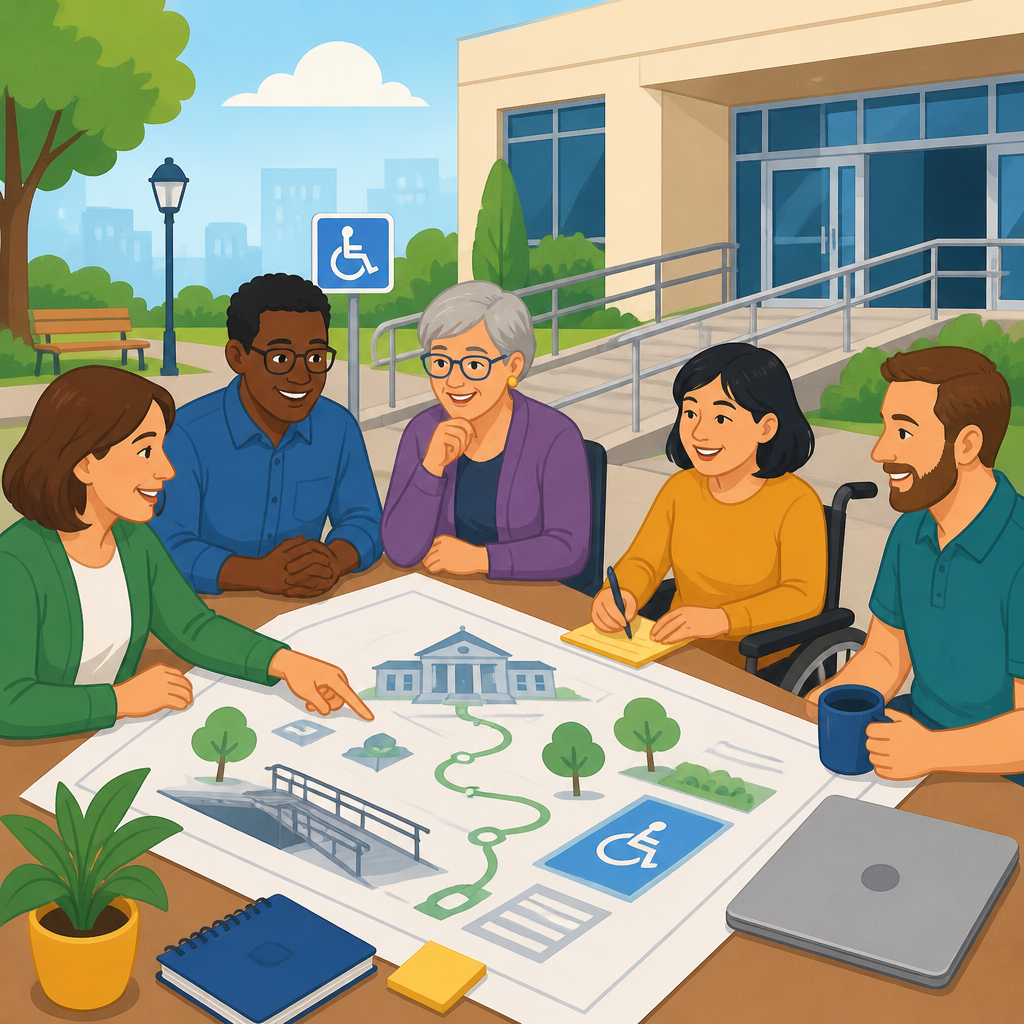
Title II transition plans are the written roadmaps public entities use to remove barriers to accessibility, prioritize corrective work, assign responsibility, and schedule completion so programs, services, and activities are usable by people with disabilities. Under the Americans with Disabilities Act, Title II applies to state and local governments and to departments, agencies, special purpose districts, and other instrumentalities of those governments. In practice, that means cities, counties, school districts, public colleges, transit agencies, courts, police departments, parks systems, and public hospitals all operate under the same core rule: people with disabilities must have equal access to public programs unless doing so would fundamentally alter the service or create an undue financial and administrative burden.
A transition plan matters because accessibility failures in public entities are rarely isolated. I have seen the same jurisdiction install compliant curb ramps on one block while leaving inaccessible meeting rooms, websites, sidewalks, and restrooms untouched because no centralized inventory or schedule existed. The transition plan solves that management problem. It turns broad legal duties into a working document that identifies barriers, documents methods, sets priorities, and shows how the entity will achieve program access over time. For ADA coordinators, facilities directors, public works teams, and counsel, the plan also provides evidence that the entity has evaluated its obligations systematically rather than reacting only after complaints or litigation.
For a hub page on Title II: Public Entities, it is important to define two related but distinct ideas. Program access is the governing standard for existing facilities. A public entity does not necessarily have to make every older building fully accessible if people with disabilities can access the program when viewed in its entirety. By contrast, new construction and alterations must comply with applicable accessibility design standards, most commonly the 2010 ADA Standards for Accessible Design. A transition plan sits at the intersection of those concepts. It addresses structural changes needed to achieve program access in existing facilities, while also helping agencies coordinate capital projects, self-evaluations, digital accessibility efforts, and grievance procedures.
The central question most agencies ask is simple: when is a Title II transition plan legally required, and what exactly must it contain? The answer depends on the size of the public entity, whether structural changes are necessary, and whether the entity employs fifty or more people. Yet the practical answer is broader. Even where an older plan technically exists, it may be outdated, incomplete, or silent on sidewalks, pedestrian signals, web content, and leased spaces. A defensible modern plan should therefore go beyond minimum formality and function as the accessibility backbone for the entire public entity.
When a Title II Transition Plan Is Required
The ADA regulation for state and local government services, 28 C.F.R. part 35, requires a public entity with fifty or more employees to develop a transition plan if structural changes to facilities are necessary to achieve program accessibility. That requirement works together with the self-evaluation rule. Public entities were originally required to evaluate their services, policies, and practices and identify needed modifications. If that evaluation showed that barrier removal or other structural work was needed in existing facilities, an entity meeting the employee threshold had to create a transition plan describing how and when the work would occur.
Several points are critical. First, the trigger is not simply ownership of old buildings. The trigger is the need for structural changes to make programs accessible when viewed in their entirety. Second, the fifty-employee threshold applies to the obligation to maintain a formal transition plan, not to the underlying duty to provide access. A town with fewer than fifty employees still must operate accessible programs. Third, the plan requirement is not limited to a city hall or one department. If a county runs elections, courts, libraries, recreation programs, and road maintenance, the analysis must account for the accessibility of all those programs and the facilities that support them.
Sidewalks and pedestrian rights-of-way are one of the most litigated examples. The Department of Justice has long taken the position that sidewalks are a government program, service, or activity under Title II. Courts have often agreed, especially where inaccessible curb ramps block travel routes to schools, transit stops, polling places, or government offices. In the field, I advise agencies to treat sidewalks, curb ramps, on-street parking interfaces, and pedestrian signals as core transition-plan assets, not optional appendices. If structural changes are needed there, the plan should say so clearly.
Agencies sometimes ask whether having a capital improvement plan, facilities condition assessment, or pavement management system is enough. It is not. Those tools are useful, but they rarely satisfy Title II by themselves because they do not typically tie projects to program access, disability priorities, responsible officials, public input, or an ADA-specific schedule. A valid transition plan can align with those systems, but it must directly address accessibility obligations.
What Title II Covers Across Public Entities
Title II reaches every service, program, and activity of a public entity. That includes obvious public-facing functions such as parks, classrooms, buses, and courthouses, but it also includes permitting counters, emergency communications, online bill payment, police interactions, public meetings, detention facilities, and election administration. The requirement is operational, not merely architectural. If a county website posts hearing notices as inaccessible PDFs, residents who use screen readers may be excluded from civic participation even if the council chamber itself has a ramp. If a public safety answering point lacks effective communication procedures for deaf callers, the accessibility failure is immediate and high risk.
Because this page serves as a hub under ADA Titles Explained, it helps to understand how Title II organizes compliance work. Public entities generally need an ADA coordinator if they employ fifty or more people. They also need a grievance procedure meeting regulatory requirements. Those administrative requirements connect directly to transition planning. The coordinator often owns the barrier inventory, complaint tracking, departmental coordination, and annual updates. The grievance process surfaces barriers the original assessment missed. Together, these components create the internal governance structure that makes the plan operational instead of aspirational.
Title II also intersects with other federal rules. Section 504 of the Rehabilitation Act applies to recipients of federal financial assistance and often overlaps with ADA obligations. Public transit providers may have additional duties under U.S. Department of Transportation regulations. Public housing, education, and healthcare settings may face program-specific accessibility requirements. A strong transition plan acknowledges those overlaps so departments are not managing accessibility in isolated silos.
Required Elements of a Compliant Transition Plan
The regulation identifies core content that a transition plan must include. At minimum, it should list the physical obstacles in facilities that limit accessibility to programs or activities, describe in detail the methods that will be used to make the facilities accessible, specify a schedule for taking the necessary steps, and indicate the official responsible for implementation. If the time period is longer than one year, the plan should identify steps that will be taken each year. Public entities must also provide an opportunity to interested persons, including individuals with disabilities or organizations representing them, to participate in developing the plan.
In practice, a compliant plan should be much more detailed than that short regulatory list suggests. The obstacle inventory should identify each site, facility, route, and feature, such as entrances, parking, service counters, restrooms, elevators, alarms, signage, curb ramps, detectable warnings, pedestrian pushbuttons, courtroom well access, aquatic lifts, and voting areas. The methods section should not just say “renovate as needed.” It should specify whether the fix is barrier removal, route relocation, policy modification, leased-space substitution, facility alteration, mobile service delivery, or a new accessible facility. The schedule should be date-driven and tied to budget cycles, procurement windows, and capital projects.
| Required element | What it should contain | Plain-language example |
|---|---|---|
| Obstacle inventory | Facility-by-facility barriers linked to programs | “North Branch Library lacks an accessible restroom on the public floor.” |
| Methods | Specific corrective action and standard used | “Alter restroom to meet 2010 ADA Standards sections for turning space, grab bars, and lavatory clearances.” |
| Schedule | Start date, completion date, interim phases | “Design in FY2026, bid in Q1 FY2027, construction complete by September 2027.” |
| Responsible official | Named title, department, reporting line | “Director of Facilities, reporting quarterly to the ADA Coordinator and City Manager.” |
| Public participation | Comment process and outreach record | “Hold two public meetings, accept web comments for thirty days, consult local disability commission.” |
The best plans also document prioritization criteria. For example, I usually recommend prioritizing government offices that deliver essential services, facilities with repeated complaints, routes serving schools or transit, locations used for public meetings, and barriers that affect emergency egress or effective communication. This ranking system helps explain why one site is remediated before another and shows that the entity is making reasoned choices rather than ad hoc repairs.
How Public Entities Build an Effective Plan
The most reliable process starts with a current self-evaluation. Teams review policies, practices, communications, digital content, and physical assets program by program. For facilities, trained assessors survey sites against the 2010 ADA Standards and, where relevant, Public Right-of-Way Accessibility Guidelines used as a technical reference even though they have had a complex regulatory path. The key is not to confuse a checklist with legal judgment. Measurements matter, but so does understanding how a barrier affects access to the actual government function being delivered.
After inventory, agencies map barriers to programs. A court clerk counter that is too high is not merely a millwork issue; it may deny confidential communication and equal participation in a judicial service. An inaccessible route from parking to a polling place can impair voting rights. A missing pool lift at a municipal aquatic center affects recreation access, but the entity may also need to consider whether another nearby facility provides the same program in an accessible manner while alterations are pending. This program-based analysis is what distinguishes Title II planning from ordinary maintenance.
Budget integration is another decisive step. Plans fail when they live outside capital planning. I have seen municipalities adopt thoughtful documents, then ignore them during street resurfacing, resulting in missed curb-ramp upgrades that later had to be rebuilt at greater cost. Accessibility projects should be coded in the capital improvement program, linked to asset management systems, and reviewed at every alteration trigger. Departments should know that a renovation, lease renewal, or streetscape project can activate design-standard compliance beyond the narrow scope originally proposed.
Public participation deserves more than a notice on a website. Effective outreach includes accessible meetings, captioned virtual options, plain-language summaries, direct engagement with independent living centers and disability advisory boards, and mechanisms for people to identify high-impact routes and facilities. Residents often reveal barriers staff overlook, such as inaccessible spectator seating at school gyms or unusable pushbuttons at intersections near medical clinics. That lived experience improves both legal defensibility and project sequencing.
Common Mistakes, Enforcement Risks, and Best Practices
The most common mistake is treating the transition plan as a one-time historical artifact. Many agencies still rely on plans drafted decades ago that predate the 2010 Standards, omit digital services, and never accounted for annexed areas, new facilities, or revised departmental structures. A stale plan is risky because plaintiffs and enforcement agencies can compare the document to present conditions and show that identified barriers were never addressed. Another frequent error is creating a barrier list without assigning responsibility, cost ranges, or interim measures.
Enforcement can come from Department of Justice investigations, private lawsuits, settlement agreements, or compliance reviews tied to federal funding. Sidewalk and curb-ramp cases have produced large systemwide remediation obligations in cities such as Los Angeles and New York. School districts and colleges have faced scrutiny over accessible routes, assembly areas, housing, and websites. Counties have been challenged over inaccessible court services and jail communications. In each setting, the absence of an updated transition plan weakens the entity’s ability to show organized compliance efforts.
Best practice is to review the plan annually and fully refresh it on a set cycle, often every three to five years or whenever there is major portfolio change. Track completed items, barriers added through complaints or audits, and projects deferred for documented reasons. Coordinate the plan with web accessibility governance, procurement standards, emergency management procedures, and complaint resolution. If a barrier cannot be fixed immediately, document the interim accommodation. For example, if an older hearing room remains inaccessible during design, provide an accessible alternate location with equivalent scheduling, signage, and notice.
Documentation quality matters. Use facility IDs, photos, measurements, standard references, and status codes. Keep public versions readable, but preserve technical appendices for design and legal teams. Most importantly, make sure leadership owns the plan. Accessibility is not solely the ADA coordinator’s burden; it requires executive sponsorship, departmental accountability, and sustained funding.
Conclusion
Title II transition plans are required when a public entity with fifty or more employees needs structural changes to existing facilities in order to make programs, services, or activities accessible. But the broader lesson is more important than the threshold question. Every public entity, regardless of size, must deliver accessible programs. The transition plan is the clearest way to turn that obligation into action by identifying barriers, defining corrective methods, scheduling work, naming responsible officials, and incorporating public input.
For agencies managing Title II: Public Entities compliance, the strongest plans are current, program-based, data-driven, and integrated with budgeting, capital projects, grievance procedures, and digital accessibility. They cover buildings, sidewalks, meetings, communications, and online services together because residents experience government as one system, not a set of disconnected departments. They also acknowledge real constraints while still setting measurable progress expectations.
If you oversee accessibility for a city, county, school district, transit authority, or other public entity, review your self-evaluation and transition plan now. Confirm whether structural changes are still needed, whether your inventory reflects current facilities and digital services, and whether each item has a schedule and accountable owner. A well-built Title II transition plan reduces legal exposure, improves public trust, and, most importantly, makes government meaningfully accessible to the people it serves.
Frequently Asked Questions
What is a Title II transition plan, and why does it matter for public entities?
A Title II transition plan is a written accessibility roadmap used by public entities to identify physical barriers, document needed corrections, assign responsibility, and establish a realistic schedule for bringing programs, services, and activities into compliance with the Americans with Disabilities Act. Under Title II, the obligation is not limited to a single building or department. It applies broadly to state and local governments and to their departments, agencies, special purpose districts, and other instrumentalities. In practical terms, that includes cities, counties, school systems, public safety agencies, transportation-related functions, parks departments, libraries, courts, utilities, and many other government-operated programs.
The reason the transition plan matters is simple: accessibility compliance is not just about policy language. It requires a structured process for removing barriers that prevent people with disabilities from fully participating in civic life. A well-prepared plan helps a public entity move from general legal obligations to concrete action. It shows what barriers exist, which ones most directly affect access to programs and services, who is responsible for corrective work, and when those corrections are expected to be completed. It also creates a record that the entity has evaluated its facilities and is taking accessibility obligations seriously.
From a risk-management perspective, a transition plan is also important because it supports consistency and accountability. Without one, accessibility issues are often addressed reactively, one complaint or construction project at a time. With one, the entity can prioritize high-impact barriers, coordinate budgeting, integrate accessibility into capital planning, and make measurable progress over time. In short, the transition plan is one of the central tools public entities use to turn ADA obligations into an organized, defensible, and practical compliance strategy.
When is a Title II transition plan required under the ADA?
A Title II transition plan is generally required when a public entity has responsibility for structural changes needed to achieve program accessibility. The core idea is that if barriers in the built environment must be removed in order for people with disabilities to access programs, services, or activities, the public entity should have a written plan for making those changes. This requirement grows out of Title II’s broader rule that public entities must operate each service, program, or activity so that, when viewed in its entirety, it is readily accessible to and usable by individuals with disabilities.
That does not mean every entity will face the exact same planning burden in the same way, but it does mean public entities should not assume that accessibility can be handled informally. If curb ramps are missing, entrances are inaccessible, routes are blocked, restrooms are unusable, service counters are too high, parking lacks compliant access aisles, or voting and civic spaces are not accessible, those conditions can trigger the need for organized corrective planning. In many cases, the transition plan becomes the formal mechanism for documenting those conditions and showing how they will be resolved.
As a practical matter, any public entity with multiple facilities, aging infrastructure, or public-facing programs should carefully evaluate whether it needs a current transition plan, even if it has older ADA documents on file. Plans prepared years ago may no longer reflect present conditions, current standards, completed work, deferred projects, or newly identified barriers. Because accessibility obligations are ongoing, transition planning should be treated as a living compliance process rather than a one-time paperwork exercise. If structural modifications are necessary to provide access, a documented transition plan is the clearest and most effective way to show how the entity intends to meet its Title II responsibilities.
What must a Title II transition plan include?
A strong Title II transition plan should do more than list general intentions. It should clearly identify the physical obstacles that limit accessibility for people with disabilities, describe the methods the public entity will use to remove those barriers, provide a schedule for taking the necessary steps, and indicate the official or office responsible for implementation. Those are the core elements that make the plan useful both for internal management and for demonstrating compliance efforts.
In practice, the most effective plans begin with an inventory or assessment of facilities, sites, and pedestrian features connected to public programs and services. That may include buildings, parking areas, sidewalks, curb ramps, crosswalks, parks, recreation facilities, service counters, public meeting rooms, restrooms, and entrances. Each barrier should be documented with enough detail to make the issue understandable and actionable. For example, rather than saying “parking needs improvement,” a plan should specify whether accessible spaces are missing, improperly sized, incorrectly sloped, or lacking proper signage.
The plan should also explain how corrective work will be prioritized. High-priority items often include barriers that affect primary program access, public safety, voting, court participation, transportation connections, and routes to government services. Many entities rank barriers based on severity, frequency of public use, complaint history, project cost, and whether the work can be integrated into scheduled maintenance or capital improvements. Including prioritization criteria strengthens the plan by showing that decisions are being made systematically, not arbitrarily.
Another essential element is the implementation schedule. The schedule should be realistic, phased when necessary, and specific enough to support accountability. Major structural improvements may take years and require budgeting cycles, design work, procurement, and coordination across departments. That is acceptable, provided the timeline is genuine and the entity is making progress. The plan should also identify who is responsible for carrying out the work, such as a facilities director, public works department, ADA coordinator, parks department, or outside consultant team. Naming responsible parties helps prevent accessibility from becoming an unfunded or ownerless obligation.
Finally, a thorough plan often includes supporting components such as maps, photo documentation, cost estimates, public input summaries, methodology descriptions, and procedures for updating the plan over time. While the legal focus is on barrier identification, methods, scheduling, and responsibility, the most useful transition plans are operational documents that public entities can actually manage, fund, and implement.
Who is covered by Title II, and what kinds of facilities or programs should be addressed in the transition plan?
Title II covers state and local governments and the departments, agencies, special purpose districts, and other instrumentalities they operate. That is a broad category, and it reaches far beyond city hall or a county administrative building. Coverage can extend to municipal offices, courthouses, police and fire stations, public works facilities, community centers, libraries, schools in some contexts, election facilities, parks, playgrounds, pools, senior centers, transit-related facilities, sidewalks, curb ramps, and other public infrastructure tied to government programs and services.
The key question is not simply whether a facility is publicly owned, but whether it is part of a public entity’s service, program, or activity. If members of the public need to access a space in order to obtain government services, attend meetings, participate in recreation, vote, use pedestrian routes, or otherwise engage with civic life, that space should be evaluated for accessibility. Even facilities not used by the general public may still matter if they affect access to employment-related services, emergency response, judicial functions, or other government operations involving people with disabilities.
For that reason, a transition plan should look comprehensively at where accessibility barriers interfere with actual participation. It should not focus only on building interiors while ignoring exterior routes, parking, sidewalks, curb ramps, and connections between facilities. In many communities, some of the most significant Title II barriers are found in public rights-of-way, where missing or damaged curb ramps, excessive slopes, inaccessible crossings, or broken pedestrian routes can prevent people from reaching government programs in the first place.
Public entities should also remember that accessibility is evaluated at the program level, not solely at the individual facility level. If one inaccessible location prevents meaningful access to a public program, the entity may need to relocate services, modify operations, or make structural changes. A transition plan helps identify where those structural changes are needed and how they will be coordinated across the full range of covered government facilities and functions.
How often should a Title II transition plan be updated, and what are best practices for keeping it effective?
A Title II transition plan should be updated whenever it no longer reflects current conditions, priorities, completed work, or remaining barriers. Although the ADA does not operate on a simple “update every X years” formula, public entities should treat transition planning as an ongoing compliance responsibility. If facilities have changed, new barriers have been identified, major projects have been completed, standards and guidance have evolved, or the entity has received complaints pointing to unresolved access issues, the plan should be reviewed and revised.
As a best practice, public entities should build transition plan review into regular operational and capital planning cycles. That may mean annual progress tracking, periodic field verification, updates tied to budgeting, and full plan refreshes after major facility assessments or infrastructure initiatives. Plans often become outdated because they sit on a shelf while departments independently complete projects without feeding those changes back into the accessibility roadmap. A good process keeps the document active and coordinated across facilities, public works, parks, procurement, risk management, and legal or administrative leadership.
Another best practice is public engagement. Input from community members with disabilities can help identify barriers that may not be obvious in a technical survey alone. For example, a route that appears usable on paper may still present practical difficulties because of surface conditions, crossing timing, gate hardware, or inconsistent maintenance. Incorporating feedback improves both legal defensibility and real-world usability. It also demonstrates that the entity is approaching accessibility as


