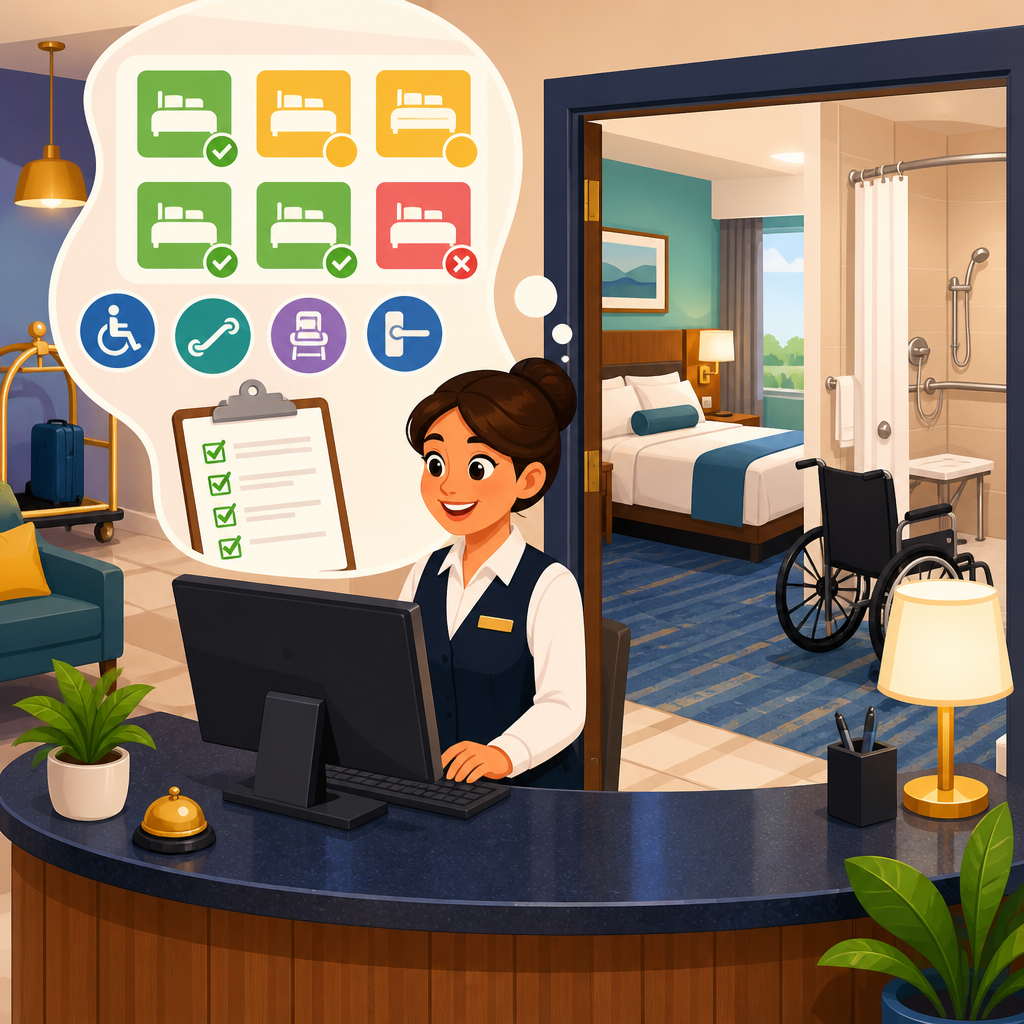
Accessible hotel room inventory is the system a property uses to identify, reserve, protect, and verify rooms with mobility, hearing, and communication features so guests receive exactly what they need at check-in. In hotels and lodging, this is not a narrow operations issue; it sits at the intersection of guest service, legal compliance, revenue management, housekeeping, maintenance, and front desk execution. When accessible inventory is tracked poorly, the failure shows up immediately: a roll-in shower is sold to a guest who does not need it, a hearing-access kit is missing, a connecting accessible room is blocked incorrectly, or an agent moves a reservation during oversell recovery and breaks the promised feature set. I have seen each of these errors create long recovery costs, from refunds and walk situations to chargebacks, bad reviews, and formal complaints.
For hotels, the term accessible room inventory means more than counting how many compliant rooms exist in the building. It means maintaining accurate feature-level data for each room type and each physical room, then controlling how those rooms can be sold, assigned, taken out of order, cleaned, inspected, and returned to service. Key features usually include mobility-accessible layouts, roll-in showers, transfer showers, tub with grab bars, lowered peep holes, wider door clearances, visual alarms, notification devices for door or phone, accessible routes to elevators, and available connecting configurations. The front desk depends on this data, but reservations, revenue, housekeeping, engineering, and digital distribution all shape whether the data stays reliable.
This matters because a guest is not simply buying a bed. They are buying a stay they can physically use safely and independently. In the United States, standards under the Americans with Disabilities Act establish requirements for accessible lodging features and reservation practices, and many jurisdictions add their own rules. Beyond regulation, practical service standards are clear: if your property advertises a room as accessible, the promised feature must exist, function, and remain protected from accidental reassignment. Hotels that do this well reduce operational chaos, support direct bookings, improve review sentiment, and give staff a repeatable method for handling one of the highest-risk room assignment categories in the hotel.
What front desks must track in accessible hotel room inventory
The front desk should track accessible hotel room inventory at two levels: room-type data in the property management system and physical-room verification on property. Room-type data controls what can be sold online, through the brand site, through online travel agencies, and by call center or reservation agents. Physical-room verification confirms that room 214 actually has the listed shower type, bed configuration, communication features, and route conditions. Both matter because many PMS builds are inherited from an opening conversion or a brand template, and I regularly find mismatches between the system description and the actual room.
At minimum, every accessible room record should include the accessibility category, bathing facility type, bed type, maximum occupancy, connecting options, floor and elevator relationship, and communication features. Hotels also need status fields for temporary limitations. If the strobe alarm is awaiting replacement, or the shower seat is loose and the room is out of service for repair, the room should not remain sellable as fully accessible. A generic notes field is not enough. The data has to be structured so a desk agent, reservations team member, and night auditor can all identify the same protected features within seconds.
A common mistake is treating all accessible rooms as interchangeable. They are not. A king mobility room with a tub and grab bars does not solve the needs of a guest requiring a roll-in shower. A hearing-accessible double queen may work for one booking but fail entirely for another if the visual notification device is absent. Front desks should therefore use room feature mapping rather than a single accessible flag. The more precise the map, the lower the chance of a harmful room move later in the stay cycle.
How to protect room features during reservation and assignment
Protection starts before arrival. Reservations should be coded with required features, not just preferences, and those requirements should flow into room assignment logic. If the PMS or central reservation system allows hard blocks, use them for feature-dependent reservations. If it supports room-condition codes, apply them consistently. The rule should be simple: a room with protected accessible features cannot be reassigned to a nondependent reservation while standard inventory remains. This sounds obvious, yet it frequently breaks during compression dates, group arrivals, and housekeeping delays.
Pre-arrival review is the front desk’s control point. By the day before arrival, an agent or rooms controller should audit all reservations requiring accessible features against available clean and inspected inventory. If a conflict appears, resolve it before the guest reaches the desk. Do not wait for check-in to discover that an extended-stay guest in the only roll-in shower room has a late departure while a new arrival needs that exact setup. Good properties escalate these conflicts to the manager on duty, housekeeping, and engineering early, then document the resolution path.
At check-in, agents should confirm the reserved feature in plain language. Instead of saying, “You’re in an accessible room,” say, “I have you in a king mobility-accessible room with a roll-in shower and visual alarm.” That reduces misunderstanding and catches reservation errors immediately. The same discipline applies to room moves. If a guest reports noise or wants a higher floor, the alternative room must match every essential accessible feature first. Service recovery never justifies downgrading accessibility.
System setup, room audits, and cross-department workflows
Accurate accessible hotel room inventory depends on disciplined system setup and repeated physical audits. In practice, the front desk alone cannot maintain this. Revenue management controls room types and restrictions, reservations controls selling descriptions, housekeeping controls room readiness, and engineering controls feature functionality. The best-performing hotels create one source-of-truth inventory file and reconcile it quarterly against the PMS, CRS, brand website descriptions, OTA listings, and an on-property room audit sheet. Without this process, data drift is inevitable.
Physical audits should verify dimensions and fixtures that materially affect guest use, not just whether a room carries an accessible label. Staff should confirm shower entry style, seat condition, handheld shower operation, grab bar security, clearance around beds, reachable thermostat and controls, lower peep hole presence, visual alarm function, door pressure, and accessible route continuity from elevator to room. I advise properties to photograph fixed features during audit cycles and store those records with engineering logs. Photos do not replace compliance inspections, but they help settle internal disputes about what a room actually contains.
Cross-department communication must also cover out-of-order decisions. If engineering takes an accessible room offline, the action should trigger immediate review by front office leadership because the impact is greater than losing a standard room. Likewise, if housekeeping reports a broken shower seat in an occupied accessible room, the hotel should prioritize repair as a same-day safety issue, not a routine preventive task. These workflow distinctions protect guests and limit avoidable liability.
| Inventory control point | What must be tracked | Primary owner | Failure if missed |
|---|---|---|---|
| Reservation setup | Required feature codes, exact room type, arrival notes | Reservations/front desk | Guest booked into wrong accessibility category |
| PMS room profile | Bathing type, bed type, communication devices, connecting status | Front office/revenue | Inaccurate online and desk-level selling information |
| Daily assignment audit | Blocked rooms, arrivals requiring features, departures, out-of-order rooms | Rooms controller/MOD | Last-minute displacement at check-in |
| Housekeeping inspection | Feature cleanliness, furniture placement, route clearance | Housekeeping | Room technically assigned but not usable |
| Engineering verification | Visual alarms, door pressure, grab bars, shower seats, phones | Engineering | Safety and functionality defects |
| Distribution review | Website and OTA descriptions, images, booking rules | Revenue/e-commerce | Mismatched expectations and complaint risk |
Common front desk failures and how hotels can prevent them
The most common failure is feature dilution during high occupancy. A hotel oversells standard kings, notices one unsold accessible king, and upgrades a nondependent guest into it without considering tonight’s late arrival list. Hours later, an arriving guest who needs that room must be walked or placed in a noncompliant alternative. Prevention requires a protection rule in both policy and system logic: accessible rooms remain shielded until all dependent arrivals are checked in or otherwise accommodated with an equivalent feature set.
Another frequent problem is vague language. Staff say “ADA room” as if that phrase explains the room. It does not. Guests need specific, functional descriptions. Is it hearing accessible only? Is there a roll-in shower or transfer shower? Are there two beds or one? Can a wheelchair user navigate both sides of the bed? When language is vague, agents make assumptions, and assumptions become service failures. Training should therefore use feature-based terminology and scenario drills rather than generic compliance talk.
A third failure involves room maintenance and setup drift. Over time, a chair gets added that narrows clearance, the handheld shower mount breaks, the alarm strobe is disconnected during renovation punch work, or storage creeps into an accessible route. None of these changes may appear in the PMS, but each changes the room’s usability. Prevention depends on inspection checklists integrated into preventive maintenance and room release procedures. If the room cannot deliver the advertised feature, it should be removed from sale until corrected.
Technology, standards, and training that strengthen control
The most effective hotels use technology as reinforcement, not as a substitute for judgment. A modern PMS can store feature-level room attributes, assignment restrictions, traces, and out-of-order reasons. Many brands pair this with a centralized CRS and guest profile system so required features follow the reservation from booking to arrival. Some hotels also use business intelligence dashboards to flag when accessible room occupancy by nondependent guests is unusually high, which often signals policy leakage. Tools help, but only if naming conventions are standardized and staff trust the data.
Standards matter because front desks need a defensible operating baseline. In the United States, the ADA reservation rule requires hotels to identify and describe accessible features in enough detail for a guest to assess whether a room meets their needs, and to hold accessible rooms for people with disabilities until other rooms of that type are sold. That principle should shape selling and assignment behavior at every property, whether independent or branded. International operators should also review local accessibility laws and brand standards, since definitions and disclosure duties vary by country and province.
Training should be practical and recurrent. New hires need scripts for clarifying needs without sounding intrusive, guidance on documenting required features correctly, and examples of what not to promise. Experienced agents need refreshers before peak seasons and after system updates. I recommend quarterly drills built around real scenarios: a sold-out night with one roll-in shower room down for repair, a guest requesting a last-minute extension, or a third-party booking arriving with incomplete accessibility notes. Hotels that practice these moments respond calmly when they happen live.
Why this hub matters for hotels and lodging teams
Accessible hotel room inventory touches every major operating discipline in hotels and lodging, which is why it deserves hub-level attention within an industry-specific guide. Front desk leaders need reservation controls. Revenue teams need accurate distribution content. Housekeeping and engineering need room-level inspection standards. General managers need escalation protocols, documentation habits, and an audit trail that shows the property actively protects promised features. When these pieces connect, the result is not just compliance. It is a reliable arrival experience for guests who often face more planning friction than any other traveler segment.
The core takeaway is straightforward: track accessible rooms by exact feature, protect them through the full reservation lifecycle, and verify them physically on a repeatable schedule. Hotels that rely on memory, vague notes, or last-minute desk improvisation will eventually fail a guest at the moment it matters most. Hotels that build precise room data, daily arrival audits, and cross-department ownership create a safer, more trustworthy operation. Review your room profiles, audit your accessible features, and tighten your front desk protection rules now so every promised room is the room the guest actually receives.
Frequently Asked Questions
1. What is accessible hotel room inventory, and why does accurate tracking matter so much at the front desk?
Accessible hotel room inventory is the hotel’s complete system for identifying, coding, reserving, protecting, and verifying guest rooms that include specific accessibility features. That includes mobility-accessible rooms, hearing-accessible rooms, communication-accessible rooms, and combinations of those features. In practice, it means the property must know exactly which rooms have roll-in showers, transfer showers, tub grab bars, lowered peepholes, visual alarms, notification devices, accessible routes, and other features that guests may depend on. For the front desk, this is not just a room assignment detail. It is a core guest service responsibility tied directly to trust, safety, and compliance.
Accurate tracking matters because accessible features are not interchangeable. A guest who needs a roll-in shower cannot simply be moved into a standard room or even another “accessible” room that only has a transfer tub. A guest who relies on visual notification devices may not be adequately served by a room that only meets mobility needs. When inventory is coded vaguely or managed inconsistently, the front desk may accidentally oversell, misassign, or release rooms that should have been protected for guests who reserved them based on those features. The result is immediate operational failure at check-in, often at the exact moment a guest is most vulnerable and least able to absorb mistakes.
Beyond service impact, accessible room inventory affects legal exposure, brand reputation, housekeeping workflows, maintenance priorities, and revenue management discipline. A room can be marked “available” in the PMS, but if a shower seat is broken, the visual alarm is nonfunctional, or furniture placement blocks turning clearance, the room may not truly be available for the guest who booked it. That is why accurate tracking must include not only reservation coding, but also room status verification and feature-level accountability. Front desk teams need confidence that what is sold is what exists, what is blocked is protected, and what is assigned is usable at arrival.
2. Which room features should front desks track individually instead of labeling a room as simply “accessible”?
Front desks should track accessible features at a detailed, room-specific level rather than relying on one generic accessible designation. The word “accessible” is too broad to support accurate reservations or check-in assignments because different guests require different features. At minimum, each accessible room should be coded by accessibility type, such as mobility accessible, hearing accessible, or both. From there, the property should record the actual features present in each room so staff can match reservations to guest needs without guessing.
For mobility access, the most important features to track individually often include roll-in shower versus transfer shower, accessible tub, tub grab bars, shower seat type, handheld shower wand, toilet grab bars, lowered vanity, bed height if relevant to the property standard, wheelchair turning space, accessible route into the room, doorway width, and whether the room is near elevators or on a preferred floor for ease of travel. For hearing and communication access, tracking should include visual fire alarms, visual door knock or doorbell alerts, telephone signalers, closed captioning capability, TTY or similar communication support if used by the property, and any other in-room notification devices.
Hotels should also track details that can affect usability even if they are not always emphasized in reservation descriptions. Examples include whether connecting-room configurations exist, whether furniture can be moved without impairing clear floor space, whether the room has a fixed platform bed or open clearance beneath, and whether any portable accessibility equipment is required for the room to function as promised. The goal is to eliminate ambiguity. A front desk agent should be able to look at one room record and know exactly what the room offers, whether it matches the reservation, and whether any service or maintenance issue has compromised the feature set. That level of specificity reduces mistakes and gives the team a practical way to protect the right inventory for the right guest.
3. How should hotels protect accessible rooms from being reassigned, oversold, or used incorrectly before the guest arrives?
Protecting accessible inventory starts with clear reservation controls and continues through arrival day execution. First, the PMS and CRS must use distinct room types or feature codes that accurately reflect the actual accessibility configuration of each room. Accessible rooms should not be grouped into a broad bucket that allows staff to swap one type for another without noticing the difference. When a guest reserves a room based on accessibility features, that room type must remain attached to the booking through pre-arrival, room blocking, and final assignment. Front desk and revenue teams should avoid practices that treat accessible rooms as general inventory too early in the booking cycle.
Second, hotels need explicit release rules. If the property allows accessible rooms to be sold to guests who do not request them when demand is high, that process should happen only after a documented cutoff and only when the hotel is confident it can still meet any late-arriving accessibility needs. Even then, the hotel should avoid moving an accessible reservation for operational convenience, VIP placement, group balancing, or housekeeping speed. These rooms are not simply alternate room types. They are inventory with a higher duty of protection because guests may have selected the property specifically for those features.
Third, arrival-day controls are critical. Accessible rooms should be preblocked earlier than standard rooms, and the blocked assignment should be reviewed during shift changes, housekeeping updates, and maintenance walks. If an accessible feature becomes unavailable, such as a broken shower seat or nonworking visual alarm, the room should be removed from service for that use until the issue is corrected or an equivalent compliant room is confirmed. Front desk teams also need a clear escalation path so that no one casually reassigns the room during a sellout situation. The strongest hotels use notes, traces, room rack indicators, and manager review to make accessible assignments highly visible. Protection works best when the system, the process, and the staff all reinforce the same rule: do not compromise a room feature a guest specifically reserved.
4. What should front desk staff do if an accessible room is out of order, missing a feature, or was assigned incorrectly?
If an accessible room is out of order, missing a promised feature, or assigned incorrectly, the front desk should treat the issue as an urgent service recovery and compliance matter, not a routine room move. The first step is to verify the exact problem and the exact guest need. Staff should not make assumptions based on the label “accessible.” They need to confirm whether the issue involves a roll-in shower, communication device, grab bars, accessible path, bed clearance, or another critical feature. Once that is clear, the team should immediately search for a room that matches the reserved features exactly, not just a room that is generally similar.
If a suitable room exists on property, it should be reassigned immediately, inspected before the move, and prepared with urgency. If no equivalent room is available, management should be involved at once. The hotel may need to identify options within the property portfolio or nearby lodging while covering the cost difference and transportation as appropriate. What matters most is that the guest is not left to absorb the hotel’s inventory failure. Staff should communicate clearly, respectfully, and without defensiveness. The conversation should focus on resolving the need, not debating whether the room is “close enough.”
After the immediate problem is addressed, the hotel should document the failure at the feature level. Was the issue caused by bad room coding, maintenance breakdown, housekeeping setup, a front desk reassignment, or a distribution system mismatch? Corrective action should follow quickly. That may mean updating room descriptions, retraining staff, revising blocking rules, or adding inspections for accessibility features. Hotels improve accessible inventory protection when they investigate root causes instead of treating each incident as a one-off exception. A misassignment is not just a service lapse; it is a signal that the inventory control process needs stronger safeguards.
5. How can hotels train front desk teams to manage accessible inventory accurately and consistently?
Effective training begins by teaching that accessible inventory is not a courtesy upgrade category and not a generic room pool. Front desk staff need to understand that these rooms contain specific features guests may rely on for bathing, entering the room, receiving emergency alerts, using the bathroom, or communicating safely and independently. Training should explain the differences among mobility, hearing, and communication features, using the hotel’s actual room types and photos whenever possible. Agents should be able to identify what each accessible room includes, what the reservation codes mean, and which substitutions are not acceptable.
Hotels should also train the team on the full operational workflow, not just check-in scripting. That includes how accessible reservations are entered, how room types are protected, how preblocking works, how to read room feature notes, when to escalate a mismatch, and how housekeeping and maintenance affect room readiness. Staff should practice real scenarios such as a sellout night, an out-of-order roll-in shower, a guest whose reserved room was moved by mistake, or a third-party booking that lacks enough detail. Scenario-based training is especially valuable because it helps agents make correct decisions under pressure rather than relying on guesswork at the desk.
Consistency improves when training is supported by tools and accountability. Front desks should use reference sheets, PMS notes standards, shift-check procedures, and manager review of accessible arrivals. Properties should also include accessible feature verification in room inspections and morning meetings so the front office is not working from outdated assumptions. Finally, leadership should reinforce that protecting accessible inventory is


