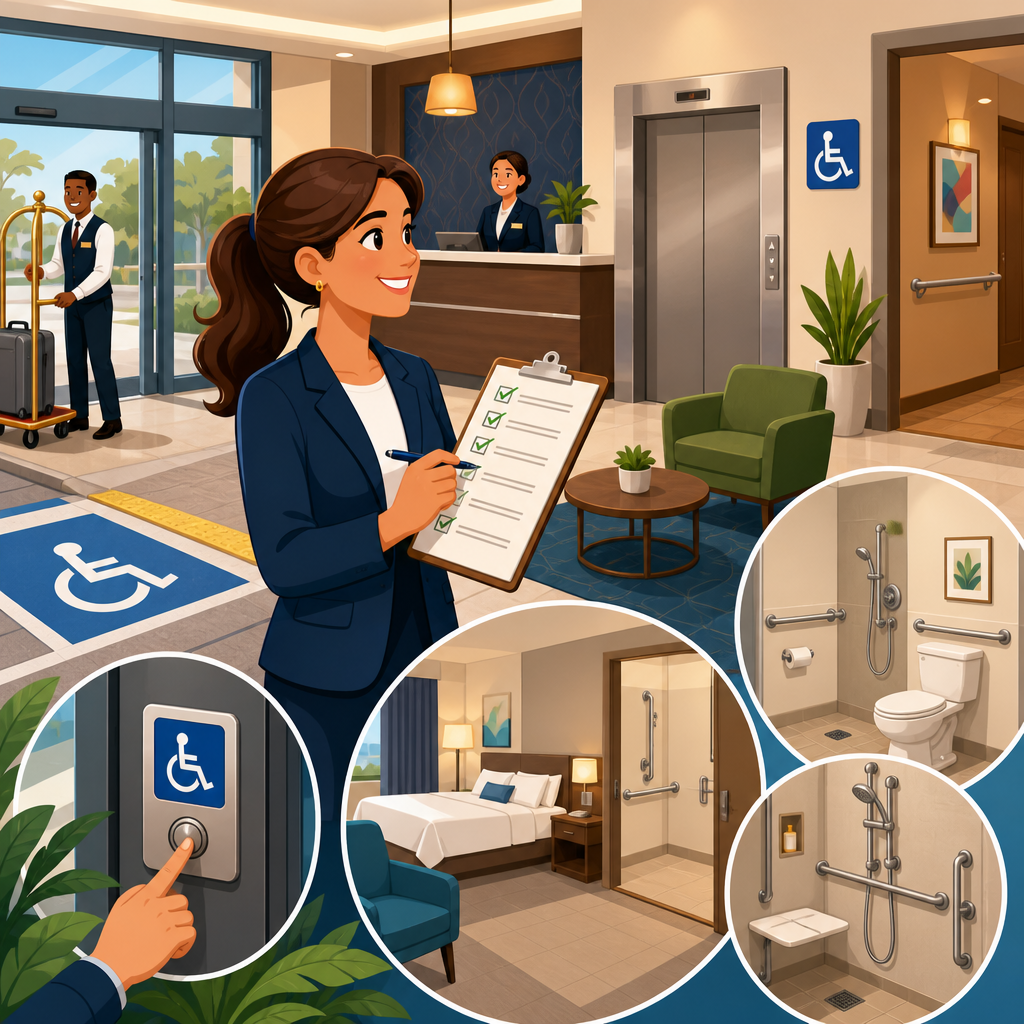
A hotel ADA compliance audit is a structured review of the features, policies, and guest touchpoints that determine whether people with disabilities can access, use, and enjoy a lodging property on an equal basis. For hotels and lodging operators, that means more than checking a few accessible rooms. It includes arrival routes, parking, entrances, front desk design, guest room usability, bathroom clearances, visual alarms, pool access, breakfast areas, websites, reservation systems, and staff practices that affect the guest experience from booking through checkout.
The ADA, or Americans with Disabilities Act, sets the legal framework for public accommodations in the United States, and hotels are directly covered. In practice, most audits rely on the 2010 ADA Standards for Accessible Design, relevant Department of Justice guidance, and, for websites and digital booking paths, widely accepted accessibility benchmarks such as WCAG 2.1. State and local building codes may impose additional obligations, but the ADA is the baseline every operator should understand. A hotel ADA compliance audit is not only a legal exercise; it is a service quality review that reveals whether a guest can independently navigate core hospitality functions.
I have worked through hotel accessibility reviews where the property technically had designated accessible rooms, yet the van parking space lacked proper access aisle markings, the lobby coffee station blocked the route to the elevators, and the online booking engine mislabeled roll-in showers. Those are not minor defects. They are the exact points where a guest’s trip can break down. For independent inns, limited-service brands, resorts, and extended-stay properties alike, guest-facing accessibility failures create complaint risk, lost revenue, poor reviews, and expensive reactive remediation.
This guide serves as a hotels and lodging hub article for industry-specific accessibility work. It explains the 25 guest-facing items to check during a hotel ADA compliance audit, why each item matters, and how to prioritize corrections. The goal is practical clarity. If you manage, own, design, renovate, or audit lodging properties, this page gives you a disciplined framework for reviewing the spaces and systems guests actually use.
How to approach a hotel ADA compliance audit
A strong hotel ADA compliance audit follows the guest journey. Start before arrival with the website, room descriptions, and reservation disclosures. Continue at the property line with parking, passenger loading, exterior routes, and entrances. Then move through the lobby, service counters, elevators, guest rooms, amenity spaces, restrooms, emergency communication features, and checkout. This sequence matters because accessibility failures are cumulative. A compliant guest room does not solve an inaccessible arrival route, and a compliant pool lift does not help if the path to the deck includes steps.
Documentation should combine measurements, photographs, room inventories, policy review, and direct observation of guest use conditions. Measure widths, slopes, clear floor spaces, mounting heights, and turning radii. Confirm whether accessible elements are actually operable, not just installed. I have seen accessible peepholes hidden by decorative plaques, lowered closet rods blocked by luggage racks, and portable shower seats missing on occupied-room turnover days. An audit should identify both fixed-barrier issues and operational failures caused by housekeeping, maintenance, or front office procedures.
Because this article is a hub for hotels and lodging, use the 25-item checklist below as your primary field framework. Then expand into deeper property-specific reviews for guestrooms, pools, transportation, conference facilities, spas, and digital accessibility.
The 25 guest-facing items every hotel should check
| Item | What to verify | Why it matters to guests |
|---|---|---|
| 1. Accessible parking | Correct number, signage, dimensions, access aisles, van space | Arrival begins safely and independently |
| 2. Passenger loading zone | Marked space, curb ramp, accessible route | Critical for valet and ride-share drop-off |
| 3. Exterior accessible route | Stable surface, compliant slope, no abrupt level changes | Connects parking and transit to the entrance |
| 4. Main entrance | Thresholds, door pressure, maneuvering clearance, power door function | First physical point of access |
| 5. Secondary entrances | Side, rear, conference, pool, and restaurant entries | Guests use more than the front door |
| 6. Front desk accessibility | Lowered counter section and clear approach | Enables check-in, payment, and questions |
| 7. Lobby circulation | Furniture placement, queue lines, floor mats, displays | Prevents route obstructions |
| 8. Accessible public restrooms | Stall layout, grab bars, lavatory height, turning space | Essential in all common areas |
| 9. Elevators | Call buttons, audible and visual signals, door timing | Needed for multistory access |
| 10. Interior route to rooms | Hall width, carpeting, door hardware, level changes | Supports independent room access |
| 11. Accessible room inventory | Proper number and distribution by room type | Guests need real choice, not one token room |
| 12. Reservation accuracy | Room features described correctly online and by phone | Prevents failed bookings |
| 13. Guest room entry | Door width, latch side clearance, viewer and hardware heights | Determines whether the room is usable |
| 14. Bed clearances | Space around beds for wheelchair approach | Affects transfers and movement |
| 15. Controls and outlets | Thermostat, switches, drapes, phones, outlets within reach range | Guests must operate room features independently |
| 16. Accessible bathrooms | Tub with seat or roll-in shower, grab bars, clearances | High-risk area for usability failures |
| 17. Communication features | Visual alarms, notification devices, TTY or equivalent options | Supports guests who are deaf or hard of hearing |
| 18. In-room information access | Readable directories, TV captioning, emergency instructions | Information must be accessible too |
| 19. Dining and breakfast areas | Route, seating, buffet reach ranges, service policies | Food service is a core lodging amenity |
| 20. Meeting and event spaces | Routes, seating locations, stages, assistive listening where required | Important for business and social travel |
| 21. Fitness rooms | Route, door width, circulation space, accessible equipment approach | Amenity access influences booking decisions |
| 22. Pools and spas | Lift or sloped entry, route, operating condition | Frequently cited accessibility issue |
| 23. Guest laundry and vending | Route, clear floor space, operable parts, payment access | Extended-stay usability depends on these areas |
| 24. Emergency egress communication | Refuge info, alarms, staff procedures, visual notification | Safety cannot rely on one sensory channel |
| 25. Service animal and assistance policies | Staff training, no-pet-fee handling, practical accommodation steps | Policy errors create immediate discrimination risk |
Arrival, entrances, and front-of-house priorities
The first seven items often generate the highest volume of complaints because they affect every arriving guest. Accessible parking must be correctly counted and configured, including van-accessible spaces with proper vertical clearance where garages are involved. A common hotel issue is restriping during resurfacing that narrows access aisles or removes compliant signage. Another is using accessible spaces for valet staging, which defeats their purpose during peak check-in periods.
Passenger loading zones deserve separate attention. Urban hotels often rely more on curbside drop-off than self-parking, and a compliant parking lot does not fix an inaccessible valet zone. Guests using wheelchairs need a place to deploy a ramp or lift and enter the building via an accessible route without crossing traffic hazards. Exterior routes should be slip-resistant, stable, and free of temporary obstructions such as planters, ash urns, promotional signs, or snow piles.
Main and secondary entrances must be checked under real operating conditions. Revolving doors cannot be the only usable entrance. Power-assist doors must actually function and remain on during service hours. Front desk accessibility is equally important. A lowered transaction surface is not optional if the counter height otherwise excludes seated guests. In practice, I also check whether card readers, registration clipboards, and key packet handoffs can be handled at that accessible section, because staff sometimes default back to the tall counter and erase the benefit.
Guest rooms, bathrooms, and in-room usability
Accessible room inventory is where many hotels misunderstand compliance. It is not enough to have one accessible room at the end of a hallway. The required number depends on total room count, and rooms must include mobility features, communication features, and dispersion among room classes where applicable. If a property offers suites, premium views, or multiple bed configurations, accessible options should not be artificially limited to the least desirable category.
Reservation accuracy is one of the most important hotels and lodging issues because guests make decisions based on described features. A room labeled “accessible” without specifying tub versus roll-in shower, hearing-accessible features, bed type, or transfer space is not sufficient. Major brand systems usually support detailed room attributes, but independent hotels often have third-party booking engines with weak accessibility fields. Audit the property website, brand site, OTAs, and call scripts together, because inconsistency across channels creates preventable booking failures.
Inside the room, entry clearances, bed spacing, reach ranges, bathroom layout, and communication devices determine actual usability. Bathrooms are the most failure-prone area. I routinely find grab bars mounted incorrectly, hand-held shower wands installed without reachable controls, shower thresholds that are too high, or lavatories that lose knee clearance because trash cans or hair dryers were added later. Communication-feature rooms must include visual notification devices and compatible alert systems, and televisions should have closed captioning enabled and easy to activate.
Amenities, dining, digital access, and operations
Hotels are evaluated on the full guest experience, not just sleeping rooms. Dining and breakfast areas need accessible routes, dispersed seating, and buffet layouts that can be used by guests with limited reach. Self-service stations often create hidden barriers: stacked plates placed too high, narrow approach aisles between banquettes, or condiment bars blocked by decorative crates. Where self-service is difficult, staff assistance should be prompt and routine rather than improvised.
Meeting rooms, ballrooms, fitness centers, pools, laundry rooms, and vending areas all belong in a hotel ADA compliance audit because they influence group sales, leisure satisfaction, and length-of-stay value. Pool lifts are a well-known example. A lift that is present but uncharged, covered, or missing its seat belt is functionally inaccessible. Fitness rooms should have enough circulation for a wheelchair user to enter, turn, and approach equipment, even though not every machine itself must be specially adapted.
Digital access now sits alongside physical access. Guests must be able to find accessibility information, book accessible rooms, understand policies, and contact the hotel through accessible digital channels. For hotels and lodging operators, that means reviewing page structure, keyboard navigation, alt text, form labels, color contrast, error identification, and mobile usability. Operationally, staff training closes the gap between design and delivery. Teams should know how to handle service animals properly, communicate accessible features accurately, respond to maintenance outages quickly, and avoid relocating guests who reserved accessible rooms unless the guest agrees.
How to prioritize corrections and maintain compliance
After the audit, classify findings into life safety, access blockers, high-impact usability defects, and administrative issues. Life safety items include alarm notification failures and egress communication gaps. Access blockers include missing curb ramps, inaccessible entrances, unusable bathrooms, and reservation barriers that prevent booking the right room. High-impact usability defects include poor furniture placement, inoperable door openers, or breakfast layouts that require staff intervention every day. Administrative issues include missing signage, weak room descriptions, or outdated policy language. This triage helps owners budget intelligently while reducing risk fast.
Maintenance and renovation planning should incorporate accessibility from the start. Replacing carpet changes maneuvering force. Re-striping parking can trigger dimensional errors. Guest room soft goods refreshes can remove required clearances if oversized furniture is added. The most reliable hotels and lodging programs build periodic audits into preventive maintenance, capital planning, and brand quality assurance reviews. Quarterly walk-throughs for guest-facing items and annual deeper measurements work well for many properties.
The central lesson is simple: a hotel ADA compliance audit should mirror the guest journey and verify the 25 touchpoints that shape real access. When hotels and lodging teams audit accurately, describe features honestly, and maintain accessible elements consistently, they reduce legal exposure and improve hospitality for every traveler. Use this hub as your starting framework, then move property by property, amenity by amenity, and page by page. The best next step is to schedule a documented audit and turn the findings into a timed corrective action plan.
Frequently Asked Questions
What is included in a hotel ADA compliance audit, and why is it more than just checking accessible guest rooms?
A hotel ADA compliance audit is a structured review of the physical features, guest services, and operational practices that affect whether people with disabilities can access and use the property on an equal basis. While accessible guest rooms are an important part of the review, they are only one piece of the overall guest experience. A thorough audit typically looks at the full path a guest takes, from researching the hotel online and making a reservation to arriving on-site, checking in, navigating the property, using amenities, and checking out.
That means the audit often covers accessible parking, passenger loading zones, exterior routes, curb ramps, entrances, lobby circulation, front desk counter height, elevators, signage, guest room doors, maneuvering clearances, bed access, bathroom layouts, roll-in showers or tubs, grab bars, toilet clearances, visual alarms, communication features, and accessible routes to dining areas, pools, fitness centers, meeting rooms, and other common spaces. It also includes digital touchpoints such as website accessibility and whether the reservation system accurately identifies accessible room features.
Just as important, an ADA audit reviews how hotel policies and staff practices support accessibility. For example, staff should understand how to handle room assignments for accessible rooms, communicate with guests who have hearing or vision disabilities, and respond appropriately to requests involving service animals or reasonable accommodations. In short, a hotel ADA compliance audit is not simply a room checklist. It is a guest-facing review of whether the entire lodging experience is accessible, usable, and consistent with ADA expectations.
What are the most important guest-facing items to check during a hotel ADA compliance audit?
The most important guest-facing items are the features and touchpoints that directly affect whether a guest can independently arrive, enter, move through, and use the hotel. In practice, that starts with accessible parking spaces, proper access aisles, compliant signage, and a continuous accessible route from parking or drop-off areas to the main entrance. If a guest cannot safely get from the lot to the front door, the rest of the property’s accessibility becomes much less meaningful.
Inside the hotel, priority items usually include entrance hardware, door widths, threshold heights, lobby circulation space, front desk accessibility, elevator access, accessible public restrooms, and route continuity to key amenities. Guest room reviews should go beyond counting how many accessible rooms exist. Auditors should check door maneuvering space, accessible hardware, bed height and approach space, controls, thermostat reach ranges, clear floor space, bathroom turning space, shower or tub configuration, grab bar placement, sink access, mirror height, and emergency communication features such as visual alarms and notification devices.
Hotels should also closely review amenities that are often overlooked but highly visible to guests, including pool lifts or other compliant pool access, breakfast buffets and seating, business centers, self-service kiosks, meeting spaces, and laundry rooms. On the digital side, accessible booking paths matter because a guest may encounter barriers before ever stepping onto the property. A reservation system should allow guests to identify and reserve accessible room types with enough detail to understand what features are actually provided. The most important items are the ones that affect real-world usability at every stage of the guest journey, not just the items that are easiest to count.
How can hotels evaluate whether their accessible rooms and bathrooms are truly usable for guests with disabilities?
Usability is the key standard. A room can be labeled “accessible,” but if the layout does not allow practical use, the guest experience may still fall short. Hotels should begin by checking whether guests can enter the room easily, move around furniture, approach the bed, access storage, operate environmental controls, and use the bathroom without obstruction. Clear floor space and maneuvering room are essential, especially for wheelchair users who need turning space and approach clearances at doors, beds, desks, and fixtures.
Bathrooms deserve particularly close attention because they often create the biggest functional barriers. A proper audit should verify toilet location and clearance, grab bar placement, sink knee and toe clearance, mirror and accessory heights, faucet operability, and whether the shower or tub configuration matches the room description. In roll-in showers, details such as slope, seat placement, handheld shower controls, and threshold conditions can dramatically affect usability. In tub rooms, transfer access, grab bars, and control placement matter just as much. Even small issues, such as trash cans, shelving, or decorative furniture placed in clear floor space, can make a compliant-looking room difficult to use in practice.
Hotels should also confirm that communication-access rooms include the right features, such as visual alarms, notification devices for the door or phone, and other supports for guests who are deaf or hard of hearing. Operational accuracy matters too. If a room is marketed as accessible, the listed features should be specific and correct. The best approach is to combine measurements, observation, and real-world usability review. In other words, do not just ask whether the room has accessible elements. Ask whether a guest with a disability can use the room safely, comfortably, and with reasonable independence.
Why are the hotel website and reservation system part of an ADA compliance audit?
For many guests, the hotel experience begins online, which is why website accessibility and reservation system functionality are essential parts of a hotel ADA compliance audit. If a guest with a disability cannot navigate the website, read room information with assistive technology, or book an accessible room through the reservation platform, the accessibility failure happens before arrival. That makes digital access a core guest-facing issue, not an optional technical concern.
A hotel website should present content in a way that is usable for people relying on screen readers, keyboard navigation, captions, sufficient color contrast, and clear page structure. Photos, room descriptions, amenity pages, contact forms, and booking steps should all be reviewed. Accessibility problems often appear in third-party booking engines, interactive calendars, map widgets, image-heavy room listings, and unlabeled form fields. These barriers can prevent guests from completing reservations independently or understanding whether the hotel can meet their access needs.
Reservation systems should also provide enough detail about accessible room features so guests can make informed choices. A vague label such as “ADA room” is usually not enough. Guests often need to know whether the room has a roll-in shower or tub, visual alarm, hearing-access features, bed configuration, and accessible route to key amenities. The system should make those features easy to find and should allow accessible room types to be reserved in a reliable, nondiscriminatory way. Including the website and reservation system in the audit helps hotels address one of the most important realities of accessibility: equal access starts long before check-in.
How often should a hotel perform an ADA compliance audit, and who should be involved?
Hotels should treat ADA compliance auditing as an ongoing process rather than a one-time project. A full audit is especially important before opening, after renovations, when acquiring or rebranding a property, or when recurring guest complaints suggest access barriers may exist. Even without a major project, periodic reviews are wise because rooms change, furniture gets replaced, websites are updated, amenities are reconfigured, and staff turnover can affect how accessibility policies are carried out in daily operations.
Many operators benefit from conducting a formal baseline audit and then following up with routine spot checks, annual reviews, or audits tied to capital planning and preventive maintenance programs. High-use guest areas such as entrances, parking, public restrooms, pool areas, breakfast spaces, and accessible guest rooms should be reviewed regularly because minor changes can create major barriers. Something as simple as moving furniture, adding planters, changing counter setups, or storing items in clear floor space can affect accessibility.
The right team usually includes operations leaders, facilities or engineering staff, housekeeping, front office management, revenue or reservations personnel, and web or marketing teams. In many cases, hotels also work with qualified accessibility consultants or legal and design professionals who understand ADA requirements and lodging-specific issues. Staff input is valuable because employees often see recurring problems that drawings and measurements alone will miss. The strongest audits combine technical review with day-to-day operational reality, helping the property identify barriers, prioritize corrections, improve guest service, and reduce compliance risk over time.


