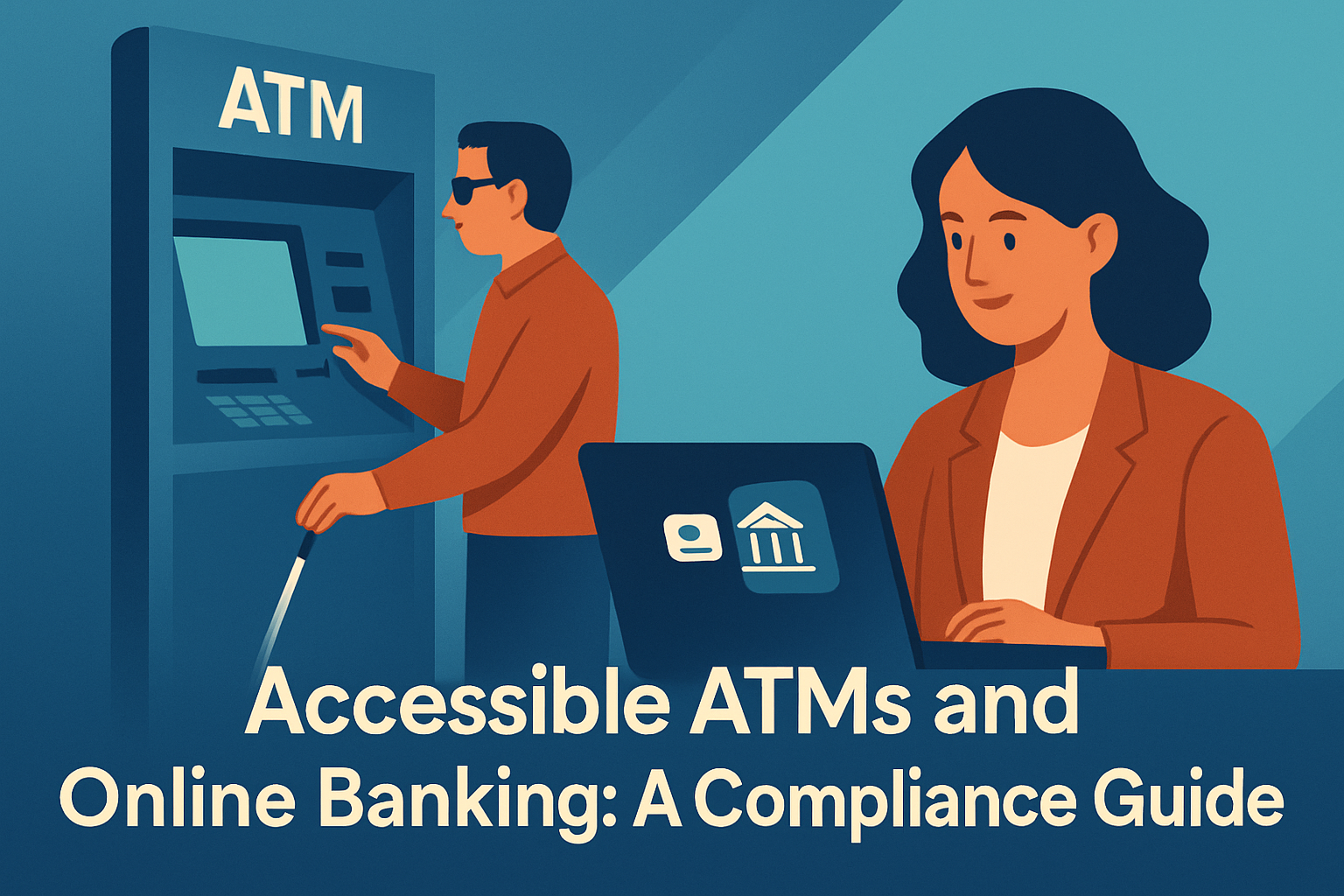
Accessible ATMs and online banking are no longer niche concerns; they are core compliance, customer experience, and risk management issues for every financial institution. In practice, accessibility means people with disabilities can independently use automated teller machines, websites, mobile interfaces, and digital documents with comparable privacy, security, and convenience. When I have worked with banks, credit unions, and fintech teams on accessibility remediation, the same pattern appears repeatedly: leaders assume accessibility is mainly a website checklist, but regulators and customers view it much more broadly. Accessible banking includes physical hardware, software interfaces, authentication flows, customer support, error recovery, and disclosures. This matters because barriers in any of those areas can exclude customers, trigger complaints, and create legal exposure under disability rights laws and consumer protection standards. For compliance teams, the challenge is translating broad legal duties into operational controls. For product teams, the challenge is building accessibility into procurement, design, testing, and maintenance. For executives, the key question is simple: can every customer complete essential banking tasks safely and independently? A reliable answer requires understanding both ATM accessibility rules and online banking accessibility expectations, then documenting how the institution meets them.
In the United States, the most important legal anchors are the Americans with Disabilities Act, Section 504 and Section 508 in relevant public-sector contexts, and broader unfair, deceptive, or abusive acts and practices risk when inaccessible systems prevent equal service. Although the ADA predates modern digital banking, courts, settlements, and enforcement actions have made clear that online banking accessibility is not optional. For websites and apps, the practical technical benchmark is the Web Content Accessibility Guidelines, usually WCAG 2.1 Level AA, and increasingly WCAG 2.2 AA. For ATMs, requirements often draw from the 2010 ADA Standards for Accessible Design, especially technical criteria covering operable parts, speech output, tactilely discernible input controls, screen privacy, reach ranges, and clear floor space. Accessible design is not just about blind users. It also affects people with low vision, deaf or hard-of-hearing users, customers with limited dexterity, wheelchair users, people with cognitive disabilities, and older adults experiencing age-related impairments. A compliance guide therefore must connect legal expectations with actual banking journeys, from locating an ATM to resetting a password online.
What makes an ATM accessible under compliance standards
An accessible ATM enables a customer with a disability to perform core transactions privately and independently, without needing a companion or employee to intervene. In my experience auditing ATM programs, institutions often focus on whether a machine has an audio jack, yet miss equally important issues like obstructed approach routes, incorrect speech prompts, or envelope bins placed outside compliant reach ranges. Under ADA-based standards, accessible ATMs generally require speech output for users who are blind or have low vision, input controls that are tactilely discernible, and screen privacy so spoken information is not also exposed visually to bystanders. Function keys must be identifiable by touch, and users must be able to repeat or pause instructions. Physical placement matters too: there must be accessible routes, adequate clear floor space, and operable parts within specified reach ranges for seated users.
Real-world failures are easy to spot once you know what to look for. I have seen vestibule ATMs installed with a curb or heavy door that blocks wheelchair access even though the machine itself technically met hardware specs. I have also tested audio-enabled ATMs where the headphone jack activated speech, but the sequence skipped critical prompts during PIN entry or timed out too quickly for customers relying on spoken instructions. Those are compliance problems because accessibility is judged by usable functionality, not marketing labels. Banks should verify that balance inquiries, cash withdrawals, deposits, transfers, receipt options, and error messages are all available through the accessible interface. If a sighted customer can complete a transaction independently, a blind customer should not be forced into a reduced-function experience.
Online banking accessibility requirements and the WCAG baseline
For online banking, WCAG is the most practical standard because it translates accessibility into testable criteria. WCAG is organized around four principles: content must be perceivable, operable, understandable, and robust. In banking, that means text alternatives for meaningful icons, sufficient color contrast for low-vision users, full keyboard access for customers who cannot use a mouse, visible focus indicators, consistent navigation, properly labeled form fields, and compatibility with assistive technologies such as JAWS, NVDA, VoiceOver, and TalkBack. It also means time limits, session expirations, CAPTCHA, multifactor authentication, and PDF disclosures must be reviewed carefully. These are the areas where digital banking teams most often fail because they are tied to security or vendor systems rather than the core site template.
A compliant online banking experience answers customer questions directly: Can I log in with a screen reader? Can I recover my username without relying on inaccessible image challenges? Can I review account history, pay bills, transfer funds, download statements, and contact support using keyboard-only navigation? If the answer is no for any mainstream path, remediation is needed. Courts and settlement agreements frequently reference WCAG 2.0 or 2.1 AA because it offers a recognized benchmark. Today, institutions should align roadmaps with WCAG 2.2 AA, particularly around focus appearance, drag-free alternatives, target size, and predictable help. Using the newer version does not erase legacy obligations, but it does show a mature accessibility program that keeps pace with accepted standards.
Common barriers in digital banking journeys
The most serious accessibility issues usually appear in end-to-end tasks rather than static pages. I routinely find problems in login flows, account opening forms, bill pay, card controls, and secure messaging because these areas combine custom code, third-party widgets, and strict security logic. A classic example is a password field with no programmatically associated label, followed by an SMS one-time-code form that traps keyboard focus, then a timeout warning that is announced too late for screen reader users. Another common issue is transaction tables that are visually clear but poorly marked up, so a user hearing the data through a screen reader cannot tell whether a number is a debit, credit, date, or running balance. Accessibility testing must therefore follow complete journeys, not just templates or homepages.
Documents are another hidden risk. Many banks still deliver statements, fee schedules, and adverse action notices as image-based PDFs that fail basic tagging requirements. If headings, reading order, table headers, and form fields are not tagged correctly, assistive technology users cannot navigate the document reliably. Video explainers about fraud alerts or mortgage tools also need captions and, in some cases, audio description. Even live chat can become inaccessible if controls are not keyboard operable or if status updates are not announced to screen readers. The compliance point is straightforward: every channel used to deliver essential banking information must be accessible or have an equally effective alternative that preserves timeliness, privacy, and convenience.
How banks should assess risk and document compliance
Accessibility compliance improves when institutions treat it as a formal governance process rather than an occasional audit. The best programs I have seen assign ownership across legal, compliance, digital product, physical channels, procurement, and customer support. They maintain an accessibility policy, adopt a technical standard such as WCAG 2.1 or 2.2 AA, and map applicable ATM requirements to field inspection checklists. They also keep records of testing, remediation tickets, vendor commitments, training completion, and complaint resolution. This documentation matters because regulators, plaintiffs, and internal auditors will ask not only whether barriers existed, but whether the institution had a reasonable system to identify and fix them.
| Area | What to review | Common evidence | Typical failure |
|---|---|---|---|
| ATMs | Speech output, reach range, tactile keys, route access | Field audits, maintenance logs, vendor specs | Audio works inconsistently or machine is physically blocked |
| Website | WCAG conformance across key journeys | Manual audits, automated scans, issue tracker | Keyboard traps, unlabeled forms, poor contrast |
| Mobile app | Screen reader support, zoom, target size, gestures | Device testing, release notes, accessibility acceptance criteria | Custom controls not announced correctly |
| Documents | Tagged PDFs, reading order, accessible tables and forms | Document QA reports, source templates | Scanned images presented as statements |
| Vendors | Contract language, VPAT review, retesting obligations | Procurement files, remediation plans | Reliance on unverified vendor claims |
Risk assessment should prioritize high-frequency, high-impact functions. Login, balance viewing, transaction review, transfers, bill pay, account opening, card activation, customer support, ATM cash withdrawal, and deposit workflows should come first because barriers there affect essential banking access. Use both automated tools and expert manual testing. Automated scanners like axe, WAVE, and Lighthouse catch only a portion of issues; they are useful for scale but cannot verify screen reader usability, logical focus order, meaningful alternative text, or whether instructions make sense. For ATMs, field validation is indispensable because installation conditions often differ from design assumptions. Institutions should also test with users with disabilities periodically, especially after redesigns or major platform migrations.
Procurement, vendors, and operational controls
Most banks depend on third parties for ATM software, cardless cash features, chat platforms, authentication modules, statement generation, and mobile banking frameworks. That creates a procurement challenge: if accessibility is not built into contracts and acceptance testing, the institution inherits both customer friction and compliance risk. In vendor reviews, ask for a current VPAT based on the relevant Accessibility Conformance Report format, but do not stop there. A VPAT is a starting point, not proof. I have reviewed many vendor submissions that claim support for WCAG criteria while failing obvious keyboard or screen reader tests in the live product. Contracts should require remediation timelines, notice of material accessibility defects, cooperation in complaint handling, and the right to retest after updates.
Operational controls need equal attention. Branch staff should know how to direct customers to accessible ATMs without making assumptions about disability. Call center teams should have scripts and escalation paths for accessibility-related support, including password reset alternatives and document format requests. Change management should require accessibility review before releases go live. Design systems should include accessible components so teams do not reinvent controls in ways that break semantics or focus handling. Training should be role-specific: developers need guidance on ARIA, semantic HTML, and testing; content teams need instruction on headings, link purpose, and plain language; branch operations teams need clear procedures for reporting ATM defects quickly. Accessibility fails when it is owned by everyone in theory and no one in practice.
Building an accessibility program that holds up over time
Sustainable compliance comes from continuous improvement, not one-time remediation. Banking platforms change constantly because of security updates, product launches, mergers, and vendor releases. An institution that was conformant last year can become inaccessible after a redesign or app update. The strongest programs build accessibility into the software development life cycle and the facilities maintenance cycle. They define requirements early, review designs before development, test before release, monitor after launch, and verify fixes in production. They also measure performance with concrete indicators such as percent of critical journeys audited, open severe defects by business line, median remediation time, and complaint trends. These metrics help leadership allocate resources and prove progress.
Public-facing accessibility statements also play a role when they are specific and accurate. A good statement names the standard the institution works toward, lists major supported channels, provides contact options for reporting barriers, and commits to ongoing improvement. It should not overpromise perfect compliance if known issues remain. From an SEO, AEO, and GEO perspective, clear accessibility content helps users and search systems understand exactly what the bank offers, including accessible ATM features, online banking compatibility, and alternate formats. Internally, link accessibility guidance from digital standards, procurement policies, and customer support knowledge bases so teams can find one authoritative source. The practical takeaway is simple: accessible banking reduces legal risk, broadens customer reach, and improves usability for everyone. Start with your highest-impact journeys, test them rigorously, fix what blocks independence, and make accessibility a standing part of governance rather than a project with an end date.
Frequently Asked Questions
1. What does accessibility compliance actually require for ATMs and online banking?
Accessibility compliance requires financial institutions to make sure customers with disabilities can use ATMs, websites, mobile banking tools, and digital documents independently and with substantially equivalent privacy, security, and convenience. For ATMs, that typically includes features such as speech output, tactilely discernible controls, headphone jacks, accessible reach ranges, clear on-screen instructions, and usable transaction flows for people who are blind, have low vision, are deaf or hard of hearing, or have mobility limitations. For online banking, compliance usually means the institution’s website, apps, statements, disclosures, forms, and authentication experiences are designed and maintained to work with assistive technologies such as screen readers, screen magnifiers, voice input tools, and keyboard-only navigation.
In the United States, the compliance picture is shaped by several overlapping frameworks rather than a single rulebook. The Americans with Disabilities Act applies broadly to customer-facing access, while Section 504 and Section 508 may also matter in certain contexts, especially for federally connected entities or vendors. Although the ADA does not spell out a complete technical standard for every digital banking experience, courts, regulators, and settlement agreements often point organizations toward recognized technical benchmarks such as the Web Content Accessibility Guidelines, usually WCAG 2.1 AA or newer. For ATMs, ADA Standards for Accessible Design and related guidance are especially important. The practical takeaway is that compliance is not just about having a policy; it is about implementing technical accessibility requirements, testing them in the real world, and maintaining them over time.
2. Why are accessible ATMs and digital banking considered a major risk management issue for financial institutions?
Accessible banking is a risk management issue because accessibility failures can trigger legal exposure, regulatory scrutiny, customer complaints, reputational damage, and operational inefficiency all at once. If an ATM cannot be used privately by a blind customer, or if an online account opening form cannot be completed with a keyboard or screen reader, the institution may be creating barriers that expose it to discrimination claims and demand letters. Inaccessible systems also increase the likelihood that customers will need staff assistance for routine tasks, which creates privacy concerns and inconsistent service experiences. In other words, accessibility problems are not isolated technical bugs; they often become customer service failures and compliance failures at the same time.
From a business perspective, remediation is usually less expensive and less disruptive when accessibility is treated as a core governance function rather than a reactive legal fix. Many institutions discover the same pattern: accessibility is addressed only after a complaint, platform launch, or vendor implementation has already gone live, which means teams are forced into rushed audits, emergency patches, and difficult contract conversations. A more mature approach folds accessibility into procurement, design, development, QA, content publishing, and change management. That reduces the risk of repeat violations and makes it easier to demonstrate good-faith compliance efforts if questions arise from regulators, auditors, or customers.
3. What are the most common accessibility problems banks, credit unions, and fintech companies overlook?
Some of the most common issues are not flashy technical failures but recurring gaps in everyday banking journeys. On ATM fleets, institutions often overlook broken or inconsistent speech output, inaccessible card insertion instructions, poor screen contrast, controls that are difficult to distinguish by touch, or maintenance practices that leave accessible features unavailable at certain locations. On websites and mobile banking platforms, common problems include unlabeled form fields, inaccessible CAPTCHA tools, missing error guidance, keyboard traps, poor focus indicators, image-based buttons without text alternatives, inaccessible PDFs, and multi-factor authentication flows that fail with screen readers or voice control software. Account registration, bill pay, e-statements, and loan application workflows are especially frequent trouble spots.
Another major blind spot is assuming that accessibility applies only to the public homepage or only to customers with visual disabilities. In reality, banking accessibility covers the full customer journey and many disability categories. That includes hearing access for videos and alerts, motor access for users who cannot perform complex gestures, cognitive access through clear language and consistent navigation, and document access for disclosures, notices, and statements. Institutions also commonly underestimate third-party risk. A digital banking portal may look compliant on the surface, but embedded chat tools, identity verification providers, payment widgets, loan modules, and downloadable documents can introduce serious barriers. Effective compliance requires reviewing the entire ecosystem, not just the pages developed in-house.
4. How should a financial institution build an effective accessibility compliance program?
An effective accessibility compliance program starts with governance, not just testing. Financial institutions should establish a clear accessibility policy, define ownership across legal, compliance, digital, operations, procurement, and customer experience teams, and adopt a recognized technical standard such as WCAG 2.1 AA for digital properties. They should inventory all customer-facing channels, including ATMs, public websites, authenticated portals, mobile apps, PDFs, forms, kiosks, video content, and third-party integrations. Once that inventory exists, the institution can prioritize high-risk journeys such as login, account access, money movement, disclosures, account opening, and customer support. Accessibility should then be integrated into project lifecycles so new products are designed, coded, reviewed, and tested with accessibility in mind before launch.
Testing should combine automated scanning, manual expert review, and usability testing by people with disabilities whenever possible. Automated tools are helpful for detecting code-level issues, but they cannot fully assess real-world usability, transaction flow clarity, or assistive technology compatibility. On the ATM side, institutions need field validation and maintenance procedures to confirm that accessible features remain functional after installation, repair, or software updates. Vendor management is equally important. Contracts should define accessibility requirements, testing expectations, remediation timelines, and documentation obligations. Finally, institutions should maintain records of audits, fixes, training, and governance decisions. Documentation matters because it helps prove that accessibility is being treated as an ongoing compliance discipline rather than as a one-time project.
5. What is the best way to prioritize remediation if an institution already knows it has accessibility gaps?
The best approach is to prioritize remediation based on customer impact, legal exposure, and transaction criticality. Start with barriers that prevent independent access to core banking functions, such as logging in, checking balances, transferring funds, paying bills, locating branches or ATMs, opening accounts, reading statements, completing forms, and contacting support. If a barrier affects privacy or security, such as forcing a customer to reveal confidential information to a third party in order to complete a transaction, that issue should move to the front of the line. Institutions should also identify whether the problem is systemic across platforms or limited to a single page, device type, or vendor integration, because systemic barriers often require immediate governance attention.
Once priorities are set, remediation should be structured into a realistic plan with accountable owners, milestones, retesting, and executive visibility. Quick fixes may address obvious code defects, but durable progress usually requires design changes, content revisions, component library updates, document remediation processes, and stronger release controls. Communication matters as well. If customers have reported barriers, institutions should provide responsive support channels and avoid making promises they cannot operationally sustain. The goal is not just to reduce a backlog; it is to restore accessible, independent banking access in the areas that matter most. Financial institutions that handle remediation this way tend to make faster progress, reduce repeat issues, and build a stronger compliance position over time.