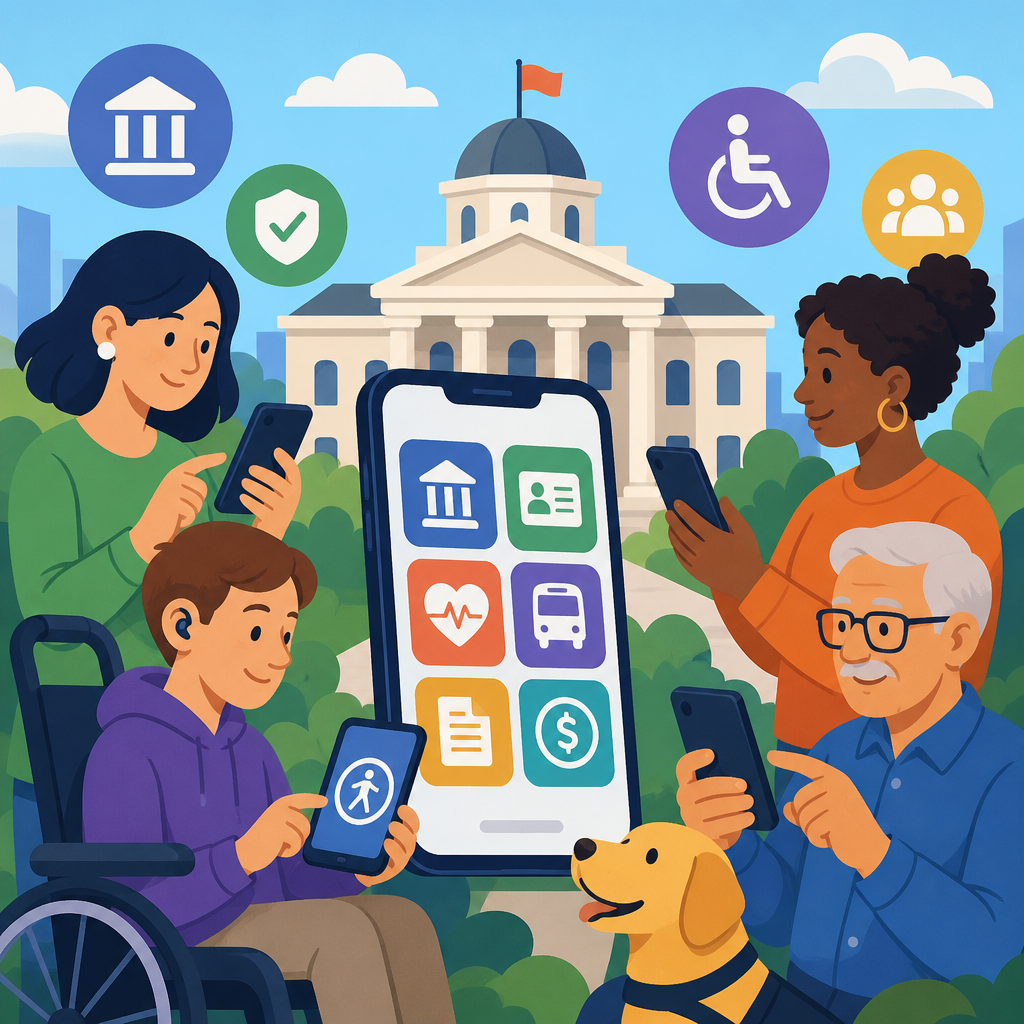
Accessible mobile apps and government services are moving to the center of disability law because daily life now depends on phones, portals, kiosks, and digital forms as much as buildings and sidewalks. In recent years, I have seen organizations treat app accessibility as a technical afterthought, only to discover that courts, regulators, and disabled users view it as a core civil rights issue. The Americans with Disabilities Act, Section 504 of the Rehabilitation Act, and related state laws increasingly shape how public entities and contractors design mobile experiences, authenticate users, deliver benefits, and communicate with residents.
In this context, accessible means that people with disabilities can perceive, operate, understand, and robustly use digital services with assistive technology such as VoiceOver, TalkBack, screen magnifiers, switch controls, captions, and speech input. Mobile apps are software installed on smartphones or tablets; government services include everything from unemployment claims and Medicaid renewals to transit alerts, court payments, emergency messaging, and digital identification. Cases to watch on accessible mobile apps and government services matter because they test whether longstanding disability principles apply cleanly to newer channels, especially when agencies rely on vendors, app stores, multifactor authentication, geolocation, and rapidly updated interfaces.
This hub article explains the emerging challenges and recent ADA legal developments that define the current landscape. It focuses on the legal theories plaintiffs are using, the compliance benchmarks agencies are adopting, and the practical facts that often decide disputes. It also serves as a gateway for deeper analysis across the broader legal cases and precedents topic: website accessibility litigation, effective communication claims, procurement obligations, digital document remediation, kiosk cases, and enforcement actions involving public accommodations and public entities. If you need a grounded overview of where mobile and government accessibility law is heading, these are the patterns worth tracking now.
Why accessible mobile apps are becoming a litigation priority
Mobile accessibility cases are rising because many services are mobile first, and in some communities they are effectively mobile only. A city may publish transit updates through an app before updating its website. A state benefits agency may push identity verification to a smartphone camera workflow. A court system may route reminders, filing alerts, and payment confirmations through mobile notifications or SMS linked to an app account. When these pathways fail for blind users, deaf users, people with limited manual dexterity, or users with cognitive disabilities, the barrier is immediate and often total.
From a legal standpoint, mobile app cases build on familiar accessibility concepts but introduce facts courts are still sorting out. Plaintiffs typically argue that inaccessible labels, gesture-only controls, time-limited forms, unreadable PDFs inside apps, missing captions, poor color contrast, or CAPTCHA and biometric verification barriers deny equal access to a program or service. Defendants often respond that alternatives exist through call centers or in-person offices, but that argument weakens when the digital channel is the primary route, when offices are distant, or when phone support cannot independently complete the task. The trend to watch is that equal access is judged in practical, not theoretical, terms.
Government services face a higher and clearer duty
Government entities face especially strong expectations because disability law has long required meaningful access to public programs. Title II of the ADA covers state and local governments, while Section 504 applies to entities receiving federal financial assistance. Those frameworks do not just prohibit obvious exclusion; they require public services to be delivered in a way that people with disabilities can use with substantially equivalent ease, privacy, timeliness, and independence. In my experience reviewing public sector digital programs, the strongest claims often arise where an agency provides a nominal alternative that strips away one or more of those elements.
A major recent development is the Department of Justice rule establishing specific technical expectations for web content and mobile apps of state and local governments. The rule adopts WCAG 2.1 Level AA as the operative benchmark, with limited exceptions, and it confirms what accessibility practitioners have argued for years: digital public services are not optional conveniences but part of the government service itself. This matters in litigation because plaintiffs no longer need to argue only from broad nondiscrimination principles. They can point to a recognized technical standard that courts, procurement teams, auditors, and vendors understand.
What issues courts and regulators are likely to scrutinize next
The next wave of disputes will focus less on whether digital access matters and more on how far accessibility obligations reach across integrated systems. A mobile app rarely stands alone. It may embed third party chat, maps, payment processors, identity proofing, document viewers, and video platforms. Agencies often assume vendors carry the accessibility burden, yet users experience one end to end service. Courts and investigators increasingly look at the complete transaction path, asking whether a disabled person can register, authenticate, submit information, receive confirmation, and retrieve records without hitting a dead end.
Several recurring friction points deserve close attention because they create the fact patterns most likely to produce influential precedent.
| Issue | Why it creates legal risk | Common example in government services |
|---|---|---|
| Identity verification | Biometric or camera workflows may exclude blind users and people with dexterity limitations | ID scan required to access benefits account |
| Time limits | Short sessions can block users relying on screen readers or voice input | Tax filing form logs out before submission |
| Uncaptioned media | Misses effective communication obligations for deaf users | Emergency briefing videos in an app |
| Document access | Tagged PDF failures make essential notices unreadable | Eligibility letters delivered only as image PDFs |
| Third party components | Agencies remain responsible for the service they offer to the public | Payment gateway inaccessible to keyboard users |
Cases involving effective communication and equal participation
One reason accessible mobile apps and government services are important cases to watch is that they increasingly blend technical accessibility with classic effective communication claims. A blind resident who cannot complete a permit renewal because form fields are unlabeled is not merely facing bad coding; that resident is being denied intelligible communication from the agency. A deaf parent who receives emergency updates only through uncaptioned in-app video is similarly blocked from timely information. These facts can support claims about equal participation, not just software defects.
Courts often respond well to narratives that connect technical barriers to concrete civic consequences. Missing alt text sounds abstract until it prevents a user from understanding whether a ballot cure notice requires action. Inaccessible push alerts seem minor until they withhold evacuation instructions during a wildfire or hurricane. Cases with strong records usually document the failed steps, the assistive technology used, the attempts to get help, and the real world impact of delay, privacy loss, or missed deadlines. That evidence turns a debugging problem into a civil rights record.
Vendor responsibility, procurement, and shared liability
Many public entities now depend on outside software vendors for mobile development, hosting, chatbots, authentication, and document generation. That outsourcing does not eliminate legal exposure. When I have audited government technology contracts, the most common weakness is boilerplate accessibility language without measurable acceptance criteria, testing rights, remediation timelines, indemnity terms, or requirements for a current VPAT based on WCAG and applicable procurement standards. If litigation expands, courts will likely examine not only the app itself but also whether the agency exercised reasonable diligence before deployment.
This is where procurement law and disability law intersect. A city that buys an inaccessible inspection app may still be responsible to residents under Title II, even if the coding defect originated with a contractor. At the same time, disputes between agencies and vendors can reshape the market by forcing stronger warranties, audit rights, and conformance testing. The practical takeaway is straightforward: future leading cases may not only decide user rights, they may influence contract architecture across public sector technology procurement.
Authentication, security, and privacy as emerging accessibility flashpoints
Security features are becoming some of the hardest accessibility issues in mobile government services. Agencies must protect sensitive records, but they also must avoid security designs that function as exclusionary barriers. Facial matching, liveness detection, drag and drop puzzles, rotating image CAPTCHA, timeout driven verification, and one device assumptions can all break for users with disabilities. The legal question is rarely whether security matters. It is whether the chosen method is necessary, whether an accessible equivalent exists, and whether the alternative preserves privacy and independence.
For example, requiring a blind applicant to call an agent and disclose personal information because the app-based identity flow cannot be completed with a screen reader may undermine confidentiality compared with the self-service path available to others. Likewise, forcing a user with limited dexterity into repeated failed attempts can trigger lockouts and missed deadlines. Expect future ADA legal developments in this area to revolve around balancing fraud prevention with accessible design patterns such as passkeys, accessible one-time code entry, and human review paths that do not stigmatize the user.
What standards and evidence make these cases stronger
Although lawsuits are fact specific, the strongest accessible mobile apps cases usually align legal theory with recognized technical benchmarks and disciplined evidence collection. WCAG 2.1 Level AA is now central for state and local government digital content, and mobile specific success criteria often implicated include focus order, name, role, value, orientation, reflow, status messages, and input assistance. Testing that combines automated scans with manual review on iOS and Android, using VoiceOver and TalkBack, tends to be far more persuasive than screenshots alone.
Plaintiffs and agencies alike should also pay attention to records outside the codebase. User complaints, support tickets, app store reviews, procurement files, accessibility statements, remediation roadmaps, and training records can all shape liability and remedy. A defendant that ignored repeated reports looks very different from one that documented testing, prioritized fixes, and offered prompt accessible workarounds while remediating. In other words, recent ADA legal developments are not just about standards adoption; they are about operational maturity and whether an organization treated accessibility as a continuing duty.
How this hub connects to the broader legal cases and precedents landscape
As a sub-pillar under legal cases and precedents, this page sits at the intersection of several related topics. Accessible mobile apps cannot be separated from website accessibility because many services move users between browsers, embedded web views, and native app screens. Government services cases also overlap with digital forms, PDF accessibility, online learning, telehealth, election access, transportation systems, and public meeting technology. Readers following this hub should watch for decisions that clarify how remedies are framed, what standing evidence is sufficient, and how courts treat rapidly updated platforms.
They should also monitor enforcement activity, not only published opinions. Department of Justice settlements, Office for Civil Rights resolutions, state attorney general actions, and structured negotiation agreements often shape real practice faster than appellate decisions do. These agreements commonly require audits, user testing with people with disabilities, designated coordinators, training, procurement reform, and deadlines for mobile and web remediation. For practitioners, those details are valuable because they show what compliance looks like when abstract legal obligations are translated into implementation plans.
Cases to watch on accessible mobile apps and government services reveal where disability law is heading in a digital public sphere. The central lesson is simple: when agencies deliver benefits, alerts, payments, records, and civic participation through mobile tools, accessibility is part of lawful service delivery, not a peripheral feature. Recent ADA legal developments, especially the move toward explicit technical standards for public entities, give courts and regulators a clearer framework for judging barriers involving authentication, documents, media, third party components, and end to end transaction flows.
For public agencies, contractors, advocates, and legal teams, the most effective response is proactive. Audit mobile apps and connected services against WCAG 2.1 AA, test with assistive technology on real devices, tighten procurement language, and document remediation before complaints mature into litigation. For readers using this article as a hub, the next step is to explore the connected topics within legal cases and precedents, including website claims, vendor liability, effective communication, and digital document access. The organizations that act now will reduce legal risk while delivering government services that more people can actually use.
Frequently Asked Questions
Why are accessible mobile apps and government digital services becoming such important legal issues?
Accessible mobile apps and government digital services are now central legal issues because so many essential activities happen through phones, websites, portals, kiosks, and online forms rather than in person. People apply for benefits, renew licenses, pay taxes, request accommodations, schedule appointments, review notices, and communicate with agencies through digital systems that function as the modern doorway to public life. When those systems are not accessible to people with disabilities, the barrier is not merely inconvenient; it can block access to rights, services, and opportunities in the same way a staircase can block entry to a public building.
That shift matters under disability law because statutes such as the Americans with Disabilities Act and Section 504 of the Rehabilitation Act are designed to ensure equal access to programs, services, and public accommodations. Courts and regulators increasingly recognize that equal access cannot be limited to physical spaces when government operations and consumer interactions have moved online and onto mobile devices. If a public entity or covered organization offers key services through an app or portal, accessibility is no longer a technical enhancement or customer service preference. It is increasingly treated as part of the organization’s basic legal obligation to provide meaningful access.
The practical reason these cases are worth watching is that they help define how old civil rights principles apply to new technology. Litigation and enforcement actions are testing questions such as whether an app is covered in the same way as a website, what level of accessibility is expected, how quickly defects must be corrected, and what organizations must do to prevent recurring barriers. As a result, these disputes are shaping compliance expectations for agencies, contractors, healthcare providers, schools, transit systems, and private businesses that interact with the public through digital platforms.
What kinds of cases should readers watch in this area?
Readers should pay attention to cases involving inaccessible government portals, mobile applications used to access public services, and digital tools that act as gatekeepers for essential benefits or programs. That includes lawsuits and investigations involving unemployment systems, Medicaid or public benefits portals, online court services, voting information tools, transportation apps, public university systems, municipal payment platforms, and digital intake or scheduling systems. If a service is required for participation in civic life, it is a strong candidate for future accessibility scrutiny.
It is also important to watch cases involving mobile-specific barriers rather than only traditional website claims. Many organizations have improved desktop websites while overlooking their iOS and Android apps, responsive mobile versions, in-app document readers, biometric login tools, chat functions, and third-party payment or identity verification features. Cases in these areas often reveal that accessibility problems do not disappear when an organization adopts a mobile-first strategy. In fact, they may multiply if accessibility testing is not built into product development from the start.
Another category to watch includes enforcement actions and regulatory developments, not just courtroom opinions. Settlement agreements, consent decrees, agency guidance, and Department of Justice activity often have outsized influence because they set practical expectations about timelines, testing, training, procurement, user feedback, and conformance standards. In many situations, the most significant developments do not come from a final appellate ruling but from detailed resolutions that require organizations to audit systems, remediate barriers, appoint accessibility coordinators, and monitor compliance over time.
Finally, readers should watch cases that involve integrated systems, such as kiosks linked to mobile apps, online forms that generate inaccessible PDFs, or portals run by outside vendors on behalf of public agencies. These disputes are especially important because they address a common real-world problem: access failures often arise not from one isolated product but from an entire digital service chain. The legal takeaway from these cases is frequently that an organization cannot avoid responsibility simply because a vendor built the app or because one inaccessible step appears in a larger process.
How do the ADA and Section 504 apply to mobile apps and government services?
The ADA and Section 504 both play major roles, but they do so in somewhat different ways. Title II of the ADA generally applies to state and local governments and requires public entities to provide people with disabilities equal access to programs, services, and activities. Section 504 applies to recipients of federal financial assistance and also prohibits disability discrimination, often overlapping with ADA obligations for public agencies, universities, healthcare systems, and other institutions that receive federal funds. When a government service is offered through an app, portal, or digital form, the core question is whether people with disabilities can access and use that service in a manner that is as effective and meaningful as it is for others.
In practice, this means accessibility is not limited to whether some alternative method exists somewhere in theory. An agency may not satisfy its obligations by pointing to a phone line with limited hours if the general public can access services instantly through an app at any time. Nor is it enough if only portions of a digital workflow are accessible. If a user can log in but cannot complete identity verification, upload documents, read notices, or submit forms with assistive technology, meaningful access may still be lacking. Courts and regulators often look at the entire user journey rather than isolated screens.
For private companies, the legal analysis may also involve Title III of the ADA, particularly when a mobile app connects users to goods, services, or locations offered by a business open to the public. State disability laws can expand exposure further, sometimes allowing broader remedies or easier claims. Because legal standards can vary by jurisdiction and facts matter, organizations should not assume that accessibility risk depends on one narrow rule. The overall trend is toward treating digital accessibility as part of mainstream civil rights compliance, especially where the technology is essential to obtaining public or commercial services.
Many organizations use technical standards such as the Web Content Accessibility Guidelines as the benchmark for evaluating accessibility, even when statutes do not name a single standard in every context. That is why legal disputes often turn on familiar issues such as screen reader compatibility, keyboard navigation, color contrast, captions, form labels, focus order, error identification, and accessible authentication. The law speaks in terms of equal access and non-discrimination, but the evidence in a case often comes from these very practical usability barriers.
What accessibility problems most often trigger lawsuits or enforcement actions involving apps and public services?
The most common triggers are barriers that prevent users with disabilities from independently completing important tasks. For blind and low-vision users, that often includes unlabeled buttons, missing form instructions, images without meaningful text alternatives, pop-ups that are not announced by screen readers, inaccessible CAPTCHA or identity verification tools, and poor focus management that makes navigation confusing or impossible. For users with limited dexterity, problems frequently include touch targets that are too small, features that require complex gestures without alternatives, interfaces that cannot be used with external keyboards or switch devices, and time limits that cannot be adjusted.
For deaf or hard-of-hearing users, enforcement issues often involve missing captions, inaccurate captions, videos without transcripts, or audio-based instructions that are not provided in a visual format. People with cognitive disabilities may face barriers caused by cluttered layouts, inconsistent navigation, vague error messages, or complicated multi-step workflows that offer little guidance. In government systems especially, inaccessible PDFs, scanned notices, and document upload requirements can be major problems because they affect legal deadlines, benefits eligibility, and the ability to respond to agency actions.
A major source of risk is the mismatch between an organization’s formal accessibility statement and the actual user experience. Many entities publish broad commitments to inclusion but fail to test real-world flows such as account creation, password resets, document submission, payment processing, appointment scheduling, or appeals. Claims often arise when the service appears accessible at a surface level yet breaks down at critical moments. From a legal and operational standpoint, those failures are exactly what make a system discriminatory: the user can enter the process but cannot finish it on equal terms.
Another recurring issue is overreliance on third-party tools. Government agencies and businesses often integrate payment vendors, chatbot platforms, mapping features, e-signature tools, or identity proofing services into their apps and portals. If those third-party components are inaccessible, users still experience the barrier as part of the agency’s or company’s service. That is why procurement, contract language, vendor testing, and ongoing monitoring are becoming central topics in accessibility cases and settlements.
What should organizations do now if they want to reduce legal risk and improve accessibility?
Organizations should start by treating accessibility as a governance and civil rights issue, not just a developer task. That means assigning clear responsibility, adopting a written digital accessibility policy, setting measurable standards, and ensuring leadership oversight. Accessibility should be built into design, procurement, content creation, quality assurance, and release management. If mobile apps and digital government services are critical to public access, then accessibility belongs in the same risk category as privacy, security, and records compliance.
The next step is to perform a serious accessibility review of actual user flows, not just a homepage scan or automated test. Automated tools are useful, but they do not catch everything. Organizations should combine manual testing, assistive technology testing, and user-centered review of high-impact transactions such as registration, login, form completion, document access, scheduling, payment, and appeals or complaint procedures. It is especially important to test on the devices and platforms people really use, including both major mobile operating systems and any native app features unique to each one.
Procurement and vendor management are equally important. If an organization relies on third-party products, it should require accessibility commitments in contracts,


