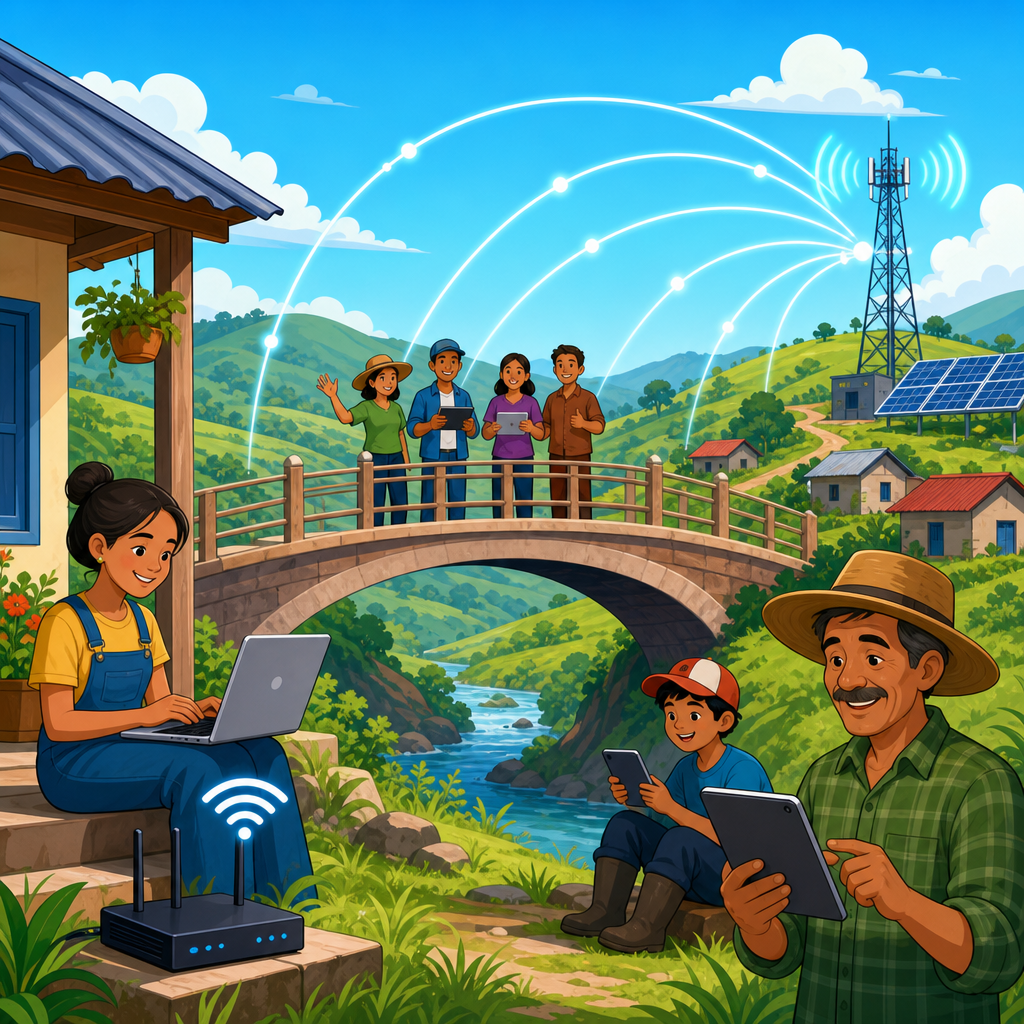
Bridging the digital divide in rural areas is no longer a niche policy issue; it is a defining challenge for economic opportunity, healthcare access, education quality, and civic participation. In practical terms, the digital divide is the gap between people who have reliable access to modern information and communication technologies and those who do not. In rural communities, that gap is shaped by geography, infrastructure costs, lower population density, aging networks, affordability barriers, and gaps in digital skills. When accessibility is added to the conversation, the challenge becomes broader and more urgent: technology must not only reach rural residents, it must work for older adults, people with disabilities, low-income households, multilingual users, and anyone navigating limited bandwidth or outdated devices.
I have worked on digital accessibility and technology adoption projects where the biggest lesson was simple: access is never just about a connection. A family may technically have internet service, yet still be excluded if speeds are too slow for telehealth, if a school-issued app fails on low-cost phones, if a government form is unreadable by screen readers, or if a farm worker cannot use a service because it assumes constant broadband coverage. Rural accessibility means designing for real conditions, including intermittent service, shared devices, long travel distances, and limited technical support. It also means understanding that future-ready technology must be resilient, inclusive, and practical from the start rather than retrofitted after deployment.
This hub article examines the future of technology and accessibility through the rural lens. It covers infrastructure, devices, inclusive design, education, healthcare, agriculture, public services, funding models, and the metrics organizations should track. It matters because rural areas are home to major parts of the workforce, food systems, energy production, and cultural life. According to the World Bank and the International Telecommunication Union, meaningful connectivity increasingly determines whether communities can participate in modern economies. The future of accessible technology in rural areas will depend on combining broadband expansion with universal design, affordable hardware, accessible software, community training, and policy frameworks that reward long-term inclusion rather than short-term deployment numbers.
Why rural digital accessibility requires a different strategy
Rural technology planning fails when it assumes that solutions built for cities will scale neatly into remote regions. The economics are different. Extending fiber across sparsely populated terrain costs more per household, while maintaining towers or backhaul links can be harder because of weather, distance, and power reliability. Users are also different. Rural populations often include larger shares of older adults, veterans, agricultural workers, and people who depend on public institutions such as libraries, schools, clinics, and extension offices for internet access and technical assistance. In many projects I have seen, adoption rose only after support was routed through trusted community anchors rather than through generic provider marketing.
Accessibility in rural settings must be interpreted broadly. The Web Content Accessibility Guidelines, or WCAG, remain essential for digital products, but compliance alone is not enough. A website can technically meet accessibility criteria and still be unusable on a weak mobile connection or impossible to navigate on an entry-level Android device with limited storage. Rural inclusion requires low-bandwidth design, offline capability, language clarity, captioned media, keyboard navigation, compatible assistive technology support, and interfaces that minimize data consumption. It also requires customer service that works by phone, text, and in person, because chatbots and app-only workflows can exclude people with poor connectivity or low digital confidence.
The future will reward organizations that treat accessibility as a systems issue. Broadband providers, software vendors, public agencies, schools, and healthcare networks have to coordinate decisions instead of operating in silos. If a county upgrades fiber to anchor institutions but local residents still cannot afford devices, the divide remains. If a telehealth platform supports captions but not interpreter workflows or screen reader landmarks, many patients are still blocked. Real progress happens when infrastructure, service design, procurement standards, and training programs align around the same outcome: every resident can access essential digital services independently and with dignity.
Infrastructure that supports inclusive access
The first building block is robust connectivity, but rural areas need a mix of technologies rather than a single winner. Fiber offers the highest long-term capacity and reliability, making it the strongest option for towns, schools, hospitals, and business corridors. Fixed wireless can serve scattered homes more quickly when terrain and line of sight cooperate. Low Earth orbit satellite services have improved rural coverage, especially in extremely remote areas, though latency, equipment cost, weather sensitivity, and monthly pricing still matter. In practice, resilient rural networks are usually hybrid systems that combine fiber backbones, middle-mile investments, wireless last-mile links, and public Wi-Fi access points at community anchors.
Accessibility considerations should be built into infrastructure choices. Backup power matters for users who rely on connected medical devices. Network management should prioritize stability for video consultations, remote learning, and emergency communications. Public funding programs increasingly recognize this. In the United States, the Broadband Equity, Access, and Deployment program emphasizes both expansion and adoption, while the FCC’s rural initiatives and E-Rate framework support schools and libraries that often function as digital lifelines. Globally, universal service funds, community networks, and municipal partnerships are helping fill gaps where major commercial returns are weak. The core principle is clear: accessible technology starts with dependable service that reaches the people most likely to be left out.
| Technology option | Best rural use case | Accessibility strengths | Key limitations |
|---|---|---|---|
| Fiber broadband | Towns, anchor institutions, dense corridors | High speed, low latency, strong support for telehealth and assistive tools | High build cost, slower deployment in remote terrain |
| Fixed wireless | Scattered homes within tower range | Faster rollout, useful where trenching is expensive | Line-of-sight issues, variable performance in bad weather |
| Low Earth orbit satellite | Very remote locations | Extends access where terrestrial networks are absent | Equipment cost, congestion risk, weather effects |
| Community Wi-Fi | Libraries, schools, clinics, town centers | Shared access point for low-income users and visitors | Limited privacy, not a full substitute for home broadband |
Devices, software, and design choices that make access usable
Connectivity alone does not guarantee participation. Many rural households depend on older smartphones, refurbished laptops, or one shared family computer. That reality changes how digital services should be built. Lightweight websites, progressive web apps, downloadable forms, and offline synchronization features make a measurable difference. So do practical accessibility basics: sufficient color contrast, clear heading structure, form labels, error prevention, alt text, resizable text, and captioned video. These are not cosmetic improvements. They reduce abandonment, lower support costs, and help all users, especially when screens are small and connections are unstable.
Assistive technology compatibility deserves early testing, not a final-stage check. Screen readers such as JAWS, NVDA, and VoiceOver remain essential for blind and low-vision users. Speech recognition tools, switch devices, screen magnifiers, hearing aid-compatible audio systems, and plain-language content also matter in rural communities, where access to specialist support may be limited. I have seen agencies invest heavily in new portals while overlooking something basic, such as inaccessible PDF forms or unlabeled buttons in a mobile app, which forced residents to drive miles to complete tasks in person. The future of accessible technology depends on preventing those avoidable barriers through procurement requirements, usability testing with disabled users, and continuous monitoring after launch.
Artificial intelligence will shape this next phase, but only if deployed carefully. AI-generated captions, translation, voice interfaces, and document summaries can expand reach quickly. At the same time, automated tools still miss context, dialect variation, and disability-specific needs. Rural deployments should treat AI as assisted access, not a replacement for human review. The strongest model is layered support: standards-based design, tested assistive compatibility, low-bandwidth performance, and AI features that enhance rather than determine the user experience.
How accessible technology is changing education, healthcare, and agriculture
Education is one of the clearest examples of why rural accessibility matters. During the pandemic, many districts discovered that assigning digital coursework was not the same as ensuring equitable learning. Students parked outside libraries for Wi-Fi, siblings shared one device, and inaccessible platforms blocked learners with disabilities. The future is more promising when schools combine broadband access with accessible learning management systems, device loan programs, captioned instruction, and teacher training on inclusive digital materials. Tools such as Microsoft Immersive Reader, Google accessibility features, and built-in Chromebook supports help, but only when schools configure them intentionally and support families who may be unfamiliar with the settings.
Healthcare is another area where accessible technology can reduce rural disadvantage dramatically. Telehealth expands access to specialists, mental health support, follow-up care, and chronic disease management, especially where travel times are long. Yet telehealth only works when platforms are captioned, keyboard operable, mobile friendly, interpreter compatible, and secure under standards such as HIPAA in the United States or equivalent health privacy rules elsewhere. Remote patient monitoring adds more promise, but devices must be easy to set up, readable for older adults, and backed by reliable connectivity. In successful rural deployments, clinics pair digital tools with local onboarding help, printed instructions, and fallback phone options so care does not fail when technology does.
Agriculture is often overlooked in accessibility discussions, despite being central to rural technology adoption. Precision agriculture, GPS-guided equipment, IoT soil sensors, drone imaging, and farm management platforms can improve yields and reduce waste. However, these systems are only truly accessible when dashboards work on mobile devices in the field, alerts are understandable under pressure, and interfaces account for gloves, bright sunlight, limited coverage, and multilingual workforces. Future farm technology will be more inclusive if vendors design for harsh real-world conditions rather than office environments. That principle extends beyond farming to logistics, energy, and small rural businesses that depend on accessible digital operations to compete.
Community institutions, policy, and the road ahead
Libraries, schools, clinics, cooperatives, and local governments are the connective tissue of rural digital inclusion. They provide trusted spaces for training, device access, and problem solving. In the strongest communities I have worked with, the library was not just a place to borrow books; it was a workforce lab, telehealth access point, accessibility support center, and source of basic cybersecurity education. That local role will grow as technology becomes more complex. Residents need practical guidance on password managers, multifactor authentication, scam detection, privacy settings, and accessibility features already built into their devices. Digital inclusion succeeds when support is nearby, credible, and ongoing.
Policy must also evolve from counting connections to measuring outcomes. A map showing service availability does not reveal whether a household can afford service, whether speeds hold up during school hours, or whether a public website works with assistive technologies. Better metrics include adoption rates, latency, device access, digital skill attainment, telehealth completion, school participation, and accessibility conformance. Procurement rules should require WCAG-based standards, mobile performance thresholds, multilingual support where relevant, and independent testing. Funding should reward maintenance, support, and training, not just construction. Without those safeguards, rural communities can receive technology that looks modern on paper but fails in daily use.
Looking ahead, the future of technology and accessibility in rural areas will be defined by convergence. Broadband, accessible design, affordable devices, digital skills, and community support can no longer be treated as separate programs. They are one system. The regions that close the divide fastest will build that system deliberately, using public-private partnerships, inclusive procurement, universal design, and local feedback loops. For organizations building within this subtopic, the essential next step is straightforward: audit your services for rural usability and accessibility together, then fix the barriers that prevent real-world participation. That is how digital access becomes genuine inclusion.
Frequently Asked Questions
What does the digital divide look like in rural areas, and why is it such a serious issue?
The digital divide in rural areas is the gap between people who have dependable, affordable access to high-speed internet and modern digital tools and those who do not. In many rural communities, this divide is not simply about whether an internet connection exists at all. It often includes slow speeds, unstable service, limited provider competition, outdated infrastructure, high monthly costs, weak mobile coverage, and a lack of access to devices that can fully support work, learning, telehealth, and online services. A household may technically be “connected” but still be unable to stream a virtual class, attend a video medical appointment, apply for jobs online, or run a small business efficiently.
This issue is serious because digital access now affects nearly every part of daily life. Students need reliable broadband for homework, research, remote learning, and college applications. Patients increasingly rely on telehealth, online scheduling, and electronic medical records. Workers use digital platforms for job searches, training, remote employment, and professional communication. Farmers and rural businesses depend on connectivity for logistics, e-commerce, precision agriculture, marketing, and financial management. Local governments and community organizations also use digital tools to deliver information, emergency alerts, and public services.
In short, the rural digital divide is a compounding barrier. When access is limited, existing challenges tied to distance, transportation, healthcare shortages, and economic isolation become even harder to overcome. That is why closing the divide is not just a technology goal. It is a broader strategy for improving opportunity, resilience, and quality of life in rural communities.
Why is broadband deployment more difficult and expensive in rural communities?
Broadband deployment in rural areas is often more difficult because of basic geography and economics. Rural communities typically have fewer residents spread across larger distances, which means internet providers must invest more money per household to build and maintain networks. Extending fiber lines, upgrading towers, trenching cable, securing equipment sites, and maintaining service over mountains, forests, farmland, or remote roads can be significantly more expensive than serving dense urban neighborhoods where many customers live close together.
Population density plays a major role. In a city, infrastructure costs can be spread across a large number of subscribers in a relatively small area. In rural regions, a provider may need to build miles of network to reach a relatively small number of homes or businesses. That lowers the return on investment and can discourage private providers from expanding service without subsidies, public-private partnerships, or targeted policy support. In some areas, older telephone or cable systems were never designed to meet today’s bandwidth demands, and upgrading them can require major capital investment.
There are also operational challenges. Severe weather, difficult terrain, supply chain constraints, permitting delays, labor shortages, and ongoing maintenance costs can slow deployment. In some communities, residents may have access to only one provider, limiting competition and reducing incentives for faster upgrades or lower prices. That is why rural broadband solutions often require a mix of technologies, including fiber, fixed wireless, satellite, and mobile broadband, paired with strategic funding and local planning. The challenge is real, but it is not unsolvable when infrastructure investment is treated as essential rather than optional.
What types of accessible technology can help close the digital divide in rural areas?
Accessible technology for rural areas includes more than one type of internet connection. The most effective approach usually combines infrastructure, devices, affordability tools, and digital support services. Fiber broadband is widely considered the gold standard because it offers high speeds, strong reliability, and long-term scalability. However, fiber is not always immediately practical in every remote location. Fixed wireless can help reach homes and businesses faster in some regions, while improved mobile broadband and newer satellite services can provide additional options where terrain or distance make wired deployment difficult.
Access also depends on having the right devices. A smartphone alone is not always enough for school assignments, telehealth consultations, government forms, or business management. Laptops, tablets, accessible desktop systems, Wi-Fi hotspots, and community computer labs can all play an important role. For older adults and people with disabilities, accessibility features such as screen readers, voice controls, captioning, large-text interfaces, hearing support, and simplified user experiences are essential to making digital participation truly inclusive.
Community-based access points matter as well. Libraries, schools, health clinics, and community centers can serve as trusted digital hubs by offering public Wi-Fi, device lending, training, and assistance with online tasks. Telehealth kiosks, remote learning support stations, and shared workspaces can extend the value of broadband beyond the home. In many rural communities, the most successful technology strategies are practical and layered: they improve connectivity, reduce costs, expand device access, and make sure people have the skills and confidence to use technology effectively.
How do affordability and digital literacy affect technology access in rural areas?
Affordability and digital literacy are two of the biggest reasons the digital divide persists even when some infrastructure is available. A broadband line passing by a home does not automatically mean that family can afford installation fees, monthly service, replacement equipment, or multiple devices for work and school. In rural areas where incomes may be lower and households may face long-standing economic pressures, the cost of internet service can compete with essentials such as fuel, food, housing, and healthcare. This is especially important in places with limited provider competition, where prices may remain high and plan choices may be limited.
Digital literacy is just as important. Many people need support learning how to safely and effectively use the internet for everyday needs, including email, telehealth portals, online banking, job applications, video conferencing, school platforms, and cybersecurity best practices. Older adults, first-time users, and households that have had inconsistent access may be especially affected. Without training and ongoing support, people may feel discouraged, vulnerable to scams, or unable to take full advantage of the services available to them.
Closing the rural digital divide therefore requires more than building networks. It also means offering low-cost service options, device assistance, local tech support, and practical training tailored to community needs. Programs work best when they are delivered through trusted local institutions such as libraries, schools, extension offices, community colleges, health centers, and nonprofit organizations. When affordability and skills are addressed together, technology adoption rises and the benefits of connectivity become much more meaningful and sustainable.
What are the most effective strategies for bridging the digital divide in rural communities long term?
The most effective long-term strategies are comprehensive, locally informed, and focused on sustainability. First, rural communities need strong broadband infrastructure planning that reflects actual local conditions rather than one-size-fits-all assumptions. That includes identifying unserved and underserved areas accurately, choosing the right mix of technologies, coordinating construction efficiently, and aligning state, federal, local, and private investment. Reliable mapping, community input, and clear performance standards are critical for making funding count.
Second, long-term success depends on collaboration. Public-private partnerships can help share costs and accelerate deployment. Local governments, cooperatives, utility providers, schools, healthcare systems, and economic development groups often have a better understanding of local barriers and can help shape practical solutions. In some rural areas, electric cooperatives and municipal initiatives have played an important role in reaching residents overlooked by traditional market models.
Third, digital inclusion must be treated as a permanent priority, not a short-term add-on. That means affordable service plans, device access, digital literacy training, technical support, and accessible design should be built into the strategy from the beginning. Communities also benefit from policies that support telehealth expansion, remote learning, small business digitization, workforce training, and modern agricultural technology. Broadband is most valuable when people can use it to improve health, education, employment, and civic engagement.
Ultimately, bridging the digital divide in rural areas requires recognizing broadband as foundational infrastructure, much like electricity, roads, and clean water. The goal is not merely to connect places on a map. It is to ensure that rural residents can fully participate in modern economic, educational, healthcare, and civic life. When investment is paired with affordability, skills, and community leadership, rural technology access becomes a catalyst for long-term growth and resilience.