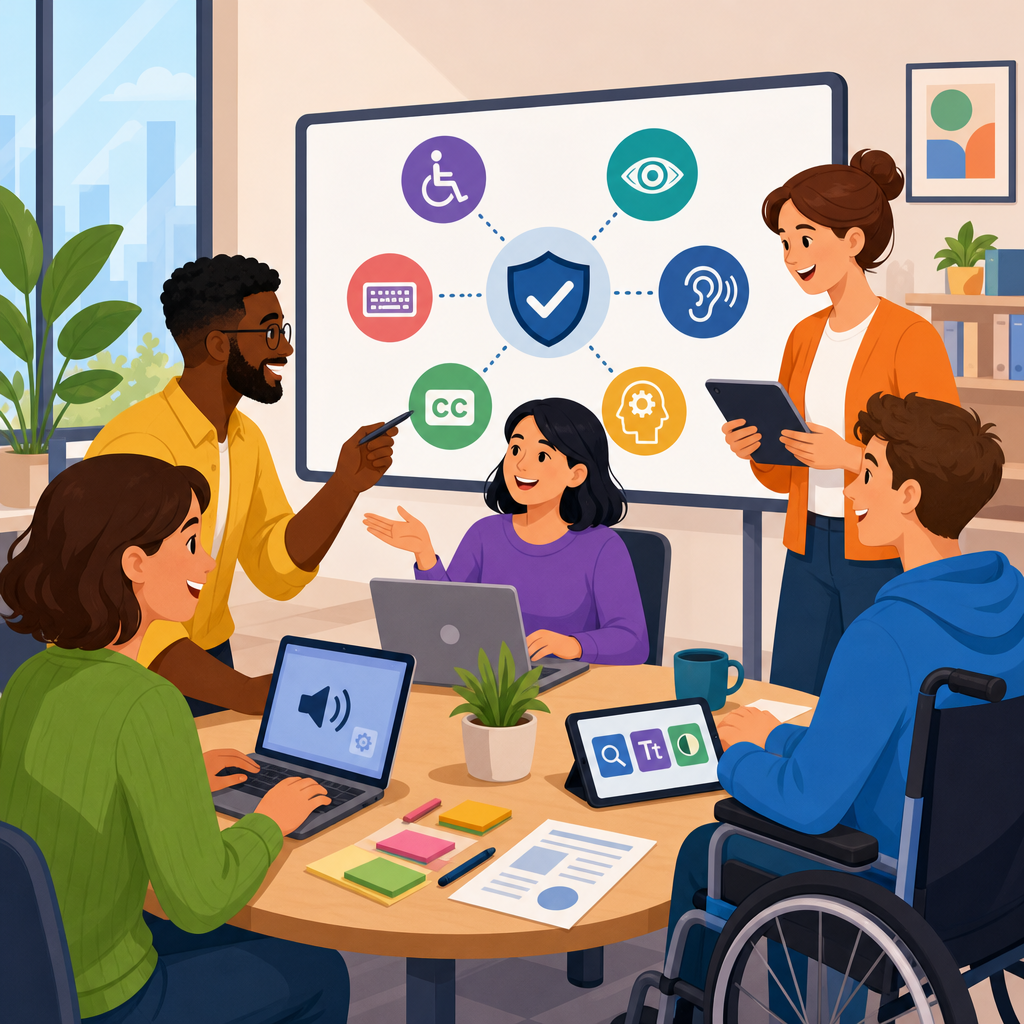
Accessible technology policies for organizations are the operating rules that ensure digital tools, devices, content, and procurement decisions work for people with disabilities today and remain usable as technology changes. In practice, a strong policy defines accessibility standards, assigns ownership, sets testing requirements, and connects legal obligations with day-to-day decisions in design, purchasing, development, support, and training. I have helped organizations write and implement these policies, and the difference between a policy that sits in a binder and one that changes outcomes always comes down to specificity. Vague promises about inclusion rarely survive budget pressure or vendor deadlines. Clear policy language does.
This matters because technology now shapes nearly every employee and customer interaction. Recruiting, onboarding, learning management systems, video meetings, cybersecurity tools, self-service kiosks, mobile apps, AI assistants, and public websites all affect whether people can participate equally. Accessibility, in this context, means people with visual, hearing, motor, cognitive, speech, or multiple disabilities can perceive, understand, navigate, and use technology with equivalent effectiveness. The future of technology and accessibility is therefore not just about compliance. It is about building governance that keeps pace with cloud software, automation, artificial intelligence, mixed reality, and rapidly changing digital ecosystems.
Organizations also face a more demanding external environment. In the United States, the ADA, Section 504, Section 508, and evolving Department of Justice expectations shape risk. In Europe, the European Accessibility Act expands obligations across products and services. Globally, procurement teams increasingly ask for VPATs based on the Accessibility Conformance Report format. Meanwhile, employees expect flexible digital workplaces, and customers compare brands partly on friction. A modern accessible technology policy gives leaders a way to coordinate legal, technical, procurement, and user-experience goals in one framework.
As a hub for the future of technology and accessibility, this article explains how organizations can develop policies that hold up under real operational pressure. It covers core policy components, governance models, procurement controls, emerging technologies, measurement, and practical implementation. The central idea is simple: accessibility must move from a reactive accommodation process to a proactive technology management discipline. When policy does that well, organizations reduce risk, expand market reach, improve product quality, and make innovation more durable.
What an Accessible Technology Policy Must Include
An accessible technology policy should answer five questions directly: what systems are covered, which standards apply, who is responsible, how conformance is measured, and what happens when barriers are found. If any of those answers are missing, the policy will create confusion at exactly the moment teams need clarity. At minimum, coverage should include websites, mobile apps, software, electronic documents, collaboration platforms, kiosks, multimedia, internal tools, customer-facing systems, and third-party technology. Many organizations mistakenly exclude internal systems, yet inaccessible HR and productivity tools often create the most immediate harm for employees.
The standards section should name recognized requirements rather than relying on general language. Most organizations anchor digital content and software expectations to WCAG 2.1 AA or WCAG 2.2 AA, depending on readiness and regulatory context. For software and hardware procurement, EN 301 549 is increasingly important, especially for multinational organizations. U.S. public sector entities may need Section 508 alignment. The policy should also define related practices such as captioning, audio description, accessible authentication, keyboard operability, color contrast thresholds, document tagging, and compatibility with assistive technologies including screen readers, screen magnifiers, voice control, switch devices, and refreshable braille displays.
Responsibility must be distributed, not dumped on one accessibility specialist. Executive leadership sets direction, legal interprets obligations, procurement controls vendor intake, product and UX teams build requirements into workflows, engineering fixes defects, content teams publish accessible materials, IT administrators configure platforms accessibly, and support teams know how to respond to access issues. I advise organizations to write this as a RACI matrix in supporting procedures even if the policy itself stays concise. Without named owners, accessibility becomes everyone’s job in theory and no one’s job in practice.
Measurement should include both preventive and detective controls. Preventive controls include design system requirements, accessible component libraries, procurement review gates, and mandatory training for authors and developers. Detective controls include automated scanning with tools such as Axe, WAVE, or Siteimprove; manual keyboard testing; screen reader checks with NVDA, JAWS, and VoiceOver; and user testing with disabled participants. No policy should imply that automated tools alone are sufficient. They catch recurring code issues efficiently, but they do not reliably evaluate interaction logic, focus management quality, caption accuracy, or overall usability.
Finally, the policy needs an exception and remediation process. There will be legacy systems, vendor limitations, mergers, or emergency deployments. The policy should require documented exception approval, a time-bound remediation plan, interim accommodations, and re-review dates. That structure keeps exceptions from becoming permanent loopholes while recognizing operational realities.
Governance, Procurement, and Lifecycle Controls
The strongest accessible technology policies treat accessibility as a lifecycle control, not a last-minute audit. In procurement, that means requiring vendors to provide current VPATs, product roadmaps, accessibility contact processes, and evidence of testing beyond self-attestation. A VPAT is useful, but experienced teams know it is only a starting point. I have seen procurement files filled with optimistic VPATs that did not match real product behavior. The fix is straightforward: combine document review with scripted demos, hands-on testing, and contract language that obligates remediation.
Contract terms matter more than many organizations realize. Good policy requires accessibility warranties, cooperation in issue investigation, service-level expectations for critical barriers, and clear language on who pays for remediation when defects block use. For custom development, statements of work should include accessibility acceptance criteria, test artifacts, and the right to reject inaccessible deliverables. For SaaS, renewal decisions should consider unresolved barriers and responsiveness. Procurement is where policy becomes enforceable.
Governance should also align with the technology lifecycle. During strategy and budgeting, accessibility needs funding for audits, training, remediation, and user research. During design, teams should use accessible patterns and include disabled users in discovery. During development, accessibility checks belong in definition of done, code review, and CI pipelines where practical. During deployment, release readiness should include regression testing for major workflows. During operations, help desks need intake paths for access issues, and change management should assess accessibility impact before major upgrades.
Many organizations benefit from an accessibility council that includes IT, security, procurement, legal, communications, HR, product, facilities, and employee resource groups. This group should not replace ownership in the business. Its role is to coordinate priorities, review metrics, resolve escalations, and maintain standards. In large enterprises, federated governance works well: central policy and tools, local accountability in product lines and departments. In smaller organizations, one sponsor plus a cross-functional working group is often enough if roles are explicit.
| Policy Area | Required Control | Practical Example |
|---|---|---|
| Procurement | VPAT review plus hands-on validation | Test a candidate HR platform with NVDA before purchase |
| Design | Approved accessible components | Use a design system with compliant form fields and dialog patterns |
| Development | Accessibility criteria in definition of done | Reject a feature if keyboard focus is trapped in a modal |
| Content | Authoring standards and training | Require tagged PDFs, alt text, headings, and captioned video |
| Operations | Issue intake and remediation SLAs | Route a screen reader defect to engineering within one business day |
| Exceptions | Documented approval with end date | Allow temporary use of a legacy tool while replacement is funded |
A future-ready policy also integrates cybersecurity and accessibility instead of treating them as competing priorities. Multifactor authentication, session timeouts, CAPTCHAs, endpoint agents, and identity workflows can easily become barriers if not designed carefully. The policy should require accessible authentication methods, compatible security tools, and equivalent alternatives when a control cannot be used by a disabled person. This is especially important as zero-trust environments and conditional access controls expand across enterprises.
Preparing for AI, Automation, and Emerging Interfaces
The future of technology and accessibility will be shaped heavily by artificial intelligence, automation, voice interfaces, wearable devices, extended reality, and adaptive personalization. Policies written only for websites and documents are already outdated. Organizations need language that covers new interaction models and clarifies how accessibility will be evaluated when products use machine learning, conversational interfaces, or dynamically generated content.
AI creates both opportunity and risk. Automatic captioning, image description, reading support, voice transcription, and personalized interfaces can improve access dramatically. Microsoft, Google, Apple, and Adobe have all embedded accessibility-related AI features into mainstream products. But AI systems also introduce failure modes that policy must address. Automated captions can distort meaning in legal, medical, or educational settings. Image descriptions may omit critical context. Chatbots can become unusable if they do not expose structure and controls properly to assistive technology. Hiring or customer-service automation can amplify bias against disabled users if datasets or workflows are poorly designed.
An accessible technology policy should therefore require human review for high-impact AI outputs, transparency about system limitations, and testing with disabled users for AI-enabled experiences. It should also require procurement teams to ask vendors how accessibility is handled in model training, interface design, guardrails, and fallback options. If an AI assistant summarizes an inaccessible PDF, that does not make the source document accessible. Policy should state this plainly: assistive features are helpful, but they do not replace accessible originals.
Voice and multimodal interfaces deserve special attention. Voice can benefit people with mobility impairments, but speech-only systems can exclude users with speech disabilities, temporary voice loss, strong accents, or noisy environments. Gesture-based or immersive systems can create similar issues for people with limited range of motion, vestibular disorders, low vision, or cognitive overload. The policy should require equivalent input and output methods, user control over motion effects, clear orientation cues, and alternatives to time-sensitive interactions. These principles apply whether the technology is a warehouse wearable, a retail kiosk, or an AR training simulation.
Personalization is another major frontier. Properly governed, it allows users to adjust text spacing, contrast, captions, reading levels, notification methods, and input settings in ways that reduce friction. Poorly governed, it fragments experiences and creates support challenges. Policy should encourage interoperable preferences and user-controlled settings while preventing teams from assuming one mode fits everyone with a particular disability. Accessibility is not a fixed persona. It is an interaction between users, tasks, environments, and tools.
Implementation, Metrics, and Continuous Improvement
Policy development is only the starting point. Implementation succeeds when organizations combine training, tooling, governance, and measurement over time. Training should be role-based. Developers need semantic structure, ARIA discipline, focus management, and testing techniques. Designers need color, layout, motion, error prevention, and component behavior. Content authors need heading structure, plain language, alt text judgment, table formatting, and caption workflows. Procurement teams need to interpret VPAT claims and contract terms. Help desk staff need scripts for triage and escalation. Generic annual awareness modules are not enough.
Metrics should show both compliance posture and user impact. Useful leading indicators include percentage of staff trained by role, percent of products reviewed before launch, vendor assessments completed, component-library coverage, and remediation age by severity. Lagging indicators include accessibility defect volume, repeat issue categories, accommodation turnaround times, complaint trends, and task completion success for disabled users in usability studies. The most mature organizations connect these measures to business outcomes such as conversion rates, employee productivity, call-center volume, and digital self-service adoption.
Continuous improvement also depends on realistic prioritization. Not every issue has equal severity. A missing decorative alt attribute is not the same as an inaccessible authentication flow that blocks employment or payment. Policies should define severity levels based on task impact, frequency, and audience reach. They should also require root-cause analysis. If teams repeatedly ship the same focus-order defect, the answer is not endless bug fixing; it is usually a flawed component, absent design guidance, or inadequate code review criteria.
Internal linking signals within a technology and accessibility content hub should support this policy work. Organizations benefit from maintaining companion guidance on accessible procurement, document accessibility, mobile accessibility, captioning standards, testing methods, and AI accessibility governance. A hub model helps teams find the right depth when the main policy points them to procedures and standards. That structure is especially useful during onboarding, audits, and vendor evaluations because it separates durable policy statements from detailed implementation guidance that will evolve more frequently.
Accessible technology policies for organizations are future-facing when they are specific, enforceable, and embedded across the technology lifecycle. The best policies define scope clearly, anchor expectations to recognized standards, assign accountable owners, and require testing that reflects real user experience. They strengthen procurement, guide design and engineering, address AI and emerging interfaces, and create measurable improvement rather than symbolic intent. Most important, they help organizations move from reacting to barriers after harm occurs to preventing barriers before products launch. Review your current policy, identify the gaps in governance and procurement, and build the next version around the technologies your people will actually use tomorrow.
Frequently Asked Questions
What is an accessible technology policy, and why does an organization need one?
An accessible technology policy is the internal framework that tells an organization how accessibility will be built into its digital ecosystem. It covers the rules, responsibilities, and decision-making processes that ensure websites, software, mobile apps, documents, collaboration platforms, kiosks, and purchased technology can be used by people with disabilities. A strong policy does not treat accessibility as a one-time remediation project. Instead, it establishes accessibility as an ongoing operational requirement across design, development, procurement, content publishing, training, support, and governance.
Organizations need this kind of policy because accessibility problems rarely come from a single department. They typically result from disconnected decisions: a procurement team buys tools without accessibility review, a content team publishes inaccessible PDFs, a development team releases features without keyboard testing, or support staff are not trained to handle accommodation requests. An accessible technology policy brings consistency to those decisions so accessibility is addressed before issues become expensive, disruptive, or exclusionary.
There is also a legal and risk-management reason to have a formal policy. Many organizations must meet disability rights laws, procurement requirements, industry regulations, or contractual obligations. A policy helps translate those external requirements into clear internal expectations. It shows leadership intent, supports accountability, and gives teams practical direction for meeting standards in day-to-day work. Just as important, it improves user experience for employees, customers, students, patients, and members of the public by making technology more usable for everyone.
What should be included in an effective accessible technology policy?
An effective accessible technology policy should include both high-level commitments and detailed operational requirements. At a minimum, it should define the scope of covered technology, identify the accessibility standards the organization will follow, assign ownership, and explain how accessibility will be evaluated throughout the technology lifecycle. Many organizations reference recognized standards such as WCAG for web and digital content, while also addressing software, hardware, electronic documents, communication tools, and third-party platforms.
The policy should clearly state who is responsible for what. That usually includes executive sponsorship, an accessibility lead or program owner, procurement staff, content creators, designers, developers, QA testers, IT administrators, trainers, and help desk personnel. Without named responsibilities, accessibility often becomes everyone’s priority in theory and no one’s task in practice. Strong policies also define review and approval processes, including when accessibility must be considered during planning, purchasing, implementation, upgrades, and renewals.
Testing and verification requirements are another essential part of the policy. The document should explain what kinds of testing are expected, such as automated scans, manual keyboard testing, screen reader checks, document accessibility review, usability testing with assistive technology, and vendor conformance documentation review. It should also describe what happens when issues are found: how defects are logged, who approves exceptions, what remediation timelines apply, and how interim accommodations will be provided if a product is not yet fully accessible.
Finally, the best policies address training, documentation, monitoring, and continuous improvement. Teams need role-based training so they understand how to meet the policy in real work. The organization should maintain procedures, templates, procurement language, and reporting mechanisms that support compliance. A policy should not sit on a shelf; it should be backed by governance, measurement, and periodic updates so it remains relevant as technologies, laws, and standards evolve.
How do organizations develop an accessible technology policy that actually works in practice?
Developing a policy that works starts with understanding the organization’s current environment. That means identifying the digital products and tools in use, reviewing existing standards and workflows, assessing current accessibility maturity, and mapping where decisions are made. It is important to learn not just what technology exists, but how it is chosen, built, configured, maintained, and supported. A policy is far more effective when it reflects the organization’s actual structure rather than an idealized process that no one follows.
Stakeholder involvement is critical. The policy should be developed with input from leadership, legal, procurement, IT, product teams, communications, HR, training, support, and, when possible, people with disabilities. This broad participation helps uncover practical barriers early and creates shared ownership. It also improves adoption, because departments are more likely to implement a policy they helped shape. In many organizations, accessibility stalls when the policy is written by one team in isolation and handed down without operational planning.
To work in practice, the policy must be specific enough to guide action but flexible enough to fit different technologies and teams. It should define mandatory requirements, supporting procedures, escalation paths, and exception handling. For example, it may require accessibility review before any technology purchase, mandate accessibility acceptance criteria in digital projects, and require remediation plans for known barriers. At the same time, it should allow for phased implementation, realistic prioritization, and documented alternatives where immediate full conformance is not possible.
Successful organizations also pair the policy with implementation tools. These may include accessible procurement checklists, VPAT review processes, content authoring guidance, design system requirements, document templates, testing protocols, issue-tracking workflows, and reporting dashboards. In other words, the policy provides the rulebook, but the procedures and tools make compliance achievable. That is often the difference between a policy that exists on paper and one that changes how technology decisions are made every day.
How does an accessible technology policy affect procurement, vendors, and third-party tools?
Procurement is one of the most important areas covered by an accessible technology policy because organizations often introduce accessibility barriers by purchasing inaccessible third-party products. If accessibility is not addressed before selection and contract signing, the organization may end up with technology that is difficult or impossible to use for employees or customers with disabilities. Retrofitting accessibility after purchase is often costly, slow, and dependent on vendor willingness to make changes. A good policy helps prevent those problems at the source.
In practice, the policy should require accessibility review at multiple procurement stages. That usually includes defining accessibility requirements in solicitations, asking vendors for conformance documentation, reviewing accessibility claims critically, requesting demonstrations of assistive technology compatibility, and including accessibility language in contracts. Organizations should avoid treating vendor documents as proof by themselves. A vendor may provide a conformance report, but internal review, testing, and follow-up questions are still necessary to understand real-world usability and risk.
The policy should also explain how procurement teams handle products that are partially conformant or have known accessibility gaps. In some cases, a product may still be selected if there is a documented business need, a comparative review shows no better accessible alternative, a remediation commitment is secured from the vendor, and an interim accommodation plan is in place. The key is disciplined decision-making. Accessibility exceptions should be documented, time-bound, and approved through a defined process rather than handled informally.
Over time, a strong policy improves vendor relationships as well. It signals that accessibility is a serious business requirement, not an optional preference. Vendors learn that they need to provide meaningful answers, product roadmaps, and accountable support. This raises expectations in the marketplace and helps organizations build a more accessible technology portfolio. Procurement may be where accessibility becomes visible in contract language, but its real value is strategic: it prevents barriers before they are embedded into the organization’s systems.
How can an organization maintain and enforce its accessible technology policy over time?
Maintaining and enforcing an accessible technology policy requires governance, measurement, and regular review. A policy is only effective if the organization has a way to monitor whether teams are following it. That usually means assigning a program owner or oversight group, defining key performance indicators, and establishing reporting routines. Metrics might include accessibility review completion rates, testing coverage, remediation timelines, training participation, procurement compliance, unresolved critical issues, and the number of documented exceptions. These indicators help leadership see whether accessibility is being managed as an operational priority.
Training is another major part of long-term enforcement. Different roles need different levels of instruction. Developers need technical implementation guidance, content teams need document and publishing training, procurement teams need vendor evaluation skills, and support staff need procedures for responding to accessibility-related requests. New employees should be introduced to the policy as part of onboarding, and existing staff should receive refreshers as standards, tools, and expectations change. Without ongoing training, policy compliance usually weakens over time.
Organizations should also review the policy on a scheduled basis, especially when laws, standards, platforms, or internal technology practices change. Accessibility is not static. New tools are adopted, legacy systems remain in use, and product teams change their workflows. A periodic review process allows the organization to update scope, improve procedures, clarify responsibilities, and close gaps revealed by audits or user feedback. Including people with disabilities in these reviews helps ensure the policy remains grounded in actual usability rather than checklist assumptions.
Enforcement works best when it is tied to normal business processes rather than treated as a separate compliance exercise. Accessibility requirements should be built into project approvals, design reviews, software development lifecycles, content publishing workflows, contract reviews, and support escalation paths. When accessibility is embedded in existing governance mechanisms, it becomes part of how work gets done. That is the ultimate goal of an accessible technology policy: not merely to state good intentions, but to create durable systems that keep technology inclusive as the organization grows and changes.