Snow, storage, and temporary obstructions in accessible parking create some of the most common and most preventable barriers on a site. Under ADA Accessibility Standards, accessible parking is not just about counting spaces or painting symbols on asphalt. It is about keeping the full parking access route usable in real conditions, including winter weather, deliveries, maintenance work, and short-term events. In Chapter 5: General Site and Building Elements, this topic sits at the intersection of parking, exterior routes, passenger loading, and operational policies, which is why it deserves hub-level attention.
In practice, I see the same pattern repeatedly during site reviews: a property installs compliant parking dimensions, then gradually loses usability because snow is piled in access aisles, landscape materials are stored on curb ramps, or contractors place cones and dumpsters where wheelchair users need clear maneuvering space. A temporary obstruction is any object or condition that blocks or reduces the required accessible route for a limited period, whether that period is fifteen minutes or three months. Snow storage means the designated locations where plowed or shoveled snow is piled. If those locations interfere with accessible parking spaces, access aisles, curb ramps, passenger loading zones, or the route to the entrance, the site stops functioning as intended even if the original striping met code.
This matters because accessible parking is only effective when every linked element works together. The required space includes the parking stall, adjacent access aisle, signage, slope, surface condition, curb transition where provided, and accessible route to the entrance. When any one of those elements is blocked, the entire chain fails. People who use wheelchairs, walkers, scooters, canes, prosthetics, or service animals are affected first, but families with strollers, older adults, delivery visitors, and emergency responders also benefit from keeping these areas open. Property owners, facility managers, designers, and contractors need a clear operational playbook, not just a striping plan.
As a hub article for Chapter 5: General Site and Building Elements, this guide explains how snow, storage, and temporary obstructions affect accessible parking, what standards and common enforcement triggers apply, where failures happen most often, and how to build maintenance procedures that keep sites compliant year-round. It also points to related subtopics such as parking geometry, accessible routes, curb ramps, exterior surfaces, passenger loading zones, and maintenance responsibilities, because real compliance is managed as a system rather than a checklist.
What Chapter 5 Requires for Accessible Parking to Stay Usable
Chapter 5 addresses the site and building features people encounter before they reach a door. For accessible parking, the key principle is usability, not merely designation. Accessible spaces must be provided in the required number, located on the shortest accessible route to an accessible entrance where feasible, marked appropriately, and connected by an accessible route. The 2010 ADA Standards for Accessible Design, especially sections covering parking spaces, access aisles, passenger loading zones, protruding objects, and ground surfaces, establish the technical baseline. Local building codes, state accessibility provisions, and adopted versions of ICC A117.1 may add dimensions, signage, or enforcement details, but they do not reduce the obligation to maintain access.
Maintenance is the overlooked part of compliance. The U.S. Access Board has long emphasized that accessible features must be maintained in operable working condition, though isolated or temporary interruptions due to maintenance are permitted. That exception is narrow. It does not allow predictable seasonal barriers or casual site storage. If a property knows snow will accumulate every year, then snow management is part of accessibility maintenance. If a retail center receives weekly pallet deliveries, then staging controls must protect access aisles and curb ramps. In other words, recurring operational realities are not excuses; they are foreseeable conditions that must be planned for.
When I audit sites, I evaluate three questions first. Can a person park and deploy safely from the vehicle? Can the person travel from the space to the entrance without encountering a step, excessive cross slope, unstable surface, or blockage? Can the person return to the vehicle with the same level of access after weather events, trash pickup, landscaping, or contractor work? Those questions translate legal requirements into field checks that managers can actually use. If the answer to any of them is no, the site has an accessibility problem even if the paint and sign are technically present.
How Snow Becomes an Accessibility Barrier
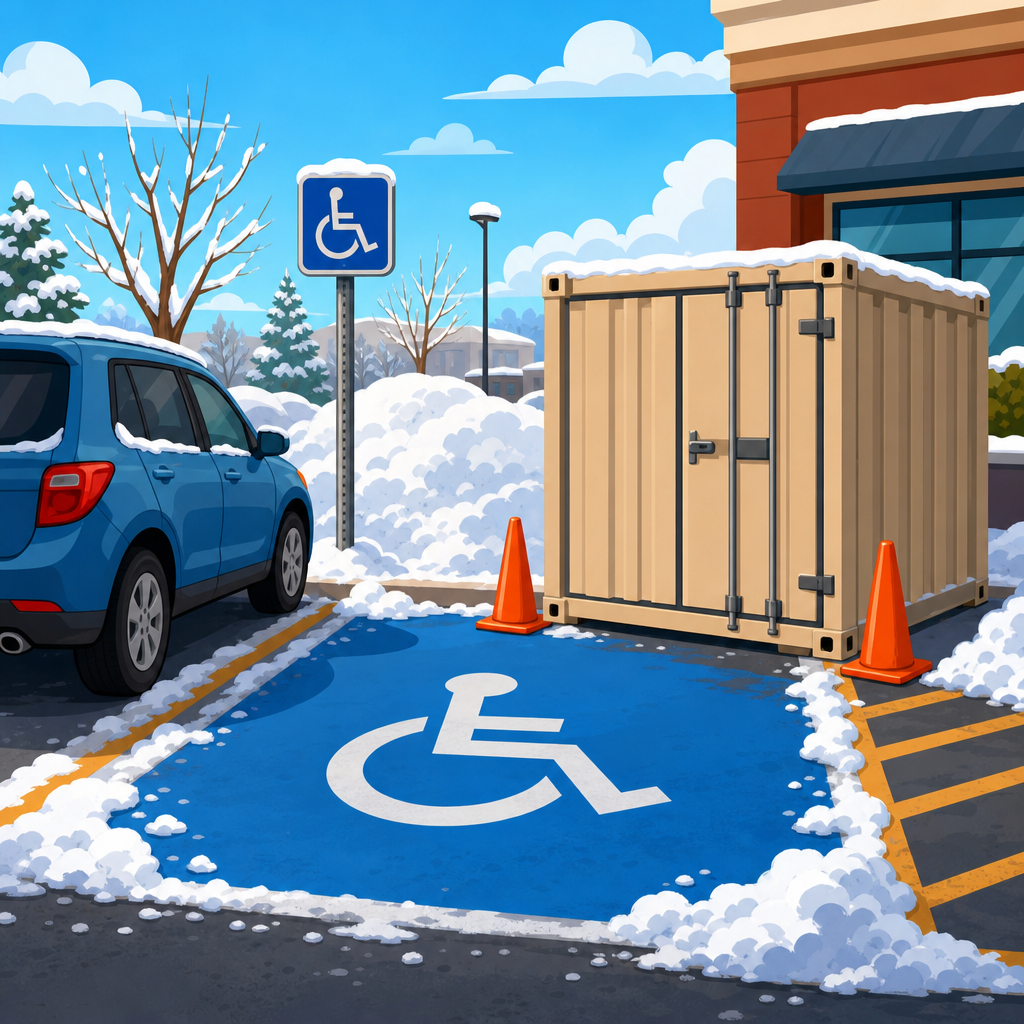
Snow creates hazards differently from ordinary clutter because it changes surface height, texture, traction, drainage, and visibility at once. A few inches of packed snow in an access aisle can prevent side lift deployment from a van. Refrozen meltwater creates ice that raises slip resistance concerns for ambulatory users. Plowed windrows at the head of parking spaces force wheelchair users into drive aisles. Snow also hides striping, curb edges, wheel stops, and level changes, making an otherwise compliant layout confusing or dangerous.
The most serious winter failure is using access aisles as snow storage. Access aisles are not spare pavement; they are the maneuvering area that allows a wheelchair user to transfer into or out of a vehicle and enter the accessible route. Blocking them is equivalent to blocking the space itself. The same is true when snow is piled over a curb ramp, at the base of a ramp landing, or across the route from the space to the entrance. Facilities sometimes clear the driving lane first and leave the pedestrian route for later. That sequence may restore vehicle circulation, but it does not restore accessibility.
Good snow operations start with mapping. Before winter, identify approved snow pile zones that do not encroach on accessible parking, routes, hydrants, loading areas, or drainage paths. Mark no-pile zones on the site plan and in the snow contractor scope. Use stakes or curbing references so operators can see boundaries at night. Train crews to clear access aisles, curb ramps, and the route to the entrance to the same priority level as fire lanes. On larger sites, I recommend post-storm verification with timestamped photos because recurring failures often come from subcontractors who were never shown the accessibility-sensitive areas.
Storage and Staging Problems That Undermine Compliance
Outside winter conditions, storage is the next major source of accessible parking violations. The problem is broader than abandoned shopping carts. I routinely find bagged salt, planters, traffic cones, sandwich boards, hose reels, temporary fencing, pallets, and trash carts placed in or beside accessible spaces because staff consider them convenient, visible, and out of the way. From an operational viewpoint, those objects may seem temporary. From a user viewpoint, they remove required maneuvering space and may force travel in vehicle lanes.
Contractor staging is especially risky. Roofing crews stack materials near the entrance. Electricians park lifts on the flattest pavement. Landscapers leave mulch in curb ramp flares. Event staff place barricades to manage crowd flow without maintaining the original accessible route. None of these teams may understand accessible parking geometry unless the owner spells it out in the contract documents and pre-job meeting. That is why facility standards should include a simple rule: no material, equipment, waste container, or barrier may be stored within accessible parking spaces, access aisles, curb ramps, passenger loading zones, or the connecting accessible route.
Short-term activities still count. A dumpster dropped for one weekend, a mobile pressure washer parked for one afternoon, or a line of delivery carts held for one hour can create an access denial at the exact time a disabled visitor arrives. Enforcement agencies and plaintiffs do not treat the phrase “only temporary” as a defense when the interference was avoidable. The practical fix is designating separate staging zones, painting or signing no-storage areas, and making one person on each shift accountable for keeping these zones clear.
Common Site Failures and Better Operational Responses
| Failure | Why It Blocks Access | Better Response |
|---|---|---|
| Snow piled in access aisle | Prevents lift deployment and safe transfers | Assign off-limits snow pile zones and inspect after plowing |
| Salt bags or carts stored on curb ramp | Breaks the route between parking and entrance | Use a dedicated storage alcove away from pedestrian circulation |
| Temporary fencing across route | Forces users into vehicle traffic or dead ends | Provide an alternate accessible route with equivalent usability |
| Dumpsters or pallets in accessible spaces | Eliminates required parking and maneuvering area | Reserve a separate contractor staging area in lease and bid documents |
| Ice left in aisle after partial clearing | Creates slip risk and unstable surface | Remove snow to pavement and apply deicer with follow-up treatment |
These failures happen because responsibility is fragmented. Leasing teams control tenant deliveries, maintenance teams control snow, security teams place cones, and outside vendors follow their own habits. Without one accessibility protocol, each group can unintentionally disable the site. The strongest programs use written checklists, photo examples, and escalation rules. If an obstruction cannot be removed immediately, staff should know who has authority to relocate equipment, call a contractor back, or create an alternate route that remains accessible.
Documentation also matters. If a complaint arises, owners who can show inspection logs, contractor instructions, and corrective action records are in a much better position than owners who rely on verbal expectations. I recommend integrating accessible parking checks into routine opening and closing inspections, severe weather response plans, and capital project closeout. Accessibility should be audited the same way life safety and housekeeping are audited: consistently, visibly, and with assigned accountability.
Design Strategies That Reduce Obstruction Risk
Operations carry most of the burden, but design choices can prevent repeated failures. The best layouts protect accessible parking from being treated as overflow pavement. Locate spaces where there is a direct route to the entrance and where snow plows are less likely to push material into access aisles. Avoid placing curb ramps exactly where plowed snow naturally accumulates at the end of islands. Provide generous, clearly separated pedestrian paths using detectable edge conditions, striping, bollards where appropriate, and drainage that does not sheet water across accessible routes.
Signage and pavement marking should support maintenance, not just initial compliance. In many lots, the standard upright sign identifies the accessible space, but nothing marks the access aisle as a no-parking, no-storage area once snow covers the diagonal striping. Supplemental signs, reflective pavement markers, or flexible delineators can help crews recognize protected areas during storms. For larger commercial sites, a snow plan should be attached to the civil set and shared with property management after construction. Too often, valuable design intent disappears at turnover.
Material choices matter as well. Stable, firm, slip-resistant surfaces perform better under winter maintenance than broken asphalt or rough patchwork repairs. Positive drainage reduces ice formation. Proper slopes within parking spaces and access aisles improve usability and lower the chance that meltwater will pond and refreeze. Where reconstruction is planned, accessible parking should be reviewed alongside pedestrian route continuity, crosswalk markings, lighting, and passenger loading zones so one upgrade does not create a new bottleneck elsewhere.
Policy, Training, and Enforcement on Real Properties
The most reliable compliance programs combine physical design with policy. Every property should have a written accessible parking maintenance policy that covers snow removal priority, approved storage areas, vendor restrictions, response times for reported obstructions, and procedures for temporary route changes during construction. The policy should define terms plainly. Staff need to know that an access aisle is part of the accessible parking space, that curb ramps cannot be used as staging pads, and that “temporary” does not mean “acceptable.”
Training should be role-specific. Snow contractors need route maps and no-pile zones. Janitorial teams need storage boundaries for carts and supplies. Security staff need authority to remove cones, enforce tow rules, and escalate blocked routes. Tenant managers need lease language that prohibits merchandise displays, queue rails, and seasonal décor from extending into accessible paths. During renovations, project managers should require accessible phasing plans and inspect them in the field, not just on paper. I have found that a fifteen-minute kickoff with annotated site photos prevents more violations than a long generic compliance memo.
Enforcement is where policy becomes credible. If contractors repeatedly block accessible spaces and face no consequences, the behavior continues. Contracts should allow charge-backs for rework, emergency snow relocation, or corrective barricading when accessible routes are obstructed. Managers should also provide a clear reporting channel for visitors and employees. A phone number on building signage, a service desk script, or a digital work order category can shorten response time and reduce conflict. Fast correction is not a substitute for planning, but it limits harm when something goes wrong.
How This Hub Connects to the Rest of Chapter 5
Snow, storage, and temporary obstructions in accessible parking connect directly to nearly every exterior element in Chapter 5. Parking counts and dimensions determine whether spaces exist in the first place. Access aisles and passenger loading zones determine whether people can deploy mobility devices. Curb ramps and blended transitions determine whether the route is continuous. Exterior accessible routes, walking surfaces, protruding object controls, and entrance approaches determine whether users can reach the door safely. Maintenance policies tie all of those pieces together over time.
For that reason, this hub should lead readers to deeper articles on accessible parking layout, van space design, signage, slopes and cross slopes, curb ramp placement, exterior route continuity, passenger loading requirements, winter maintenance planning, and temporary route management during construction. Looking at any one element in isolation produces weak compliance decisions. Looking at the whole site system produces durable results, fewer complaints, and a better visitor experience for everyone.
The key takeaway is simple: accessible parking remains compliant only when it stays clear, stable, and connected every day, in every season, and during every temporary activity. Snow piles, stored materials, and short-term barricades can defeat an otherwise well-designed site in minutes. Review your property now, map the risk points, train every team that touches the exterior, and build maintenance checks into normal operations. If you manage Chapter 5 elements as an active system rather than a one-time construction item, accessible parking will work the way the standards intend.
Frequently Asked Questions
Why are snow, stored materials, and temporary obstructions such a serious ADA issue in accessible parking?
Because accessible parking only works when the entire parking access route remains usable, not just when the space is striped correctly. Under ADA Accessibility Standards, compliance is about function as much as layout. An accessible parking space, its access aisle, the curb ramp if one is provided, and the route leading to the accessible entrance all have to remain available and passable in actual day-to-day conditions. When snow is piled into an access aisle, when maintenance crews stage cones or equipment in the route, or when deliveries block the path for “just a few minutes,” the space may still look compliant on paper while being unusable in practice.
This matters because people with disabilities often rely on precise, predictable clearance. A driver using a wheelchair lift may need the full width of the access aisle to enter or exit the vehicle safely. A person using a walker or cane may need a stable, level path free from ice, mud, cords, pallets, and debris. Someone with limited stamina may be able to use the designated space only if the route to the entrance is direct and unobstructed. Even a short-term barrier can effectively remove access altogether. In other words, temporary obstructions are not minor housekeeping issues; they can deny equal access to the site.
From a risk standpoint, these conditions also create safety and liability concerns. Snow and ice increase slip hazards, and blocked aisles can force people into vehicular travel lanes. That is why this topic sits squarely within general site accessibility responsibilities. The accessible features must be maintained in operable working condition, and that includes keeping them clear during weather events, service activity, and routine site operations.
What parts of an accessible parking area must stay clear at all times?
The answer is broader than many property owners expect. It is not enough to keep only the marked parking stall open. The accessible space itself, the adjacent access aisle, any curb ramp serving the area, and the accessible route from parking to the accessible entrance all need to remain clear and usable. If any one of those pieces is blocked, the parking accommodation may fail in practice even if the painted markings are still visible.
For example, an access aisle cannot be treated as spare storage space for snow, landscaping materials, trash carts, portable signs, or maintenance equipment. That aisle is part of the required accessible use zone. Likewise, the route from the parking area to the building cannot be narrowed by stored merchandise, temporary fencing, extension cords, hose lines, dumpsters, or event setup materials. If a curb ramp is present, it must not be blocked by snow piles, stacked bags, or construction barricades. The route must also remain stable and safe, which means ice, slush, loose gravel, and pooling water can be just as problematic as a physical object.
A good rule is to evaluate the full user journey. Can a person park, deploy mobility equipment, move through the aisle, reach the route, and enter the building independently and safely? If the answer is no because of a temporary condition, then the site has an accessibility problem. That operational view is essential to proper ADA maintenance.
How should a site handle snow removal in and around accessible parking spaces?
Snow removal plans should specifically prioritize accessible parking and the full accessible route, not treat those areas as an afterthought. In practice, that means plowing, shoveling, and de-icing accessible spaces, access aisles, curb ramps, and the path to the accessible entrance early and consistently during winter weather events. The common mistake is clearing the drive lanes first and pushing snow into the very areas that must remain open for accessible use. Once snow is piled into an access aisle or at the base of a curb ramp, the accessible parking space may be effectively unusable.
An effective plan includes designated snow storage locations that do not interfere with accessible features. Contractors and in-house staff should know ahead of time where snow may be placed and where it may never be placed. They should also understand that compacted snow and refrozen slush can be as obstructive as a solid object. De-icing should be prompt, and follow-up inspections are important because accessible areas often become blocked again as plowed snow melts and refreezes or as runoff crosses the route.
It is also wise to build accountability into winter operations. Many sites benefit from written procedures, maps marking accessible elements, staff training, and inspection checklists during storms. If outside snow contractors are used, accessibility expectations should be written into the service scope. The key point is simple: accessible parking must remain functional in real winter conditions, not just after the storm is over or only during business-hours cleanup.
Are temporary obstructions like deliveries, maintenance work, or event equipment allowed if they are only there briefly?
Short duration does not automatically make an obstruction acceptable. If a delivery truck, pallet drop, scissor lift, caution tape, or event setup blocks the accessible parking space, access aisle, curb ramp, or route to the entrance, the site may still be denying access during that period. For a person arriving at that moment, a “temporary” blockage can be the same as no access at all. ADA responsibilities are based on usability, and brief operational convenience does not override the need to maintain accessible features in working condition.
That said, real sites do have deliveries, repairs, and special events. The best approach is planning. Schedule work to avoid accessible routes whenever possible. Identify staging areas that are outside required accessible parking and circulation zones. Train vendors and staff not to use access aisles for unloading, even for a few minutes. If a temporary disruption truly cannot be avoided, site managers should provide an equivalent accessible approach during the disruption and restore the original route as quickly as possible. However, that should be the exception, not the routine method of operation.
Many preventable violations happen because teams view accessible parking as low-risk overflow space. It is not. Access aisles are not loading zones, curb ramps are not storage pads, and accessible routes are not flexible staging corridors. Keeping those distinctions clear in operations, vendor instructions, and event planning is one of the most effective ways to avoid recurring barriers.
What are the best practices for property owners and managers to prevent these barriers year-round?
Start by treating accessible parking as an actively managed accessibility feature rather than a one-time striping project. That means assigning responsibility for routine inspections, maintenance, and rapid response when obstructions appear. Staff should regularly check that accessible spaces, access aisles, signs, pavement markings, curb ramps, and the route to the entrance remain visible, clear, and usable. These checks should happen not only after storms but also during deliveries, trash collection, landscaping, building repairs, and special events.
Written procedures make a major difference. A site policy should state that snow, equipment, carts, inventory, cones, and debris may not be placed in accessible spaces or along accessible routes. Snow removal contracts should identify protected accessible areas. Event planners should receive setup rules. Maintenance teams should know approved staging locations. Delivery personnel should be directed away from access aisles. When everyone understands that accessibility is an operational requirement, not just a design issue, compliance becomes much more reliable.
It is also helpful to document inspections and corrective actions. Photos, maintenance logs, and contractor instructions can help show that the property is taking accessibility seriously and responding promptly. Finally, think seasonally and proactively. Winter brings snow and ice, spring may bring runoff and mud, summer events can crowd routes with temporary equipment, and fall maintenance can introduce stored materials and leaf debris. The goal is consistent usability across changing conditions. If a person with a disability can arrive at any normal time and use the accessible parking and route without encountering preventable barriers, the site is much closer to meeting both the spirit and the practical demands of ADA accessibility.