ADA toilet room layouts affect whether a restroom is merely usable or truly accessible, and the difference comes down to precise dimensions, fixture placement, door swing, and clear floor space. In the context of ADA Accessibility Standards, toilet rooms fall under Chapter 6: Plumbing Elements and Facilities, the section that governs how people with mobility, reach, balance, strength, and dexterity limitations can use essential plumbing fixtures safely and independently. I have reviewed and applied these requirements on renovation projects, tenant fit-outs, school restrooms, restaurants, offices, and medical clinics, and the same issue appears repeatedly: teams remember a few headline dimensions, but miss the layout relationships that make a room compliant in practice. A single grab bar in the wrong location, a lavatory that projects too far into the turning area, or a door that blocks the wheelchair clearances can unravel an otherwise polished design.
This matters because toilet rooms are one of the most frequently inspected accessibility elements in commercial buildings, multifamily common areas, public facilities, and workplaces. They are also one of the easiest places for users to experience exclusion immediately. Chapter 6 does not cover only water closets. It includes toilets, toilet compartments, urinals, lavatories, sinks, mirrors, faucets, operable parts, shower and bathtub controls, and related clearance rules that connect back to Chapters 2, 3, and 4 on scoping, clear floor space, reach ranges, and accessible routes. For a sub-pillar hub article, the goal is simple: understand the core planning logic behind ADA toilet room layouts so every deeper topic in plumbing accessibility makes sense. When you know the required clearances and the reason behind them, you can evaluate almost any restroom plan quickly and accurately.
What Chapter 6 Covers in an ADA Toilet Room
Chapter 6 sets the technical requirements for plumbing fixtures and facilities, but successful ADA toilet room layouts depend on reading these provisions together rather than in isolation. The most important toilet room elements are the water closet location, toilet centerline, side and rear clearance, grab bar placement, accessible lavatory dimensions, knee and toe clearance, insulated pipes, mirror height, accessory reach range, and the maneuvering space for doors. Designers often treat these as separate checklist items. In real plan review, they function as one system. If the water closet clearance overlaps the lavatory correctly, the room may fit. If the lavatory shifts two inches, the turning space may fail. If the paper towel dispenser is mounted above reach range, the room becomes noncompliant even when the plumbing fixture layout is otherwise correct.
The chapter also distinguishes between single-user toilet rooms, clustered multi-user restrooms, and toilet compartments within larger rooms. That distinction matters because a one-person restroom often relies on overlapping clearances to fit within a small footprint, while a multi-user restroom may provide accessibility through one or more compliant compartments plus accessible common-use lavatories and accessories. On projects I have seen, confusion usually starts when teams use standard manufacturer cut sheets as substitutes for the standard itself. Fixture rough-in dimensions are not accessibility dimensions. ADA compliance is based on the usable space around the fixture, not just the fixture body. That is why layout review must begin with floor clearances, approach direction, and user transfer needs before anyone finalizes partitions or plumbing walls.
Key Dimensions That Drive Compliant Layouts
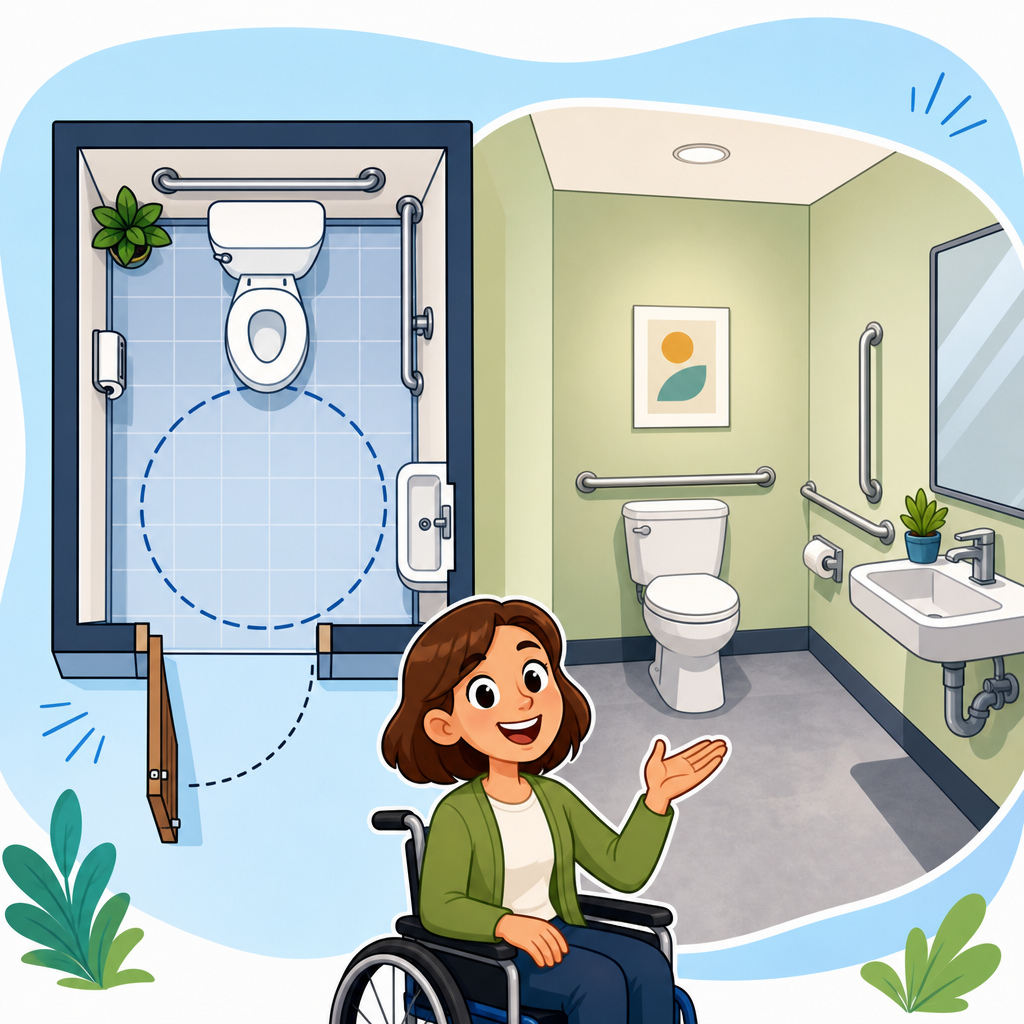
The core dimensions are well established. Accessible water closets require a centerline 16 to 18 inches from the side wall or partition. The clearance around a standard accessible toilet is at least 60 inches wide measured perpendicular from the side wall and 56 inches deep for wall-hung units or 59 inches deep for floor-mounted units measured from the rear wall. Grab bars are required on the side wall and rear wall, with specific minimum lengths and mounting heights. The seat height must be 17 to 19 inches above the finished floor. Flush controls must be on the open side of the toilet area except in certain residential applications. These are not suggestions. They are the dimensions that allow a wheelchair user to position, transfer, stabilize, and operate the fixture safely.
Lavatories add another set of governing numbers. The rim or counter surface can be no higher than 34 inches above the finished floor. Knee clearance must provide at least 27 inches high, 30 inches wide, and 11 to 25 inches deep depending on the section measured, with toe clearance below. Exposed pipes and sharp surfaces must be insulated or otherwise protected. Faucets must be operable with one hand and without tight grasping, pinching, or twisting of the wrist, and the operating force must remain low enough for users with limited dexterity. Mirrors above lavatories must have the reflecting surface no higher than 40 inches above the finished floor. Accessories such as soap dispensers, hand dryers, and paper towel dispensers must be located within accessible reach ranges, and that detail is missed constantly in value-engineered restrooms.
| Element | Common ADA Requirement | Why It Matters in Layout |
|---|---|---|
| Toilet centerline | 16 to 18 inches from side wall | Supports stable side transfer and grab bar use |
| Toilet clearance | 60 inches wide by 56 or 59 inches deep | Provides maneuvering and overlap with other clear spaces |
| Lavatory height | 34 inches maximum | Allows forward approach by seated users |
| Knee clearance | 27 inches minimum high | Permits wheelchair footrests and knees under fixture |
| Mirror height | 40 inches maximum to reflecting surface | Ensures visibility for seated and shorter users |
| Door impact | Cannot block required fixture clearances | Preserves actual usability after construction |
Single-User Toilet Rooms: The Most Common Layout Problems
Single-user restrooms are where ADA toilet room layouts look deceptively simple. Because only one person uses the room at a time, owners assume any larger room will work. In reality, compliance depends on how the clearances overlap. A wheelchair turning space, typically a 60-inch diameter circle or a T-shaped turning space, must exist without being destroyed by door swing or fixture encroachment beyond what the standards allow. The toilet clearance may overlap the turning area and lavatory clear floor space in some cases, which is why compact accessible restrooms are possible. But overlap has limits. A trash can, baby changing station, or in-swing door placed casually can eliminate the compliant maneuvering area the plan originally showed.
The door is often the biggest problem. If an inswing door projects into the room, it cannot swing into the required clear floor space or clearances for fixtures in a way the standard prohibits. Outswing doors often solve the issue, but corridor conditions, egress, privacy, and local code can complicate that choice. I regularly advise teams to check the strike-side and latch-side maneuvering clearances at the restroom door early, not after wall framing. Another recurring issue is accessory creep. A room may pass on paper, then fail after installation because the coat hook is too high, the dispenser intrudes into the circulation path, or the hand dryer creates a protruding object hazard. The lesson is practical: an ADA single-user restroom is not just a toilet and sink in a box. It is a coordinated set of dimensional allowances that must survive real-world construction decisions.
Multi-User Restrooms and Toilet Compartments
In multi-user restrooms, the accessibility strategy shifts from one room serving all functions to a combination of accessible compartments, accessible common lavatories, and reachable accessories. Standard accessible toilet compartments must provide compliant width, depth, door approach, grab bars, and water closet placement. Ambulatory accessible compartments, required in some cases, are different: they are intended for people who use crutches, walkers, or braces rather than wheelchairs, and they require parallel grab bars on both sides with a narrower compartment width. Many layouts fail because the design team provides one large wheelchair-accessible stall but forgets the ambulatory compartment where fixture counts trigger it.
Lavatory banks also deserve more attention than they usually get. It is not enough to designate one lavatory as accessible if the clear floor space is blocked by adjacent users or by a floor-mounted trash receptacle. Pipe protection, faucet operability, mirror height, and soap and drying accessories all need to align with that fixture. Urinals, when provided, also have accessible requirements for rim height and clear floor space. In schools and stadiums, where fixture counts are high and user flow is constant, I have seen compliant compartment dimensions undermined by poor circulation. Queuing space in front of compartments, path width between lavatories and partitions, and accessory placement all influence whether people can navigate the room independently. A compliant stall inside a congested room is not a successful accessible restroom.
How Related Plumbing Fixtures Fit Into the Hub Topic
As the hub for Chapter 6: Plumbing Elements and Facilities, this article should connect the toilet room to every other fixture category covered in the chapter. Lavatories and sinks are closely related but not identical in application. Service sinks are generally not intended for accessibility in the same way as public lavatories, while employee break room sinks, classroom sinks, and healthcare handwashing sinks may trigger different scoping questions. Showers and bathtubs involve transfer or roll-in configurations, seat requirements, control locations, hand-held shower units, and threshold limits. Drinking fountains add spout height, flow location, and knee clearance issues. Water closets and toilet compartments connect to all of these because they train teams to think in usable clearances rather than simple fixture counts.
That broader view matters for internal planning and future code research. If you are building a content cluster under ADA Accessibility Standards, the natural follow-up pages from this hub include accessible toilet clearances, ADA grab bar requirements, accessible lavatory design, mirror and accessory mounting heights, toilet compartment rules, ambulatory stalls, urinal accessibility, and shower and bathtub standards. In project work, those topics are interdependent. A hotel guest bathroom may involve accessible toilet placement, lavatory approach, mirror height, and a roll-in shower in one compact room. A restaurant restroom may focus on a single-user toilet room with hand dryer reach ranges and turning space. A medical office may add stricter operational concerns tied to patient mobility. Chapter 6 works best when it is understood as a coordinated fixture framework, not a list of isolated details.
Best Practices for Design, Review, and Renovation
The most reliable way to simplify ADA toilet room layouts is to review them in layers. First, confirm scoping: how many accessible rooms, stalls, lavatories, and related fixtures are required for the building type and occupant load. Second, test the plan geometry using actual clearance diagrams rather than fixture blocks from a manufacturer library. Third, verify mounting heights, operable parts, and reach ranges on elevations. Fourth, field-check the installation before closeout. I have found that many accessibility failures occur after the approved drawings are complete, especially when partitions shift, a thicker countertop is substituted, or accessories are mounted by field crews without dimensioned backing plans. A final punch focused specifically on accessibility catches problems while they are still inexpensive to fix.
Use recognized references and tools. The 2010 ADA Standards for Accessible Design are the primary federal technical baseline for most projects, while ICC A117.1 is commonly adopted through building codes and should be cross-checked because local enforcement often runs through the code official rather than a federal review. Manufacturer resources from Bradley, Bobrick, Sloan, and similar companies can help with rough-ins and accessories, but they should support, not replace, a standards-based review. For renovations, measure the existing conditions carefully. Old plumbing chases, structural walls, and door locations can make a textbook layout impossible without reconfiguration. When constraints exist, prioritize compliance through fixture relocation, outswing doors, wall-hung fixtures, or room enlargement rather than hoping tolerances will save the design. The simplest approach is disciplined accuracy: dimension the clearances, protect them during construction, and verify every accessory before turnover.
ADA toilet room layouts become manageable when you stop thinking of compliance as a mystery and start treating it as a set of coordinated spatial rules. Chapter 6: Plumbing Elements and Facilities provides the technical framework, but the practical outcome depends on integrating toilet clearances, lavatory access, accessory reach ranges, door maneuvering, and compartment design into one coherent plan. The most common failures are rarely dramatic. They are small dimensional mistakes with major usability consequences: a centerline off by two inches, a mirror mounted too high, a paper towel dispenser outside reach, or a door swing that clips required clear floor space. Those details determine whether a restroom supports independence and dignity for real users.
For teams building, renovating, specifying, or reviewing accessible restrooms, the main benefit of mastering this hub topic is speed with confidence. Once you understand how ADA toilet room layouts work, every related Chapter 6 subject becomes easier to assess, from grab bars and lavatories to compartments, urinals, showers, and accessory mounting. Use this page as the starting point for the full plumbing accessibility cluster, then apply the same method on every project: confirm scoping, map clearances, coordinate fixtures, and verify installation in the field. If you are evaluating restroom plans now, start with one room, mark every required clearance directly on the drawing, and correct conflicts before construction begins.
Frequently Asked Questions
What makes an ADA toilet room layout compliant?
An ADA toilet room layout is compliant when the space is designed so a person with a disability can enter, maneuver, transfer, reach fixtures, and use the room safely and independently. In practice, that means compliance is not based on one single dimension. It depends on how multiple requirements work together, including clear floor space, turning room, toilet location, grab bar placement, lavatory access, door swing, and the reachability of accessories and controls. Even a restroom with the correct toilet and grab bars can still fail if the door blocks the required maneuvering clearance or if the lavatory intrudes into required clearances.
The ADA Accessibility Standards address toilet rooms primarily through Chapter 6, which covers plumbing elements and facilities, but layout decisions also connect to clearances, operable parts, protruding objects, and accessible routes found in other sections of the standards. That is why toilet room design should always be viewed as a complete system rather than a checklist of isolated parts. A compliant layout supports people with mobility limitations, balance issues, reduced strength, limited reach, and impaired dexterity. It should allow a wheelchair user to approach the fixtures, position correctly, transfer with support, and exit without obstruction.
In simple terms, the room must provide enough usable space in the right locations. The toilet needs to be positioned correctly relative to the side wall, with the proper seat height and required grab bars. The lavatory must offer knee and toe clearance where required, with pipes protected and controls that are easy to operate. Accessories such as toilet paper dispensers, coat hooks, mirrors, and hand dryers must be mounted within accessible reach ranges. Doors must not create conflicts with required fixture clearances or make the room difficult to use. When all of those details are coordinated accurately, the toilet room moves from merely functional to truly accessible.
What are the most important dimensions in an ADA toilet room?
The most important dimensions in an ADA toilet room are the ones that directly affect maneuvering and transfer. Among the most critical are the required clear floor spaces, the turning space, the location of the toilet from the adjacent side wall, and the clearances around the water closet. These dimensions are essential because they determine whether a person using a wheelchair, walker, or other mobility aid can enter the room, position themselves correctly, and use the fixtures without unsafe reaching or awkward movement.
For many designers, the toilet location is the first major control point. The centerline of the toilet must be placed a specific distance from the side wall so the user can make an effective lateral transfer and rely on the grab bars for support. The clearance around the toilet must also be preserved. If another fixture, partition, trash can, or door swing intrudes into that space improperly, the layout may not function as intended. Turning space is equally important because accessible toilet rooms must allow wheelchair users to turn or reposition. If the room is technically large enough overall but the usable floor area is broken up by fixture placement, the room can still become noncompliant.
Lavatory dimensions also matter. A lavatory may look properly installed at first glance, but if there is not enough knee clearance below, or if surrounding walls and accessories block the approach, it may not be usable. Door maneuvering clearance is another frequent trouble spot. A door that swings into an already tight room can consume valuable floor space and interfere with fixture use. That is why experienced reviewers pay close attention not just to published ADA dimensions, but also to how those dimensions overlap in a real plan. The key is preserving functional clearance, not merely matching isolated measurements.
How does door swing affect an ADA restroom layout?
Door swing has a major impact on ADA restroom usability because it influences maneuvering clearance, fixture access, and overall safety. In a small toilet room, the path of the door can easily overlap with required clear floor space at the toilet or lavatory, making the room far more difficult to use than the drawing initially suggests. A compliant restroom is not just about what fits inside the room on paper. It is about whether the occupant can open the door, enter, close it, position themselves, and exit without conflicting with fixtures, walls, or required clearances.
One of the most common design mistakes is allowing the door to swing into space that is needed for wheelchair turning or toilet transfer. Even if every plumbing fixture is technically mounted at the right height and location, a poorly placed door can undermine the entire layout. This is especially true in single-user toilet rooms, where compact plans often leave little margin for error. In many cases, an outswing door, a larger room, or a different fixture arrangement solves the problem more effectively than trying to force compliance into a tight footprint.
Door hardware and approach are also part of accessibility. The door should be operable without tight grasping, pinching, or twisting of the wrist, and the user must have adequate clearance to approach and operate it. Thresholds, closers, and opening force can also affect accessibility. From a planning standpoint, door swing should be studied early in design, not after the fixtures are placed. It is one of the clearest examples of why ADA toilet room layouts depend on coordinated space planning rather than simple fixture scheduling.
Can a small restroom still meet ADA requirements?
Yes, a small restroom can meet ADA requirements, but only if it is carefully planned around the required clearances and usable floor space. Size alone does not determine compliance. A compact restroom may work very well if the toilet, lavatory, grab bars, and door are arranged efficiently. On the other hand, a slightly larger room can still fail if the layout is poorly coordinated. The goal is not to make the room feel spacious in a general sense. The goal is to provide the exact maneuvering and access conditions the standards require.
That said, smaller rooms leave far less room for design error. In tight layouts, even minor shifts in wall thickness, fixture selection, partition depth, or door location can affect compliance. A deeper lavatory, a projecting paper towel dispenser, or an inward-swinging door can eliminate the usable clear floor space needed for access. This is why ADA restroom design often benefits from detailed plan review rather than relying on standard room templates. What works in one project may not work in another if the door, wall conditions, or accessory selections differ.
When space is limited, designers often improve compliance by selecting fixtures with more compact profiles, rethinking the door swing, and laying out accessories with care. It is also important to verify field conditions before construction, because tolerances can matter. A restroom that is drawn to barely comply may become noncompliant if framing, finishes, or fixture rough-ins shift dimensions in the field. In short, a small restroom can absolutely be accessible, but the design must be precise, practical, and reviewed as a complete user experience rather than a minimal code exercise.
Why is precise fixture placement so important in ADA toilet room layouts?
Precise fixture placement is essential because accessibility depends on predictable use. The ADA standards are built around the way people actually approach, transfer to, reach, and operate restroom fixtures. If a toilet is even slightly misplaced relative to the side wall, the grab bars may no longer support a safe transfer in the intended way. If a lavatory is mounted too high, too low, too deep, or too close to another element, it can reduce knee clearance or make the controls hard to reach. Accessibility is highly sensitive to location because each fixture affects how the surrounding space functions.
This is especially true in toilet rooms where multiple clearance zones overlap. The toilet needs dedicated space for transfer and grab bar use. The lavatory requires its own approach space and accessible operating conditions. Accessories must be mounted where users can reach them without stretching beyond the allowed range or maneuvering into an unsafe position. Mirrors, soap dispensers, hand dryers, and toilet paper dispensers are often treated as finishing details, but in ADA compliance they are part of the functional layout. A restroom may appear complete and modern yet still present daily barriers if those details are ignored.
Precise placement also matters because ADA review does not stop at design intent. Installations are evaluated based on actual built conditions. A layout that is conceptually correct can still fail if the contractor places the toilet off center, mounts the grab bars at the wrong height, or installs accessories outside the allowable reach range. That is why successful ADA toilet room design involves both accurate planning and careful field verification. The simplest way to think about it is this: in accessible restroom design, inches matter because independence, dignity, and safety depend on them.