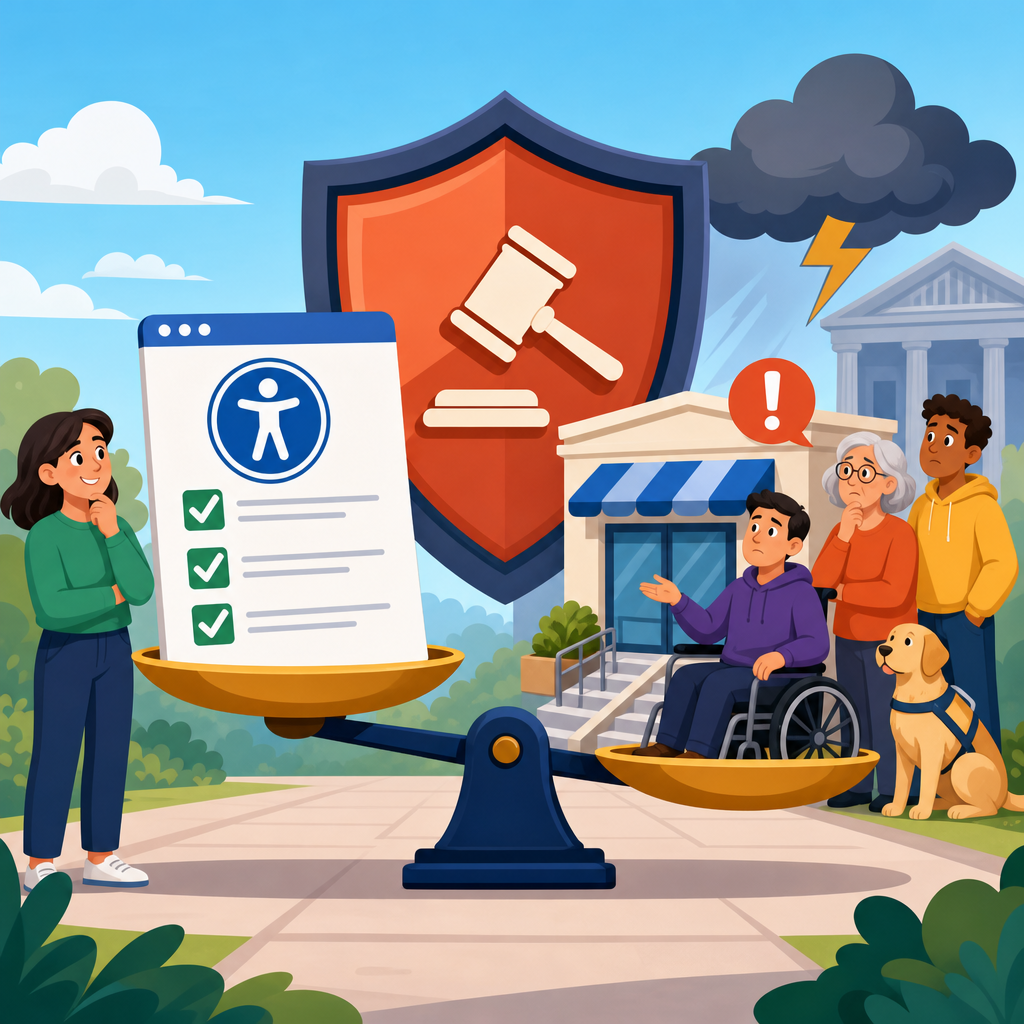
Litigation risks in accessibility statements and public promises have become a defining issue in digital accessibility litigation because the words organizations publish about inclusion can later be used to measure legal exposure, technical diligence, and credibility. An accessibility statement is a public document describing how a website, app, document library, kiosk, or digital service addresses access for people with disabilities, usually by referencing standards such as the Web Content Accessibility Guidelines, identifying known limitations, and offering a feedback channel. A public promise is broader: it includes press releases, procurement responses, annual reports, ESG disclosures, product roadmaps, customer commitments, social media posts, and executive remarks that claim a digital experience is accessible, compliant, inclusive, or usable by everyone. In practice, plaintiffs’ lawyers, regulators, advocacy groups, procurement teams, and judges often read these materials closely because they reveal what the organization knew, what it represented, and whether its conduct matched its statements.
This matters because digital accessibility litigation now sits at the intersection of disability law, consumer protection, contract risk, and software governance. In the United States, claims often arise under the Americans with Disabilities Act, Section 504, Section 508 in government contexts, state statutes such as California’s Unruh Civil Rights Act, and unfair or deceptive practices theories where marketing claims overstate accessibility. In Europe, organizations also face pressure from the European Accessibility Act, public sector accessibility rules, and national anti-discrimination laws. Across jurisdictions, the same pattern appears: when a company says a platform is accessible but users cannot complete core tasks with a screen reader, keyboard, captions, color contrast, or error recovery, the statement can become evidence. I have seen teams treat accessibility language as a branding exercise, then discover during demand letter response that every sentence created a factual record. The safer approach is not silence. It is disciplined, accurate communication tied to real testing, clear remediation, and accountable governance.
Why accessibility statements create legal exposure
An accessibility statement can reduce risk when it is truthful, specific, and operationalized, but it can increase risk when it is vague, absolute, or outdated. The central legal problem is mismatch. If a company states that its site “fully complies” with WCAG 2.2 AA, yet a blind user cannot submit a job application because the form fields are unlabeled, the gap between representation and reality becomes powerful evidence. Plaintiffs may use the statement to argue knowledge, reliance, and feasibility of remediation. Regulators may use it to test whether internal controls existed. Procurement customers may claim breach if accessibility was part of the bid response. Shareholders or watchdogs may point to inclusion language in sustainability reports and ask whether executives exercised adequate oversight.
Absolute terms are especially dangerous. Words such as “fully accessible,” “accessible to all,” “100% compliant,” or “meets every user’s needs” are easy to challenge because accessibility is not static and no meaningful digital estate remains unchanged for long. New releases, third-party widgets, PDFs, embedded video players, and account flows can introduce regressions weekly. Even when a platform performs well in one testing cycle, that does not guarantee universal access across assistive technologies, browsers, devices, and content types. Courts do not require perfect language from users asserting access barriers; they do, however, pay attention when defendants overstate capabilities. A measured statement that identifies the standard targeted, the scope covered, the testing methods used, and the way users can report issues is much easier to defend than a sweeping promise.
How plaintiffs and regulators use public promises
Public promises are discoverable, quotable, and often persuasive because they frame intent and expectations in the organization’s own words. During pre-suit investigation, counsel may compare marketing pages, help center language, investor materials, and policy documents against actual user experience. If the company claimed that online reservations, telehealth intake, banking login, or checkout were accessible, plaintiffs can allege that disabled users were invited to rely on those claims and then excluded at the point of transaction. Even where a claim is not independently actionable, it can support standing, rebut arguments that barriers were minor, and show that the organization already recognized accessibility as important and feasible.
Regulators look at these promises in a similar way but through a governance lens. The Federal Trade Commission has long scrutinized deceptive representations generally, and state attorneys general can investigate misleading consumer-facing claims. In education, healthcare, and public sector settings, agencies may review public accessibility commitments alongside procurement requirements, complaint histories, and remediation records. An accessibility page that promises prompt responses but routes users into an unmanned mailbox signals process failure. A statement that names WCAG 2.1 AA while internal teams build without any accessibility acceptance criteria signals control failure. The practical lesson is simple: every external promise should map to an internal owner, a measurable process, and evidence that the process works.
High-risk language and lower-risk alternatives
The language itself often determines whether an accessibility statement helps or harms. Over many reviews of website policies, app store descriptions, and RFP responses, the recurring risk pattern is unsupported certainty. Legal exposure rises when language guarantees outcomes, implies universal coverage, or misstates legal status. It falls when language accurately describes the current state, acknowledges limits, and directs users to effective support. The goal is not evasive drafting. The goal is precise drafting grounded in engineering reality and user feedback.
| High-risk wording | Why it creates exposure | Lower-risk approach |
|---|---|---|
| “Fully compliant with WCAG 2.2 AA” | Implies complete conformance across all pages, states, and content | “Designed to conform to WCAG 2.2 AA, with ongoing testing and remediation” |
| “Accessible to everyone” | Universal promise no complex system can guarantee | “We aim to provide an accessible experience for users with disabilities” |
| “If you have trouble, call us” | Alternative may not provide equal access or timely completion | “Report barriers here; we prioritize fixes and offer equivalent assistance” |
| “Our site meets ADA requirements” | The ADA does not publish technical web criteria in that form | “We use WCAG as our technical benchmark for accessibility improvements” |
| “Third-party content excluded” | May appear to disclaim responsibility for critical functions | “Some third-party features may present issues; we work with vendors and provide support” |
These alternatives work because they replace unsupported legal conclusions with verifiable operational facts. They also leave room for the most important truth in accessibility: conformance is a useful benchmark, but user experience is the ultimate test. A statement should therefore identify scope, such as website, mobile apps, or PDFs; versioned standards, such as WCAG 2.1 AA or WCAG 2.2 AA; testing methods, such as manual keyboard testing, screen reader checks, automated scanning, and document review; and a monitored contact method. Where issues remain, say so plainly. Credible candor is legally safer than polished overstatement.
Technical reality behind defensible statements
Defensible accessibility language starts with competent technical practice. WCAG provides success criteria, but litigation usually turns on whether users can complete critical tasks: searching products, reading disclosures, filling forms, authenticating accounts, scheduling appointments, viewing statements, and finalizing transactions. That is why mature programs pair conformance review with task-based testing. In my work, the strongest evidence has never been a dashboard alone. It has been a release process showing accessibility requirements in design, semantic HTML in implementation, quality assurance with keyboard and screen reader checks, defect tickets with severity ratings, and retesting after fixes. When that record exists, counsel can support the statement with facts rather than aspiration.
Named tools and methods matter because they demonstrate rigor, but they are not substitutes for human review. Automated scanners such as axe DevTools, WAVE, Lighthouse, and Siteimprove can identify recurring issues like missing alternative text, color contrast failures, empty buttons, and heading misuse. They cannot reliably judge task completion, meaningful alternative text, focus order adequacy in complex components, or the accessibility of dynamic states in single-page applications. Manual testing with NVDA, JAWS, VoiceOver, TalkBack, keyboard-only navigation, zoom, and reflow remains necessary, especially for modals, carousels, tables, date pickers, authentication flows, and PDF forms. If a statement says the site is tested regularly, there should be a defined cadence, documented methodology, and named accountable role behind that claim.
Third-party tools, legacy content, and inherited risk
Many digital accessibility disputes do not begin with code a company wrote itself. They begin with payment processors, chat widgets, mapping tools, applicant tracking systems, learning platforms, embedded videos, or vast PDF archives maintained across departments. Yet from a claimant’s perspective, the source of the barrier often does not matter if the barrier blocks access to the service being offered. That is why blanket disclaimers about third-party content rarely solve the legal problem. If a third-party checkout blocks a purchase, or an inaccessible identity verification flow blocks account creation, the organization that chose and deployed that vendor remains exposed.
The better strategy is layered control. Procurement terms should require accessibility standards, VPAT accuracy, testing cooperation, defect remediation timelines, and notice before material interface changes. Internally, teams should inventory high-impact third-party components and test them in realistic user journeys, not in isolation. Legacy documents deserve prioritization rather than denial. A hospital may have thousands of old PDFs, but the urgent issue is whether current intake forms, patient notices, and billing statements are usable now. A university may host years of inaccessible lecture files, but litigation risk rises sharply when current admissions, financial aid, and course registration materials are blocked. Statements should reflect this prioritization honestly: identify ongoing remediation, explain the fastest way to request accessible versions, and avoid implying that historical content is already remediated if it is not.
Governance, evidence, and response planning
Digital accessibility litigation is often won or lost on governance evidence created long before a complaint arrives. Organizations need a repeatable structure that connects legal review, product development, content publishing, customer support, procurement, and executive oversight. At minimum, that structure should include an accessibility policy, a standard for design and development, training for relevant teams, intake channels for user reports, triage rules, remediation service levels, and periodic audits of critical journeys. Issue tracking should distinguish minor conformance defects from barriers that prevent access to goods, services, or employment opportunities. The latter require immediate escalation.
Response planning is equally important because accessibility statements create expectations about timing and support. If the statement promises a response within five business days, the mailbox must be staffed and escalated. If users are invited to request accessible materials, the organization needs a workflow for fulfillment, not just acknowledgment. When a demand letter arrives, counsel will ask for versions of the statement over time, testing records, backlog history, support logs, vendor contracts, and prior complaints. A company that preserved these records, updated statements after major releases, and tied public claims to internal metrics is in a far stronger position than one that posted generic language years ago and never revisited it. Good governance does not eliminate liability, but it narrows allegations and improves settlement posture because it shows seriousness, continuity, and concrete progress.
How to write a hub-worthy accessibility statement strategy
Because this page serves as a hub for digital accessibility litigation, the practical takeaway is broader than drafting one website notice. Organizations need a statement strategy that aligns legal, technical, and operational realities across the digital estate. Start with scope: identify which websites, apps, portals, documents, and transactional journeys the statement covers. Next, identify the benchmark standard and version, usually WCAG 2.1 AA or WCAG 2.2 AA, and confirm that teams understand the difference between targeting conformance and claiming verified conformance. Then describe testing methods in plain language, including both automated and manual checks, and specify the channels users can use to report issues or request accessible alternatives. Finally, define update triggers such as redesigns, major feature releases, mergers, platform migrations, or new vendor deployments.
The strongest organizations treat accessibility statements as living governance artifacts, not footer decorations. They review them with counsel, accessibility specialists, product owners, and support leaders. They remove absolute language, add scope limitations where needed, and ensure that every promise can be fulfilled in practice. They also connect the statement to broader digital accessibility litigation preparedness: records retention, issue prioritization, procurement controls, and executive reporting. The benefit is twofold. First, users receive clearer information and better support when barriers arise. Second, the organization reduces the chance that its own words will become the sharpest evidence against it. Audit your current accessibility statements and public promises, compare them to actual testing and workflows, and revise them before a dispute forces the issue.
Frequently Asked Questions
1. Why can an accessibility statement create litigation risk if it is meant to show good faith?
An accessibility statement is intended to communicate commitment, transparency, and a path for users to report barriers, but it can also become a key piece of evidence in a dispute. When an organization publicly promises that its website, app, portal, or other digital service is accessible, plaintiffs and their counsel may compare that promise against the actual user experience. If the statement says the organization complies with WCAG, meets a specific conformance level, or provides equal access across digital properties, any gaps between the promise and reality can be framed as misleading, careless, or evidence of inadequate governance. In other words, the legal risk often comes not from having a statement at all, but from making broad, absolute, outdated, or unsupported claims.
Statements can also affect credibility. If a company says accessibility is a priority but has recurring barriers in basic workflows such as navigation, forms, checkout, authentication, or document access, the public commitment may be used to argue that the organization knew about accessibility obligations and failed to follow through. That can make it harder to characterize problems as isolated, newly discovered, or purely technical oversights. A carefully drafted statement should therefore align with documented accessibility work, current testing practices, remediation plans, and internal ownership. The safest approach is accuracy over aspiration: describe what has been done, what standard is being used as a target, what limitations remain, and how users can report issues and obtain assistance.
2. What kinds of wording in an accessibility statement are most likely to increase legal exposure?
The highest-risk language is language that is absolute, unqualified, or impossible to prove on an ongoing basis. Examples include phrases such as “fully accessible,” “100% compliant,” “all content meets WCAG,” or “accessible to everyone under all circumstances.” Digital environments change constantly because of software releases, third-party integrations, content uploads, document publishing, personalization, and mobile updates. Because accessibility can regress over time, sweeping claims are difficult to maintain and easy to challenge. If even one important feature fails for a user with a disability, an opposing party may point to the statement as evidence that the organization overstated its performance.
Another common problem is outdated specificity. A statement that references an old audit, an outdated WCAG version, or a conformance claim that no longer reflects the current state of the site can create unnecessary risk. Similarly, vague but promotional language such as “industry-leading accessibility” or “we guarantee equal access” can invite scrutiny if there is no measurable basis behind those claims. Organizations should also be cautious when describing timelines. Promising that all issues will be fixed by a certain date, or that accessibility will be achieved across all systems in a short window, can create a future benchmark that may later be used against them if delays occur.
Safer wording tends to be precise, current, and verifiable. It is better to say that the organization is working toward conformance with a named standard, conducts periodic testing, addresses reported issues according to priority, and offers a contact method for assistance. That kind of language still demonstrates commitment, but it avoids creating an evidentiary record of overstatement.
3. How should organizations balance transparency and legal caution when writing a public accessibility statement?
The goal is not to avoid saying anything meaningful. A bare, generic statement may do little to help users and can look performative. The better strategy is to be transparent in a controlled, accurate way. An effective statement usually identifies the scope of coverage, such as the website, mobile app, self-service kiosk, or document repository it applies to; the accessibility standard being used as a target, such as WCAG 2.1 AA or WCAG 2.2 AA; the methods used to evaluate accessibility, such as automated scanning, manual testing, assistive technology testing, or third-party review; and a clear process for users to report problems or request alternate formats. This gives users useful information without making promises the organization cannot support.
Legal caution comes from disciplined phrasing and internal validation. Every claim in the statement should be checked against actual policies, audit results, remediation workflows, and responsible teams. If the organization knows there are limitations, it is often better to acknowledge them carefully than to imply there are none. For example, a statement may explain that some legacy documents or third-party components may not yet fully meet the target standard and that the organization is prioritizing improvements. That kind of candor can improve trust while reducing the risk that the statement is characterized as deceptive or reckless.
It is also wise to treat the statement as a living compliance document rather than a one-time marketing asset. Accessibility, legal, product, procurement, and communications teams should all have input so that the final text reflects both user needs and defensible governance. Transparency helps most when it is matched by process, evidence, and maintenance.
4. Can public promises outside the formal accessibility statement, such as marketing claims or executive comments, be used in litigation too?
Yes. Litigation risk is not limited to the page labeled “Accessibility Statement.” Public promises can appear in press releases, ESG reports, annual reports, social media posts, investor materials, procurement responses, customer contracts, help center articles, and interviews by executives or spokespeople. If those statements describe the organization as accessible, compliant, inclusive by design, or committed to equal digital access, they may be cited to show what the organization represented to the public. In practice, a plaintiff may assemble a broader record of promises and compare that record to the barriers they encountered.
This matters because inconsistent messaging across departments can create avoidable exposure. For example, the legal team may approve a cautious accessibility statement, while marketing publishes stronger claims about seamless access for all users, or sales includes accessibility assurances in proposals without technical verification. Those different statements can be read together, and contradictions can undermine credibility. A company that says one thing in policy language and another in promotional language may appear disorganized or inattentive to accessibility governance.
To reduce this risk, organizations should create a review process for accessibility-related claims across public channels. Teams should know which terms require substantiation, what standards the company is referencing, and who approves language about conformance, testing, remediation, and timelines. The central principle is consistency: if the organization makes public promises about accessibility anywhere, those promises should be accurate, supportable, and aligned with actual implementation efforts.
5. What should a defensible accessibility statement include to reduce litigation risk while still helping users?
A defensible accessibility statement should be specific enough to be useful and restrained enough to remain accurate over time. It should identify the digital properties covered, the accessibility standard or conformance target being used, and the date the statement was last reviewed or updated. It should explain, in plain language, the organization’s accessibility efforts, such as integrating accessibility into design and development, conducting regular testing, remediating known issues, training staff, and evaluating third-party tools where possible. This shows that accessibility is being managed as an ongoing program rather than treated as a one-time claim.
It should also include a reliable contact mechanism for reporting barriers and requesting support, such as an email address, form, or phone number, along with what users can expect after making contact. That operational detail matters because it demonstrates a real pathway to assistance. If there are known limitations, the statement can acknowledge them in a measured way and describe the remediation approach. For example, it may note that some older PDFs, archived content, or embedded third-party features may present challenges and that the organization is working to improve them. This is often more credible than pretending every asset is already compliant.
Just as important, the statement should be backed by evidence. That means documented audits, issue tracking, remediation records, ownership assignments, review cycles, and a plan to update the statement as the digital environment changes. The strongest accessibility statements are not just well written; they are supported by real governance. When the published language matches the organization’s actual accessibility program, the statement is more likely to help users, support trust, and reduce the risk that public promises become damaging evidence in litigation.


