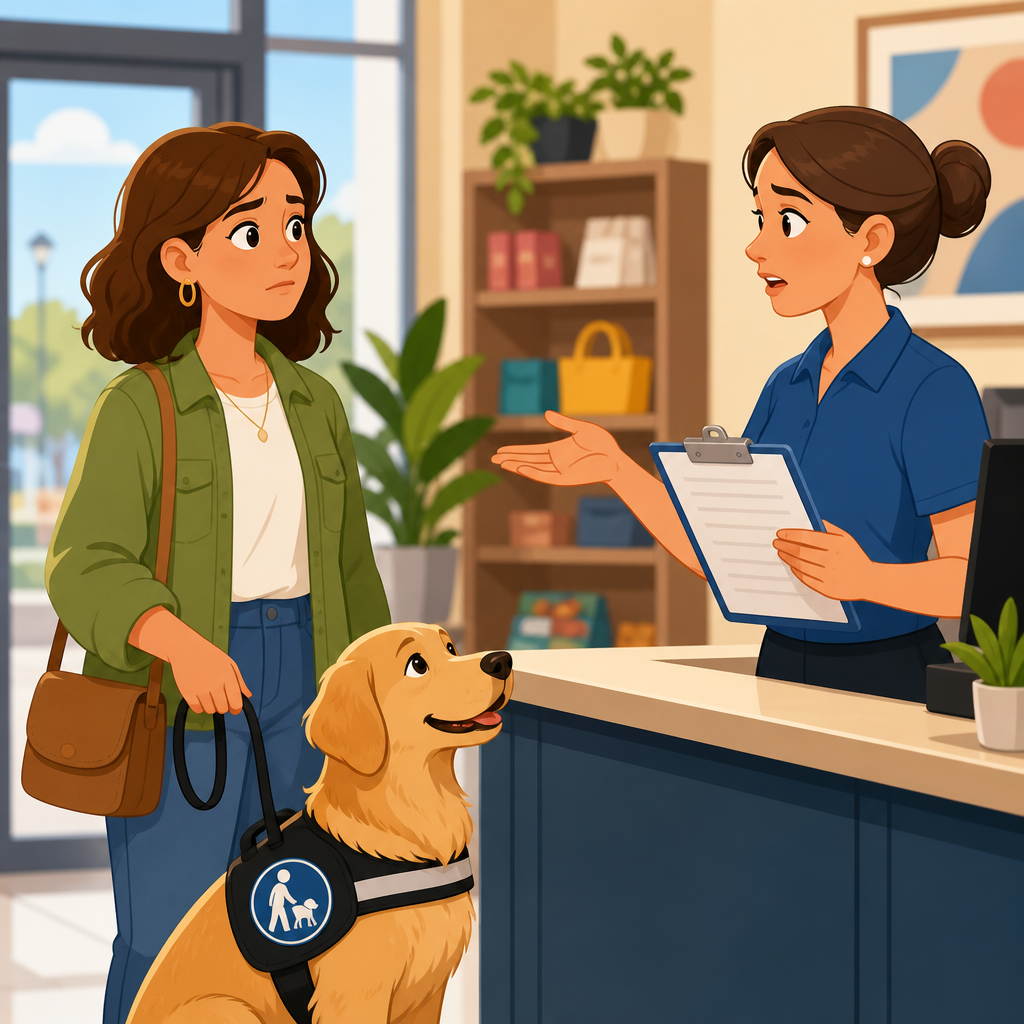
Service dog access disputes often begin with a simple but loaded question: “Can I see your papers?” In the United States, that question usually reflects confusion about the law, not a valid legal requirement. For businesses, housing providers, schools, and members of the public, understanding when documentation may be requested—and when it may not—matters because mistakes can quickly become discrimination claims. For disabled handlers, the issue is even more personal. Being stopped at a restaurant door, challenged in a hotel lobby, or delayed at a medical office can mean humiliation, denial of access, and interruption of necessary assistance. The central legal point is straightforward: under the Americans with Disabilities Act, businesses open to the public generally cannot require “service dog papers” as a condition of entry. But that broad rule has important limits, exceptions, and practical applications that are often misunderstood.
A service dog, in ADA terms, is a dog individually trained to do work or perform tasks for a person with a disability. The disability may be physical, sensory, psychiatric, intellectual, or another mental disability. The task must be directly related to the person’s disability, such as guiding a blind handler, alerting to seizures, retrieving items, interrupting self-harm behavior, or providing balance support. Emotional support, comfort, or companionship alone do not qualify as trained tasks under the ADA’s public-access rules. “Service dog papers” is not a legal term found in the ADA. People usually mean one of several things: a doctor’s letter, a training certificate, an online registration, an identification card, or a vest. None of those items, by themselves, determine whether a dog is a service animal for public access under federal law.
I have seen this confusion play out repeatedly in compliance reviews and complaint investigations. Frontline staff often assume that because parking placards, driver licenses, and professional credentials come with formal documentation, service dogs must work the same way. They do not. The ADA was designed to prevent disabled people from facing extra screening barriers in everyday life. That is why the Department of Justice allows only two narrow questions when a disability and the dog’s work are not obvious: whether the dog is required because of a disability, and what work or task the dog has been trained to perform. Staff may not demand documentation, require the dog to demonstrate its task, or inquire into the nature of the person’s disability. Those are the baseline rules that shape nearly every real-world case.
What the law actually allows when a customer is asked for service dog papers
The legal answer depends first on setting. In places of public accommodation—restaurants, stores, hotels, theaters, hospitals, banks, gyms, and similar businesses covered by Title III of the ADA—staff cannot require proof, certification, or registration before admitting a service dog. The Department of Justice guidance is explicit on this point. There is no federally recognized service dog registry, no official national certificate, and no lawful public-access rule requiring handlers to carry paperwork. If the need for the dog is obvious, such as a guide dog assisting a blind person, staff should not ask the two ADA questions at all. If the disability or task is not apparent, those two questions are the outer limit of the inquiry.
That does not mean handlers have unlimited rights in every circumstance. A service dog may be excluded if it is out of control and the handler does not take effective action to control it, or if the dog is not housebroken. A business also does not have to alter legitimate safety requirements that are necessary for safe operation, though those standards must be based on actual risk, not stereotypes or generalized fear of dogs. Allergies and fear of dogs are not valid reasons to deny entry. In practice, many unlawful denials arise when staff skip the actual ADA standard and substitute their own checklist: vest, ID card, registration number, doctor’s note, or “papers.” That is where legal exposure begins.
State law can add penalties or procedural details, but it cannot reduce federal ADA protections. Some states criminalize misrepresenting a pet as a service animal. Those laws are aimed at fraud, yet they do not authorize businesses to invent documentation demands inconsistent with the ADA. This distinction matters. A manager may believe that asking for papers is a reasonable anti-fraud measure. Legally, it is usually not. Businesses should train staff to evaluate behavior and ask only the two permitted questions when appropriate. That approach is lawful, practical, and less likely to escalate conflict.
Where documentation rules differ: housing, air travel, employment, and schools
Many access disputes happen because people mix together legal regimes that serve different purposes. Housing is a common example. Under the Fair Housing Act, a landlord or housing provider may request reliable disability-related information when a disability or disability-related need for an assistance animal is not obvious. Assistance animals in housing include both service animals and emotional support animals, so the analysis is broader than under the ADA. In that setting, documentation can be lawful, but it must be limited and relevant. A landlord cannot demand overly intrusive medical records, yet can often ask for information that reasonably supports the disability-related need for the animal.
Air travel changed significantly after the U.S. Department of Transportation revised its rules. Airlines are no longer required to treat emotional support animals as service animals, but they may require passengers traveling with service dogs to complete specific DOT forms attesting to health, behavior, and training. That is a true paperwork requirement, but it exists in air travel, not in restaurants or retail stores. I often see travelers assume airline forms prove public-access rights everywhere else. They do not. Conversely, business owners sometimes believe airline paperwork standards apply to their café or hotel. They do not either.
Employment under Title I of the ADA introduces another distinction. An employee requesting to bring a service dog to work is seeking a workplace accommodation, not merely entering a public space. Employers may engage in the interactive process and request reasonable documentation of disability and need when not obvious. Schools, colleges, and healthcare settings can involve overlapping federal and state rules, including disability law, patient safety protocols, and in some cases separate accommodation procedures. The key is to identify the governing framework before deciding whether any documentation may be requested.
| Setting | Can papers be required? | Main rule | Typical lawful inquiry |
|---|---|---|---|
| Restaurant, store, hotel | No, not as entry condition | ADA Title III public access | Only the two ADA questions if need is not obvious |
| Rental housing | Sometimes | Fair Housing Act accommodation | Reliable information supporting disability-related need |
| Air travel | Yes, often | DOT air carrier rule | DOT service animal forms |
| Workplace | Sometimes | ADA Title I accommodation | Reasonable documentation in interactive process |
| Public school or college | Depends on context | ADA, Section 504, school policy | Context-specific accommodation review or public-access standard |
Rights in action: real-world case studies that show how these rules work
Case studies make the doctrine clearer than abstract summaries. Consider a restaurant host who stops a customer with a dog wearing no vest and says, “No dogs unless you show certification.” The customer replies that the dog is a service animal trained to alert to seizures. Under the ADA, the host’s certification demand is improper. The lawful response would have been either to admit the team if no question was needed, or to ask the two ADA questions and stop there. If the dog then lies quietly under the table, the restaurant has no basis to exclude it. If the host turns the customer away, that may support an ADA complaint, a state civil rights complaint, or private litigation depending on the facts.
Now compare a grocery store scenario where a dog in a vest is barking at shoppers, lunging toward carts, and ignoring repeated handler cues. The manager asks the handler to remove the dog. That action may be lawful even if the dog is a genuine service animal. Public access rights depend not only on status but on control. I have reviewed incidents where businesses made the opposite mistake: they tolerated dangerous or disruptive behavior because they feared any action would violate disability law. The ADA does not require that. It requires equal access, not exemption from basic behavior standards.
A hotel example shows another common problem. A clerk asks for pet fees because “there’s no proof this is a service dog.” Charging a pet fee for a service dog is unlawful under the ADA, though a hotel may charge for actual damage if it would charge any guest for comparable damage. In one compliance audit I worked on, the real issue was not hostility but fragmented training. Reservations staff knew the rule, front-desk staff did not, and night managers improvised. The result was inconsistent treatment that exposed the business to avoidable complaints. Written policies, scenario-based training, and manager scripts fixed the problem faster than any sign posted at the desk.
Healthcare settings produce especially sensitive disputes. A clinic may not impose a blanket “papers required” rule, but it may still enforce legitimate infection-control and safety protocols grounded in clinical necessity. For example, a service dog can usually accompany a patient in exam rooms and waiting areas, but not necessarily into a sterile operating environment where access restrictions apply to everyone. The decisive question is whether the limitation is based on evidence and applied neutrally, not on assumptions that dogs are inherently unsanitary. When clinics train staff on that distinction, conflict drops sharply.
Common myths, high-risk mistakes, and how businesses should respond
The biggest myth is that a vest, ID tag, certificate, or online registration proves legal status. In reality, those items are neither required nor conclusive. A legitimate service dog may have none of them, while a pet owner can buy all of them online in minutes. The second myth is that businesses are helpless against abuse. They are not. They can ask the two permitted questions, observe behavior, remove uncontrolled or unhousebroken dogs, and document incidents factually. The third myth is that staff may ask for a diagnosis if the task sounds psychiatric. They may not. Psychiatric service dogs are recognized service animals when individually trained to perform disability-related tasks.
High-risk mistakes usually come from overreaching during intake. Staff ask for medical records, demand that the dog perform a task on command, insist that only “certified” programs are valid, or declare that local health codes ban all animals in food establishments. Federal law overrides conflicting local rules for service animals in covered public spaces. Another common error is speaking only to the handler’s companion, not to the handler directly, or publicly challenging the person in a way that reveals private disability information. These are not just courtesy failures; they increase complaint risk because they show poor policy execution.
The best business response is operational, not emotional. Create a short written policy using DOJ language. Train frontline staff with realistic examples, including invisible disabilities and psychiatric service dogs. Give employees a script for the two questions and for behavior-based exclusion decisions. Empower a manager to resolve disputes quickly. Keep incident notes limited to objective observations: barking, lunging, urinating indoors, running loose, or handler refusal to answer the two permitted questions. Avoid labels like “fake service dog” unless there is clear evidence tied to policy violations. Precision matters in both customer service and legal defense.
What handlers can do when unlawfully asked for papers
Handlers facing an unlawful demand should respond calmly and clearly. A practical script is: “Under the ADA, there is no certification requirement for public access. You may ask whether the dog is required because of a disability and what task the dog is trained to perform.” That statement often resolves the issue because many staff members simply have outdated or incorrect training. If the denial continues, ask for a manager, note the names of employees involved, record the date, time, and what was said, and preserve receipts or reservation records. If witnesses are present, collect contact information if possible. Good documentation strengthens any follow-up complaint.
Options for enforcement vary. A person may file an ADA complaint with the U.S. Department of Justice. Many states and cities also have civil rights agencies that accept disability-access complaints, sometimes with faster intake and mediation options. In some situations, private counsel may pursue injunctive relief, damages under state law, or settlement demands based on repeated denial patterns. I generally advise handlers to distinguish between ignorance and entrenched policy. A single confused employee can often be corrected through education. A business that posts a “service dog papers required” sign or repeatedly denies access after notice is creating a larger legal problem for itself.
Preparation helps. Although papers are not required for ADA public access, handlers may benefit from carrying a concise card quoting DOJ guidance, especially during travel. They should also ensure the dog is reliably housebroken, under control, and prepared for the environments they enter. That is not about proving legitimacy through paperwork; it is about reducing conflict and protecting access for everyone who depends on a working dog.
The question “Is it legal to ask for service dog papers?” has a clear core answer: in most public businesses covered by the ADA, no. Staff may ask only whether the dog is required because of a disability and what work or task it has been trained to perform when the need is not obvious. They may not demand certification, registration, a doctor’s letter, or a demonstration. But the broader rights-and-protections landscape is more nuanced. Housing, employment, air travel, and education operate under different standards, and that is why this topic needs a hub approach grounded in real cases rather than slogans.
The practical lesson is simple. For businesses, lawful service dog compliance means replacing myths with policy, scripts, and behavior-based decision-making. For handlers, it means knowing the exact rule, asserting it calmly, and documenting violations carefully. Rights in action are rarely tested in court first; they are tested at host stands, check-in desks, clinic counters, and apartment offices. If you want fewer conflicts and stronger protection, use this page as your starting point and build from these real-world applications into the related articles in the Rights and Protections hub.
Frequently Asked Questions
Is it legal to ask a customer for service dog papers in the United States?
In most everyday public access situations, no. Under the Americans with Disabilities Act (ADA), businesses that serve the public generally may not require a person with a service dog to show “papers,” certification, registration, an ID card, or any other special documentation before allowing entry. That is because the ADA does not require service dogs to be federally registered or certified, and there is no official national service dog paperwork that handlers must carry. A customer cannot legally be turned away just because they do not have documents to present.
What a business usually can do, if the disability is not obvious and the dog’s role is not clear, is ask two limited questions: whether the dog is required because of a disability, and what work or task the dog has been trained to perform. Those are the recognized boundaries in most public accommodations cases. Staff may not demand medical records, ask the customer to disclose the diagnosis, require the dog to demonstrate its task, or insist on proof from a doctor as a condition of entry. So when someone asks, “Can I see your papers?” the question is usually based on misunderstanding, not an enforceable legal rule.
What questions is a business actually allowed to ask about a service dog?
In a typical public business setting, the law allows a very narrow inquiry. If it is not obvious that the dog is a service animal, staff may ask: first, whether the dog is required because of a disability; and second, what work or task the dog has been trained to perform. Those two questions are designed to balance disability access with a business’s need to understand whether the animal qualifies for protection under the ADA.
Just as important is what staff may not ask. They should not ask the customer to identify or explain the disability in detail, produce medical documentation, show a training certificate, reveal private health information, or prove that the dog is “official.” They also should not rely on things like a vest, tag, or online registration as the legal standard, because those items are not what determines protected status under federal law. The focus is on whether the dog is individually trained to do work or perform tasks for a person with a disability. If employees go beyond those limited questions, a routine interaction can quickly become a privacy problem or a discrimination issue.
Are there situations where documentation for a service dog can legally be requested?
Yes, but context matters a great deal. The familiar ADA rule against demanding “papers” applies mainly to public accommodations such as restaurants, stores, hotels, and similar businesses open to the public. Other settings operate under different laws and may allow different types of documentation requests. Housing is a major example. Under fair housing rules, a landlord or housing provider may in some circumstances request reliable information supporting the need for an assistance animal if the disability or disability-related need is not obvious. That is not the same as demanding a service dog certificate, but it can involve documentation related to the person’s disability-related need for the animal.
Schools, workplaces, air travel, and court systems can also involve different legal frameworks and procedures. For example, employers evaluating a workplace accommodation request may seek reasonable documentation connected to the accommodation process. Housing providers may ask questions that a restaurant cannot. That is why the answer to “Can they ask for papers?” is often “not in a public business, but maybe in another legal setting depending on the facts.” The key point is that documentation rules are highly context-specific, and people often make mistakes by assuming the public access rules apply everywhere in exactly the same way.
Can a business ever remove or exclude a service dog if it cannot ask for papers?
Yes. A business does not need the right to ask for papers in order to enforce legitimate behavior and safety standards. Even a protected service dog can be excluded in limited situations, such as when the dog is out of control and the handler does not take effective action to control it, or when the dog is not housebroken. A business may also exclude an animal if its presence would create a legitimate direct threat to health or safety that cannot be reduced by reasonable measures. These decisions must be based on actual conduct and real circumstances, not fear, stereotypes, allergies, assumptions about breed, or suspicion that the customer “looks too healthy” to have a disability.
That distinction is important. The law generally protects access for service dog handlers, but it does not require businesses to tolerate disruptive or unsafe behavior. If a dog is barking repeatedly without justification, lunging at customers, running loose, or causing sanitation problems, the business may take action. However, the customer should still be offered the opportunity to obtain goods or services without the animal present when that is feasible. In other words, businesses may address behavior, but they cannot create their own paperwork requirement as a gatekeeping tool.
What should a customer do if they are stopped and asked for service dog papers?
The most effective response is usually calm, brief, and informed. A handler can explain that the ADA does not require service dog papers for public access and, if appropriate, answer the two permitted questions: that the dog is required because of a disability and what task or work the dog performs. Many disputes are caused by lack of staff training rather than intentional discrimination, so a composed explanation often resolves the issue faster than an argument. If the employee seems unsure, asking politely for a manager can help.
If access is still denied, the customer should document what happened as soon as possible. Useful details include the date, time, location, names of employees or managers, what was said, whether other witnesses were present, and whether the business cited a policy about certification or registration. Receipts, photos, and written notes can be helpful later. Depending on the situation, the person may choose to file a complaint with the business, submit a complaint to the U.S. Department of Justice or the appropriate state or local civil rights agency, or speak with an attorney about disability discrimination rights. The bottom line is that handlers do not have to produce nonexistent “service dog papers” just to enjoy equal access in most public places.