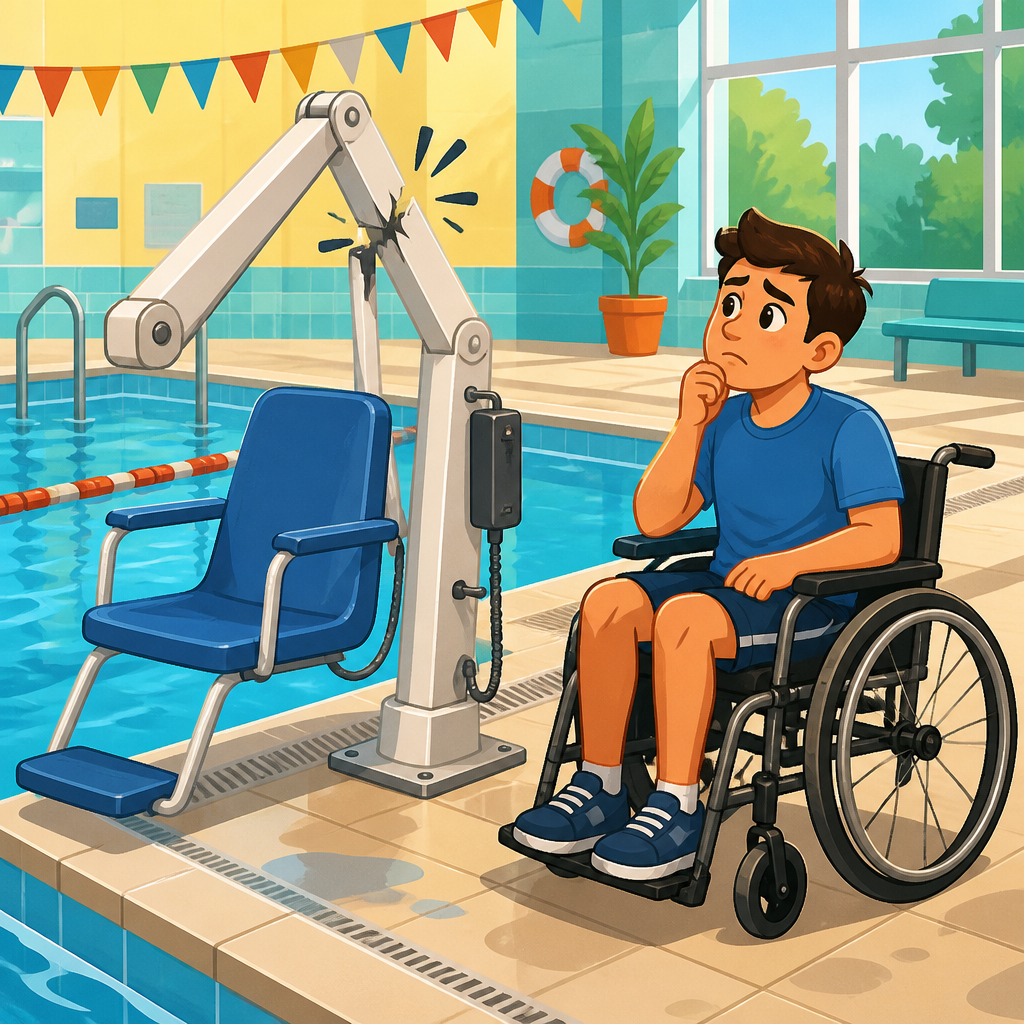
A wheelchair user arrives at a public pool on a hot afternoon, changes into swimwear, reaches the deck, and discovers the lift is broken; in that moment, civil rights law stops being abstract and becomes a practical test of whether equal access exists in daily life. This case study sits at the center of rights and protections because it shows how disability access works in the real world: not only through statutes and technical standards, but through maintenance routines, staff training, budgeting decisions, complaint systems, and the choices made by public agencies under pressure. A public pool is typically operated by a city, county, school district, park authority, or contracted recreation provider, which means multiple legal duties may apply at once. Key terms matter. Accessibility means a facility can be used by people with disabilities in an equitable, integrated way. Reasonable modification means changing policies or practices when necessary to avoid discrimination, unless doing so would fundamentally alter the service. Program access means a public entity must ensure people with disabilities can participate in services when viewed in their entirety. This topic matters because a broken lift is rarely just a mechanical problem; it is often a systems problem that reveals whether an organization understands its obligations, documents inspections, plans repairs, and responds respectfully when access fails. I have worked through accessibility complaints where the decisive facts were not dramatic legal theories but maintenance logs, incident reports, email trails, and whether staff knew what to do when equipment went down. This article serves as the hub for rights in action case studies and real-world applications by using one concrete scenario to connect legal principles, operational responsibilities, and practical next steps for wheelchair users, families, advocates, and facility managers.
What rights apply when a pool lift is broken
When a public pool lift is broken, the first question is simple: does the operator have a legal duty to provide accessible entry to the pool on that day? In most public settings, the answer is yes, subject to the type of facility, when it was built or altered, and whether another accessible means of entry is available. Public entities are generally covered by Title II of the Americans with Disabilities Act, while privately operated places of public accommodation are generally covered by Title III. Section 504 of the Rehabilitation Act may also apply if the operator receives federal funding. State disability rights laws often add parallel protections and, in some jurisdictions, stronger remedies.
For swimming pools, accessibility requirements are tied to the 2010 ADA Standards for Accessible Design. Large pools generally must provide at least two accessible means of entry, with a pool lift or sloped entry required as one of them; smaller pools generally must provide at least one accessible means of entry, usually a lift or sloped entry. A lift must be operable and available during all hours the pool is open unless it is shared in a compliant way or another lawful arrangement applies. In practical terms, a covered pool cannot satisfy access requirements by owning a lift that is stored, uncharged, missing a sling, blocked by furniture, or reserved only when a manager is present.
Program access is especially important for older public facilities. Even when a facility predates current design standards, a public entity still must provide access to its services when viewed in their entirety. That does not always mean every old pool must be rebuilt immediately, but it does mean a city cannot advertise open swim to the public and then leave wheelchair users without a usable way to enter the water. If the only compliant entry at that location is out of service, the operator should already have a response plan: immediate repair, access to another nearby compliant pool with transportation support where appropriate, schedule adjustments, and direct communication with patrons.
Real disputes often turn on details. If the lift broke that morning and a repair technician was called immediately, the legal analysis may differ from a situation where the battery had been dead for weeks and staff repeatedly ignored complaints. The law recognizes genuine equipment failures; it does not excuse preventable neglect. That distinction is why records matter so much in rights in action cases.
How this case study reveals the gap between policy and practice
On paper, many recreation departments have strong accessibility language. Their websites say everyone is welcome, their capital plans mention inclusion, and their procurement files show that a compliant lift was purchased. Yet the real experience of a wheelchair user depends on operational follow-through. In my experience reviewing access failures, the same pattern appears repeatedly: the organization treats accessibility equipment like optional furniture rather than mission-critical infrastructure. A broken chlorine pump closes a pool quickly because staff understand the safety implications. A broken lift too often remains unresolved because managers misclassify it as an inconvenience rather than a barrier to equal participation.
This gap between policy and practice shows up in small failures that compound. The lift battery is not on a charging schedule. Staff were never trained to do the daily operability check. The user manual is locked in an office. The emergency lowering system has not been tested. The seatbelt is missing. The deck route to the lift is narrowed by stacked lounge chairs. A patron asks for help and the front-desk employee says, “We don’t know how to use it.” None of those facts alone tells the whole story, but together they reveal whether a public entity has built accessibility into standard operations.
Public pools are ideal case studies because they involve facilities, equipment, staffing, dignity, and time-sensitive participation. If access fails at a courtroom, the person may reschedule. If access fails at a pool during a community event, swim lesson, or therapy session, the lost opportunity may not be recoverable. Children miss class progression. Adults with rehabilitation goals lose a reserved aquatic therapy slot. Families experience public embarrassment. Rights in action means looking at these downstream effects, not just the hardware defect.
| Issue at the Pool | What It Means Legally | Practical Evidence |
|---|---|---|
| Lift battery dead | Possible failure to maintain accessible features in operable condition | Charging logs, inspection checklist, staff statements |
| Staff cannot operate lift | Possible policy and training failure affecting equal access | Training records, manuals, incident report |
| Lift blocked by deck furniture | Accessible route may be obstructed | Photos, witness accounts, surveillance footage |
| Lift broken for weeks | Potential ongoing discrimination if repair unreasonably delayed | Work orders, emails, repeat complaints |
| No alternative offered | Possible failure to provide program access or reasonable modification | Patron notes, call records, posted schedules |
What the wheelchair user should do in the moment
The immediate goal is access, not argument. Start by asking for the supervisor on duty and state the problem clearly: the pool lift is broken, you are ready to use the pool, and you need an accessible means of entry now. Ask whether another compliant entry exists at that pool, whether staff can restore the lift immediately, and whether there is an alternative accessible pool available today. This phrasing matters because it frames the issue as a request for equal participation, not a favor.
Document facts while they are fresh. Note the date, time, names of staff, the exact response given, and whether any alternative was offered. Take photos of the lift, the surrounding deck, and any posted notices if permitted. If the lift has an error code or low-battery indicator, capture that. If you came for a scheduled class or therapy session, keep confirmation emails or receipts. If others witnessed the denial of access, ask for their contact information. In accessibility matters, contemporaneous notes are often more persuasive than later summaries.
It is also reasonable to ask for the facility’s accessibility coordinator, ADA coordinator, or risk manager. Many public entities are required to designate responsible personnel and maintain a grievance procedure. A calm request such as, “Please connect me with the ADA coordinator and create an incident report today,” signals that the problem is legally significant. If staff offer manual lifting by employees instead of a compliant device, be careful. Well-intended improvisation can create safety risks and does not necessarily satisfy legal obligations.
Finally, ask for a concrete remedy and timeline. That could mean immediate transfer to another accessible pool, a makeup lesson, waived fee, transportation assistance, or written notice when the lift is repaired. Specific requests produce specific responses, which is useful both for solving the problem and for preserving the record if escalation becomes necessary.
How public agencies should respond and where they often fail
A well-run public agency responds to a broken lift the way it responds to any essential service interruption: verify the problem, mitigate harm, repair urgently, document every step, and communicate respectfully. The first responsibility is maintenance of accessible features. Department of Justice regulations require accessible features to be maintained in operable working condition, except for isolated or temporary interruptions due to maintenance or repairs. That exception is narrow. It protects good-faith operators dealing with genuine breakdowns; it does not shield chronic neglect.
In practice, strong agencies use preventive maintenance schedules, manufacturer-recommended battery replacement cycles, daily opening checklists, and annual audits aligned with ADA Standards. They train all relevant staff, not just one specialist, because a single trained employee may be absent when a patron arrives. They stock common replacement parts, maintain service contracts, and give frontline workers authority to escalate repairs without bureaucratic delay. They also build communication protocols so websites, phone lines, and on-site signage accurately reflect outages and alternatives.
Failures usually come from fragmentation. Parks staff assume facilities staff handle the lift. Facilities staff assume aquatics staff check the battery. Procurement delays hold up a simple repair. No one owns the patron communication plan. I have seen complaints resolved quickly when a city attorney, ADA coordinator, and aquatics manager treated the issue as a cross-functional incident rather than a customer-service annoyance. I have also seen the opposite: months of delay because each department insisted the problem belonged to someone else.
Budget is a real constraint, but it is not a blanket defense. Courts and agencies look at reasonableness, planning, and effort. If an operator can fund marketing campaigns, concession upgrades, and seasonal events, it will be difficult to justify leaving the only accessible pool entry unusable for an extended period. Prioritization tells the story.
Enforcement paths, evidence, and related rights in action topics
If the issue is not resolved promptly, several enforcement paths exist. A complaint may be filed through the public entity’s grievance procedure, with the city or county ADA coordinator, with a state human rights or civil rights agency where applicable, or with the U.S. Department of Justice. If the pool is connected to a school or university, the U.S. Department of Education’s Office for Civil Rights may also be relevant. Section 504 complaints can matter when federal funding is involved. In some situations, consultation with a disability rights attorney or protection and advocacy organization is appropriate, especially if the barrier is recurring or affects multiple users.
The strongest cases are built on ordinary evidence. Preserve photographs, repair timelines, emails, voicemails, screenshots of web pages advertising accessible swimming, receipts, witness statements, and copies of policies. Request records when possible, including maintenance logs, work orders, incident reports, and training materials. Public records laws can be useful for city-operated pools. Patterns matter. A single failure may be framed as temporary interruption; a string of battery problems, canceled classes, and ignored complaints can establish systemic denial of access.
This case also connects to a broader set of rights in action articles. Broken lifts overlap with transportation barriers to reaching alternative facilities, communication barriers when outage information is not provided accessibly, service animal issues on pool decks, inclusive recreation policies, and retaliation concerns when patrons who complain are treated poorly afterward. As a hub topic, this scenario helps readers understand how disability rights operate across environments: schools, parks, libraries, housing offices, voting sites, clinics, and digital services all produce similar evidence trails and similar questions about maintenance, modification, and meaningful access.
The central lesson is practical. Rights are enforced through systems, and systems leave records. When people know what standards apply, what evidence to gather, and what remedies to request, they move from frustration to effective action. For public agencies, the same lesson applies in reverse: if you want to reduce legal risk and serve residents well, make accessibility operational, measurable, and accountable before the lift breaks.
A wheelchair user facing a broken lift at a public pool is not encountering an isolated inconvenience; they are encountering a real-world test of whether rights and protections function as promised. This hub article shows why case studies matter. They translate legal language into observable facts: was the lift operable, were staff trained, was an alternative offered, was the repair timely, and did the agency document its response? Those questions recur across nearly every access dispute, which is why this pool scenario is such a useful anchor for the broader rights in action topic.
The main benefit of understanding this case is clarity. Wheelchair users and families can recognize when an access failure is likely a legal issue rather than a simple customer-service problem. Advocates can build stronger complaints by focusing on maintenance records, policies, timelines, and program access. Facility managers can use the same framework to prevent failures before they become public incidents or formal claims. Good accessibility work is concrete: inspect equipment, train staff, assign responsibility, communicate outages, and repair barriers fast.
If you are building knowledge around rights and protections, use this article as your starting point for the wider set of real-world applications. Review related case studies, compare how standards apply in different public settings, and keep a practical checklist for documentation and escalation. Rights become meaningful when people know how to recognize a violation, ask for an effective remedy, and insist that equal access be treated as an essential public service.
Frequently Asked Questions
What rights does a wheelchair user have if a pool lift is broken at a public pool?
A wheelchair user generally has the right to equal access to the pool’s programs, services, and facilities, and a broken lift can raise serious accessibility concerns under disability civil rights law. For a public pool operated by a city, county, school district, park district, or other government entity, the legal framework usually includes the Americans with Disabilities Act, particularly Title II. For a privately operated public accommodation such as a hotel, gym, health club, or swim school, Title III of the ADA often applies. In either setting, the central issue is not whether access exists on paper, but whether it is available in practice when the person arrives ready to use the pool.
If the lift is the designated accessible means of entry and it is out of service, the question becomes whether the facility has failed to maintain accessible features in operable working condition. The ADA does not treat accessibility as a one-time construction obligation only; it also expects ongoing usability. That means a public pool cannot simply install a lift to meet a requirement and then ignore maintenance, inspections, repairs, or staff readiness. A broken lift may be evidence that equal access is being denied in a real and immediate way, especially when no comparable alternative is available.
That said, the legal analysis can depend on the facts. A brief and unexpected mechanical failure that is addressed promptly may be viewed differently from a lift that has been broken for weeks, lacks repair orders, or remains unusable because nobody budgeted for maintenance. Staff response matters too. If employees are trained, communicate clearly, document the issue, offer available alternatives, and escalate repairs immediately, that can affect how the situation is evaluated. But from the wheelchair user’s perspective, the practical harm is obvious: they arrived to swim and could not access the water like everyone else. That is exactly why this scenario is often used to explain how disability rights operate in everyday life.
Is a public pool required to keep its accessibility equipment maintained and ready for use?
Yes, in general, accessibility equipment such as a pool lift must be maintained in operable working condition so that disabled patrons can actually use the facility. This is one of the most important real-world aspects of disability access. Compliance is not just about design drawings, equipment purchases, or passing an inspection at some point in the past. It is also about everyday operational reliability. A lift that is technically present but frequently broken, missing parts, uncharged, blocked by furniture, or unusable because no one knows how to operate it may still amount to a serious access failure.
Proper maintenance usually includes regular inspection schedules, battery charging if the lift is powered, preventive servicing, prompt repairs, and clear procedures for taking equipment out of service and restoring it quickly. It also includes making sure the lift is not treated like optional equipment that can be ignored until someone complains. Public entities and businesses that serve the public are expected to understand that accessible features are part of the facility’s core function, not an add-on. If a pool regularly welcomes the public, then the mechanism that allows some patrons to enter the water is every bit as important as the ladders, filtration systems, or locker room lights.
Readiness also depends on staff training. A lift may be fully functional, but if no one on duty knows where the sling is, how to secure the seatbelt, how to position the chair, or who is authorized to assist, access can fail all the same. That is why strong compliance programs include both equipment care and personnel preparation. In many access disputes, the breakdown is not a dramatic legal issue but a management issue: no checklist, no accountability, no routine testing, and no urgency. When that happens, a broken lift becomes more than an inconvenience. It becomes evidence that equal access was not built into the facility’s daily operations.
What should staff do in the moment when a disabled patron discovers the pool lift does not work?
Staff should respond immediately, respectfully, and in a way that treats the problem as urgent. The first priority is communication. Employees should acknowledge the issue clearly, apologize without defensiveness, and avoid minimizing the impact. A wheelchair user who has already traveled to the pool, changed clothes, and reached the deck has invested time, effort, and trust in the facility. Being met with confusion, indifference, or excuses can turn an access barrier into a humiliating experience. Good staff response starts with recognizing that this is not a minor customer service issue; it is an access issue affecting equal participation.
Next, staff should verify the problem and escalate it right away to a supervisor or manager with authority to act. If the issue is something simple and safely fixable, such as a battery that was not charged or a component that was stored improperly, trained personnel should address it promptly. If the lift is truly broken, staff should document the malfunction, place an immediate repair request, and explain the timeline honestly. They should also be prepared to discuss any lawful, safe, and actually available alternatives, without pressuring the patron to accept something inferior, unsafe, or undignified. Alternatives should never be improvised in ways that put the swimmer at risk, such as manual lifting by untrained staff.
Equally important, staff should know what not to say. They should not blame the patron for coming at a busy time, suggest they return another day without further help, claim ignorance about accessibility obligations, or imply that because the pool has a lift somewhere on site, the facility has done enough. A well-run facility trains employees in advance so they know how to handle accessibility breakdowns with competence and respect. That includes reporting protocols, maintenance contacts, customer communication standards, and a clear understanding that preserving disabled patrons’ dignity is part of the job. The immediate response will not erase the barrier, but it can determine whether the incident becomes a solvable problem or a preventable civil rights failure.
Does one broken lift automatically mean the pool has violated the ADA?
Not automatically, but it can strongly suggest a violation depending on the circumstances. Disability access cases are often fact-specific. The law generally distinguishes between isolated, temporary interruptions in service or access due to maintenance or repairs and ongoing failures that effectively deny equal access. So if a lift failed unexpectedly that morning, the facility had a solid maintenance history, staff discovered the problem quickly, repair efforts began immediately, and the interruption was genuinely temporary, that may be viewed differently from a situation where the lift has been broken repeatedly or left unusable for an extended period.
Still, “temporary” is not a magic word. A facility cannot avoid responsibility simply by labeling chronic neglect as temporary inconvenience. Investigators, advocates, and courts often look at patterns: How long was the lift out of service? Were there prior complaints? Was there a preventive maintenance plan? Did management order repairs promptly? Were staff trained to test the equipment? Was there a backup method of providing accessible entry where one is legally appropriate and practically usable? The answers help show whether the problem was an unavoidable short-term malfunction or the predictable result of poor policies and weak oversight.
In practical terms, the wheelchair user’s lived experience matters greatly. If the person could not use the pool on equal terms with others, that is the harm disability law is designed to address. A single incident may still support a complaint, particularly if it reveals broader problems such as nonexistent maintenance systems or staff who do not understand their obligations. So while not every broken lift automatically proves an ADA violation, no facility should assume the issue is legally trivial. When access depends on one piece of equipment, keeping that equipment working is central to compliance, not incidental to it.
What can a wheelchair user do after encountering a broken lift at a public pool?
A wheelchair user who encounters a broken lift can take several practical steps, both to protect their own interests and to help create a clear record of what happened. First, they may want to ask for the name and title of the employee or manager on duty, request an explanation of the problem, and note the date, time, and location. If possible, they can document the condition of the lift and surrounding area with photos or notes, especially if there are visible signs of neglect such as missing parts, dead batteries, blocked access routes, or a lack of posted instructions. They can also write down exactly what staff said, including whether anyone admitted the lift had been broken before or was unsure how to operate it.
After the visit, the person may choose to file a complaint directly with the facility, the city or agency that operates it, a corporate accessibility office, or a disability rights coordinator if one exists. A clear written complaint should explain what happened, why the broken lift denied equal access, and what corrective actions are being requested. Those actions might include immediate repair, a maintenance schedule, better staff training, regular equipment testing, clearer reporting procedures, and confirmation that accessible pool entry will be reliably available going forward. Specific requests tend to be more effective than generalized frustration, even though that frustration is completely understandable.
If the response is inadequate, additional options may include contacting a disability rights organization, state protection and advocacy agency, local legal aid program, private attorney, or the appropriate government enforcement body. For public entities, internal grievance procedures may also apply. In some situations, filing an ADA complaint with the U.S. Department of Justice may be appropriate. The broader point is that reporting the incident is not just about one afternoon at the pool. It is about