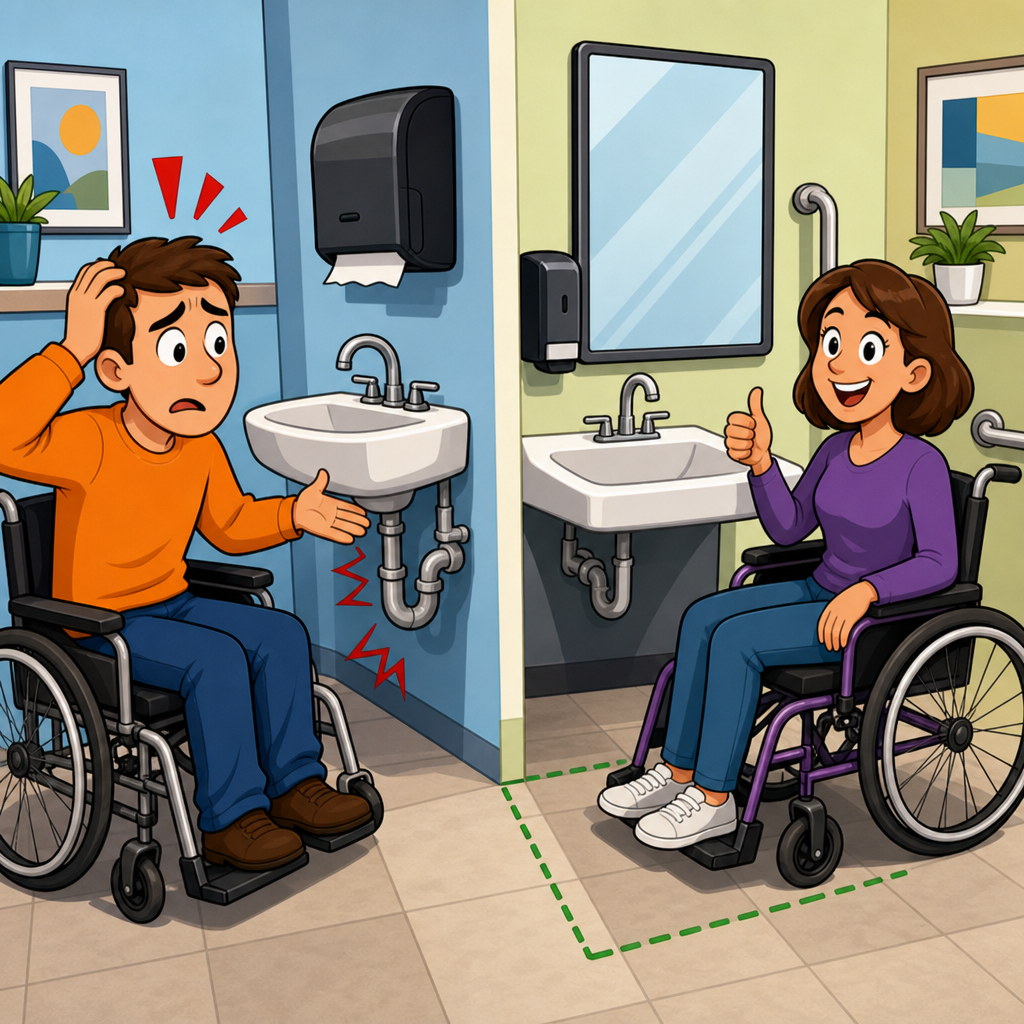
Sink and lavatory clearance errors are among the most common plumbing design mistakes that trigger ADA claims because they affect routine, high-frequency tasks such as handwashing, grooming, and basic restroom use. In Chapter 6 of the ADA Accessibility Standards, plumbing elements and facilities include drinking fountains, water closets, urinals, bathtubs, showers, and, critically for this discussion, sinks and lavatories. A sink generally refers to a basin used for handwashing or utility functions, while a lavatory is the fixture intended for personal hygiene in restrooms and similar spaces. In practice, the compliance issues overlap: both must be installed so a person using a wheelchair can approach, position, reach controls, and use the fixture without unsafe twisting, blocked knees, or contact with hot or abrasive surfaces.
I have reviewed many renovation scopes where teams chose compliant-looking fixtures but failed on the surrounding geometry. That is where lawsuits start. The ADA does not judge a sink in isolation; it evaluates clear floor space, forward approach, knee clearance, toe clearance, mounting height, exposed pipe protection, faucet operability, and the relationship between the fixture and adjacent walls or partitions. A beautiful restroom can still be noncompliant if the underside of the lavatory is too low, the drain trap is uninsulated, or a base cabinet eliminates required knee space. These errors matter because they can deny independent use, create burn risks, or force awkward side approaches that the standards do not allow. For owners, contractors, architects, and facility managers, understanding these rules is essential because sink and lavatory claims are usually easy for plaintiffs to document with a tape measure and photographs.
This hub article covers Chapter 6 plumbing elements and facilities with a focus on sink and lavatory clearance errors, how they are measured, why they lead to claims, and what practical teams should verify before opening a space to the public. It also frames the broader compliance context so related subtopic articles on drinking fountains, toilet rooms, showers, and reach ranges can connect back here.
What Chapter 6 Requires for Sinks and Lavatories
Chapter 6 establishes the technical criteria for plumbing fixtures, and sinks and lavatories are governed primarily by the provisions for height, clear floor space, knee and toe clearance, exposed surfaces, and operable parts. The core rule is straightforward: at least one of each type in each accessible space must be usable by a person using a wheelchair. In most commercial restrooms, that means the rim or counter surface can be no higher than 34 inches above the finish floor, measured to the top of the fixture or counter. Beneath the fixture, knee clearance must be at least 27 inches high minimum, measured from the finish floor to the underside at a point 8 inches back from the front edge. Toe clearance must extend at least 17 inches under the fixture, and the clear floor space for a forward approach must be 30 inches by 48 inches minimum.
Those dimensions sound simple, but installation realities complicate them. A lavatory may be specified at the correct rim height, yet the apron thickness, support brackets, sink bowl depth, or decorative shroud can reduce the actual knee space below the required 27 inches. Similarly, toe clearance may disappear when a casework toe kick is recessed too little or plumbing lines are routed through the wrong zone. The standards also require that hot water pipes and drain pipes under sinks and lavatories be insulated or otherwise configured to protect against contact. Abrasive surfaces are prohibited under the fixture where knees and legs may touch. Faucets must be operable with one hand and cannot require tight grasping, pinching, or twisting of the wrist, with operable force limited to 5 pounds maximum.
When advising project teams, I tell them to think in sections and in motion. A compliant sink is one a user can approach, fit under, reach, operate, and exit from without obstruction. If any step fails, the installation fails. Courts and consultants often focus on exact measurements because they provide objective proof, but the user experience behind the numbers is what drives the law.
The Clearance Errors That Most Often Trigger ADA Claims
The most frequent claims involve five repeating mistakes: insufficient knee clearance, missing toe clearance, mounting the rim or counter too high, blocking the clear floor space, and leaving exposed pipes unprotected. These are not obscure technicalities. They are predictable field errors caused by late design changes, poor coordination between trades, and assumptions that standard millwork or decorative plumbing can be adapted without consequence.
Insufficient knee clearance is the leading problem I see in post-construction surveys. Designers may select a deep bowl sink, then add a solid-surface counter and steel support frame that drops the underside several inches. On paper, the top still sits at 34 inches, but the usable clearance below may fall to 25 or 26 inches. A wheelchair user cannot pull close enough to the basin, so washing hands becomes a reach-and-splash maneuver rather than direct use. Missing toe clearance often appears when vanity bases or side panels are installed for aesthetics. If the lower recess is too shallow, footrests strike the cabinet before the knees align with the sink.
Blocked clear floor space is another common trigger. A waste bin, baby changing station projection, door swing conflict, or even a protruding paper towel dispenser can overlap the 30-by-48-inch approach area. In existing buildings, I often find accessible lavatories technically compliant until a housekeeping cart, decorative planter, or freestanding sanitizer stand is added. ADA claims regularly cite these operational barriers because they are visible and easy to document. Exposed supply and drain lines matter as well. Plaintiffs often note that bare metal traps can cause burns if users contact hot pipes. Even when injury has not occurred, the presence of an uninsulated trap is enough to support a deficiency claim because the standard requires protection, not proof of harm.
| Error | Typical Cause | Why It Leads to Claims |
|---|---|---|
| Knee clearance too low | Deep sink bowls, thick counters, support framing | User cannot pull forward under fixture |
| Toe clearance blocked | Vanity panels, shallow recesses, plumbing placement | Footrests hit obstruction before approach is completed |
| Rim higher than 34 inches | Installer measures rough height incorrectly | Fixture exceeds maximum accessible height |
| Clear floor space obstructed | Trash cans, dispensers, door swings, decor | Required forward approach is not available |
| Exposed hot or abrasive pipes | Missing insulation or protective covers | Creates burn and contact hazards under fixture |
Measurement Mistakes in Design, Construction, and Alterations
Most sink and lavatory disputes are not caused by ignorance of the ADA Accessibility Standards. They come from measuring the wrong point or failing to verify the final installed condition. One persistent mistake is measuring height to the underside of the sink instead of to the rim or counter surface, or vice versa, depending on what requirement is being checked. Another is assuming manufacturer cut sheets guarantee compliance. They do not. Cut sheets show product dimensions under ideal conditions, but field shims, mounting rails, substrate buildup, floor slope, and countertop fabrication can change critical heights enough to create a violation.
Alteration projects create the highest risk. In an older building, teams may replace fixtures but keep existing plumbing rough-ins. To align the new basin with old drain locations, installers sometimes raise the sink, add trim, or use decorative enclosures that erase knee space. I have seen projects where a cabinet was removed to create accessibility, yet the relocated drain line crossed directly through the knee clearance zone. The owner believed the restroom had been made accessible because the old vanity was gone. A field measurement said otherwise.
Door and partition geometry also causes subtle errors. In small single-user toilet rooms, a lavatory may be placed where the clear floor space overlaps the required turning space. That can be acceptable if the overlap is allowed and actually usable, but the room often fails in practice because the door swing cuts into the approach or the user cannot position centrally at the sink. The safest approach is to check plans during design, then verify rough framing, then verify final installation. Use a tape measure, digital level, and a physical wheelchair template or full-scale mockup when the room is tight. Building Information Modeling helps, but field confirmation still decides compliance.
How ADA Claims Develop and What Plaintiffs Usually Document
ADA sink and lavatory claims typically arise from either a routine visit by a disabled customer or a structured site review performed by an accessibility plaintiff or consultant. The evidence package is usually simple: photographs, date-stamped measurements, and notes identifying the violated provision. Because the dimensions are objective, these claims are comparatively inexpensive to investigate and difficult to defend when the condition is obvious. A photo showing a base cabinet under the only lavatory in a public restroom is powerful. So is an image of a tape measure reading 35 inches at the rim.
Plaintiffs usually document the route to the restroom, the door hardware, turning space, sink height, knee clearance, pipe protection, mirror height, soap dispenser reach, and hand dryer or towel dispenser operability. That matters because sink access is rarely litigated alone. It is often part of a cluster of restroom barriers showing a pattern of noncompliance. Under federal law, private plaintiffs generally seek injunctive relief and attorney’s fees, while some state laws, including California’s Unruh Civil Rights Act, can add statutory damages. That increases settlement pressure even for modest physical corrections.
Owners sometimes argue that a sink is technically usable despite dimensional noncompliance. That is usually a weak position. If the standard says 34 inches maximum and the installed condition is 34 3/4 inches, the variance may still be actionable. Likewise, promising future remediation after a complaint does not erase the original barrier, though prompt correction can reduce prolonged exposure. The best defense is documented compliance work completed before occupancy: plan reviews, punch lists, corrective logs, and final measurements tied to specific fixtures.
Best Practices for Compliance Across Chapter 6 Plumbing Elements
As the hub for Chapter 6 plumbing elements and facilities, this page should anchor a broader compliance strategy. Sinks and lavatories interact with adjacent elements, so teams should coordinate them with water closets, urinals, showers, bathtubs, drinking fountains, and accessories. For example, moving a lavatory to improve knee clearance can unintentionally reduce toilet compartment maneuvering space. Lowering a mirror may interfere with a backsplash or faucet splash zone. Compliance works best when plumbing fixtures are designed as part of a complete accessible user sequence rather than as isolated checklist items.
In practice, I recommend six controls. First, select fixtures with published accessible dimensions from established manufacturers such as Sloan, Bradley, Zurn, Elkay, American Standard, or Kohler, then still verify them in the field. Second, detail wall-mounted lavatories carefully; they often perform better than cabinet-based vanities because they preserve open knee and toe space. Third, specify insulated traps or protective panels as part of the plumbing package, not as an afterthought. Fourth, coordinate accessory heights and reach ranges so soap, towels, and hand drying are usable from the sink position. Fifth, perform a pre-submittal or pre-permit ADA review against the 2010 ADA Standards and any applicable state code. Sixth, conduct a final accessibility audit before opening, after all accessories, trash receptacles, and signage are in place.
For subtopic coverage, related articles should drill down into drinking fountain spout height and knee space, toilet room turning space conflicts, accessible shower controls and seats, and common reach range errors for soap dispensers and mirrors. This hub matters because many claims begin with one visible barrier but expand to every plumbing element in the same room. Fixing the sink while ignoring the rest of Chapter 6 is not a durable compliance strategy.
How to Prevent Expensive Retrofits and Repeat Violations
The cheapest time to solve sink and lavatory clearance issues is before rough-in. Once tile, stone counters, and finished millwork are installed, even a one-inch error can force demolition, plumbing relocation, and weeks of delay. Owners should require accessibility dimensions on shop drawings, not just architectural backgrounds. Contractors should include ADA checkpoint inspections at rough plumbing, backing installation, fixture mounting, and final punch. Facility managers should train maintenance staff not to store trash bins or cleaning supplies in accessible clear floor spaces. These operational details matter because a compliant restroom can become noncompliant through everyday use.
Repeat violations usually indicate that teams are treating accessibility as a one-time permit issue instead of an operating standard. Build a simple inspection protocol: measure rim height, verify 27-inch knee clearance, confirm 17-inch toe clearance, check insulation, inspect faucet operation, and photograph the final setup. Keep those records. If a complaint arrives, you will know whether the barrier existed at turnover or developed later through maintenance drift, fixture replacement, or unauthorized modifications.
The main benefit of mastering Chapter 6 is practical risk reduction. Correct sink and lavatory clearance protects independent use, supports safer restroom access, and lowers the chance of an ADA claim built on easy measurements and undeniable photos. Review each plumbing element as part of a connected system, verify installed conditions instead of relying on assumptions, and correct small dimensional errors before the public finds them. If you manage, design, build, or renovate public facilities, use this article as your hub and audit your plumbing fixtures now.
Frequently Asked Questions
What sink and lavatory clearance mistakes most often lead to ADA claims?
The most common ADA-related sink and lavatory errors involve insufficient knee clearance, inadequate toe clearance, improper mounting height, exposed or unprotected pipes, and obstructed forward approach space. These problems are especially risky because sinks and lavatories are used constantly throughout the day for handwashing, grooming, and other basic tasks, so even a small design mistake can affect usability in a very visible and repetitive way. When a user cannot roll under the fixture comfortably, position close enough to the basin, or avoid contact with hot water lines and sharp drain components, the fixture may become difficult or impossible to use independently.
In practice, claims often arise when the sink is installed too low or too high, when cabinetry or decorative panels eliminate the required clear space below, or when the underside of the fixture includes plumbing that has not been insulated or otherwise configured to protect users. Another frequent issue is that surrounding elements, such as trash receptacles, base cabinets, side walls, or door swings, interfere with the required clear floor space. Designers sometimes focus on the fixture itself but overlook whether a wheelchair user can actually approach it properly. ADA compliance depends on the complete user experience, not just a single dimension on a product specification sheet.
These claims are also common because sink and lavatory noncompliance is easy to identify. Plaintiffs, inspectors, and accessibility consultants can usually spot problems quickly during a site visit. If the fixture does not provide the required usable space beneath and in front of it, or if plumbing creates a burn or abrasion hazard, that issue is often straightforward to document. For owners and design teams, that means sink and lavatory clearance should be treated as a high-priority compliance item during planning, installation, and final verification.
Why are knee and toe clearance requirements so important for ADA sink compliance?
Knee and toe clearance are fundamental because they determine whether a person using a wheelchair can pull forward into a usable position at the sink or lavatory. Without adequate space below the fixture, the user may be forced to stop too far away from the basin, making handwashing, reaching the faucet, or using soap dispensers extremely difficult. This is one of the reasons sink-related accessibility violations are so frequently cited: the fixture may technically be present, but if the space beneath it does not accommodate the user’s legs and footrests, it is not functionally accessible.
The ADA standards address this by requiring clear floor space and specific accessible approach conditions, including space below the fixture that allows a forward approach. If designers or installers add casework, apron panels, storage, or decorative enclosures after the initial plans are approved, those additions can unintentionally eliminate the required clearance. Even a well-selected accessible sink can become noncompliant if field conditions change. That is why compliance reviews should include both design drawings and final installed conditions.
From a legal and operational perspective, knee and toe clearance issues are highly significant because they affect independence and dignity. A user should not have to reach awkwardly from the side, ask for assistance, or risk contact with sharp or hot plumbing components simply to wash their hands. Courts and claimants often view these barriers as serious because they interfere with one of the most basic restroom functions. For that reason, ensuring proper clearance below the sink is not just a technical box to check; it is one of the central accessibility obligations in restroom design.
Do exposed pipes and undersink components create ADA liability?
Yes, exposed pipes and undersink components can absolutely create ADA liability if they are not properly protected. One of the ADA’s critical concerns with sinks and lavatories is user safety during forward approach and use. When a person rolls into position, their legs and knees may extend beneath the fixture. If the hot water pipe, drain line, trap, or other undersink hardware is exposed, it can create a risk of burns, abrasions, or impact injuries. The standards therefore require protection for these elements so users are not harmed while using the fixture as intended.
This issue commonly arises in projects where the sink bowl itself appears compliant, but the plumbing rough-in or final trim was installed without adequate insulation, covers, or protective configuration. Decorative wall-mounted lavatories and open-concept restroom designs are especially prone to this problem because the exposed appearance is often treated as a design feature. However, aesthetic preferences do not override accessibility requirements. If the exposed components present a hazard to a seated user, the fixture can become the basis for a complaint or claim.
Owners should also understand that pipe protection is not a one-time design decision. Maintenance work, plumbing repairs, and fixture replacements can remove or alter protective covers over time. A lavatory that passed inspection when first installed can become noncompliant later if insulation is damaged, removed, or not reinstalled after service. For that reason, accessibility checks should be included in facility maintenance protocols, not just in initial construction review. Proper protection of undersink elements is a relatively simple step, but failing to address it can create a very visible and avoidable ADA exposure.
How do mounting height and surrounding layout affect whether a lavatory is ADA compliant?
Mounting height and surrounding layout are both critical because ADA compliance is based on usability, not just product selection. A lavatory may be labeled accessible by the manufacturer, but if it is mounted at the wrong height or placed in a location that restricts approach, reach, or maneuvering, it can still violate ADA requirements. The rim or counter height, the depth of the sink, the location of the faucet controls, and the amount of clear space in front all work together to determine whether the fixture can be used comfortably and independently by people with disabilities.
Layout problems are especially common in tight restroom designs. A sink may technically fit within the room, but the surrounding conditions may undermine accessibility. For example, door swings can overlap the required clear floor space, adjacent partitions can limit side positioning, and accessories such as paper towel dispensers, waste bins, or soap dispensers can intrude into usable areas. In some cases, the sink itself is mounted correctly, but the route to it or the maneuvering space in front of it is blocked. These are exactly the kinds of practical, on-site problems that often lead to complaints, because they become obvious during routine use.
Mounting height errors also frequently result from coordination failures between architects, plumbers, millwork installers, and general contractors. A dimension that looked right on one trade drawing may shift when countertops, wall finishes, brackets, or cabinetry are installed. That is why final field measurement matters so much. Teams should verify not only the fixture height, but also the underside clearance, faucet reach, and actual usable floor space after all components are in place. An ADA-compliant lavatory is not just a properly chosen fixture; it is a fixture installed in a fully compliant surrounding environment.
What are the best ways to prevent sink and lavatory clearance errors before they become ADA claims?
The best prevention strategy is to treat sink and lavatory accessibility as a coordination and verification issue from the earliest design stage through final occupancy. That means reviewing ADA requirements carefully during planning, selecting fixtures that support compliant installation, detailing the required knee and toe clearance clearly on the drawings, and coordinating plumbing, architectural, and millwork components before anything is built. It is not enough to note “ADA sink” on a plan. The drawings should make clear how the required clearances, heights, protection measures, and floor space will actually be achieved in the field.
Mockups, pre-installation reviews, and final punch inspections are also highly effective. Many ADA claims stem from conditions that could have been caught in minutes with a tape measure and a field walkthrough. Before sign-off, teams should verify the height of the lavatory, the clear space beneath it, protection of hot water and drain pipes, reachability of controls, and unobstructed approach area. It is also wise to review adjacent accessories and operational conditions, such as whether a trash can, diaper station, or cleaning cart could block the fixture during normal use. Accessibility failures often come from these everyday operational details, not just from the original design intent.
For building owners and facility managers, ongoing monitoring is just as important as initial compliance. Renovations, repairs, maintenance work, and even well-intended cosmetic upgrades can introduce new barriers. Replacing a wall-hung sink with a vanity base, adding storage below a lavatory, or relocating dispensers can all create compliance issues that expose the property to ADA claims. The strongest risk-reduction approach is to combine expert design review, careful installation oversight, and routine post-occupancy inspections. Because sinks and lavatories are among the most frequently used plumbing fixtures in any facility, keeping them consistently compliant is one of the most practical and defensible steps an owner can take.