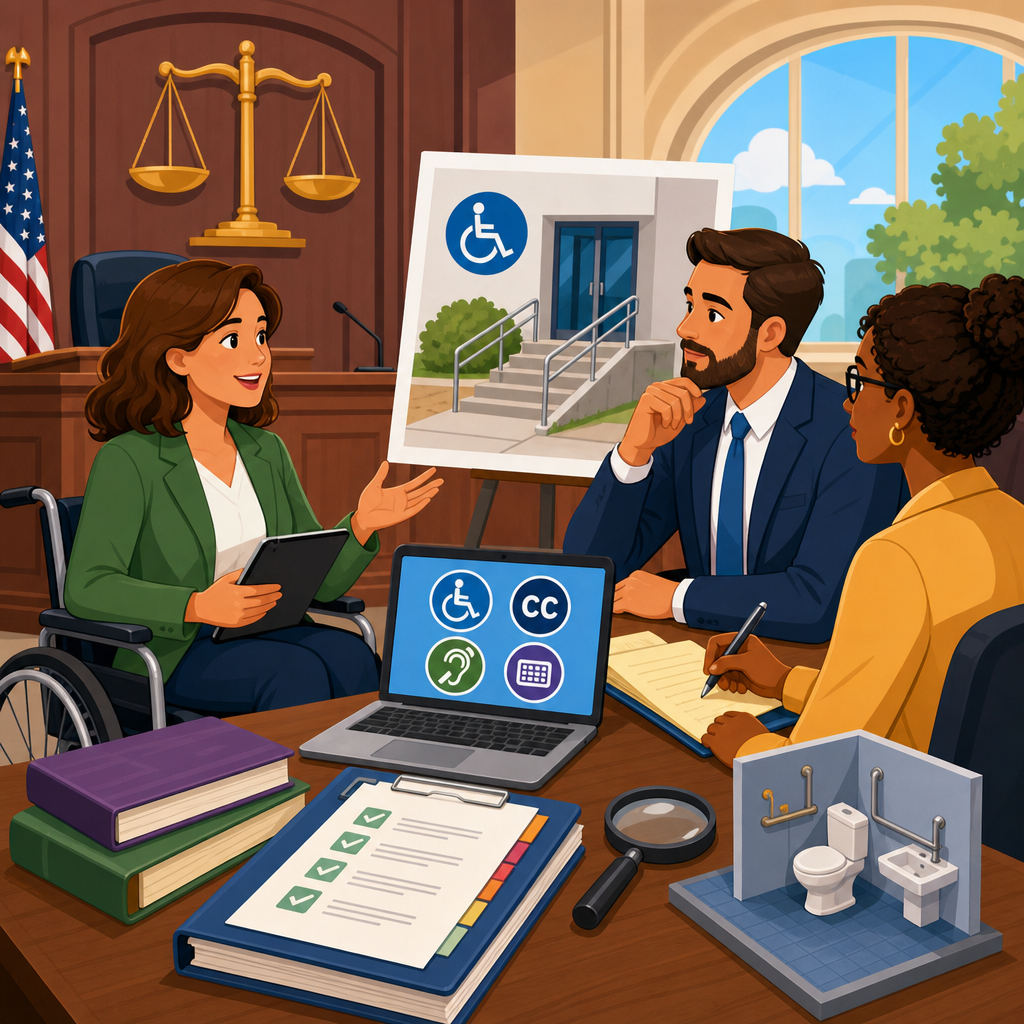
Accessibility consultants sit at the intersection of law, design, engineering, and risk management, and that position becomes especially visible when digital accessibility disputes turn into formal litigation. In the context of digital accessibility litigation, consultants are the specialists who evaluate websites, mobile apps, documents, kiosks, and software against recognized accessibility requirements, document barriers, advise counsel, and help organizations fix defects without creating new legal exposure. I have worked on matters where a single unlabeled form field became the focal point of a demand letter, and on others where years of scattered remediation notes became more important than the code itself because those records shaped arguments about knowledge, diligence, and timing.
This topic matters because accessibility claims are no longer rare edge cases. In the United States, plaintiffs have filed thousands of website accessibility lawsuits in recent years, most often under the Americans with Disabilities Act, state civil rights laws such as California’s Unruh Civil Rights Act, and related consumer protection theories. Courts, regulators, and settlement agreements consistently look to the Web Content Accessibility Guidelines, usually WCAG 2.1 Level AA, as the practical benchmark even when a statute does not explicitly codify that standard. For companies, schools, healthcare providers, retailers, financial institutions, and public entities, the stakes include injunctive relief, attorneys’ fees, reputational harm, redevelopment costs, and operational disruption.
As the hub for digital accessibility litigation, this article explains the consultant’s role across the dispute lifecycle, the records that help or hurt, and the risks that emerge when technical work and legal strategy are poorly coordinated. It also connects the larger subtopic: demand letters, expert reports, privilege issues, remediation planning, procurement controls, testing methodologies, and settlement compliance. The central point is straightforward. Accessibility consultants can materially reduce risk and improve outcomes, but only when their scope, documentation, and communication practices are disciplined from the beginning.
Where accessibility consultants fit in a digital accessibility case
In litigation, accessibility consultants usually perform one or more of four functions: assessor, remediation advisor, program architect, and expert or testifying witness. As assessors, they identify barriers through manual testing, assistive technology testing, and code review. As remediation advisors, they translate findings into defect tickets, design changes, and development acceptance criteria. As program architects, they help an organization establish governance, training, procurement language, and ongoing monitoring so the same defects do not reappear. In some cases, a consultant also supports counsel with declarations, affidavits, rebuttal analysis, or trial testimony, although that role demands stricter documentation and independence.
The work begins with scoping. A consultant must define the digital properties at issue, the applicable standards, the user journeys to test, and the environments to include. A retail case may focus on account creation, product search, cart, checkout, coupon application, and order history across desktop, iOS, and Android. A higher education matter may expand to learning management systems, admissions forms, PDF course materials, video captions, and third-party integrations. Good scoping prevents a common failure I see in disputes: a narrow audit that misses the pages a plaintiff actually used or an overbroad review that generates noise without resolving the allegations.
Consultants also help legal teams separate three distinct questions that are often blurred together: whether a barrier exists, whether it denies meaningful access, and whether the organization had a reasonable process for prevention and correction. Those questions are related but not identical. For example, an image missing alternative text is a technical defect, but its legal significance depends on context, function, and impact. A decorative image may be low risk; an unlabeled “submit payment” button in checkout is a serious barrier because it blocks completion of a core transaction. The consultant’s credibility comes from making those distinctions carefully, not from treating every issue as equally consequential.
Testing methods, standards, and the evidence consultants generate
Digital accessibility litigation turns heavily on methodology. Reliable consultants do not rely on automated scans alone, because automated tools typically catch only a subset of issues. Industry studies often place the detectable share somewhere around one third of common WCAG failures, depending on page type and tool configuration. Serious assessments combine automated testing with manual keyboard review, semantic inspection of the DOM, screen reader testing, form behavior analysis, color contrast verification, focus management checks, reflow and zoom testing, error identification review, and examination of dynamic components such as modals, menus, and single-page application updates.
Recognized standards anchor that work. For websites and web applications, WCAG 2.1 Level AA remains the most common benchmark in settlements and consent decrees, though WCAG 2.2 is increasingly relevant for current remediation planning. Public-sector entities may also need to consider Section 508, state rules, or procurement requirements. Mobile apps raise platform-specific issues tied to iOS VoiceOver, Android TalkBack, native control labeling, gesture alternatives, and dynamic type or text resizing behavior. Documents and multimedia bring in separate expectations around tagged PDFs, reading order, form fields, captions, transcripts, and audio description.
Evidence quality depends on reproducibility. A useful consultant record identifies the exact page or screen, URL or route, test date, browser or device, assistive technology, steps to reproduce, relevant success criterion, observed impact, and severity rationale. Screenshots alone are rarely enough. Short videos, exported issue logs, DOM snippets, Jira tickets, pull requests, accessibility conformance reports, and before-and-after test results can all become important later. When those artifacts are consistent, counsel can explain what was found, what was fixed, and what remains. When they are inconsistent, the record invites arguments that the organization lacked rigor or that remediation claims cannot be verified.
| Consultant task | Typical record created | Why it matters in litigation |
|---|---|---|
| Manual audit | Issue log with WCAG references, reproduction steps, impact notes | Shows methodology and supports or rebuts alleged barriers |
| Assistive technology testing | Screen reader transcripts, video captures, device and browser matrix | Demonstrates real user impact beyond automated scans |
| Remediation guidance | Developer tickets, design annotations, code examples | Connects identified issues to concrete corrective action |
| Validation testing | Retest reports and closure criteria | Supports assertions that fixes were implemented effectively |
| Program governance | Policies, training logs, procurement clauses, VPAT reviews | Helps establish ongoing diligence rather than one-time cleanup |
Records that strengthen a defense and records that create exposure
Documentation is often the hidden driver of litigation outcomes. Helpful records show a pattern of structured diligence: accessibility policies approved by leadership, training attendance records for designers and engineers, procurement requirements for vendors, periodic audits, issue triage protocols, and evidence that defects were prioritized according to user impact. If a company can show that it adopted a standard, tested against it, assigned fixes, validated completion, and monitored regressions, the narrative changes from neglect to active compliance management. That does not erase existing barriers, but it can affect negotiations, injunctive terms, and credibility with a court.
Bad records usually fail in one of three ways. First, they are vague. A spreadsheet entry that says “homepage accessibility fixed” tells nobody what changed. Second, they are fragmented. I often see findings in one consultant PDF, remediation notes in Slack, exceptions in email, and retest results nowhere. Third, they contain casual language that sounds worse under scrutiny than the underlying facts justify. Statements like “we know the site is inaccessible” or “let’s patch enough to make this go away” can be read as admissions of broad failure or bad intent. Precision matters. The better practice is to describe specific defects, affected user flows, remediation status, and remaining dependencies.
Version control is another overlooked issue. In modern web environments, content and code can change daily. If the consultant does not preserve the tested state, later teams may not be able to determine whether a plaintiff encountered a historic defect, a regression, or a third-party script problem. Saved copies of pages, release notes, repository references, and timestamps help reconstruct events. So do documented exceptions. Sometimes a barrier cannot be fixed immediately because of a vendor limitation, a security dependency, or a platform sunset. If that decision is explained, approved, and paired with an interim workaround, the organization looks managed rather than indifferent.
Privilege, independence, and the line between consulting and expert work
One of the most misunderstood issues in digital accessibility litigation is whether a consultant’s work is protected from disclosure. The answer depends on jurisdiction, engagement structure, role, and what materials are shared. If outside counsel retains the consultant to assist in providing legal advice, some communications may fall within attorney-client privilege or work-product protection. But protection is not automatic, and it can be weakened by broad internal distribution, business use of legal reports, or mixing ordinary operational advice with litigation strategy in the same documents. Organizations should align retention letters, recipients, and reporting lines before substantive work begins.
Independence matters as well. A consultant who is deeply embedded in remediation may be useful as a non-testifying advisor but less persuasive as a supposedly neutral expert. Conversely, a testifying expert needs a methodology that can survive scrutiny: repeatable procedures, complete notes, accurate references to WCAG success criteria, and clear explanations of user impact. Courts are not impressed by conclusory opinions copied from automated tools. They respond better to concrete demonstrations, such as a checkout flow that fails because focus disappears after a modal opens or a medical intake form that cannot be submitted by keyboard alone.
The practical lesson is to separate functions where possible. Use one stream of work for privileged litigation support and another for ordinary operational remediation, with clear labeling and disciplined circulation. Keep factual issue tracking clean and professional because it may eventually be produced, quoted, or described. And when an expert report is likely, assume every test step, screenshot, and severity ranking will be challenged. Consultants who work as though their files may be examined line by line generally produce stronger analyses and fewer surprises.
Remediation strategy, settlement obligations, and recurring risk patterns
Most digital accessibility cases do not end with a single audit and a promise to improve. They evolve into remediation programs with timelines, reporting duties, training requirements, and sometimes recurring third-party assessments. Consultants therefore need to think beyond defect lists. The durable question is whether the organization can build an accessibility management system that survives future releases. Effective plans usually include governance ownership, design system updates, definition-of-done criteria, automated checks in CI/CD pipelines, manual QA gates for critical journeys, captioning and document workflows, and procurement controls for software vendors and content providers.
Real-world risk patterns repeat across industries. Retailers often struggle with promotional overlays, payment widgets, store locators, and inaccessible PDFs for returns or financing. Healthcare organizations see issues in patient portals, telehealth interfaces, appointment booking, and lab result displays. Universities face risk in course materials, video platforms, LMS customizations, and department websites maintained outside central IT. Financial institutions regularly confront inaccessible authentication flows, disclosure documents, and loan calculators. In each setting, the consultant’s role is to identify not just the visible defect but the process failure behind it, whether that is weak component governance, unreviewed vendor code, or no accessibility acceptance testing before launch.
Settlements frequently require measurable actions: conform the public website to WCAG 2.1 AA within a stated period, appoint an accessibility coordinator, train relevant personnel annually, maintain a feedback mechanism, test with assistive technology users, and report progress. Those obligations sound simple but are operationally demanding. If an organization has hundreds of templates, multiple agencies, and decentralized publishing, broad compliance claims can backfire unless there is a realistic inventory and sequencing plan. The strongest consultants tie remediation to business criticality and user impact, validate fixes in production-like conditions, and document exceptions honestly. If your organization is active in digital accessibility litigation, use this hub as a starting point and build a record that proves sustained accessibility work, not temporary crisis response.
Accessibility consultants influence litigation outcomes because they shape three things at once: the technical diagnosis, the documentary record, and the remediation path. When they scope accurately, test with defensible methods, and explain user impact in plain language, they help counsel and decision-makers see the case clearly. When they maintain disciplined records, they create evidence of diligence rather than confusion. When they design remediation programs that extend beyond the immediate complaint, they reduce the chance that the same barriers will trigger future claims. That combination is why consultant work deserves executive attention, not just developer attention.
The key records are also the key risks. Detailed audits, retest reports, training logs, procurement clauses, issue trackers, and governance policies can strengthen a defense and support settlement compliance. Vague notes, fragmented communications, undocumented exceptions, and overconfident claims can do the opposite. Privilege questions add another layer, especially when legal advice and operational remediation are mixed together without clear boundaries. The practical answer is not to document less. It is to document better: specifically, consistently, and with an understanding that technical files often become legal facts.
As a hub for digital accessibility litigation, this page should guide how you evaluate every related issue, from demand-letter response and expert selection to vendor management and long-term compliance architecture. The main benefit of using accessibility consultants well is simple: you get a clearer view of barriers, a stronger basis for action, and a more credible story about the work your organization has done. Review your current testing methods, records, and consultant engagements now, then close the gaps before the next complaint defines them for you.
Frequently Asked Questions
What does an accessibility consultant actually do during digital accessibility litigation?
An accessibility consultant plays a highly practical and often pivotal role when a digital accessibility dispute moves into litigation. At the most basic level, the consultant evaluates digital properties such as websites, mobile applications, PDFs, online forms, kiosks, software interfaces, and other user-facing technologies against recognized accessibility standards, most commonly the Web Content Accessibility Guidelines (WCAG), along with any applicable legal or contractual requirements. That evaluation is not limited to automated scanning. A qualified consultant typically combines manual code review, keyboard testing, screen reader testing, form and workflow analysis, document review, and where appropriate, testing across multiple devices, browsers, and assistive technologies.
In litigation settings, the consultant’s work often extends beyond technical testing. Consultants may help attorneys understand how a digital experience functions in practice, which barriers are likely to matter most to users with disabilities, and which findings are supported by objective evidence. They can identify whether alleged defects are isolated, systemic, temporary, environment-specific, or tied to third-party tools. They may also help distinguish between issues that affect usability generally and issues that rise to the level of legally significant accessibility barriers.
Another major responsibility is documentation. Consultants create records of what was tested, when it was tested, how it was tested, what standards were applied, what barriers were found, and how severe those barriers were. In many disputes, that documentation becomes critically important because websites and apps change frequently. A consultant’s dated records, screenshots, code captures, video recordings, issue logs, and replication notes can help establish the condition of a digital property at a particular point in time.
Consultants may also support remediation planning. That includes prioritizing fixes, advising development teams on implementation approaches, reviewing proposed changes, and helping organizations avoid introducing new barriers while attempting to resolve older ones. In some matters, consultants work behind the scenes as technical advisors to counsel; in others, they may serve as expert witnesses, provide declarations, prepare reports, or testify about methodology, findings, and industry practice. Their value lies in translating technical accessibility issues into credible, defensible, and actionable information for legal teams and business stakeholders alike.
What kinds of records should accessibility consultants create and preserve in a litigation-related matter?
Recordkeeping is one of the most important and most underestimated aspects of accessibility consulting in litigation. Because digital content changes constantly, a consultant should create a clear, contemporaneous record of the testing process and findings. That usually includes the date of testing, the specific URLs, screens, user flows, application versions, document names, or software builds reviewed, along with the devices, operating systems, browsers, screen readers, magnifiers, speech input tools, and other assistive technologies used during testing. Without this level of specificity, later readers may not be able to reproduce the findings or understand whether a reported issue still reflects the same technical conditions.
Strong records also include the methodology. A consultant should be able to explain whether the review involved automated tools, manual testing, code inspection, task-based usability analysis, native mobile testing, document accessibility review, or a combination of methods. The applicable benchmark should be identified as well, such as WCAG 2.1 AA or WCAG 2.2 AA, any internal policy standard, procurement requirement, settlement obligation, or statutory reference relevant to the matter. If the consultant deviated from standard practice for a good reason, that should be documented too.
Issue-level records matter just as much. For each accessibility barrier, it is helpful to preserve screenshots, DOM captures or code snippets where appropriate, keyboard path descriptions, screen reader output notes, error messages, and a concise explanation of the user impact. Good records connect the technical defect to the functional consequence. For example, rather than simply noting a missing form label, a thorough record would explain that a screen reader user may be unable to determine what information the field requires, preventing completion of a purchase, registration, or application process.
Remediation records are also important. Consultants should track when issues were communicated, what recommendations were made, which fixes were implemented, what was retested, and whether the fix resolved the original barrier without introducing regressions. In a litigation context, these records can demonstrate diligence, support privilege strategies where applicable, and help show a timeline of investigation and corrective action. Preservation practices should be coordinated with counsel, especially where litigation holds, expert disclosures, confidentiality concerns, and questions of privilege or work-product protection may affect how records are created, stored, and shared.
How do accessibility consultants work with attorneys, developers, and business teams without increasing legal or operational risk?
The most effective accessibility consultants understand that litigation-related work sits at the intersection of legal strategy, technical reality, and business decision-making. Their role is not simply to identify defects, but to do so in a way that supports informed action while minimizing avoidable risk. That starts with clarity about scope and communication channels. Consultants should know whether they are being retained directly by counsel, by the client, or through another intermediary, because that can affect reporting structure, confidentiality expectations, and how findings are documented and circulated.
When working with attorneys, consultants help translate technical conditions into accurate, supportable explanations. They can clarify what a given barrier means for a user with a disability, whether an issue appears reproducible, whether it is likely systemic, and how difficult it may be to remediate. Good consultants avoid overstating certainty, speculating outside their expertise, or using vague language that can later create confusion. They also understand that legal teams may need concise summaries for pleadings or negotiations, as well as deeper technical backup for expert analysis or internal evaluation.
With developers and product teams, consultants reduce operational risk by providing precise, implementable guidance. A vague instruction such as “make this accessible” is rarely useful. A better consulting approach identifies the relevant component, the accessibility failure, the affected standard, the user impact, and one or more practical remediation paths. Consultants also help prioritize work, focusing first on barriers that block core tasks such as logging in, completing purchases, submitting forms, accessing account information, or consuming essential content.
To avoid increasing risk, consultants should be disciplined in how they communicate findings. Draft notes, issue logs, and email summaries can all become important later. That does not mean consultants should avoid candor; it means they should be accurate, measured, and professional. They should document what they observed, what they tested, and what they concluded, while avoiding loose statements that mischaracterize legal obligations or technical facts. They should also resist recommending quick fixes that create new usability problems or temporary patches that fail under retesting. In practice, the safest and most effective consultant is one who is technically rigorous, process-aware, and comfortable operating within a coordinated legal, engineering, and governance framework.
What are the main risks organizations face when using accessibility consultants in a litigation setting?
Organizations often assume that hiring an accessibility consultant automatically reduces exposure, but the reality is more nuanced. A consultant can add significant value, yet the engagement itself can create risk if it is poorly scoped, poorly documented, or disconnected from legal and technical strategy. One common risk is incomplete or superficial testing. If a consultant relies too heavily on automated tools, skips key user flows, ignores mobile experiences, or fails to test with assistive technologies, the organization may gain false confidence while serious barriers remain unresolved. In litigation, that gap can be costly.
Another major risk is weak documentation. If findings are not preserved with dates, environments, replication details, and supporting evidence, it may be difficult to defend the quality of the assessment or prove that remediation occurred. This becomes especially important where the digital experience changes rapidly through ongoing releases, content updates, A/B testing, or vendor integrations. A consultant who cannot clearly show what was reviewed and what changed may leave the organization with uncertainty rather than protection.
There is also strategic risk in communications. Casual summaries, overbroad conclusions, inconsistent issue descriptions, or unsupported claims about compliance can all create problems. For example, declaring a website “fully compliant” after limited testing can be dangerous if later review reveals obvious barriers. Similarly, a consultant who gives legal opinions outside their lane, or a business team that treats technical observations as definitive legal conclusions, can blur responsibilities in unhelpful ways. Accessibility consulting should inform legal strategy, not replace legal judgment.
Vendor and remediation risk should not be overlooked either. Some accessibility barriers arise from third-party widgets, payment tools, embedded media, document generation systems, or legacy platforms. If the consultant identifies issues but the organization lacks a realistic remediation pathway, delays can compound legal and reputational exposure. Finally, there is the risk of ineffective fixes. Poorly implemented remediation can break functionality, confuse users, or create new barriers, which is why retesting and quality assurance are essential. In short, the greatest risks are not caused by accessibility review itself, but by treating it as a checkbox exercise instead of a disciplined, evidence-driven process tied to governance, engineering, and legal oversight.
Can accessibility consultants serve as expert witnesses, and what makes their testimony credible?
Yes, accessibility consultants can serve as expert witnesses in digital accessibility litigation, and in many cases they do. Whether they are retained as consulting experts behind the scenes or as testifying experts depends on the needs of the case and the direction of counsel. When functioning as an expert witness, the consultant may prepare a formal report, submit a declaration, respond to opposing opinions


