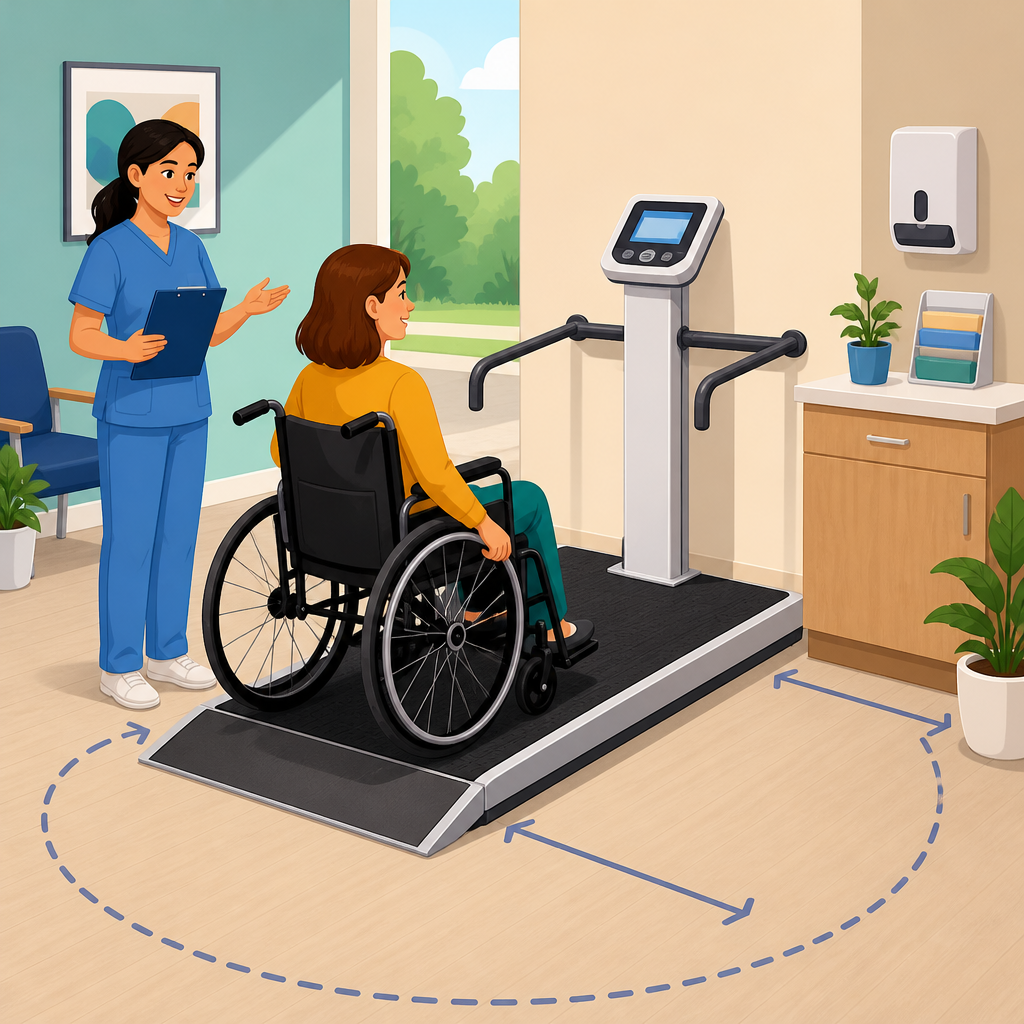
Wheelchair-accessible scales are essential medical devices in accessible care because they allow patients to be weighed safely, accurately, and with dignity without forcing transfers that can cause pain, delay treatment, or create avoidable fall risk. In the context of ADA accessibility standards, medical care and accessible equipment include the physical environment, the usability of diagnostic devices, and the workflow practices that determine whether a patient with a mobility disability receives care equivalent to that offered to everyone else. A wheelchair-accessible scale is typically a platform scale with a low entry ramp, sufficient surface area for mobility devices, handrails or edge protection where appropriate, and controls visible to staff while preserving patient privacy. Space, approach, and workflow requirements matter because equipment can be technically present yet practically unusable if the route is blocked, the turning space is inadequate, the ramp slope is too steep, or staff are not trained to use tare functions and transfer alternatives correctly. In clinics I have evaluated, the most common failure was not the scale itself but the room planning around it: storage carts placed in the clear floor space, cords crossing the approach route, and doors that reduced maneuvering clearance. When that happens, the organization may believe it has solved accessibility when it has only purchased a device. True accessibility requires the scale, the room, and the care process to work together.
Why wheelchair-accessible scales are a core part of medical care and accessible equipment
Weight is a basic clinical measurement used for medication dosing, anesthesia planning, dialysis management, heart failure monitoring, pregnancy care, nutritional assessment, and tracking fluid status. If a patient cannot be weighed because the office uses only a stand-on scale, the effects spread through the visit. Staff may estimate weight, ask the patient to self-report an outdated number, or defer care until another location can provide the measurement. Each workaround introduces risk. Many drugs, including chemotherapy agents, anticoagulants, pediatric medications, and weight-based antibiotics, depend on accurate body weight. For patients with edema, recent surgery, spinal cord injury, or severe arthritis, forcing a transfer to a chair scale or exam table can also be unsafe and clinically inappropriate.
Accessible equipment standards are therefore not an amenities issue; they are a patient safety issue and a civil rights issue. The U.S. Access Board’s Standards for Accessible Medical Diagnostic Equipment established recognized technical criteria for transfer surfaces, supports, clearances, and operable parts. While not every health care setting is directly required to adopt every specification in the same way, the standards provide a reliable design benchmark and are widely used by manufacturers, compliance teams, architects, and risk managers. In practice, a wheelchair-accessible scale supports equivalent access by allowing a patient to remain in a mobility device when clinically appropriate and by reducing the need for manual lifting. That protects patients and staff alike.
As a sub-pillar hub under ADA Accessibility Standards, this topic connects to several related areas of medical care and accessible equipment: accessible exam tables, height-adjustable chairs, mammography equipment, transfer supports, clear floor space, signage, and staff assistance policies. The hub perspective matters because weighing a patient is rarely an isolated task. The route from reception to triage, the dimensions of the room, the type of wheelchair or scooter in use, and the sequence of the visit all affect whether the scale can be used efficiently. A good program treats the accessible scale as part of an integrated care pathway rather than a single procurement line item.
Space requirements: clear floor area, turning room, and placement strategy
The first design question is not brand or capacity; it is where the scale will sit and how a patient will reach it. A wheelchair-accessible scale needs clear floor space at the entry point, on the platform, and at the exit path. Patients may approach head-on, back onto the platform, or enter and exit straight through depending on the room layout and the mobility device. Power chairs and scooters often require more maneuvering room than a standard manual wheelchair because of longer wheelbases and wider turning arcs. If the user must perform a multi-point turn around a trash can, stool, or supply cart, the measurement process becomes slow and stressful even if the platform itself meets dimensional requirements.
Clinics should preserve an unobstructed accessible route to the scale from the corridor or exam area. That means accounting for door swing, threshold height, floor transitions, and parking locations for mobile equipment. I have repeatedly seen accessible scales installed in alcoves that looked adequate on plan drawings but failed in operation because nearby blood pressure machines, linen hampers, and sharps containers migrated into the maneuvering area. The fix is operational as much as architectural: mark the clear area, audit it daily, and assign ownership for keeping it open. Floor markings alone are not enough unless managers reinforce them.
Placement strategy should also consider privacy and circulation. A scale in a busy hallway may technically function, but it can expose the patient’s weight reading, create congestion, and force rushed maneuvers. Locating the scale in triage or a vitals room often works better, provided staff can still move quickly and the room supports direct entry. Through-platform designs can be especially effective in high-volume settings because they reduce backing maneuvers. However, they require sufficient space on both sides and careful planning for egress so the patient does not reverse into a door leaf or another patient.
| Planning factor | What to verify | Common failure | Better practice |
|---|---|---|---|
| Approach route | Continuous accessible path, no abrupt level changes, adequate door clearance | Scale reachable only by passing stored carts or tight turns | Place scale on primary patient route and prohibit storage in access zone |
| Platform entry | Low-profile ramp or flush entry, non-slip surface, edge definition | Steep ramp lip that catches small casters | Test with manual chairs, power chairs, and walkers before approval |
| Turning space | Room for forward approach, backing, or exit without collision | Patient trapped after weighing because door swing blocks exit | Use through-access layout or offset door swing from maneuvering area |
| Staff position | Controls visible, display readable, assistance possible without crowding patient | Staff must lean over patient to read indicator | Choose remote display or angled readout and preserve side access |
| Privacy | Weight reading and process shielded from waiting room traffic | Public hallway placement exposes personal information | Use triage room, screen, or layout that limits sightlines |
Approach requirements: ramps, thresholds, controls, and patient usability
Approach requirements begin with the platform geometry. A low-entry platform is critical because small front casters on manual wheelchairs and some walkers can stop abruptly at even modest lips. The surface should be stable, firm, and slip resistant. If a ramp is used, it should allow controlled ascent without excessive effort and without high-centering longer mobility devices. Edge protection, contrast markings, and handrails may improve safety depending on the model and patient population, especially in bariatric care, neurology, and rehabilitation settings where balance and upper-extremity strength vary widely.
Usability depends just as much on controls and display design as on the rolling surface. Staff need a display they can read without twisting around the patient, and patients benefit when the process is explained clearly before movement begins. Many modern medical scales include BMI calculation, EMR connectivity, motion compensation, and tare functions. The tare feature is indispensable in wheelchair weighing because it subtracts the mobility device weight to estimate the patient’s body weight. That sounds simple, but accuracy depends on a disciplined process: the same wheelchair configuration, the same accessories present or removed, and periodic verification of wheelchair tare values. If oxygen tanks, backpacks, leg rests, or communication devices change between visits, the tare must change too.
Approach design should also account for diverse users beyond full-time wheelchair users. Patients using rollators, canes, prostheses, or temporary mobility aids may need side support or a dual-purpose platform that can serve both seated and standing use. In outpatient oncology and cardiology, I have seen clinics gain major workflow efficiency by selecting fold-up handrail scales with wide platforms and remote indicators. Those models serve ambulatory patients who need support while still accommodating wheelchairs, reducing the need for separate devices and minimizing room crowding. The tradeoff is footprint, so selection must be tied to space planning rather than handled as a standalone purchasing decision.
Workflow requirements: staff training, safe weighing, and documentation
Even an excellent accessible scale fails if staff do not know when to use it, how to position the patient, or how to document the measurement. Workflow starts at scheduling and intake. If the patient record indicates use of a wheelchair, scooter, or transfer limitation, staff should route the visit to a room or station with accessible equipment. That avoids the awkward and common scenario in which a medical assistant discovers at triage that the only available scale is unusable and then improvises. Standard work should identify who escorts the patient, where the scale is located, how the tare is confirmed, and what to do if the patient cannot be weighed safely that day.
Training should cover communication as well as mechanics. Staff should ask the patient how they prefer to approach the platform, whether brakes should be engaged, and whether any part of the mobility device has been added or removed since the last weight. They should never push or pull a wheelchair without consent unless immediate safety requires intervention. For patients with autonomic instability, pain, respiratory equipment, or pressure injury risk, a slow and predictable process matters. In rehabilitation and primary care settings, I teach teams to narrate the sequence: approach, stop, lock if appropriate, confirm foot position, capture weight, and exit. That simple script reduces anxiety and errors.
Documentation is another overlooked requirement. The chart should indicate whether the weight was obtained in the wheelchair, with a known tare, by stretcher scale, or by standing scale with assistance. If the method changes across visits, trend interpretation can change as well. For example, a heart failure patient weighed in a power chair one month and on a stand-on scale the next may show an apparent change that reflects equipment variation rather than fluid status. Policies should therefore specify acceptable methods, calibration intervals, and escalation steps when a reliable weight cannot be obtained. Biomedical engineering or vendor service should verify calibration according to manufacturer instructions and facility policy, because accessibility does not excuse inaccuracy.
Procurement, compliance, and integration with the broader accessibility program
Buying a wheelchair-accessible scale should be handled like any other clinical equipment project: define patient needs, review technical specifications, test real-world use, and integrate maintenance and training before go-live. Capacity is an obvious factor, but not the only one. Facilities should compare platform dimensions, entry configuration, indicator visibility, power options, cleaning requirements, rail design, and compatibility with bariatric wheelchairs and scooters. Named manufacturers such as Detecto, Rice Lake, seca, and Health o meter Professional offer models with different footprints and features, but the right choice depends on the care setting. A small specialty office may need a compact ramped platform, while a hospital clinic may justify a larger drive-through model with EMR integration.
Compliance review should include the equipment, the room, and the policy environment. ADA accessibility standards focus on equal access, and enforcement risk often comes from inconsistent implementation rather than absolute absence of equipment. If only one accessible scale exists in a multi-floor practice and it is routinely blocked or unavailable, access is not meaningfully equivalent. A strong program maps accessible equipment across departments, sets response times for patient routing, and links preventive maintenance with operational checks. Internal audits should include direct observation: can a patient using a power chair actually enter, turn, and exit without staff moving furniture? This kind of audit reveals problems that plan review misses.
This hub page should guide readers to deeper topics within medical care and accessible equipment, including accessible exam rooms, transfer supports, imaging equipment accessibility, patient lift decision-making, and staff accommodation procedures. The central principle is consistent: accessibility is achieved through coordinated design, equipment selection, and workflow discipline. When those elements align, wheelchair-accessible scales improve safety, clinical quality, and patient trust. Review your current scale location, test the approach path with actual mobility devices, train staff on tare and documentation, and treat accessible weighing as a standard of care rather than a special exception.
Frequently Asked Questions
Why are wheelchair-accessible scales so important in healthcare settings?
Wheelchair-accessible scales are important because an accurate weight is a basic part of safe, effective medical care, and many patients with mobility disabilities cannot safely use a standard standing scale. When a clinic lacks an accessible option, staff may skip the weight entirely, estimate it, or ask the patient to transfer in a way that is painful, unsafe, or undignified. That can affect medication dosing, treatment planning, nutrition monitoring, fluid management, and chronic disease assessment. In many cases, a reliable weight is not optional; it is a clinical necessity.
Accessible scales also matter because they reduce preventable risk. Forced or improvised transfers can lead to falls, staff injuries, skin trauma, and delays in care. For patients who use power chairs, have balance limitations, experience fatigue, or have conditions that make standing difficult, a platform or ramped wheelchair scale allows the weight to be obtained with far less physical strain. That supports not just safety, but also patient cooperation and trust.
Just as important, these scales are part of accessible care in a broader sense. Accessibility is not only about whether a building has a ramp or a doorway of sufficient width. It also includes whether the patient can actually use the medical equipment needed during the visit and whether the clinic’s workflow allows that to happen routinely. A wheelchair-accessible scale helps ensure that a patient with a mobility disability receives a standard element of care in a way that is equivalent, respectful, and clinically sound.
How much space is typically needed around a wheelchair-accessible scale?
The space requirement is about more than fitting the scale into a room. A wheelchair-accessible scale needs enough clear floor area for a patient to approach, align, enter the platform, stop safely, and exit without awkward maneuvering. In practical terms, that means there must be adequate room in front of the scale, beside it where needed, and along the route leading to it. If the scale is placed in a cramped corner, behind furniture, or where doors swing into the maneuvering area, it may technically be present but functionally unusable.
Clinics should think in terms of unobstructed circulation and turning space. Patients may arrive using manual wheelchairs, power chairs, scooters, walkers, or with a caregiver alongside them. Some devices are long or have wider turning radii, and some patients need a more gradual setup to enter a ramped platform straight on. Staff may also need room to stand nearby without blocking the patient’s path or creating pressure to rush. The best installations avoid narrow choke points and provide enough open space so positioning can happen calmly and safely.
From an operational standpoint, scale placement should support the full visit flow. The route to the scale should be on an accessible path, with stable flooring, minimal thresholds, and no temporary storage blocking access. Nearby counters, trash cans, privacy screens, or portable equipment should not reduce usable maneuvering clearance. Planning for real-world use, rather than minimum fit, makes a significant difference. A wheelchair-accessible scale works best when the surrounding space supports approach, entry, weighing, and exit as a normal part of care rather than as a special workaround.
What does a proper approach to a wheelchair-accessible scale look like?
A proper approach means the patient can get to and onto the scale directly, safely, and without unnecessary assistance. The path should be level or appropriately sloped, wide enough for mobility devices, and free from clutter or abrupt changes in surface. If the scale uses a ramped platform, the patient should be able to line up straight with the ramp rather than making a sharp or unstable turn at the last moment. The design should support controlled movement onto the platform and a similarly safe exit after the weight is recorded.
Approach also includes what happens at the point of use. Handrails, edge definition, a low-profile platform, readable displays, and controls that staff can operate without obstructing the patient all improve usability. For many patients, the issue is not only whether they can physically roll onto the platform, but whether they can do so confidently. A clear, predictable setup helps reduce anxiety and minimizes the need for pushing, lifting, or repositioning by staff. That is especially important for patients with limited trunk control, chronic pain, or conditions that make stopping and backing difficult.
In addition, the approach should preserve dignity and privacy. Patients should not need to navigate through a busy hallway while others wait around the scale, nor should they be weighed in a way that feels exposed or chaotic. Good approach design often includes thoughtful placement, clear visual access for staff, and enough room for communication before the patient moves. In short, a proper approach is one that treats wheelchair weighing as a standard clinical task, not as an obstacle course.
How should staff workflow be designed so wheelchair-accessible scales are actually used?
Workflow is one of the biggest factors in whether accessible equipment improves care in practice. A clinic may purchase an appropriate scale, but if staff are not trained, if the scale is stored out of the way, or if weighing requires multiple interruptions, patients may still be skipped or handled inconsistently. The goal should be to build weighing into the routine intake process so that staff know when to use the wheelchair-accessible scale, how to prepare it, and how to document the measurement accurately.
That starts with clear protocols. Staff should know which scale to use based on the patient’s mobility needs, how to obtain wheelchair weights when needed for net weight calculations, how to zero or tare the device correctly, and how to assist without compromising safety. Clinics should also decide where in the visit the weight is obtained, who is responsible, and what to do if the patient uses a power chair, travels with oxygen or medical equipment, or needs extra time. These steps should be standardized rather than improvised at the doorway.
Good workflow also depends on equipment readiness. The scale should be operational, charged if applicable, easy to access, and not blocked by stored items. There should be enough appointment time and staff awareness to avoid rushing. If obtaining a weight is clinically necessary, the process should not rely on the patient requesting accommodation each time. A well-designed workflow anticipates need, supports consistent use, and makes accessible weighing an ordinary part of high-quality care.
What features should clinics look for when choosing a wheelchair-accessible scale?
Clinics should start by looking for a scale that matches both the patient population and the care environment. Key considerations include platform size, weight capacity, ramp design, stability, display visibility, ease of tare functions, and whether the device can accommodate wheelchairs, power chairs, or patients using walkers. A platform that is too short, too narrow, or too steeply approached may limit usability even if the scale itself is accurate. Facilities should choose a model that supports safe access for the largest and most complex mobility devices they commonly encounter.
Accuracy and clinical usability are equally important. The scale should provide reliable measurements, be easy for staff to operate, and allow for consistent workflows. Features such as remote displays, handrails, non-slip surfaces, and simple controls can improve both patient safety and staff efficiency. If the clinic needs to weigh patients frequently, a permanently located scale in an accessible exam or intake area may be preferable to a portable unit that must be retrieved and set up each time. Maintenance, calibration, cleaning requirements, and battery management should also be part of the purchasing decision.
Finally, clinics should evaluate the scale as part of a larger accessibility system. The best device will still underperform if it is installed in a poor location or used without training. Before purchase, it is wise to assess room layout, route access, staff procedures, and patient flow. In other words, selecting a wheelchair-accessible scale is not just an equipment decision; it is a care delivery decision. The right choice is one that supports accurate measurement, safe approach, respectful treatment, and dependable day-to-day use.