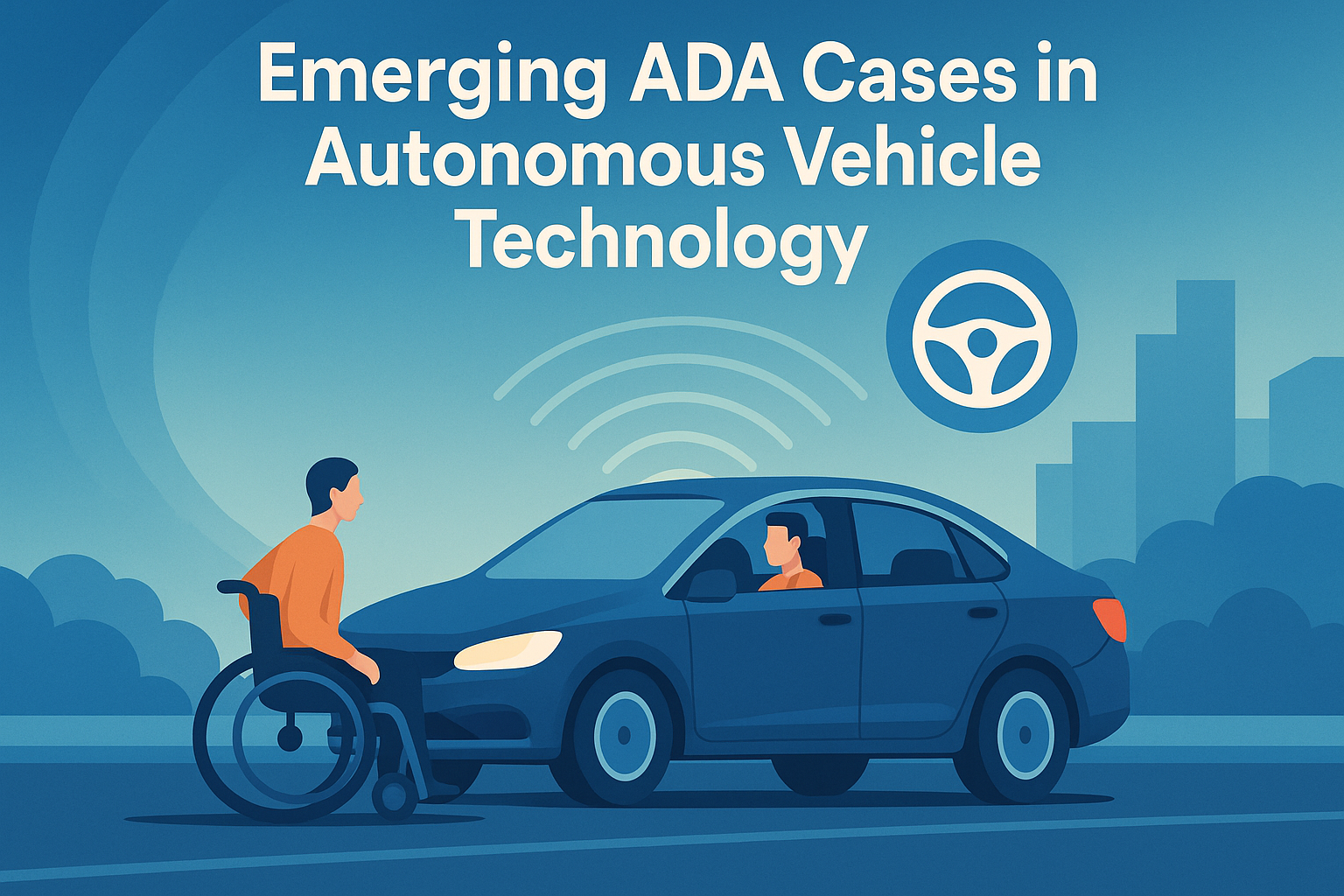
The advent of autonomous vehicles (AVs) heralds a new era of mobility that promises to drastically change how people travel and interact with the world around them. While this innovation holds significant potential, it also introduces complex challenges, particularly concerning compliance with the Americans with Disabilities Act (ADA). As AV technology continues to develop, the need to ensure accessibility for individuals with disabilities remains a critical concern. This article delves into emerging ADA cases in the field of AV technology, illustrating the importance of making these innovations inclusive and equitable for all. Whether from a legal, social, or technological perspective, ensuring ADA compliance in autonomous vehicles is imperative to prevent discrimination and enhance accessibility. As we explore the complexities surrounding AVs and ADA cases, understanding these issues allows stakeholders to create a future where everyone, regardless of ability, can benefit from technological advancements.
The Intersection of ADA Compliance and Autonomous Vehicles
At the heart of ADA compliance in autonomous vehicles is the need to accommodate travelers of all abilities. The ADA, signed into law in 1990, prohibits discrimination against individuals with disabilities in all areas of public life. Its goal is to ensure equal opportunity to access, participate, and benefit from all types of services. In the realm of autonomous vehicles, this principle translates to ensuring that such technology is accessible from inception, including the design, development, and implementation stages.
A noteworthy example is the ongoing debate over ride-sharing services that deploy autonomous vehicles. In several cases, individuals with disabilities have filed lawsuits against companies like Uber and Lyft, arguing that their autonomous fleets do not accommodate passengers using wheelchairs or service animals adequately. These lawsuits highlight the gap between cutting-edge technology and existing accessibility requirements, pushing companies to reconsider vehicle design to include ramps, space for mobility equipment, and other essential adaptations.
- Adaptations for wheelchairs (e.g., ramps, additional space)
- Accessibility for service animals
- Interface accommodations for visually and hearing-impaired individuals
Real-World Examples of ADA Lawsuits in AV Technology
To better understand the real-world implications, consider the case of the blind community’s lawsuit against Google’s Waymo division. Waymo was accused of failing to provide adequate accommodations for blind riders. Specifically, plaintiffs argued that the interface used in Waymo’s autonomous taxis did not cater to visually impaired individuals, making it difficult for them to navigate or summon rides without assistance. This lawsuit brought to the forefront the pressing need for AV companies to integrate accessible interface features, such as voice-command systems, tactile enhancements, and audio descriptions.
In another case, a group of disability rights organizations sued the city of San Francisco, citing its roll-out of autonomous shuttles that lacked accommodations for wheelchair users. The case was significant as it challenged the city’s responsibility to ensure public transportation, including experimental AV services, aligned with ADA standards. These legal challenges serve not only as a catalyst for change but also as a crucial reminder that innovation must include all users from the ground up.
Technological Solutions for ADA Compliance in AVs
Technology solutions play a pivotal role in enhancing ADA compliance in autonomous vehicles. Innovations such as AI-driven systems capable of recognizing passengers with disabilities and adjusting the in-vehicle environment accordingly can greatly improve accessibility. For instance, smart interfaces that offer personalized settings can ensure that visually impaired passengers receive the necessary audio cues, while haptic feedback systems can benefit users with hearing disabilities by providing sensory notifications.
Moreover, the development of universally designed hardware that accommodates wheelchairs and other mobility equipment inside the vehicle is imperative. Companies like General Motors and their Cruise division are actively exploring ways to integrate these features into their AV designs. This emphasis on inclusive design ensures that AVs are not only a technological marvel but also a symbol of progress in societal inclusivity.
Legal Framework and Policy Considerations
The legal landscape is rapidly evolving alongside technological advancements in AVs. Regulation is needed to bridge the gap between innovation and compliance. Federal and state policymakers are increasingly examining how existing ADA requirements can be adapted to fit the unique circumstances of autonomous vehicles. For instance, legislative measures may include mandates for AV manufacturers to conduct accessibility assessments and include stakeholders from the disabled community in the design process.
| Policy Initiative | Description |
|---|---|
| Inclusive Design Mandate | Requires AVs to cater to various disability needs right from the design phase. |
| Stakeholder Consultation | Involves the disabled community in AV development for insights and feedback. |
| Accessibility Certification | Establishes a compliance certification process for AV companies. |
Such initiatives are designed to create a fairer, more inclusive transport environment. However, challenges persist, such as ensuring consistent enforcement across states and keeping pace with rapid tech advancements. Nevertheless, they form a vital groundwork toward achieving true accessibility in autonomous transportation.
The Business Case for ADA Compliance in AVs
Beyond regulatory requirements and social responsibility, ensuring ADA compliance offers substantial business benefits for AV companies. An inclusive approach can expand market reach by tapping into the underserved segment of individuals with disabilities, estimated to be about one in four adults in the United States. Furthermore, it enhances the company’s public image and aligns brands with progressive, inclusive values.
Companies that prioritize ADA compliance tend to enjoy better customer satisfaction and loyalty, as accessibility often translates into more user-friendly designs benefitting the broader population. AV companies adopting early compliance strategies not only mitigate legal risks but also position themselves as pioneers in a rapidly evolving industry, setting the standard for others to follow. This proactive approach can also lead to invaluable partnerships with advocacy groups and contribute positively to policy-shaping, further solidifying the company’s standing in the marketplace.
Conclusion: Towards an Accessible Future with Autonomous Vehicles
The emergence of ADA cases in autonomous vehicle technology is a pivotal chapter in the ongoing journey toward inclusivity in transportation. By examining lawsuits, technological responses, and policy initiatives, it becomes clear that achieving accessibility in this domain requires a multidisciplinary effort that incorporates legal, technological, and community-driven perspectives. As we have explored, ensuring ADA compliance not only prevents discrimination but also provides significant social and business advantages.
For AV companies, embracing ADA compliance as a core value aligns them with future-forward practices and opens new avenues for growth. For policymakers and advocates, continuing to push for rigorous standards and inviting diverse voices into the conversation moves us closer to an era where accessibility is seamlessly integrated into all technological advancements. The call to action is clear: we must all work collaboratively to create a transport ecosystem that affords every individual the freedom and independence once promised by advancements in vehicular technology. In doing so, we build not just smarter systems, but better communities for everyone involved.
Frequently Asked Questions
1. What are some common ADA compliance concerns with autonomous vehicles?
The autonomous vehicle (AV) technology brings promising advancements, aiming to revolutionize how we travel by providing greater independence to individuals, including those with disabilities. However, ensuring ADA compliance presents several challenges. One significant concern is the design of these vehicles. AVs must be designed with accessibility in mind, with features like wheelchair accessibility, tactile interfaces for those with visual impairments, and audio outputs for the hearing-impaired.
Navigating through non-standard design, such as vehicles lacking steering wheels or human-operated controls, can pose problems. Ensuring that every passenger can communicate effectively with the vehicle’s system, whether through voice commands, touch screens, or other accessible input methods, is vital. Additionally, the process of entering and exiting the vehicle safely and comfortably must be considered, making sure there are proper ramps and sufficient space for maneuverability.
2. How is the auto industry addressing ADA compliance in autonomous vehicles?
The auto industry is actively working to address ADA compliance in AVs through various collaborations and innovations. Many automakers are partnering with disability organizations to better understand specific needs and develop inclusive design solutions. This collaborative approach ensures the vehicles are designed from the ground up with accessibility in mind rather than retrofitting them later.
Technological advances also play a key role. Manufacturers are exploring features like advanced voice recognition systems and customizable control interfaces that allow for adjustments based on a user’s specific disability. The industry is also focusing on standardized guidelines for accessibility, aligning their innovations with ADA requirements.
3. What role does the government play in ensuring AVs are ADA compliant?
The government’s role is crucial in setting the regulatory framework that ensures AV technology advances in a manner that is inclusive and accessible. Agencies like the Department of Transportation and the National Highway Traffic Safety Administration (NHTSA) are tasked with developing and enforcing guidelines that align with ADA mandates.
The government is increasingly involved in funding research and development initiatives to better integrate accessibility features into AV technologies. They work closely with advocacy groups to gather input and feedback from the disability community. Creating specific standards and enforcing compliance is necessary to promote the adoption of AVs that cater to all individuals, regardless of their physical capabilities.
4. Are there any emerging technologies specifically aimed at enhancing accessibility in autonomous vehicles?
Yes, several emerging technologies are being developed to enhance accessibility in AVs. One significant area of focus is the user interface, where intuitive designs allow users with varying disabilities to interact with the vehicle seamlessly. Voice-activated assistance has seen notable advancements, providing effortless control over vehicle operations.
Advanced AI-based systems are being integrated into AVs for real-time obstacle detection and navigation assistance, crucial for visually impaired users. Additionally, the development of personalized rider experiences through machine learning can adapt vehicle functions based on the user’s needs, ensuring a tailored and comfortable journey for everyone. The introduction of robotic arms and automated boarding ramps are also innovations worth noting, aiding individuals with physical disabilities in entering and exiting the vehicle with ease.
5. How can advocacy groups contribute to ensuring ADA compliance in autonomous vehicles?
Advocacy groups play a pivotal role in promoting ADA compliance for autonomous vehicles by amplifying the voices and needs of people with disabilities. They engage in active dialogue with policymakers and manufacturers to create awareness and push for necessary changes in design and policy.
These groups provide valuable insights and conduct research that highlights specific barriers faced by individuals with disabilities, advocating for improvements in accessibility features. By organizing panels, conferences, and workshops, they help foster collaboration between stakeholders, ensuring that the development of AV technology remains inclusive.
The continuous advocacy and vigilance by these groups ensure that accessibility is prioritized as a fundamental design principle in the evolving landscape of autonomous vehicle technology. Their efforts bring forth a future where mobility is truly universal, inclusive, and equitable for all individuals.


