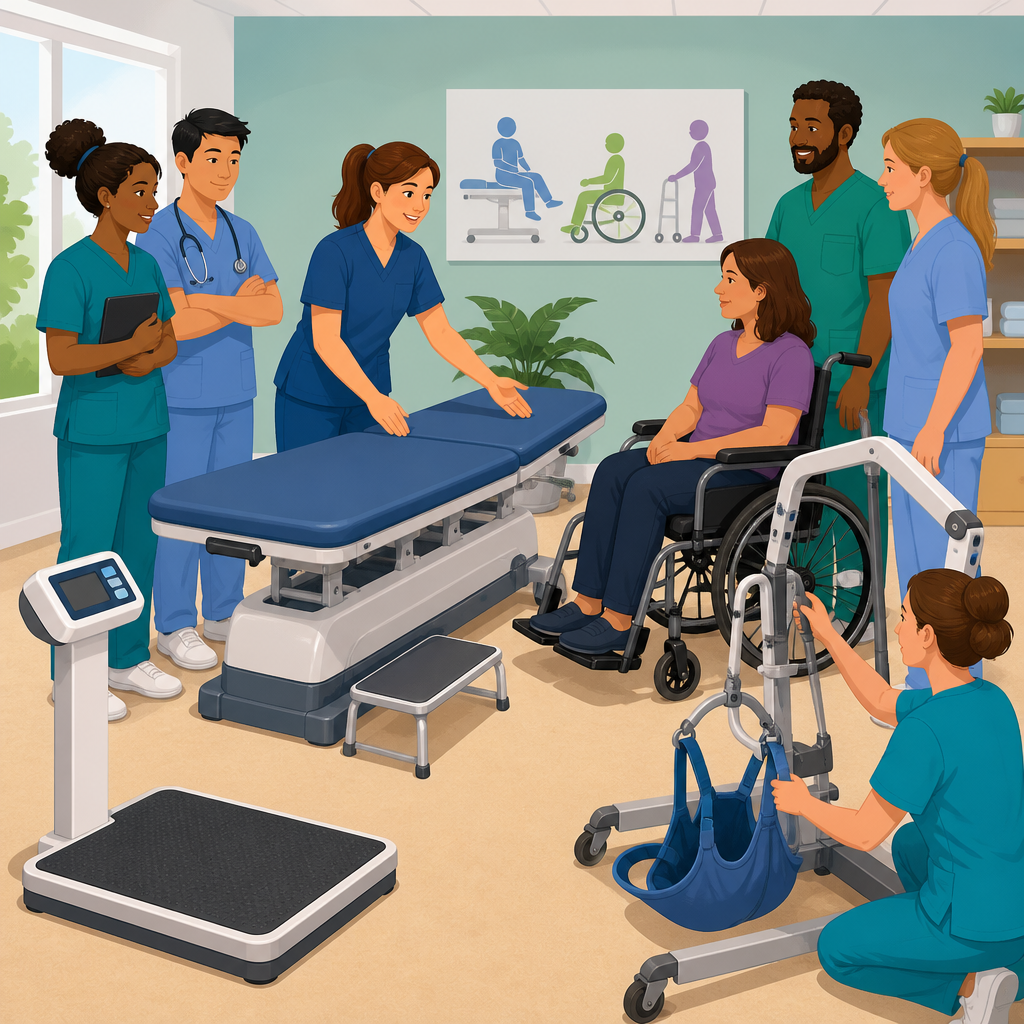
Training medical staff to use accessible exam tables, scales, and transfer equipment is one of the most practical steps a healthcare organization can take to improve care quality, reduce injury risk, and strengthen compliance. In this context, accessible equipment includes height-adjustable exam tables, wheelchair-accessible weight scales, patient lifts, transfer boards, gait belts, and positioning supports designed to help patients with mobility, balance, strength, or endurance limitations receive care safely and with dignity. Training means more than showing staff where a control button is located. It includes role-based education, hands-on practice, patient communication, emergency procedures, maintenance awareness, and documented competency checks tied to actual workflows.
This topic matters because equipment alone does not create access. I have seen clinics invest heavily in powered tables and standing lifts, then discover months later that staff still default to manual lifting, skip weights for wheelchair users, or schedule disabled patients only when a “strong staff member” is available. Those failures are rarely caused by bad intent. They are usually caused by incomplete onboarding, unclear responsibilities, rushed annual education, and no direct observation of technique. The result is predictable: delayed care, inaccurate vital data, avoidable falls, musculoskeletal injuries, patient complaints, and heightened regulatory exposure.
Training and role-based education are the hub of successful implementation because they connect policy, procurement, operations, and patient experience. Front-desk teams need to know how to identify accommodation needs during scheduling. Medical assistants must prepare rooms and operate exam tables efficiently. Nurses need safe transfer judgment. Providers must understand how accessible positioning affects the exam itself. Facilities and biomedical staff need preventive maintenance routines. Leaders need audit data, refresher schedules, and incident review processes. When each role understands its part, accessible equipment becomes normal clinical infrastructure rather than a rarely used special accommodation.
Well-designed education also supports consistent care across sites. A multi-location practice cannot rely on informal peer teaching if it wants reliable outcomes. Standard lesson plans, checklists, return demonstrations, and escalation pathways create repeatability. They also make related implementation articles easier to connect, including equipment selection, room layout, scheduling, preventive maintenance, disability etiquette, and emergency preparedness. As a hub topic, training sits at the center of all of those operational decisions because every policy eventually succeeds or fails at the point of care, where a staff member must know what to do, why it matters, and how to do it safely every time.
What role-based education must cover
Role-based education is structured training tailored to the decisions and tasks each employee performs. In practice, that means the content for a scheduler should not be identical to the content for a nurse, provider, transporter, or facilities technician. Everyone needs a shared foundation in disability access, respectful communication, patient privacy, and safe handling principles. After that, the curriculum should branch by role. Schedulers need scripts for asking about access needs without making assumptions. Front-desk staff need check-in and rooming workflows that preserve dignity. Clinical staff need device operation, contraindications, transfer mechanics, and fall response steps. Managers need documentation standards, staffing models, and competency tracking.
The most effective programs define learning objectives in observable terms. For example, “medical assistants will position an accessible exam table at wheelchair seat height, lock the table, confirm foot placement, and assist using a gait belt when indicated” is measurable. “Staff will understand accessible tables” is not. I recommend building training around common patient journeys: arriving in a power wheelchair, transferring with partial weight-bearing ability, remaining in the wheelchair for weight measurement, or requiring a mechanical lift after surgery. Scenario-based design helps staff connect equipment use to real encounters instead of memorizing isolated features.
Organizations should also separate awareness training from competency training. Awareness covers why access matters, applicable standards, equipment categories, and patient-centered communication. Competency requires supervised performance. A short video may be enough to introduce the purpose of a wheelchair-accessible scale, but it is not enough to verify that staff can zero the platform, guide entry, position mobility devices safely, and document the weight accurately. For lifts and transfer devices, competency should include sling selection, battery checks, spreader bar positioning, emergency lowering, and recognition of situations that require a second trained staff member. These are high-consequence tasks that demand demonstration, not just attendance.
Core equipment skills for exam tables, scales, and transfer devices
Accessible exam tables require more training than many clinics expect. Staff must know the table’s lowest transfer height, weight capacity, side rail function, hand control layout, stirrup operation if relevant, and infection prevention cleaning steps. More importantly, they must understand sequence. A safe transfer often starts before the patient enters the room: clear the floor, place assistive devices within reach, lower the table fully, lock wheels if the model has mobile capability, and explain each step before movement begins. During use, staff should monitor fatigue, orthostatic symptoms, and skin integrity where friction or shear can occur.
Wheelchair-accessible scales seem simple, but they are frequently used incorrectly. Common failures include leaving ramps partially obstructed, failing to zero the scale before entry, misreading kilogram and pound settings, and weighing a patient while a staff member is touching the chair. Staff should know whether the scale calculates tare weight or whether wheelchair weight must be subtracted separately according to facility policy. They should also know when a seated weight is clinically acceptable and when a standing weight is required for a specific treatment decision. In dialysis, oncology, heart failure management, and medication dosing, weight accuracy can directly affect care.
Transfer equipment training should distinguish between transfer aids and lifting devices. A transfer board helps bridge surfaces for a patient with upper body strength who can participate in the move. A gait belt supports controlled assistance during standing or pivoting but is not a substitute for a lift when the patient cannot bear weight safely. Sit-to-stand lifts require trunk control and at least some weight-bearing ability. Full-body mechanical lifts are used when manual transfer would expose the patient or staff to unreasonable risk. Confusion among these categories is where injuries happen, so the curriculum should include decision points, not just product names.
| Equipment | Primary use | Key staff competency | Common mistake |
|---|---|---|---|
| Height-adjustable exam table | Seated lateral transfer and positioning for exam | Lowering to transfer height and stabilizing patient movement | Starting transfer before explaining steps |
| Wheelchair-accessible scale | Obtaining accurate seated or roll-on weight | Zeroing scale and applying tare process correctly | Recording wheelchair plus patient as patient weight |
| Transfer board | Bridging wheelchair and table for assisted slide transfer | Placement angle, hand positioning, and skin protection | Using it for a patient without trunk control |
| Sit-to-stand lift | Assisted standing transfer for partial weight-bearing patient | Assessing candidacy and securing sling attachment | Using it for a patient who cannot follow commands |
| Full-body lift | Total assist transfer with minimal patient participation | Sling selection, lift path, and emergency lowering | Skipping pre-use battery and strap checks |
How to build a training program that works in real clinics
A strong program starts with an equipment and workflow inventory. List each accessible table, scale, and transfer device by location, manufacturer, model, capacity, and service status. Then map who uses it, how often, and in which patient scenarios. This step sounds basic, but it reveals important gaps. In one ambulatory network I supported, two clinics had accessible scales but no staff assigned to inspect ramp clearance during opening rounds. Another had a lift in storage because no one knew where the charger belonged. Training was failing because operations were undefined.
From there, create a curriculum with three layers: orientation for all staff, role-specific modules, and annual or event-triggered refreshers. Orientation should cover access principles, respectful language, accommodation workflows, and when to request help. Role-specific modules should be short, task-centered, and tied to the exact equipment in that department. Refresher training should follow incidents, near misses, equipment replacement, software changes in digital scales, or observed drift from standard technique. New construction, room redesign, and changes in patient population are also valid triggers. A bariatric medicine expansion, for example, often requires different slings, wider clearances, and revised staffing plans.
Hands-on practice is nonnegotiable. Adult learners retain more when they perform the task in the same environment where it will occur. Use simulation with wheelchairs, weighted mannequins, and realistic room setups. Include time pressure, communication challenges, and unexpected changes, such as a weak battery alarm or a patient who becomes dizzy midway through standing. Debrief every scenario with a standard rubric. What did the staff member assess first? Did they explain the process clearly? Did they protect the patient’s privacy? Did they choose the correct equipment? Could another person reproduce the same safe result using the documented workflow?
Competency validation, documentation, and compliance support
Competency validation should be formal, traceable, and role specific. The best organizations use checklists that combine direct observation with knowledge questions. For example, a nurse may be observed conducting a seated-to-table transfer, then asked how they would adapt the process for a patient with hemiparesis, severe pain, or a recent hip precaution. Documentation should capture the date, evaluator, equipment model, pass or remediation status, and next review date. Learning management systems can track completion, but they should not replace bedside observation for physical skills.
Documentation matters for more than internal quality. It supports readiness for accreditation surveys, complaint investigations, workers’ compensation review, and defense against claims that the organization failed to train staff adequately. Standards from OSHA’s safe patient handling guidance, the Americans with Disabilities Act, Section 504 obligations for covered entities, and accrediting expectations around competence, environment of care, and patient rights all intersect here. Training records will not excuse unsafe care, but absent records make it much harder to prove a reliable process existed.
Auditing should be built into the program. Useful measures include percentage of staff with current competency, number of patients weighed using accessible scales when indicated, transfer-related incident rates, staff injury reports, patient complaint themes, and time from accommodation request to fulfilled visit. I also recommend periodic unannounced observations. In my experience, post-training surveys are often overly positive, while real-world audits show staff improvising around blocked scales, dead lift batteries, or cluttered exam rooms. Observation reveals whether access is truly operationalized.
Common implementation failures and how to prevent them
The most common failure is treating accessible equipment as optional. When staff perceive a table or lift as “special equipment,” they avoid it until a difficult case forces its use. Prevent this by incorporating accessible workflows into routine rooming, weighing, and examination standards. Another frequent problem is assigning expertise to one champion per shift. Champions help, but they should not become the only people who can operate equipment safely. Redundancy is essential because patients do not arrive only when the expert is present.
Another failure is overlooking communication. Patients should never be lifted, weighed, or repositioned without a clear explanation and consent to proceed. Ask how they usually transfer, what assistance works best, and whether any pain, weakness, spasticity, or device limitation affects the plan. Many patients are highly experienced in directing safe transfers, and staff should use that knowledge. At the same time, patient preference does not override safety. If a requested manual lift would expose everyone to unreasonable risk, staff need language and policy support to choose a safer method.
Finally, organizations often neglect sustainment. Batteries fail, slings disappear, software settings drift, and turnover erodes skill. The solution is governance. Assign owners for equipment readiness, educator review, incident analysis, and policy updates. Link this hub topic to adjacent implementation work: room design, procurement specifications, preventive maintenance, patient communication, and emergency procedures. When those pieces are connected, training becomes durable rather than episodic.
Training medical staff to use accessible exam tables, scales, and transfer equipment is not a side project. It is a core operational capability that determines whether access exists in practice. The essential elements are clear role definitions, hands-on instruction, scenario-based practice, documented competency, and ongoing auditing. When these pieces are in place, staff move patients more safely, clinicians obtain accurate weights and better exam access, and organizations reduce both injury exposure and compliance risk.
The larger benefit is consistency. Patients should not have to wonder whether the next clinic, shift, or staff member will know how to weigh them, transfer them, or position them respectfully. Reliable role-based education turns accessible equipment into dependable care infrastructure. It supports dignity, efficiency, and better clinical decision-making at the same time.
If you are building out a compliance and implementation program, start by auditing your current equipment, workflows, and competencies by role. Then use this hub as the foundation for deeper work on scheduling, room setup, maintenance, disability communication, and safe patient handling. The organizations that do this well do not rely on good intentions alone. They train, observe, document, and improve.
Frequently Asked Questions
Why is training medical staff on accessible exam tables, scales, and transfer equipment so important?
Training is essential because accessible equipment only improves care when staff know how to use it correctly, consistently, and confidently. Height-adjustable exam tables, wheelchair-accessible scales, patient lifts, transfer boards, gait belts, and positioning supports are designed to make care safer and more inclusive for patients with mobility, balance, strength, or endurance limitations. However, without proper instruction, staff may avoid the equipment, use it incorrectly, or default to unsafe manual assistance techniques that increase the risk of patient falls, skin injury, staff strain, and incomplete exams.
Well-trained teams are better able to protect patient dignity, reduce delays, and complete visits more efficiently. For example, a patient who cannot safely step onto a fixed-height table may otherwise receive a limited exam or be examined in a wheelchair when a proper transfer and table-based assessment would provide better clinical information. In the same way, accurate weight measurement using a wheelchair-accessible scale can directly affect medication dosing, treatment decisions, and chronic disease management. Training helps staff understand not just how the equipment works, but why it matters clinically, operationally, and from a risk management perspective.
There is also an important compliance and quality dimension. Accessible care is closely tied to disability access obligations, patient rights, and broader organizational goals around equity and safety. Staff education supports more consistent workflows, better documentation, and stronger readiness for audits, complaints, or accreditation reviews. In short, training turns accessible equipment from a purchased asset into a reliable part of everyday patient care.
What topics should be included in a staff training program for accessible medical equipment?
A strong training program should cover both technical use and patient-centered application. Staff need to know how to operate each device safely, including setup, adjustments, locking mechanisms, weight limits, charging requirements, emergency lowering features, sling selection where applicable, cleaning protocols, and storage procedures. For height-adjustable exam tables, that means teaching staff how to lower the surface for safer seated transfers, position patients appropriately, and use supports or rails according to manufacturer instructions. For accessible scales, it means understanding platform access, wheelchair tare functions if available, patient positioning, and how to capture accurate measurements without rushing the process.
Transfer equipment training should be especially hands-on. Teams should learn how to determine whether a patient is appropriate for a gait belt, transfer board, sit-to-stand aid, or full patient lift. They should also be trained to recognize contraindications, communicate clearly during transfers, and coordinate roles when more than one staff member is involved. Safe body mechanics remain important, but modern training should emphasize reducing reliance on manual lifting whenever mechanical or low-friction options are indicated. This protects staff from musculoskeletal injuries and improves patient safety at the same time.
Just as important, training should address communication, consent, and patient experience. Staff should learn how to explain equipment in a respectful way, ask about patient preferences, avoid assumptions about ability, and preserve privacy throughout the encounter. Scenario-based training is often very effective because it helps employees apply equipment use to real clinical situations such as rooming a patient who uses a wheelchair, weighing a patient with limited standing tolerance, or assisting someone with a neurological condition onto an exam table. The most effective programs combine policy, hands-on practice, competency validation, and refreshers over time rather than treating training as a one-time event.
How does proper training reduce injury risk for both patients and healthcare workers?
Proper training reduces injury risk by standardizing safer movement practices and making sure staff choose the right equipment for the right task. Patient handling injuries often happen when staff underestimate the level of assistance needed, attempt a manual transfer too quickly, or use equipment incorrectly. A patient may lose balance during a pivot transfer, slide during repositioning, or experience pain and anxiety if the process is not explained clearly. At the same time, staff may suffer back, shoulder, or wrist injuries when they try to compensate physically for poor setup or insufficient equipment use.
When teams are trained well, they become better at assessing transfer needs before movement begins. They learn to evaluate factors such as weight-bearing ability, cognition, fatigue, recent surgery, muscle weakness, spasticity, and fall risk. That assessment guides whether the patient can transfer with verbal cueing, requires a gait belt and close assist, needs a transfer board, or should be moved with a mechanical lift. This kind of decision-making is critical because even high-quality equipment can be unsafe if used in the wrong situation. Training also reinforces preparation steps such as locking wheels, clearing obstacles, adjusting table height, checking sling fit, and coordinating staff communication during the transfer.
Injury prevention also depends on repetition and consistency. Staff who rarely use equipment may revert to older habits under time pressure, which is why refresher training and competency checks matter. Organizations that build accessible equipment use into daily workflows usually see better adherence and fewer preventable incidents. Over time, that can lead to lower workers’ compensation exposure, fewer patient handling claims, less lost work time, and a stronger culture of safety. The goal is not just to have safe equipment available, but to make safe use the routine standard of care.
How can healthcare organizations make sure staff actually use accessible equipment consistently?
Consistency usually comes from a combination of training, workflow design, leadership expectations, and equipment availability. If accessible tables, scales, and transfer devices are difficult to locate, poorly maintained, or seen as optional, staff usage will be inconsistent no matter how strong the training is. Organizations should place equipment where it is needed, keep it ready for use, and make accessibility part of normal rooming and examination procedures. For example, if a clinic has height-adjustable exam tables but schedules patients with mobility limitations into rooms without them, staff may bypass the intended process and improvise instead.
Clear policies and role-specific expectations also help. Staff should know when accessible equipment must be used, who is responsible for setup, how patient needs are identified before or during arrival, and how to escalate if the required equipment is unavailable. Embedding prompts into scheduling systems, intake forms, pre-visit planning, and room assignment can make a major difference. It is much easier for staff to succeed when they have advance notice that a patient may need a wheelchair-accessible scale, extra transfer time, or lift assistance. Supervisors and clinical leaders should reinforce that using the proper equipment is a quality and safety expectation, not a delay or inconvenience.
Organizations should also monitor performance and support improvement. That may include competency assessments, direct observation, incident review, patient feedback, and preventive maintenance tracking. If staff are not using equipment consistently, the cause is often practical rather than motivational: insufficient training time, uncertainty about patient selection, lack of confidence, battery issues, storage barriers, or scheduling pressures. Addressing those operational issues is just as important as initial education. When accessible equipment use is built into systems, measured, and supported by leadership, it becomes part of standard clinical practice instead of an exception.
What are the long-term benefits of investing in accessible equipment training?
The long-term benefits are substantial and extend far beyond immediate compliance. First, training improves care quality by making it easier for clinicians to complete thorough examinations, obtain accurate weights, and position patients appropriately for assessment and treatment. That can lead to better diagnostic accuracy, more individualized care, and fewer workarounds that compromise the visit. Patients are also more likely to feel respected and included when staff use equipment smoothly and confidently rather than treating access needs as unusual or burdensome.
Second, effective training supports workforce safety and operational stability. Musculoskeletal injuries related to patient handling can be expensive and disruptive, especially in environments already dealing with staffing shortages and burnout. Teaching staff how to use lifts, transfer aids, and adjustable surfaces correctly can reduce unnecessary physical strain and promote a safer work environment. Over time, that may lower injury-related costs, decrease lost work days, and improve employee confidence in caring for patients with diverse mobility needs.
Third, accessible equipment training strengthens organizational reputation and resilience. Healthcare organizations are increasingly evaluated not only on clinical outcomes but also on patient experience, equity, safety, and disability access. A well-trained team is better positioned to deliver consistent service, respond appropriately to patient concerns, and demonstrate good-faith efforts to meet accessibility standards. In practical terms, that can support risk reduction, survey readiness, and stronger community trust. Ultimately, investing in training helps ensure that accessible equipment is not just present in the facility, but fully integrated into safe, respectful, high-quality care.