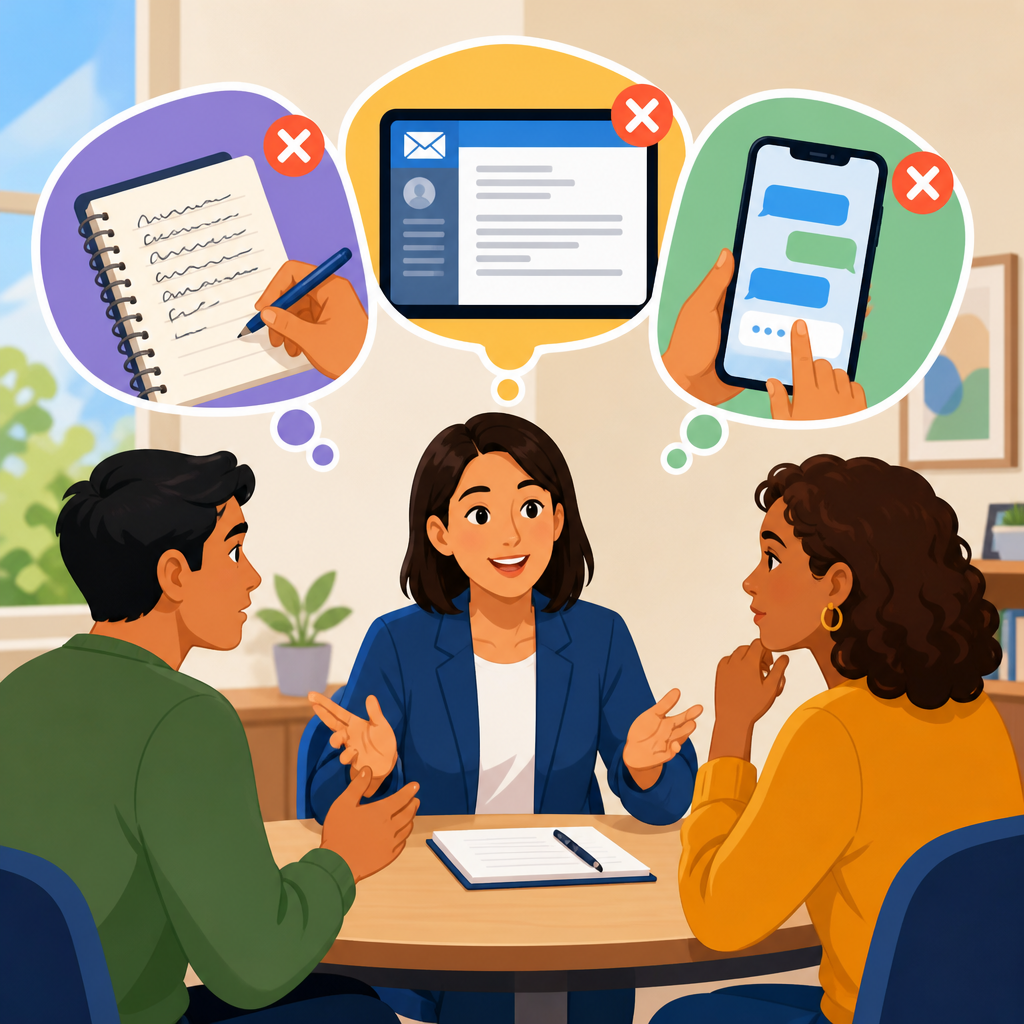
When notes, email, or text are not an effective substitute for an interpreter becomes clear the moment a conversation involves medical risk, legal consequences, financial consent, or emotionally complex decisions. In disability rights practice, “effective communication” means communication that is as clear, timely, accurate, and complete for a deaf or hard of hearing person as it is for a hearing person. “Auxiliary aids and services” include qualified sign language interpreters, video remote interpreting, real-time captioning, written materials, assistive listening systems, relay services, and other tools that help people receive and express information. I have worked with clinics, schools, employers, and service businesses on communication access planning, and the same mistake appears repeatedly: staff assume that if a patient can exchange a few written notes or answer a text, an interpreter is unnecessary. That assumption is often legally wrong and practically unsafe. This hub article explains when written communication is inadequate, what standards apply, which auxiliary aids may work better, and how organizations should decide what to provide.
The issue matters because communication access is not a courtesy; it is a civil rights obligation tied to safety, informed consent, equal participation, and dignity. Federal disability law generally requires covered entities to furnish appropriate auxiliary aids and services where needed to ensure effective communication. The right aid depends on the person, the setting, the length and complexity of the interaction, and whether the exchange is one way or interactive. A brief retail purchase may work fine with writing. A mental health intake, special education meeting, deposition, emergency room consultation, or disciplinary hearing usually does not. This page serves as a hub for the broader “Effective Communication & Auxiliary Aids” topic by defining the governing principle, identifying common failure points, and outlining how to evaluate notes, email, text, captioning, remote services, and interpreters in real situations.
What “effective communication” actually requires
Effective communication is measured by outcome, not by whether staff made some effort. The message must be conveyed accurately, in a manner the person can understand, and with an opportunity for equally effective back-and-forth discussion. That means the deaf or hard of hearing person must be able to ask questions, interrupt, clarify, react in real time, and catch nuance. In practice, I look at four variables first: complexity, length, pace, and consequences. The more technical the topic, the longer the meeting, the faster the exchange, or the higher the stakes, the less likely notes or text will be enough.
Consider a hospital discharge conversation. A nurse may think a typed summary solves the problem, but discharge instructions are rarely just a handout. Patients ask follow-up questions about side effects, timing, interactions, transportation restrictions, and what symptoms justify a return visit. If the patient uses American Sign Language as a primary language, English literacy may vary, just as Spanish literacy varies among native Spanish speakers. Written English is not a substitute for interpreted ASL any more than a phrasebook is a substitute for fluent conversation. The same analysis applies in legal intake, human resources investigations, academic advising, and counseling sessions where meaning depends on precision and trust.
When notes, email, or text fail in real-world settings
Notes, email, and text can support communication, but they often fail as substitutes for interpreters because they flatten complex dialogue into fragmented, delayed exchanges. They also assume literacy, attention, and privacy that may not exist. In a crowded emergency department, passing a clipboard back and forth can delay triage and miss details about pain, pregnancy, medications, or allergies. In a courtroom hallway, texting with counsel can omit nuance about plea terms, evidentiary risks, or client questions. In a school meeting, emailing a parent before or after an Individualized Education Program discussion does not replace access to the actual live meeting where decisions are made.
Written methods are especially weak when multiple speakers participate, people talk over each other, visual materials are presented, or the discussion shifts quickly. Group job interviews, safety trainings, college orientations, social service appeals, and police interactions all create these problems. Tone also matters. A therapist assessing suicidality, a supervisor giving corrective action, or a physician discussing a miscarriage needs direct, natural communication. Reducing those conversations to short written exchanges can strip away context, impair rapport, and produce harmful misunderstandings. In my experience, organizations often overestimate how efficient writing is; once staff must paraphrase every spoken statement into simplified text, the interaction becomes slower and less accurate than using a qualified interpreter from the start.
How to decide which auxiliary aid is appropriate
The correct aid is determined case by case, with primary consideration given to the deaf or hard of hearing person’s usual method of communication. “Primary consideration” does not mean every requested aid must be granted regardless of circumstances, but it does mean the request should lead the analysis. If a person says, “I need an ASL interpreter for this meeting,” the organization should not default to pen and paper because it is cheaper or more convenient. The decision should evaluate communication preferences, context, urgency, and whether an alternative will truly provide equivalent access.
Here is a practical comparison I use when advising organizations on common communication options.
| Method | Works best for | Common limits | Usually not enough when |
|---|---|---|---|
| Written notes | Brief, simple, one-topic exchanges | Slow, incomplete, literacy dependent, poor for nuance | Discussion is lengthy, technical, emotional, or interactive |
| Email or text | Scheduling, confirmations, follow-up summaries | Delayed, fragmented, privacy concerns, not live access | Real-time participation or informed consent is required |
| Video remote interpreting | Short-notice access where equipment and bandwidth are strong | Fails with poor internet, bad camera angles, visual fatigue | Connection quality is unstable or visual access is obstructed |
| On-site interpreter | Complex, lengthy, high-stakes, multi-speaker interactions | Advance scheduling may be needed | Rarely inadequate if the interpreter is qualified and well positioned |
| Real-time captioning | Meetings, lectures, webinars, some workplace settings | May not capture speaker identification or visual nuance alone | User primarily relies on sign language or needs expressive access |
This comparison shows why there is no universal shortcut. A bank fraud interview, prenatal consultation, or eviction hearing usually requires a qualified interpreter or, in some cases, real-time captioning depending on the person’s language and communication style. By contrast, a text confirming an appointment time may be perfectly effective. The question is not whether writing can communicate something; it is whether it can communicate enough, with equal accuracy and participation, for that situation.
Qualified interpreters, captioning, and other aids: what “qualified” means
A qualified interpreter is not simply someone who knows some sign language. The person must be able to interpret effectively, accurately, and impartially, both receptively and expressively, using necessary specialized vocabulary. In healthcare, that may include anatomy, treatment options, and medication terminology. In law, it may include privilege, waiver, continuance, and sentencing language. Family members, minor children, and bilingual staff are usually poor substitutes because they may lack vocabulary, impartiality, or confidentiality discipline. I have seen adult children filter bad news in medical meetings and supervisors ask a signing employee to interpret for a coworker in disciplinary discussions; both situations create obvious risk.
Captioning and speech-to-text tools also have a place, but they solve different problems. Communication Access Realtime Translation, commonly called CART, can be highly effective for people who use English text well and need full access to lectures, meetings, or conferences. Automatic captions, while improving, still miss names, jargon, accents, and rapid turn-taking. They are helpful backups, not guaranteed equivalents in high-stakes settings. Assistive listening systems, hearing loops, and amplified phones may help some hard of hearing users, especially those who do not sign. The right aid depends on the actual person in front of you, not assumptions about everyone with hearing loss.
Common settings where written communication is not enough
Healthcare is the clearest example because errors can cause immediate harm. Effective communication is essential during consent discussions, surgery preparation, labor and delivery, psychiatric evaluations, discharge planning, and emergency treatment. The Joint Commission has emphasized patient-provider communication as a safety issue, and malpractice exposure rises when instructions are misunderstood. A handwritten note stating “take twice daily” does not answer whether the dose should be taken with food, what to do after a missed dose, or whether it interacts with insulin. Informed consent is a process, not a signature on a form.
Legal settings are similarly demanding. Attorney-client consultations, witness preparation, mediation, and court appearances require confidentiality, precision, and rapid strategy discussion. A deaf client cannot meaningfully participate if counsel summarizes complex options by text after the hearing rather than providing interpreter access during the hearing itself. Education also presents recurring access failures. Parents and students need live access during IEP meetings, disciplinary proceedings, orientation sessions, and lectures. Sending minutes afterward is not the same as being present for the questions, disagreements, and decisions that shaped those minutes.
Employment situations can be less obvious but equally serious. Safety trainings, harassment investigations, performance reviews, benefits enrollment, and promotion interviews affect wages, discipline, and physical safety. If a machine-operator misses a lockout/tagout instruction because the employer relied on scribbled notes, the consequence can be injury. Public accommodations such as hospitals, banks, hotels, shelters, social service agencies, and counseling practices also must think beyond the front desk. Staff often handle simple check-in well by writing, then fail when the interaction moves into intake, policy explanation, eligibility screening, or crisis intervention.
How organizations should respond to requests and avoid predictable mistakes
The best access programs are built before a complaint arrives. Organizations should adopt a written effective communication policy, designate a responsible coordinator, maintain interpreter and CART vendor lists, train frontline staff, and document decisions. Intake systems should ask about preferred communication method at the earliest possible stage and flag future appointments. For remote services, test cameras, lighting, screen size, speaker placement, and bandwidth before the session starts. If video remote interpreting freezes, pixelates, or prevents clear visibility of the interpreter’s hands, face, or body positioning, it is not effective and another aid should be provided promptly.
Three mistakes cause most failures. First, staff treat cost as the deciding factor. Cost matters only within narrow legal limits and rarely justifies denying access in ordinary operations. Second, staff confuse convenience with effectiveness and push email or texting because it feels easy for hearing employees. Third, they assess access from the provider’s perspective rather than the user’s actual comprehension and participation. A simple test helps: could a hearing person in the same situation rely on delayed text messages and still be considered fully informed, fully involved, and free to ask spontaneous questions? If the answer is no, the aid is probably insufficient. Organizations that fix these issues reduce complaints, improve safety, and provide service that is genuinely equal. Review your current practices, identify high-risk interactions, and build an access plan that uses interpreters and other auxiliary aids before notes, email, or text become a preventable barrier.
Frequently Asked Questions
When are notes, email, or text messages not an effective substitute for an interpreter?
Notes, email, and text messages are often inadequate when the conversation involves anything important, fast-moving, nuanced, or emotionally difficult. In disability rights practice, the legal standard is not whether some information was exchanged, but whether communication was as clear, timely, accurate, and complete for a deaf or hard of hearing person as it would have been for a hearing person. Written back-and-forth may fail that standard when a discussion includes medical risks, diagnosis, treatment options, legal advice, financial obligations, informed consent, mental health concerns, or family decision-making under stress. In those situations, people need the ability to ask follow-up questions immediately, understand tone and emphasis, and receive full information without delay or guesswork.
Written communication can also break down when the subject matter is lengthy, technical, or urgent. A patient in an emergency room, a client in a legal consultation, or a person trying to understand surgery instructions may not be well served by short written exchanges. Texting and note-writing are slower, can leave out context, and may not reflect a person’s strongest language. For many deaf individuals, American Sign Language is not simply a signed form of English; it is a distinct language with its own grammar and structure. That means complex written English may not provide equal access. If understanding must be immediate and reliable, a qualified sign language interpreter or an appropriate video remote interpreting service is often necessary to make communication truly effective.
What does “effective communication” actually mean under disability rights law?
“Effective communication” means more than basic contact or the ability to exchange a few words. It means the communication provided to a deaf or hard of hearing person must be substantially equivalent to what a hearing person receives. In practical terms, that means it must be clear, timely, accurate, and complete. If a hearing person can participate fully in a meeting, ask spontaneous questions, understand complex explanations, and make informed decisions in real time, then a deaf or hard of hearing person must be given communication access that allows the same level of participation.
This is where “auxiliary aids and services” become important. Depending on the circumstances, effective communication may require a qualified sign language interpreter, video remote interpreting, real-time captioning, assistive listening systems, written materials, or another accommodation. The right aid depends on the context, the complexity of the communication, and the individual’s usual method of communication. A business, hospital, law office, or public entity generally cannot choose a less effective method simply because it is cheaper, easier, or more convenient for staff. If exchanging notes results in misunderstandings, delays, incomplete information, or the loss of meaningful participation, then it is not effective communication. The central question is always whether the person had equal access to the substance and pace of the conversation.
Why is an interpreter especially important in medical, legal, and financial situations?
Medical, legal, and financial settings carry serious consequences, which is why precision matters so much. In healthcare, a misunderstanding can affect diagnosis, treatment, medication use, surgery consent, discharge instructions, or awareness of risks and alternatives. Patients may need to describe symptoms in detail, understand side effects, ask urgent questions, and make decisions under pressure. Written notes rarely capture the full nuance of those conversations, especially when terminology is technical or the patient is in pain, distressed, medicated, or exhausted. In those moments, a qualified interpreter can make the difference between informed consent and confusion.
Legal and financial conversations raise the same concerns in a different form. A client meeting with a lawyer may need to discuss rights, deadlines, strategy, liability, or settlement terms. A bank or financial institution may be explaining loan documents, repayment obligations, fees, account access, or investment risks. These are not minor details. A missed phrase or incomplete explanation can lead to major consequences. An interpreter helps ensure that the person can understand the discussion fully, respond in real time, and make decisions based on accurate information rather than partial written summaries. Where rights, money, health, or legal exposure are involved, effective communication usually requires more than notes or text.
Can a provider or business rely on written communication if the deaf or hard of hearing person seems to understand some of it?
No, not if written communication does not provide equal and effective access in the full context of the interaction. The fact that a person can read, write, nod, or exchange basic messages does not automatically mean notes are sufficient. Many people can get through a simple transaction in writing, such as confirming an appointment time or requesting a receipt. But that is very different from understanding a detailed medical explanation, participating in a legal consultation, or discussing emotionally significant choices. The legal and practical standard is not whether the person appears to follow part of the conversation; it is whether the communication method works well enough to provide full, accurate, and timely understanding.
It is also important not to confuse politeness or effort with actual comprehension. People often try to move a conversation along even when access is incomplete, especially in stressful or intimidating settings. A deaf or hard of hearing person may appear cooperative while still missing critical details, simply because stopping the interaction repeatedly is frustrating or because there is pressure to decide quickly. Providers and businesses should assess the complexity, importance, and urgency of the communication and should give significant consideration to the individual’s stated communication needs. If misunderstandings are likely, or if the person requests an interpreter because writing is not enough, relying only on notes or text is risky and often legally inadequate.
What kinds of services may be appropriate instead of notes, email, or text?
The appropriate solution depends on the setting and the person’s communication needs, but common auxiliary aids and services include qualified on-site sign language interpreters, video remote interpreting, Communication Access Realtime Translation (CART) captioning, assistive listening devices, and other tools that support equal access. A qualified interpreter is often the best option when the communication is lengthy, interactive, complex, or sensitive. Video remote interpreting can be effective in some circumstances if the technology is reliable, the image is clear, the connection is stable, and the participants can communicate naturally without interruption. If the screen freezes, the camera angle is poor, or the setup causes delays, video remote interpreting may not be sufficient.
The most important point is that the aid must actually work in practice. There is no one-size-fits-all method, and a provider should not default to the cheapest or easiest option without evaluating effectiveness. Short administrative exchanges may sometimes be handled with writing, but important conversations usually require something more robust. A thoughtful communication assessment considers the nature of the interaction, the vocabulary involved, whether decisions must be made immediately, how long the discussion will last, and what method the individual typically uses and requests. When the goal is true understanding rather than minimal contact, qualified interpreting and related communication services are often the only reliable substitute for the speed, clarity, and completeness hearing people take for granted.