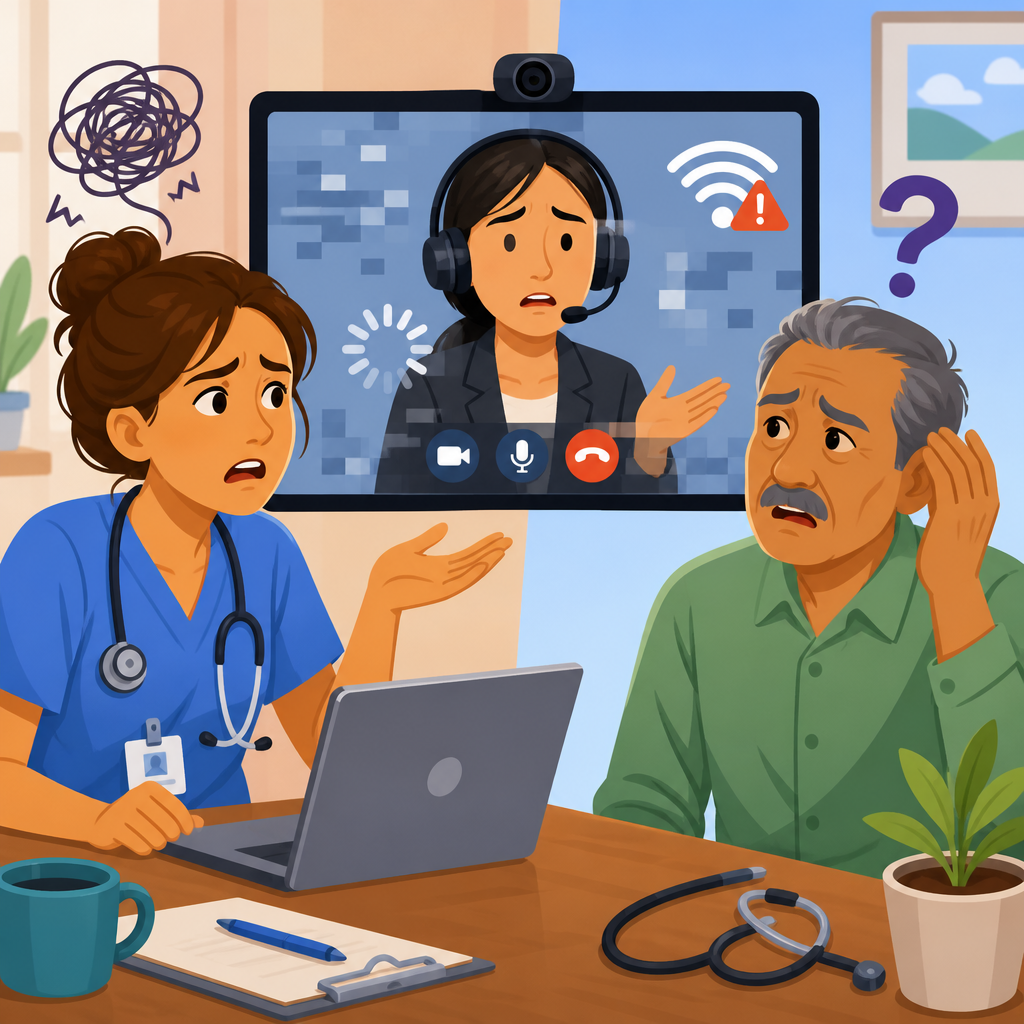
Video remote interpreting failures matter because organizations often assume that offering a screen-based interpreter automatically satisfies communication access obligations, when in practice VRI is not effective in many common situations. In disability access work, “effective communication” means a person with a disability can receive, understand, and respond to information with substantially equal accuracy, timeliness, and privacy. “Auxiliary aids and services” include qualified sign language interpreters, captioning, note takers, assistive listening systems, speech-to-speech transliteration, large print, accessible electronic documents, and other tools that make communication usable. Video remote interpreting, usually called VRI, is one option within that broader toolkit, but it is not a universal fix.
I have seen facilities roll in a tablet on a stand, connect to a remote interpreter, and believe the job is done, even while the Deaf patient cannot see the screen clearly, the connection freezes during consent discussions, or the room layout makes visual communication impossible. Those are not minor technical glitches. They are communication failures with legal, clinical, educational, and human consequences. In healthcare, a failed interpretation session can undermine informed consent, discharge planning, medication teaching, and emergency triage. In courts, schools, social services, workplaces, and public programs, ineffective VRI can block participation just as completely as providing no interpreter at all.
This hub article explains when VRI is not effective, why those failures happen, and how effective communication should be evaluated across settings. It also connects the larger subject of auxiliary aids and services: choosing the right accommodation, assessing individual needs, documenting decisions, training staff, and recognizing when an on-site interpreter, CART, captioning, plain-language materials, or another aid is the better choice. If you are building policy under a rights and protections framework, the core rule is simple: the aid must work for the person, the context, and the information being exchanged.
What makes communication “effective” under disability access rules
Effective communication is outcome-based, not checkbox-based. The question is not whether an organization offered something from an approved list; it is whether the person could actually communicate as needed. In practice, that means considering the nature, length, complexity, and importance of the interaction. A brief directional question at a front desk is different from a psychiatric assessment, an IEP meeting, police interrogation, intake interview, or explanation of surgery risks. The more complex, consequential, private, or interactive the communication, the more likely a high-quality, real-time aid is required.
The person’s normal method of communication matters too. A Deaf person who primarily uses American Sign Language may need a qualified ASL interpreter, while another person may prefer live captioning, written exchange, or a tactile interpreter if they are DeafBlind. A hard of hearing person may do well with an assistive listening device in a meeting but require CART for a webinar with technical vocabulary. Someone with low vision may need accessible digital files rather than paper handouts. There is no lawful or practical one-size-fits-all solution.
Qualification also matters. An interpreter is not “qualified” simply because they know some signs or can access a platform. They must be able to interpret effectively, accurately, and impartially, using any specialized vocabulary necessary for the setting. In hospitals, for example, interpreters need command of medication terms, anatomy, procedures, and informed-consent language. In legal matters, they must accurately convey warnings, rights, timelines, and testimony without omission or distortion. Family members, minors, bilingual staff, and untrained volunteers are rarely appropriate substitutes for qualified professionals.
When VRI is not effective: the most common failure points
VRI fails when the technology, environment, or communication task prevents a full visual and linguistic exchange. The most obvious problem is poor connectivity. Lag, pixelation, dropped calls, frozen images, and audio desynchronization make signed communication unreliable, especially when nuanced information is being exchanged quickly. If facial expressions, fingerspelling, or mouth morphemes are blurred, meaning is lost. Even a short delay can create turn-taking breakdowns that exhaust everyone involved and increase the risk of errors.
Hardware and room setup are just as important. Small screens, weak cameras, bad lighting, glare, low battery, awkward mounting, and limited camera angles all interfere with visual access. I have seen emergency rooms attempt VRI with a tablet positioned behind a clinician, forcing the Deaf patient to choose between watching the provider speak or watching the interpreter sign. In exam rooms, patients may be reclined, in pain, sedated, or physically unable to orient toward a device. In those circumstances, VRI is structurally ineffective.
Human factors also cause failure. Staff may not know how to launch the platform quickly, how to frame participants on camera, or when to stop using VRI and switch to an on-site interpreter. Providers often talk while looking away, hand papers to the patient without pausing for interpretation, or move around the room during examinations so the remote interpreter loses visual context. Group conversations are another weak point. Multi-speaker meetings, bedside rounds, classroom discussions, and case conferences are difficult for VRI unless the technology and facilitation are excellent.
| Scenario | Why VRI Often Fails | Better Auxiliary Aid or Service |
|---|---|---|
| Emergency department triage | Fast pace, movement, poor positioning, unstable connection | On-site qualified interpreter if available; backup written and visual aids only for brief interim use |
| Psychiatric evaluation | Subtle affect, rapport needs, long complex dialogue | On-site mental health interpreter or highly skilled remote specialist if conditions are ideal |
| Informed consent before surgery | High stakes, technical terminology, questions requiring precision | Qualified interpreter, preferably on-site when patient positioning or urgency impairs VRI |
| DeafBlind communication | Visual platform may be unusable entirely | Tactile interpreter, close-vision interpreter, or Support Service Provider as appropriate |
| Classroom or training session | Multiple speakers, slides, side comments, discussion flow | On-site interpreter, CART, or integrated remote setup with strong moderation |
| Police interview or court preparation | Rights advisement, accuracy, privacy, evidentiary concerns | Qualified legal interpreter, often on-site |
Healthcare examples where VRI breaks down fastest
Healthcare is where VRI failures are most visible because the stakes are immediate. Federal disability guidance has long recognized that hospitals and clinics must provide appropriate auxiliary aids and services when necessary for effective communication. In real operations, VRI can work for some scheduled, low-complexity encounters, but it often breaks down in emergency care, bedside care, labor and delivery, imaging, and post-anesthesia recovery. Patients may be lying down, masked, intubated, in severe pain, medicated, or separated from the screen by equipment and staff movement.
Consider informed consent. A surgeon explaining procedural risks, alternatives, and expected outcomes must ensure the patient truly understands and can ask questions. If the VRI image freezes during discussion of bleeding risk or post-operative restrictions, consent quality is compromised. The same is true at discharge, where medication instructions, follow-up appointments, wound care, and warning signs must be communicated accurately. The Joint Commission emphasizes communication as a patient safety issue, and failed interpretation directly increases safety risk.
Mental health care raises another set of concerns. Psychiatric interviews rely on subtle shifts in affect, pace, eye contact, and trust. Remote video can flatten those signals. If a patient is in crisis, paranoid, dissociative, or emotionally dysregulated, adding a lagging screen interface may increase distress rather than facilitate communication. In my experience, clinicians sometimes overestimate how well VRI is working because they receive short yes-or-no answers, when the patient has actually disengaged. That is not comprehension; it is communication collapse disguised as compliance.
Courts, schools, workplaces, and public services face different VRI limits
Outside healthcare, the reasons VRI fails are just as serious, though they look different. In courts and legal settings, interpretation must be precise enough to protect due process. Rights warnings, plea discussions, witness preparation, and attorney-client consultations involve confidentiality, complex terminology, and nuanced back-and-forth. A poor remote connection or an interpreter who cannot see every participant clearly can alter meaning at exactly the wrong moment. Legal communication tolerates almost no ambiguity.
In schools, effective communication extends to both students and parents. An IEP meeting can involve educators, specialists, evaluators, and family members, all referencing reports and data. VRI often struggles when multiple people speak, documents are passed around, or side discussions occur. For Deaf students, classroom access may require interpreting plus captioning, note support, visual alerting, and accessible media. For Deaf parents, conferences and disciplinary meetings must be accessible too. Offering VRI on a laptop in a noisy office does not satisfy the obligation if the parent cannot fully participate.
Workplaces and public agencies make a common mistake: they standardize one communication method for efficiency. Human resources may default to captioned video meetings, while a Deaf ASL user needs an interpreter for onboarding, benefits discussions, or performance reviews. Social service offices may use VRI for intake even when the applicant is elderly, has limited vision, or communicates in a regional sign language variation unfamiliar to the interpreter. Effective communication requires individualized assessment, not administrative convenience.
How to decide which auxiliary aid or service is appropriate
The best approach is a structured communication assessment. Start with the individual’s preferred method of communication, then evaluate the setting, complexity, urgency, privacy needs, physical layout, and available technology. Ask what has worked before and what has failed. In healthcare systems I have advised, the most useful protocol is simple: identify the communication task, identify the person’s usual access method, test whether the method will function under actual conditions, and escalate immediately if it will not. Delay caused by indecision is itself a barrier.
Choice among auxiliary aids should be practical and evidence-based. On-site interpreters are often best for complex, lengthy, emotionally charged, or high-stakes communication. VRI can be effective for some scheduled conversations if bandwidth, screen size, camera placement, and staff skill are strong. CART is excellent for lectures, meetings, and users who read English well and prefer text access. Assistive listening systems support many hard of hearing users in amplified spaces. Accessible documents, plain-language summaries, visual diagrams, and captioned media often need to supplement live services rather than replace them.
Documentation matters because disputes usually center on whether the organization reasonably assessed effectiveness. Record the request, the interactive discussion, the aid provided, any problems encountered, and the corrective action taken. If VRI failed and an on-site interpreter was called, note the failure point: connectivity, patient positioning, interpreter mismatch, environmental noise, or complexity of communication. Those records improve future decisions and show that staff are responding to actual access needs rather than relying on assumption.
Policy, training, and procurement steps that prevent communication failures
Organizations reduce risk when they treat effective communication as an operations issue, not a last-minute accommodation scramble. Policies should define available auxiliary aids and services, response times, escalation triggers, and after-hours access. Staff need training on when VRI is appropriate, how to set it up, and how to recognize failure early. A clear rule helps: if the person cannot see, understand, or interact smoothly, stop and switch methods. Continuing with a failing system because it is already in the room wastes time and can create liability.
Procurement decisions are equally important. Buying low-cost carts or tablets without testing camera resolution, screen size, battery life, speaker clarity, and secure connectivity is a false economy. Vendor contracts should specify interpreter qualifications, specialty coverage, response times, platform security, and backup procedures. Healthcare entities should coordinate communication access with patient safety and language access teams. Schools should align interpreter services with special education, family engagement, and accessible media workflows. Public agencies should include communication access in civil rights compliance audits, not bury it in general customer service.
The practical takeaway is straightforward. VRI is a tool, not a defense. When it works, it can speed access and fill gaps, especially in rural areas or for short, lower-complexity encounters. When it does not work, insisting on it undermines rights and outcomes. Build systems around effective communication, maintain multiple auxiliary aids and services, and empower staff to escalate without delay. If you manage a program under the rights and protections umbrella, review your communication access policy now, test it in real conditions, and fix the points where people are still being left out.
Frequently Asked Questions
What does it mean for Video Remote Interpreting (VRI) to be “not effective”?
VRI is not effective when it does not allow a Deaf or hard of hearing person to communicate with substantially equal accuracy, timeliness, and privacy compared with someone who does not need an accommodation. In disability access terms, “effective communication” is the real standard, not simply whether an organization turned on a screen and connected to an interpreter. If the person cannot clearly see the interpreter, cannot follow the conversation, cannot respond in real time, or cannot share sensitive information privately and accurately, then the communication access being provided is falling short.
In practice, this failure can happen for many reasons. The internet connection may freeze, lag, pixelate, or drop entirely. The camera may be positioned badly, making it impossible to see signing, facial expressions, fingerspelling, or other visual cues that are essential to understanding. Staff may talk over each other, move in and out of frame, or fail to position documents, medical equipment, or visual materials so they can be interpreted. In a loud, chaotic, fast-moving setting, the pace of communication may overwhelm the technology and the interpreting process.
Effectiveness also depends on the individual and the context. A patient in severe pain, a person under sedation, a child, an older adult with low vision, or someone with limited mobility may not be able to use VRI successfully even if the equipment technically works. Likewise, legal, medical, mental health, emergency, and end-of-life conversations often require a level of nuance, trust, and immediacy that VRI may not reliably provide. The key question is simple: did the communication method actually work for the person in that moment? If the answer is no, VRI was not effective.
In what situations does VRI commonly fail to provide effective communication?
VRI commonly fails in situations involving urgency, complexity, physical limitations, emotional distress, or technology problems. Emergency rooms are a classic example. A patient may be lying down, unable to hold or angle a device, surrounded by multiple providers, or being moved from place to place. In those circumstances, it can be difficult or impossible to maintain a clear visual connection with the remote interpreter. Even short delays or disconnections can interfere with informed consent, symptom reporting, diagnosis, and treatment decisions.
VRI also tends to be ineffective when the Deaf or hard of hearing person cannot see the screen well enough. That includes people with low vision, people who rely on close visual access to sign language, and people who are injured, medicated, in labor, or otherwise unable to focus on a device. It can also fail in group conversations, where several people speak rapidly, interrupt each other, or move around the room. In legal meetings, counseling sessions, intake interviews, discharge planning, and discussions involving financial or personal information, privacy concerns and communication nuance become especially important. If the setup prevents full participation, the organization should not insist on VRI just because it is available.
Another common failure point is the environment itself. Poor lighting, glare, background movement, low battery, weak Wi-Fi, small screens, bad camera angles, and lack of trained staff can all turn VRI into a barrier instead of a solution. Facilities sometimes use a mobile cart or tablet as if it were automatically compliant, but equipment alone does not guarantee access. If the setting or circumstances make remote visual communication unreliable, then an onsite qualified sign language interpreter or another appropriate auxiliary aid or service may be necessary.
Does offering VRI automatically satisfy ADA or other disability access obligations?
No. Offering VRI does not automatically satisfy disability access obligations. The legal and practical standard is effective communication, not the mere presence of technology. Under disability access principles, organizations must provide appropriate auxiliary aids and services when needed to ensure that a person with a disability can receive and convey information accurately, promptly, and privately. VRI can sometimes be an appropriate auxiliary aid, but only when it actually works in the specific situation and for the specific person involved.
This is where many organizations make mistakes. They treat VRI as a one-size-fits-all compliance shortcut rather than evaluating whether it is effective in the moment. If the connection is poor, the screen is too small, the interpreter cannot be seen clearly, the patient is unable to use the device, or the conversation is too complex or urgent for the setup, then continuing to rely on VRI may create legal and operational risk. The fact that an organization attempted to provide access does not excuse a failure to provide meaningful access.
Organizations are generally expected to assess the individual’s communication needs, the nature of the interaction, the setting, and the available options. In many cases, that means moving beyond VRI and arranging an onsite interpreter or another communication method that actually works. The safest approach is not to ask, “Did we offer something?” but rather, “Did this person have effective communication?” That is the standard decision-makers should use in healthcare, courts, schools, government services, workplaces, and customer-facing environments.
What are the biggest risks of relying on VRI when it is not effective?
The biggest risk is communication failure with real-world consequences. When VRI is not effective, the Deaf or hard of hearing person may misunderstand instructions, miss critical details, be unable to ask questions, or lose the opportunity to make informed decisions. In healthcare, that can lead to medication errors, flawed consent, inaccurate medical histories, poor discharge instructions, and delayed treatment. In legal or administrative settings, it can affect rights, responsibilities, deadlines, testimony, and the ability to understand official proceedings.
There are also serious privacy and dignity concerns. If a person must discuss trauma, mental health, finances, family matters, or legal issues through a glitchy, unstable, or poorly positioned video setup, the conversation may become incomplete or distorted. The person may withdraw, stop disclosing information, or agree to something they do not fully understand. That undermines not just compliance, but trust. Communication access is about meaningful participation, not symbolic accommodation.
For organizations, the risks extend beyond the immediate interaction. Ineffective VRI can lead to complaints, service failures, reputational harm, delayed operations, repeat appointments, staff frustration, and potential legal exposure. It may also increase costs in the long run because communication problems often create downstream mistakes and inefficiencies. A short-term effort to save time or money by defaulting to VRI can end up producing far greater financial, legal, and human consequences than arranging the right accommodation from the start.
What should organizations do when VRI is not working or is clearly inappropriate?
Organizations should act quickly and pragmatically. If VRI is not working, or if the circumstances show that it is unlikely to be effective, staff should stop treating it as the default solution and move to another appropriate auxiliary aid or service without unnecessary delay. In many cases, that means arranging an onsite qualified sign language interpreter. The response should be guided by the person’s communication needs, the urgency and complexity of the interaction, and whether communication can occur with equal accuracy, timeliness, and privacy.
Frontline staff should be trained to recognize common signs of VRI failure: frozen video, repeated requests for clarification, inability to maintain visual access, poor camera placement, confusion during key explanations, visible frustration, or a direct statement from the Deaf or hard of hearing person that the setup is not working. Staff should know who has authority to escalate, how to secure an onsite interpreter, and what interim communication methods can be used while a better accommodation is arranged. Waiting too long or insisting that the person “make do” with ineffective VRI often makes the situation worse.
Organizations should also build access planning into their systems. That includes maintaining clear policies, testing equipment regularly, ensuring strong connectivity, training employees on effective communication obligations, and creating procedures for rapid transition from VRI to onsite interpreting when needed. Most importantly, they should listen to the person using the service. If the Deaf or hard of hearing individual says the communication method is not effective, that feedback should be taken seriously. The goal is not to defend the use of VRI; the goal is to make communication actually work.