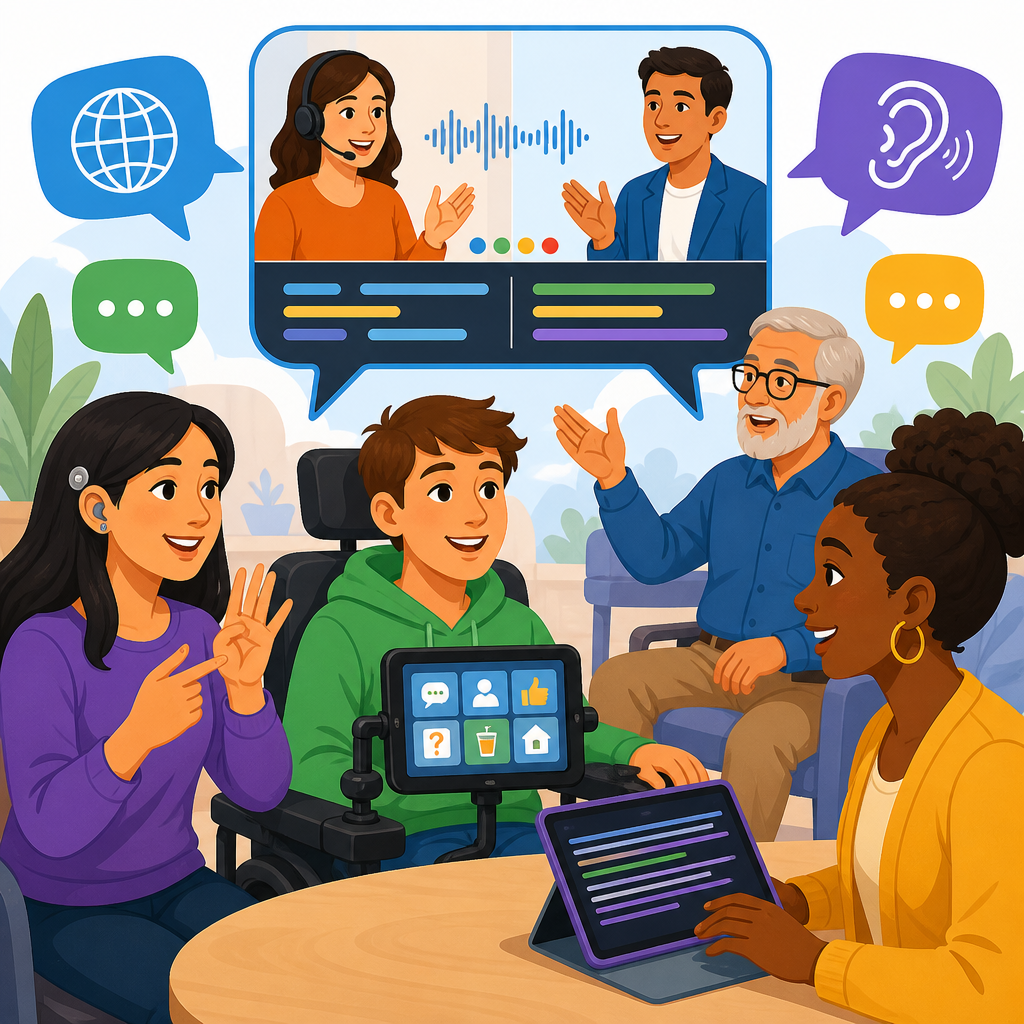
Real-time translation, CART, and hybrid communication access are reshaping how people participate in meetings, classrooms, healthcare visits, public events, and digital communities. In accessibility work, these terms describe related but distinct services that remove communication barriers for Deaf, hard of hearing, multilingual, late-deafened, and neurodivergent participants, as well as anyone joining from noisy, remote, or fast-paced environments. Real-time translation converts spoken or written language into another language with minimal delay. CART, or Communication Access Realtime Translation, turns speech into highly accurate live text in the same language, typically by a trained captioner using stenography, voice writing, or advanced captioning platforms. Hybrid communication access combines in-person and remote supports so that participants across physical rooms and virtual platforms receive equitable access at the same time. This matters because access failures rarely come from one missing tool; they come from mismatched systems, poor audio, rushed planning, and the assumption that one accommodation fits every user.
I have worked on events where organizers booked captions but forgot bilingual interpretation, and on webinars with interpreters present but no pinned video feed, no transcript delivery plan, and no way for remote attendees to ask questions in their preferred language. Those breakdowns are common because accessibility is often treated as a checkbox rather than an operating model. A stronger approach starts with understanding the communication stack: source audio quality, platform settings, human providers, AI support tools, display options, language preferences, archival transcripts, and follow-up materials. When these elements are coordinated, access improves for everyone. People catch terminology more accurately, nonnative speakers follow complex discussions more easily, searchable transcripts support documentation, and organizations reduce legal and reputational risk. As a hub within technology and accessibility, this article explains the core methods, how they work together, where they succeed, where they fail, and what teams should evaluate before choosing tools or services.
What real-time translation, CART, and hybrid access actually do
Real-time translation addresses language differences. If a presenter speaks English and attendees need Spanish, Arabic, or Mandarin access, the system must transfer meaning across languages fast enough to keep pace with the event. That can be done by human interpreters, AI speech translation, or a blended workflow where AI drafts output and a linguist corrects terminology. CART solves a different problem: it captures spoken content in the same language as synchronized text. A Deaf attendee may prefer CART in English, while a multilingual attendee may prefer translated captions in French. These are not interchangeable services. One preserves language and increases text access; the other converts language itself.
Hybrid communication access adds delivery complexity. In a hybrid board meeting, one participant may need on-screen CART in Zoom, another may need captions projected in the room, a third may need American Sign Language on a confidence monitor, and a fourth may need live translated subtitles on a mobile device. Access planning therefore has to map user need to output channel. The most reliable setups identify each audience segment, decide what appears where, and test every handoff in advance. In practice, that means confirming audio routing from room microphones into the event platform, ensuring interpreters hear floor audio and audience questions, assigning a producer to spotlight interpreters, and distributing transcript links without forcing users through multiple logins.
How CART works in practice and why quality varies
CART is often misunderstood as automated captions, but professional CART is a specialized live transcription service with quality standards that are materially higher than generic auto-captioning. Many CART providers use stenotype machines and specialized dictionaries to output text nearly instantaneously. Others use respeaking, where a trained captioner repeats speech into software while adding punctuation, speaker labels, and corrections. Accuracy depends on audio clarity, speaker pace, domain vocabulary, turn-taking discipline, and preparation materials. When I prepare a CART team for a technical conference, I always send agendas, speaker names, acronyms, glossaries, and slide decks in advance. That simple step can prevent pharmaceutical names, legal citations, and product terminology from being mangled in front of the audience.
Quality differences become obvious in high-stakes settings. In a medical consent discussion, “noninvasive” and “invasive” are not close enough. In higher education, a chemistry lecture without correct formula names becomes unusable study material. In court, transcript precision affects due process. Professional CART providers typically outperform automated systems in punctuation, context, names, and rapid speaker changes. Auto-captions are useful, especially for low-risk meetings and budget-limited teams, but they remain vulnerable to accents, crosstalk, background noise, and specialist vocabulary. The National Court Reporters Association has long shaped expectations around live captioning professionalism, and many institutions now specify minimum accuracy targets, backup connectivity, and transcript delivery terms in procurement requirements.
Where machine translation helps, and where human language professionals remain essential
Real-time translation technology has improved dramatically because automatic speech recognition, neural machine translation, and low-latency caption rendering now work together in mainstream platforms. Microsoft Teams, Zoom, Google Meet, Interprefy, KUDO, Wordly, and similar systems can generate translated captions quickly enough for many business and event scenarios. For internal town halls, product demos, and large multilingual webinars, these tools increase reach at a fraction of the cost of staffing full interpreter teams for every language pair. They also create structured text that can be repurposed into summaries, meeting notes, and searchable knowledge records.
However, speed is not the same as fidelity. Human interpreters remain essential when nuance, liability, confidentiality, or cultural precision matter. Healthcare, legal proceedings, labor negotiations, investor calls, crisis response, and sensitive HR matters are poor candidates for translation systems left entirely unsupervised. Machine output can flatten idioms, miss negation, confuse industry terms, or mishandle proper nouns. A classic failure appears when software translates product names or acronyms that should remain unchanged. Another common problem is delayed correction: by the time a mistake is fixed, the meeting has already moved on. The best model is often tiered. Use human interpreters for high-risk sessions, AI-assisted translation for broad scalable access, and written post-event review for anything that will be archived or cited later.
Designing hybrid communication access for meetings, classes, and public events
Hybrid communication access succeeds when planners treat audio capture as the foundation. If the source audio is weak, every downstream service degrades: captions become inaccurate, interpreters miss audience questions, translated subtitles drift, and remote attendees disengage. The core rule is simple: every speaker must use a dedicated microphone, and audience participation must be mic’d as well. Ceiling mics may help room coverage, but they are not a substitute for disciplined microphone use in accessible events. I have seen six-figure conferences undermined by a single presenter who refused the lectern mic and paced the stage. The caption feed degraded immediately, and the interpreter had to guess at key phrases.
Platform configuration matters just as much. Zoom, Teams, and webinar platforms handle captions, interpreter channels, and pinned video differently. Some support integrated third-party CART feeds through API or stream text URLs; others require manual caption entry or separate browser windows. In classrooms, the learning management system must support transcript posting and recording access after the session. In live venues, projection screens need enough contrast, line length, and placement for readable captions without forcing attendees to choose between the speaker and the text. Mobile caption access can solve distance issues, but only if venue Wi-Fi is stable and the sign-in flow is simple enough for guests to use instantly.
| Use case | Best-fit access mix | Primary benefit | Main limitation |
|---|---|---|---|
| Internal team meeting | Auto-captions plus edited transcript | Low cost and fast deployment | Terminology and speaker accuracy vary |
| University lecture | Professional CART with recording transcript | High accuracy for study and review | Requires prep materials and scheduling |
| Global webinar | Translated captions with human moderation | Scales across languages | Nuance can be lost in technical sessions |
| Medical consultation | Human interpreter plus CART when needed | Supports precision and patient understanding | Higher cost and stricter coordination |
| Public conference | On-site screens, remote CART, interpreter video | Serves room and virtual audiences together | Complex production and routing |
Choosing the right solution: audience needs, risk, and budget
The right communication access plan starts with three questions. Who needs access, what type of access do they need, and what is the consequence if the service fails? Those questions keep teams from defaulting to the cheapest tool or the loudest vendor. A product launch for international partners may justify multilingual captions in several languages. A small nonprofit support group may prioritize plain-language facilitation and CART over translation because members share a language but need text reinforcement. A public agency meeting may require both because community participation depends on language access as well as hearing access. The Americans with Disabilities Act, Section 504, Section 508, and comparable international frameworks do not prescribe one universal tool; they require effective communication, which must be interpreted in context.
Budget matters, but it should be evaluated against outcome, not line-item price. Professional CART and interpreters cost more than platform-native automation because they involve trained labor. Yet the cost of poor access can be greater: failed training, exclusion complaints, inaccessible records, lower event attendance, and rework after the fact. I advise teams to rank sessions by risk and visibility. Reserve premium human-supported access for executive, public, regulated, or educational settings. Use automated tools with clear disclaimers and strong audio controls for routine internal communication. Build a fallback plan for every event, including backup captioners, duplicate audio paths, dial-in options, downloadable materials, and a producer empowered to pause the program if access collapses.
Operational standards that separate inclusive systems from improvised fixes
Organizations that do this well institutionalize access rather than reinventing it for each event. They use intake forms that ask about captioning, interpretation, sign language, plain language, and transcript preferences during registration. They maintain vendor playbooks with service-level expectations, prep deadlines, contact escalation paths, confidentiality terms, and test procedures. They train moderators to repeat audience questions into microphones, identify speakers by name, describe visual content, and pace discussions. They also standardize file handling so transcripts are edited, labeled, secured, and published consistently. These operating details are not glamorous, but they determine whether accessibility is dependable.
Measurement is equally important. Track caption accuracy complaints, interpreter utilization, transcript download rates, attendee satisfaction, and the percentage of events tested in advance. Review recordings for latency, readability, and missed content. Compare AI output to human-edited transcripts in your highest-terminology meetings. Over time, patterns emerge. You may find that one department consistently undermines access by sharing videos without captions embedded, or that one venue produces poor interpreter audio because house mixing routes audience microphones incorrectly. Once those patterns are visible, improvements become practical. Technology and accessibility work best when procurement, AV, IT, communications, and disability inclusion teams share responsibility instead of handing off problems minutes before go-live.
Real-time translation, CART, and hybrid communication access belong at the center of modern accessibility strategy because communication now happens across languages, devices, rooms, and ability profiles at once. The strongest programs do not ask whether to choose human or automated support in the abstract. They match method to context, protect high-stakes interactions with trained professionals, and use scalable technology where it genuinely improves reach. They invest in audio quality, platform configuration, testing, and transcript workflows because those factors determine whether access is effective or merely promised. For organizations building out innovative solutions in technology and accessibility, this subtopic is a practical hub: it connects live captioning, language access, remote participation, content archives, and inclusive event operations into one system. Audit your current meetings, classes, and events, identify the moments where communication breaks down, and upgrade the access stack before your next critical session.
Frequently Asked Questions
What is the difference between real-time translation, CART, and hybrid communication access?
These services are closely related, but they solve different communication challenges. CART, which stands for Communication Access Realtime Translation, is the live verbatim transcription of spoken content into text. A trained CART provider listens to speech and converts it into highly accurate captions that appear on a screen in real time. CART is especially valuable for Deaf and hard of hearing participants, late-deafened adults, people with auditory processing differences, and anyone who benefits from seeing spoken information as text.
Real-time translation adds a language-access layer. Instead of only converting speech into same-language text, it can transform spoken or written content into another language while the event is happening. This may include live translated captions, multilingual subtitles, or interpreted language output delivered through a platform, app, or display. It helps multilingual audiences follow meetings, classes, webinars, medical consultations, and public events without waiting for post-event translations.
Hybrid communication access refers to the full set of supports used when some participants are in person and others are joining remotely. In a hybrid environment, communication access often requires more than one tool working together: CART captions for spoken English, real-time translation for multilingual attendees, sign language interpretation, remote microphone capture, platform integration, and screen-based delivery that is readable both onsite and online. The goal is not simply to “add captions,” but to create an experience where every participant can understand, contribute, and stay engaged regardless of hearing status, language background, location, or device.
Who benefits most from these services, and are they only for Deaf or hard of hearing participants?
No. While CART and related accessibility services are essential tools for many Deaf and hard of hearing people, their benefits extend much further. Late-deafened adults often rely on real-time text to stay connected in professional and social settings. Neurodivergent participants may find that captions improve focus, reduce processing fatigue, and make complex information easier to retain. People with auditory processing disorders, attention-related differences, or language-processing challenges also frequently benefit from live text support.
Real-time translation broadens access even more by supporting multilingual participants who may understand a topic better in their preferred language. In classrooms, it can help students follow lectures while building subject knowledge. In healthcare, it can improve comprehension during appointments where precision matters. In workplaces, it supports inclusion across global teams, helping employees participate more fully in training, leadership meetings, and day-to-day collaboration.
These tools also help people in practical, everyday situations that are not always labeled as “accessibility” needs. Someone joining from a noisy airport, a parent attending a virtual meeting while managing household distractions, or an attendee in a large conference hall with poor acoustics may all benefit from captions or translated text. In that sense, real-time translation, CART, and hybrid communication access are not niche accommodations. They are essential participation tools that make communication more resilient, flexible, and equitable for a wide range of users.
How does CART work in live meetings, classrooms, healthcare visits, and public events?
CART works by capturing spoken communication and converting it into highly accurate text as the conversation unfolds. A CART provider may work onsite or remotely, using specialized stenographic equipment or advanced realtime writing systems to produce near-instant captions. Those captions can be displayed on a laptop, tablet, phone, projection screen, conference platform, or integrated event display. The setup depends on the environment and the needs of participants.
In meetings and classrooms, CART helps attendees follow discussions, lectures, and audience questions without missing key details. This is especially important when multiple speakers are involved, terminology is specialized, or the pace is fast. In healthcare settings, CART can support patient understanding during consultations, intake conversations, discharge instructions, and follow-up care discussions, where missing a single detail can affect outcomes. At public events such as conferences, community forums, performances, or government meetings, CART makes spoken content visible in real time and can improve participation for both onsite and remote audiences.
For CART to work well, audio quality is critical. Clear microphone use, speaker turn-taking, access to agendas or presentation materials, and advance terminology lists all improve accuracy. In hybrid settings, organizers should also think about how captions will appear for remote attendees and whether in-room participants can see them easily. Strong implementation is not only about hiring a provider; it is about planning the entire communication flow so that everyone can access the information at the same time.
What should organizations consider when planning hybrid communication access?
Organizations should start by recognizing that hybrid access is both a technical and human coordination task. It is not enough to assume that the built-in caption button on a video platform will meet everyone’s needs. Effective planning requires understanding who will attend, what communication barriers may arise, and which services should be layered together. That may include CART, real-time translation, sign language interpreters, multilingual support, visual display planning, accessible handouts, and backup communication options if technology fails.
Audio capture is one of the biggest success factors. If in-room participants cannot be heard clearly by remote captioners, interpreters, or translation tools, the quality of access drops immediately. Organizations should use reliable microphones, repeat audience questions when necessary, and avoid side conversations that are not captured. It is also important to decide where captions and translated text will appear, how attendees will access them, and whether both onsite and remote users can engage equally. For example, a caption feed visible on a projector may help people in the room, but remote participants may need an integrated stream inside the conferencing platform.
Timing and preparation matter as well. Sharing agendas, slides, speaker names, industry terminology, and expected acronyms in advance can significantly improve service quality. Assigning a point person to coordinate access logistics helps prevent confusion during the event. Finally, organizations should treat communication access as part of core event design rather than a last-minute accommodation. When hybrid communication access is planned proactively, meetings become more inclusive, more professional, and more effective for everyone involved.
How do real-time translation and CART improve inclusion, compliance, and overall communication quality?
These services improve inclusion by making spoken information immediately available in forms that different people can use. That is the foundation of meaningful participation. When attendees can read captions, access translated content, or follow a hybrid discussion without struggling to hear or interpret speech, they are more likely to contribute ideas, ask questions, and remain engaged. Inclusion is not just about being present in the room or on the call; it is about being able to understand, respond, and belong in the conversation as it happens.
They also support legal and policy-related accessibility obligations in many workplaces, schools, healthcare systems, and public-facing institutions. While exact requirements vary by jurisdiction and setting, providing effective communication access is often tied to disability rights, language access responsibilities, and nondiscrimination principles. High-quality CART and real-time translation can help organizations move beyond minimal compliance toward genuinely usable access. That distinction matters because a low-quality solution that technically exists but does not function well in practice may still exclude participants.
Beyond inclusion and compliance, these services often improve communication quality for the entire group. Live captions reinforce comprehension, support note-taking, reduce misunderstandings, and help people retain information. Real-time translation allows multilingual teams and audiences to move faster and collaborate more confidently. In hybrid settings, access tools can also create cleaner workflows by encouraging better microphone use, clearer turn-taking, and more intentional facilitation. The result is a communication environment that is not only more accessible, but also more efficient, more accurate, and more equitable for everyone involved.