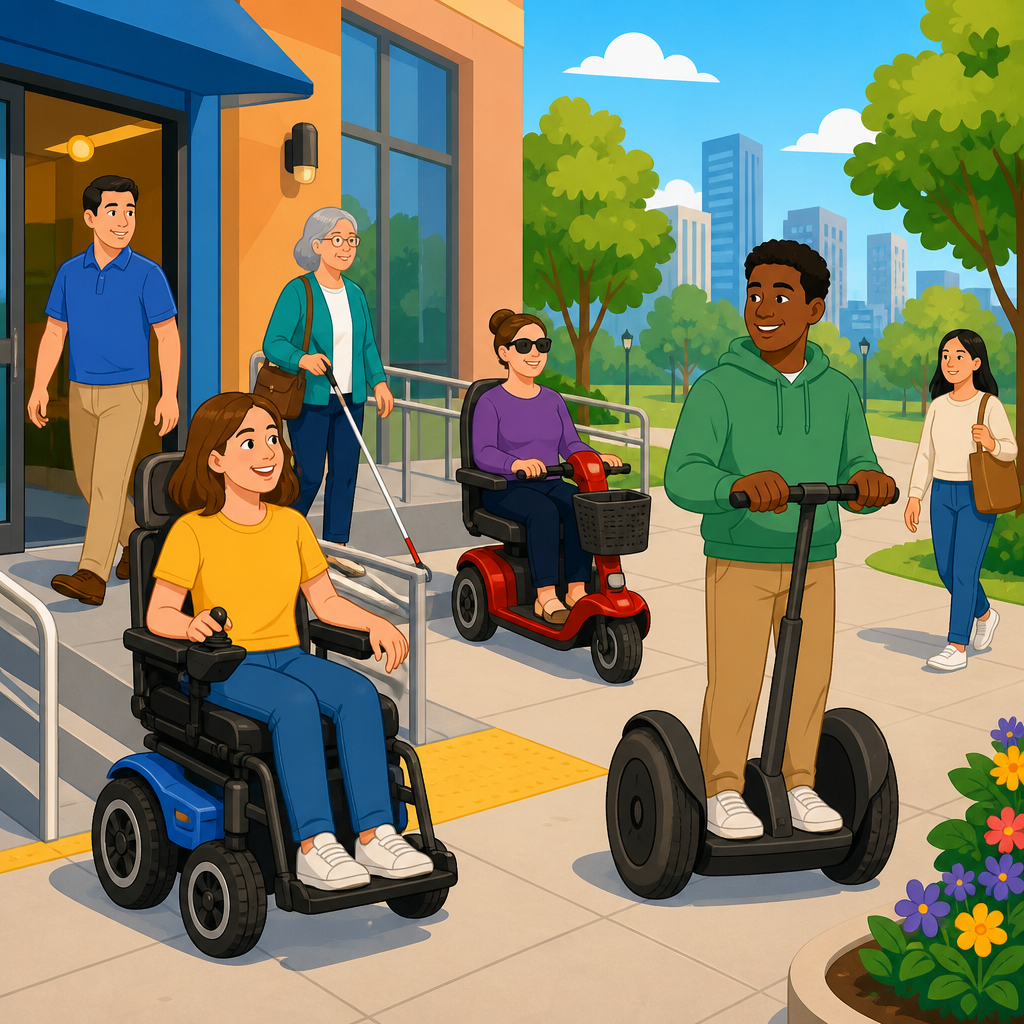
Wheelchairs, Segways, and other power-driven mobility devices are covered by the Americans with Disabilities Act in different ways, and understanding those differences is essential for people with disabilities, businesses, and public agencies. In practice, I have seen more confusion around mobility devices than almost any other ADA access issue because people often assume every powered device must be allowed everywhere or, just as often, that only traditional wheelchairs qualify. Neither assumption is correct. The ADA draws a clear distinction between wheelchairs and manually powered aids on one hand and other power-driven mobility devices on the other. That distinction affects where devices are permitted, what questions staff may ask, and when a business or government entity may lawfully restrict access. This matters because mobility technology has evolved far beyond the standard manual wheelchair. People now use powered wheelchairs, mobility scooters, Segways, golf-car-style vehicles, and specialized devices designed around balance, posture, endurance, and terrain. A hub article on service animals and mobility devices should start here, because device access rules often intersect with broader disability rights obligations, including reasonable modifications, effective communication, barrier removal, and nondiscriminatory policies.
Under ADA rules, a wheelchair includes manually operated or power-driven devices designed primarily for use by an individual with a mobility disability for indoor or both indoor and outdoor locomotion. Other power-driven mobility devices, often shortened to OPDMDs, are powered devices used by people with mobility disabilities that are not primarily designed for that purpose, such as Segways, golf carts, or all-terrain utility devices. The legal source most people rely on is the U.S. Department of Justice regulation implementing Title II and Title III, especially 28 C.F.R. sections 35.104, 35.130, 35.137, 36.104, 36.302, and 36.311, plus DOJ guidance. The core rule is straightforward. Public entities and public accommodations must allow wheelchairs and manually powered mobility aids in areas open to pedestrian use. They must also make reasonable modifications to permit OPDMDs unless they can show the class of device cannot be operated in accordance with legitimate safety requirements. Those safety requirements must be based on actual risks, not stereotypes or generalized fears. That is the framework this article explains, along with the related service animal rules that frequently come up on the same properties.
What the ADA Covers: Wheelchairs, Mobility Aids, and OPDMDs
The first question people ask is usually, “What devices are automatically allowed?” The answer is wheelchairs and manually powered aids such as walkers, crutches, canes, braces, and similar devices used by individuals with mobility disabilities. If an area is open to pedestrian traffic, those devices are allowed there. A museum cannot create a “no wheels” rule that excludes power wheelchairs from galleries. A hotel cannot direct a scooter user to service corridors instead of guest routes. A city hall cannot require a visitor using a wheelchair to enter through a loading dock if the public entrance is otherwise accessible. The obligation is not conditional on whether staff think another device would be safer, more convenient, or less disruptive. If the person uses a qualifying wheelchair or manually powered aid, access follows the person into pedestrian areas.
OPDMDs are different, but not optional in the casual sense many property owners assume. A Segway used by a person with a mobility disability may have to be allowed even though it was not designed primarily as a disability device. The same can be true for certain golf carts, standing mobility platforms, or other powered devices adapted to the user’s condition and environment. The ADA requires an individualized, evidence-based assessment of whether a type of OPDMD can be permitted. The Department of Justice identifies five assessment factors: the device’s type, size, weight, dimensions, and speed; the facility’s volume of pedestrian traffic; the facility’s design and operational characteristics; whether legitimate safety requirements can mitigate risk; and whether use creates a substantial risk of serious harm to the immediate environment or natural or cultural resources. Those factors matter because access decisions must reflect the actual setting. A wide convention center concourse may be able to accommodate a Segway safely, while a crowded historic staircase route obviously cannot.
In daily operations, this distinction changes policy writing. Businesses need separate rules for wheelchairs and OPDMDs, not one blanket mobility-device policy. I advise clients to think in terms of categories, pedestrian zones, and site-specific risk rather than brand names. A sign that says “No scooters, no carts, no Segways, no motorized vehicles” is usually overbroad and often unlawful because it fails to account for disability-related use. Better policies identify where pedestrian access exists, what devices are always allowed there, what OPDMDs may be allowed subject to safe operation, and what objective conditions apply, such as speed limits or route restrictions. That approach aligns with DOJ guidance and gives frontline staff a workable rule they can enforce consistently.
When Businesses and Public Agencies May Restrict Devices
The ADA does not require every mobility device to be accepted in every place, and that limitation is important because it keeps the law practical and credible. Restrictions are lawful when they are based on legitimate safety requirements necessary for safe operation. The key phrase is legitimate safety requirements. A restaurant cannot bar a mobility scooter because servers find it awkward. A zoo cannot reject an OPDMD because another guest complained it “looks dangerous.” On the other hand, a facility may restrict a class of device if objective evidence shows the device’s turning radius, braking characteristics, or operating speed cannot be managed safely in a specific setting. Think about a narrow historic home tour with fragile flooring, low lighting, and dense timed-entry groups. A property manager can evaluate those conditions and adopt a rule that certain large or fast devices are not compatible with that environment while still allowing wheelchairs and offering alternative access methods where required.
These decisions should be documented. The strongest ADA policies I have reviewed include measurements, route widths, slope data, traffic observations, and incident-prevention reasoning. For example, an aquarium may note that its main tunnel averages a certain width, carries a certain visitor count during peak periods, and contains emergency egress pinch points. If it limits a category of OPDMD there, the rule should explain why and whether other routes remain available. The same principle applies to outdoor properties. A golf-cart-style device might be manageable on a paved botanical garden path but not on a soft trail bordering protected habitat. The ADA expressly allows consideration of serious harm to the immediate environment or natural or cultural resources, which is especially relevant for parks, historic sites, and conservation areas.
| Issue | Wheelchairs and manually powered aids | Other power-driven mobility devices |
|---|---|---|
| General rule | Must be allowed in pedestrian areas | Must be allowed through reasonable modification unless legitimate safety requirements justify limits |
| Primary design | Designed primarily for mobility disability use | Not primarily designed for disability use |
| Questions staff may ask | Usually none about the device itself | May ask for a credible assurance of disability-related need |
| Basis for restriction | Very limited | Objective assessment using DOJ factors |
| Examples | Manual wheelchair, power wheelchair, walker, crutches | Segway, golf cart, stand-up powered platform |
What Staff Can Ask and What Counts as Credible Assurance
Frontline employees often create ADA problems by asking the wrong questions. For wheelchairs and manually powered aids, staff generally should not interrogate the user about disability status, diagnosis, or medical history. For OPDMDs, the rules are slightly different because the device itself may not obviously be disability-related. A public entity or public accommodation may ask for a credible assurance that the device is required because of the person’s mobility disability. The regulation is explicit that credible assurance can be satisfied by a valid disability parking placard, a state-issued disability card, or a verbal representation that is not contradicted by observable fact. That last part matters. Staff are not entitled to demand a doctor’s note, detailed proof of diagnosis, or an on-the-spot demonstration of walking limitations.
Good training turns this into a simple script. If the device is a wheelchair or scooter designed primarily for mobility disability use, allow it in pedestrian areas. If it is an OPDMD and the need is not obvious, staff may ask one narrow question: “Is this device required because of a mobility disability?” If the user says yes, that generally ends the inquiry unless there is an objective safety issue. Staff should then apply the property’s OPDMD policy consistently. I have found that written scripts reduce conflict more effectively than long legal memos because they give employees exact language and reduce improvisation. This is especially important at entrances, security checkpoints, stadium gates, and event venues where rushed interactions can quickly become discriminatory.
Service animal questions work differently, but they are part of the same operational picture. If a disability-related animal is not obviously a service animal, staff may ask only whether the dog is required because of a disability and what work or task the dog has been trained to perform. They may not request documentation, require a vest, or ask about the person’s disability. Emotional support animals are not service animals under Title II and Title III, although housing and air travel rules are different. Properties that understand both sets of rules avoid a common mistake: merging mobility-device and service-animal policies into one vague “special accommodation” procedure that imposes unlawful documentation demands on everyone.
Real-World Examples Across Stores, Hotels, Transit, and Recreation
Retail stores are the clearest example of the baseline rule. If customers can walk the sales floor, customers using wheelchairs or mobility scooters designed for disability use can travel the same floor. A store may enforce neutral rules against reckless operation, blocking fire exits, or bringing in gasoline-powered recreational vehicles, but it cannot use those rules to screen out disability-related mobility aids. Hotels face additional issues because routes extend beyond lobbies into guest rooms, restaurants, pools, meeting spaces, and parking areas. A hotel may need an OPDMD policy for conference wings or outdoor grounds while still allowing standard wheelchairs throughout all pedestrian areas. Resorts commonly get into trouble when they allow golf carts for staff or VIP logistics but refuse a guest’s disability-related OPDMD without conducting the required assessment.
Public transit and transportation hubs involve overlapping laws, including ADA transportation regulations, but the basic mobility-device principles remain important. Airports, train stations, and bus terminals generally must permit wheelchairs and evaluate OPDMDs under legitimate safety criteria. Transit providers also have separate obligations regarding lifts, securement, priority seating, and stop announcements. Recreation settings require the most nuanced analysis because terrain, crowd density, and environmental impact vary so widely. At a theme park, a Segway restriction may be defensible on some rides, queue lines, or dark attractions, yet the park may still need to allow OPDMD use on broad circulation routes or provide effective alternatives. At beaches and trails, operators should evaluate surface firmness, slope, and emergency response capacity rather than defaulting to bans.
For readers navigating the wider service animals and mobility devices topic, this hub should connect conceptually to more specialized pages on service animal access questions, mobility scooter rights in stores, hotel accessibility policies, and public transportation accommodations. The central takeaway is that compliance depends on classification, setting, and objective risk. When organizations understand that structure, they can welcome disabled visitors confidently instead of treating every unusual device as a legal threat.
How to Build a Compliant Policy and Resolve Disputes
A compliant policy starts with inventory. Identify pedestrian areas, route widths, vertical changes, door clearances, peak traffic conditions, and any spaces where environmental or preservation concerns are real. Next, classify devices correctly. Wheelchairs and manually powered aids are always the baseline category. OPDMDs require a reasoned evaluation using the DOJ factors. Then draft operating rules that are neutral and specific: maximum safe speed, yielding to pedestrians, prohibited zones tied to objective hazards, and procedures for credible assurance when needed. Finally, train staff repeatedly. In my experience, the biggest failures do not come from bad legal standards; they come from untrained supervisors making snap decisions at the door.
Disputes should be escalated quickly and documented calmly. If a customer using an OPDMD is denied access, staff should record the location, device type, observed conditions, the safety rule applied, and any alternative offered. Managers should review whether the rule was grounded in actual risk and applied consistently to similarly situated users. If the property made no prior assessment and simply reacted to the device, that is a warning sign. People with disabilities who encounter barriers should preserve names, photos, and policy copies, then consider using the business complaint process, the ADA coordinator for public entities, the Department of Justice complaint system, state civil rights agencies, or private counsel. Early resolution is usually best, but rights are strongest when the facts are preserved.
The ADA rights surrounding wheelchairs, Segways, and other power-driven mobility devices are detailed, but the governing principles are practical. Wheelchairs and manually powered mobility aids must be allowed in pedestrian areas. Other power-driven mobility devices must be considered through reasonable modification and may be restricted only when legitimate safety requirements, grounded in objective facts, justify the limit. Staff may request only narrow, credible assurance of disability-related need for an OPDMD, and they must avoid invasive documentation demands. Service animal rules often arise alongside these questions, but they follow their own standards and should not be merged into a single ad hoc access policy. The most effective organizations use written assessments, site-specific rules, and frequent training so that legal compliance becomes a routine part of customer service rather than a point of conflict.
For people with disabilities, the benefit of understanding these rules is straightforward: you can identify when access is guaranteed, when a restriction may be legitimate, and when a denial likely violates the ADA. For businesses and public agencies, the benefit is just as clear: a precise policy reduces risk, improves accessibility, and creates more predictable interactions for staff and visitors. If you manage a property or rely on a mobility device, review your current policy, compare it to the ADA standards described here, and update the weak points before the next access dispute happens.
Frequently Asked Questions
What is the difference under the ADA between a wheelchair and an “other power-driven mobility device” like a Segway?
Under the ADA, that distinction matters a great deal. A wheelchair is generally defined as a manually operated or power-driven device designed primarily for use by an individual with a mobility disability for the main purpose of indoor or outdoor locomotion. That includes traditional manual wheelchairs, power wheelchairs, and many mobility scooters. These devices receive the strongest level of protection because they are treated as standard mobility aids used by people with disabilities to move through public spaces.
By contrast, an “other power-driven mobility device,” often shortened to OPDMD, is a broader category that includes powered devices used for mobility that are not necessarily designed primarily for people with mobility disabilities. Segways are the most commonly discussed example, but the category can also include certain golf carts or similar devices, depending on the circumstances. The legal treatment is different because a business or public entity does not automatically have to allow every OPDMD in every setting. Instead, it must make an individualized assessment about whether the device can be permitted safely and reasonably in that particular environment.
In plain terms, wheelchairs and scooters designed for people with disabilities are generally allowed anywhere the public can go, even if a business otherwise has a “no wheels,” “no vehicles,” or “pedestrian only” policy. OPDMDs are evaluated under a separate standard that looks at legitimate safety requirements, space limitations, pedestrian traffic, and operational concerns. That is why a person may have a clear ADA right to use a power wheelchair in a store, courthouse, or restaurant, while the use of a Segway in the same place may depend on the facts. Understanding this distinction helps avoid two common mistakes: assuming all powered devices must be admitted automatically, or assuming only traditional wheelchairs are protected.
Do businesses and public agencies have to allow Segways and other power-driven mobility devices everywhere?
No, not everywhere automatically, but they cannot simply ban them across the board either. The ADA requires public accommodations and government entities to make reasonable modifications in policies, practices, or procedures to permit the use of OPDMDs by individuals with mobility disabilities unless the entity can show that the class of device cannot be operated in accordance with legitimate safety requirements. That means the analysis is not based on stereotypes, discomfort, or a manager’s personal preference. It must be based on actual safety considerations tied to the setting.
The regulations identify several factors that may be considered when deciding whether an OPDMD can be allowed in a particular location. These include the type, size, weight, dimensions, and speed of the device; the volume of pedestrian traffic; the design and operational characteristics of the facility; whether legitimate safety requirements can be established to permit safe operation; and whether allowing the device would create a substantial risk of serious harm to the immediate environment or to natural or cultural resources. Those factors are important because they require a context-specific review rather than a blanket yes-or-no rule.
For example, a wide, crowded museum exhibit with fragile artifacts and narrow pathways may have a stronger argument for restricting certain OPDMDs than a spacious hotel lobby or public sidewalk. A courthouse may be able to impose reasonable speed restrictions or route limitations if those rules are genuinely necessary for safety. What it cannot do is adopt a simplistic policy saying “Segways are never allowed here” without considering whether a person with a mobility disability can use the device safely in that environment. The ADA expects thoughtful assessment, documented safety reasoning, and equal access wherever feasible.
Can a business ask whether a person’s powered device is needed because of a disability?
Yes, but only in a limited way, and the answer depends on the type of device involved. If the device is a wheelchair or a manually powered or motorized mobility aid designed primarily for use by people with mobility disabilities, businesses generally should not be demanding proof that the person is disabled or justification for the device. Those devices are broadly recognized mobility aids, and the ADA does not permit unnecessary screening or intrusive questioning in ordinary situations.
With an OPDMD, the rules are more nuanced. Because these devices are not always designed primarily for people with disabilities, an entity may ask for a credible assurance that the device is being used because of a mobility disability. That credible assurance does not mean the person must produce medical records, disclose a diagnosis, or carry special government-issued ADA identification. In many cases, a valid state-issued disability parking placard, a disability card, or a verbal representation that is not contradicted by observable facts may be enough. The point is to verify disability-related use without turning access into an interrogation.
Businesses and public agencies should be careful here. They may not use the inquiry process as a way to discourage disabled patrons or create burdens that the ADA does not allow. Requiring detailed doctor’s notes on the spot, demanding private medical information, or subjecting only certain people to heightened scrutiny can create legal problems quickly. A lawful approach is narrow, respectful, and tied to the specific question the ADA permits: whether the OPDMD is being used because of a mobility disability. Beyond that, the focus should shift back to the real issue, which is whether the device can be accommodated safely in that setting.
Are there situations where an ADA-covered entity can legally restrict or deny a mobility device?
Yes. The ADA protects access, but it does not eliminate all safety-based restrictions. For wheelchairs and traditional mobility devices designed for use by people with disabilities, exclusions are rare and difficult to justify. These devices are generally allowed in any area open to pedestrian use. A business usually cannot exclude them just because of concerns about floor damage, appearance, inconvenience, or assumptions that the device is too large. If the public can enter the space on foot, a wheelchair user ordinarily can enter as well.
Restrictions are somewhat more likely with OPDMDs, but they still must be grounded in legitimate safety requirements rather than speculation. A covered entity may impose reasonable rules about where and how a device is operated if those rules are actually necessary for safe operation. Examples might include speed limits, prohibitions on use in extremely narrow or congested areas, or temporary restrictions during emergencies or unusual crowd conditions. In sensitive environments, such as historic sites, wilderness areas, or places with fragile infrastructure, additional limitations may sometimes be justified if supported by the ADA’s regulatory factors.
What is not allowed is the use of exaggerated or hypothetical concerns as a substitute for evidence-based judgment. Saying a device “might hit someone,” “looks dangerous,” or “is basically a vehicle” is not enough by itself. The entity should be able to explain specifically why the device cannot be accommodated in that location and whether any partial accommodation is possible. In many disputes, the strongest legal question is not whether some rule can exist, but whether the entity considered less restrictive options before denying access. The ADA favors inclusion and individualized decision-making, not broad exclusion.
What should people with disabilities, businesses, and public agencies do to handle mobility device issues correctly under the ADA?
The best approach is proactive, informed, and practical. For people with disabilities, it helps to understand whether the device in question is likely to be treated as a wheelchair or as an OPDMD, because that affects the legal analysis. If you use a Segway or similar device because of a mobility disability, be prepared for the possibility that a business may request a credible assurance of disability-related need. Calmly explaining the need for the device and, when available, carrying a disability parking placard or other accepted form of assurance can help avoid unnecessary conflict. If access is denied, documenting what happened, including the date, location, names, and stated reasons, can be very important.
For businesses and public agencies, training is essential. Front-line staff should know that wheelchairs and mobility scooters designed for people with disabilities are generally allowed anywhere pedestrians are allowed. They should also understand that OPDMDs require an individualized safety assessment rather than an automatic ban. Written policies should reflect the ADA’s actual standards, identify who makes accommodation decisions, and avoid vague language that invites inconsistent enforcement. Staff should be trained to ask only legally permitted questions, to communicate respectfully, and to consider modifications such as route adjustments or speed restrictions before denying access outright.
From a risk-management perspective, many ADA mobility device conflicts are preventable. Problems usually arise when employees rely on assumptions instead of rules, or when organizations adopt policies that sound intuitive but do not match the law. A well-drafted policy, consistent training, and a genuine willingness to assess devices case by case can reduce complaints and improve access at the same time. The ADA’s framework is not as simple as “all powered devices allowed” or “only wheelchairs allowed.” It is more precise than that, and when everyone understands the distinction, outcomes are usually fairer, safer, and more legally sound.