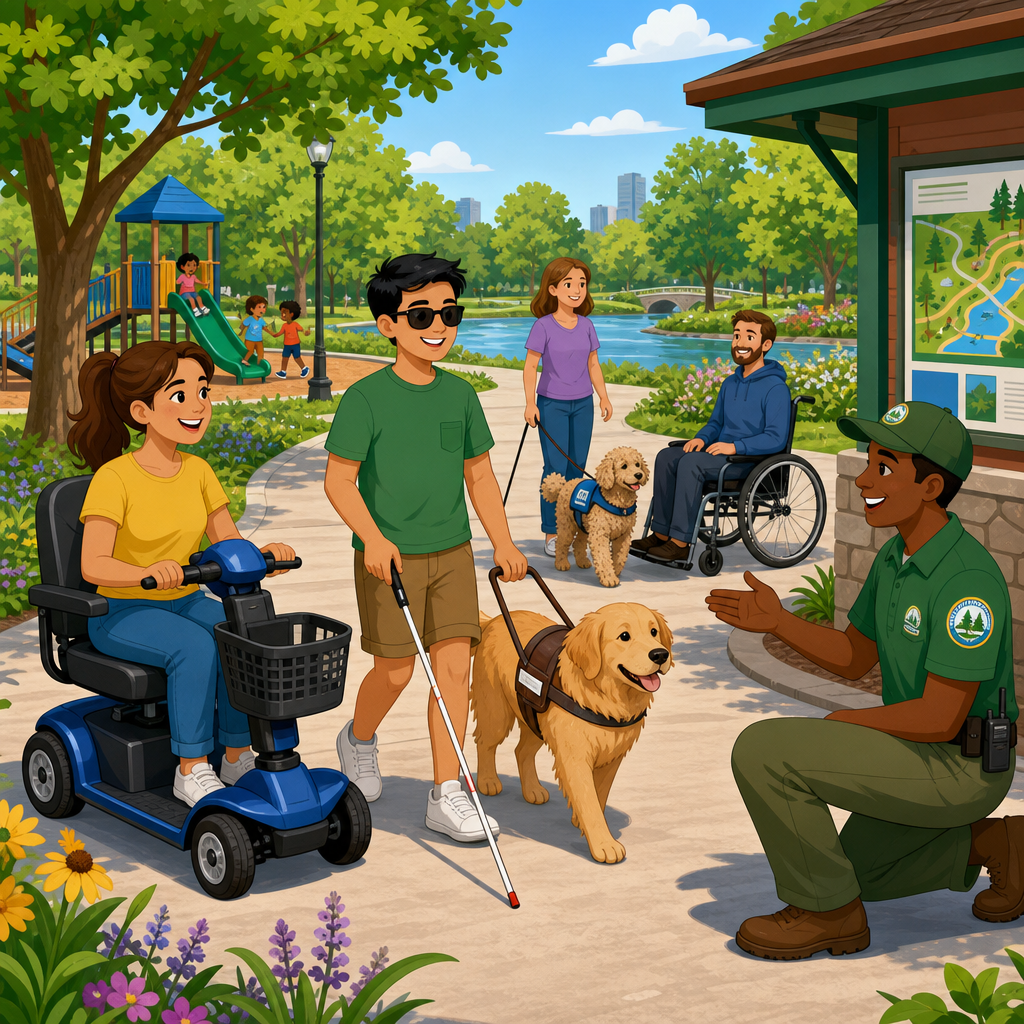
Parks departments manage some of the most visible public spaces in local government, and few issues test daily operations more than mobility devices and service animals. Staff members at trailheads, recreation centers, beaches, campgrounds, athletic complexes, and community events must make quick decisions that affect safety, access, and legal compliance. Mobility devices include wheelchairs, power-driven mobility devices such as golf cars or Segways, walkers, scooters, and other equipment used because of a mobility disability. Service animals are dogs, and in limited cases miniature horses, individually trained to do work or perform tasks for a person with a disability. These definitions matter because they determine what questions staff may ask, where access must be granted, and when restrictions are allowed.
I have helped agencies rewrite park rules, train frontline teams, and investigate complaints after inconsistent enforcement created conflict. The pattern is familiar: one employee allows an adaptive e-bike on a natural-surface trail, another denies a powered scooter at the same entrance, and a third tells a visitor to show proof for a service dog. The result is not only frustration for visitors but exposure under the Americans with Disabilities Act. For parks departments, the challenge is practical, not abstract. Facilities are diverse, terrain changes, emergency access is limited, and programs range from youth sports to wilderness interpretation. A clear, defensible system is essential.
This sports and recreation hub explains how parks departments can handle mobility devices and service animals across the full range of recreation settings. It covers the legal framework, policy design, staff training, safety analysis, field operations, and communication practices that reduce complaints while preserving legitimate program requirements. It also serves as a central guide for related topics in sports and recreation, including accessible trails, aquatics, athletics, playgrounds, special events, and contracted programming. The core principle is straightforward: departments should remove unnecessary barriers, evaluate actual risk rather than assumptions, and give staff simple rules they can apply consistently in real time.
Know the rules that govern access in parks and recreation
The starting point is the ADA, especially Title II for state and local government services and the implementing regulations at 28 CFR Part 35. Those rules require parks departments to provide equal access to programs, services, and activities. For mobility, the regulations distinguish between wheelchairs and other power-driven mobility devices. A wheelchair must be permitted anywhere pedestrian use is allowed unless a separate lawfully applied restriction exists for everyone. Other power-driven mobility devices must generally be allowed unless the department can show the class of device cannot be operated in accordance with legitimate safety requirements. The Department of Justice identifies assessment factors including the device’s type, size, weight, dimensions, speed, pedestrian volume, facility design, and risk of serious harm to the environment or natural or cultural resources.
For service animals, the ADA definition is narrow but strong. A service animal is not any pet that provides comfort; it is an animal individually trained to do work or perform tasks for a person with a disability. Staff may ask only two questions when the need is not obvious: whether the animal is required because of a disability, and what work or task the animal has been trained to perform. Staff may not require documentation, demand the task be demonstrated, or ask about the person’s diagnosis. A service animal can be excluded only if it is out of control and the handler does not take effective action, or if the animal is not housebroken. Allergies, fear of dogs, or generalized concerns about wildlife are not enough by themselves.
These rules apply across sports and recreation operations, but context matters. A pool deck, a football sideline, a boat launch, and a backcountry trail present different hazards. Compliance therefore depends on careful, written assessments rather than unwritten habits. Agencies that document why certain mobility devices are compatible with a location, and why a narrow restriction applies elsewhere, are far better positioned than agencies relying on a blanket “no motorized devices” sign posted years ago. That sign is one of the most common triggers for avoidable complaints.
Build policies around functional categories, not assumptions
The most effective park access policies classify devices and animals by the rules that apply to them. In practice, I recommend agencies separate at least four categories: wheelchairs; other power-driven mobility devices; bicycles and recreational e-bikes; and service animals. Each category should have a short definition, the access standard, allowed operational limits, and any location-specific restrictions supported by a written assessment. This structure prevents staff from treating every powered device as a recreational vehicle or every dog as a pet.
A strong policy also identifies who can make exceptions, how staff should document incidents, and where visitors can request accommodations. Recreation departments often overlook the importance of aligning registration systems, facility rental terms, and event permits with the same definitions used on-site. If a youth tournament permit says “no animals except trained service animals,” but the entrance sign says “no dogs,” and the website says “pets allowed on leash,” frontline conflict becomes inevitable. Consistency across rules, forms, and signs is an operational necessity.
| Issue | What staff should do | What staff should avoid |
|---|---|---|
| Wheelchair access | Allow wherever pedestrian access is allowed | Creating special permit requirements |
| Powered mobility device | Apply site-specific safety criteria already documented | Banning all motorized devices without analysis |
| Service animal inquiry | Ask the two permitted questions if the need is not obvious | Requesting ID, certification, or medical proof |
| Animal behavior problem | Address control or housebreaking issues based on conduct | Excluding the handler because others are uncomfortable |
| Event or program registration | Use the same terms as park rules and website content | Letting forms contradict posted policies |
When agencies use this framework, field decisions improve quickly. At one sports complex, staff had been denying entry to a parent using a golf-car-style mobility device because a nearby sign prohibited golf carts. After reviewing the situation, the department rewrote the rule to address unauthorized recreational vehicle use while preserving access for other power-driven mobility devices that met speed and route restrictions. Complaints stopped because the policy finally matched the law and the site conditions.
Evaluate trails, fields, facilities, and events using objective safety factors
Not every recreation space can safely support every device, but the reasons must be concrete. The Department of Justice factors are useful because they force agencies to evaluate operation, not appearance. On a six-foot-wide paved greenway with low grades and clear sightlines, many power-driven mobility devices can operate safely at walking speed. On a narrow boardwalk with blind turns, a steep fishing pier ramp, or a root-filled natural-surface trail crossing sensitive habitat, speed, turning radius, braking distance, and passing space may justify tighter restrictions. The important point is that agencies should analyze the specific route and record the findings.
Sports facilities require the same discipline. On synthetic turf, heavy devices may affect the surface differently than on concrete concourses. A department should consult the turf manufacturer, maintenance staff, and risk management team before setting weight or route limits. At stadiums and ballfields, conflict often arises near dugouts, benches, and emergency egress points. The best solution is usually not exclusion but route planning: designate accessible arrival paths, companion seating zones, sideline buffer distances, and staff procedures for halftime or between-inning circulation. These operational details matter more than generic statements about safety.
Special events need pre-event review because temporary layouts can create new barriers. Vendors may narrow accessible routes, cable ramps may change clear width, and crowded festivals can turn a manageable promenade into a bottleneck. Event permits should require site maps showing accessible entrances, service animal relief areas where feasible, quiet spaces when relevant, and emergency communication methods. If portable fencing or security screening is used, staff need clear instructions on how visitors using mobility devices or service animals will be screened without delay or humiliation. Good event planning prevents frontline improvisation, which is where most mistakes occur.
Train frontline staff to ask the right questions and document the right facts
Most complaints do not come from malicious conduct; they come from employees trying to solve a problem without enough training. Parks departments should train everyone who interacts with the public, including seasonal workers, gate attendants, coaches, instructors, lifeguards, rangers, maintenance personnel, and security contractors. Training should be scenario-based. Staff should practice how to respond when someone arrives with a powered device on a trail, when a participant brings a service dog to a gymnasium, or when another patron objects. Scripts help. For example: “We allow service animals. If it is not obvious, I may ask whether the dog is required because of a disability and what task it has been trained to perform.” That is short, lawful, and repeatable.
Documentation is equally important. Incident reports should capture date, location, device or animal involved, observed behavior, site conditions, staff actions, and whether a supervisor reviewed the decision. Reports should avoid editorial language such as “looked suspicious” or “did not seem disabled.” Facts matter: speed observed, width of route, dog lunged at another visitor, handler regained control, or no relief area nearby. Those details support follow-up, policy revision, and defense if a claim is filed. They also reveal patterns. If the same entrance generates repeated conflicts, the problem is usually signage, layout, or training, not individual visitor behavior.
Contractors must be included. Many recreation services are delivered by concessionaires, league operators, camp providers, or event security teams. If those partners enforce access rules inconsistently, the department still faces the public consequences. Contracts should require disability access training, compliance with department policies, prompt incident reporting, and cooperation during investigations. In my experience, this is one of the most overlooked controls in sports and recreation operations.
Manage service animals in high-activity recreation settings without overreacting
Service animals in parks create practical questions that staff can answer directly. Can a service dog accompany a spectator to a baseball game? Yes, unless the dog is out of control or not housebroken. Can a service animal enter a recreation center, nature center, or campground store? Yes. Can staff separate the handler from the animal because children are excited or another patron is nervous? No. The analysis must focus on the animal’s behavior and the actual setting, not assumptions about dogs in public.
More complex settings require nuance. On a pool deck, a service animal may generally accompany the handler in deck areas where the public goes, though the animal does not enter the water simply by virtue of being a service animal. At amusement-style splash features or highly congested spectator areas, departments should think ahead about slip resistance, leash management, and safe resting areas. At outdoor concerts or fireworks events, staff should not decide on the spot that noise alone bars the animal. Instead, provide information in advance so handlers can make informed choices, and intervene only if the animal’s actual conduct creates a problem.
Miniature horses are less common but still recognized in limited cases. Agencies should assess whether the facility can accommodate type, size, and weight; whether the handler has sufficient control; whether the horse is housebroken; and whether allowing it compromises legitimate safety requirements. This is uncommon in municipal parks, but staff should know the rule exists so they do not respond with a blanket denial based on unfamiliarity.
Use signage, websites, and complaint systems to reduce conflict before it starts
Clear communication is one of the cheapest risk controls available to parks departments. Signs should tell visitors what they need to know without creating unlawful barriers. “No motorized vehicles” is often too blunt if the department intends to allow mobility devices. A better sign specifies that unauthorized recreational motor vehicles are prohibited while mobility devices used because of disability are permitted subject to posted operating rules. Where site-specific restrictions apply, signs should state the operational reason plainly, such as steep grades, narrow width, or habitat protection, and direct visitors to accessible alternative routes when available.
Website content should mirror posted rules and answer common questions in plain language. Visitors should be able to find whether service animals are allowed, whether mobility devices may be used on trails or at sports venues, how to request an accommodation, and whom to contact before an event. This hub article should link naturally to more detailed pages on accessible sports fields, aquatic facilities, campgrounds, trail design, adaptive recreation programs, and event accessibility. Those internal connections help users solve the next question and help the department maintain a coherent sports and recreation guidance system.
Finally, every department needs a simple complaint and escalation process. When visitors feel heard quickly, disputes are easier to resolve. Assign responsibility to a trained coordinator, set response timelines, and review complaints quarterly for trends. The best departments treat each issue as operational feedback. If a complaint reveals a confusing entrance route, contradictory sign, or untrained contractor, fix the system. That is how accessibility improves across the entire sports and recreation portfolio.
Parks departments can handle mobility devices and service animals well when they replace guesswork with defined rules, documented safety analysis, and consistent training. The key distinctions are clear: wheelchairs have broad access rights, other power-driven mobility devices require site-based assessment rather than blanket bans, and service animals are working animals judged by behavior and control, not by labels or paperwork. In sports and recreation settings, success depends on translating those principles into route plans, event procedures, contractor expectations, signs, and staff scripts that work under real field conditions.
This hub page is the foundation for the broader sports and recreation accessibility program. From trails and athletic complexes to pools, beaches, camps, and festivals, the same operational habits apply: evaluate the setting, communicate the rule, train the people enforcing it, and document what happens. Departments that do this reduce complaints, improve visitor trust, and protect equal access without sacrificing legitimate safety requirements. Review your current policies, signs, contracts, and staff training materials, then update the weak points first. Small corrections at the front line produce the biggest gains.
Frequently Asked Questions
What mobility devices must parks departments allow in parks, trails, recreation centers, and public programs?
Parks departments generally must allow manual wheelchairs and powered wheelchairs wherever members of the public are allowed to go. Those devices are treated as personal mobility aids used by individuals with disabilities, so staff should not create separate rules that limit them simply because they are motorized or larger than a standard pedestrian footprint. The analysis becomes more nuanced with other power-driven mobility devices, sometimes called OPDMDs, such as golf cars, Segways, stand-up scooters, and similar equipment used because of a mobility disability. In those situations, departments should evaluate whether a particular device can be permitted in a specific setting based on legitimate safety requirements, not assumptions or blanket objections.
A practical approach is to create a written assessment process for different park environments, including paved paths, natural-surface trails, beaches, athletic facilities, campgrounds, and event sites. Factors often include path width, grade, surface conditions, pedestrian density, turning radius, speed capability, seasonal conditions, visibility, and the risk of harm to natural resources or other visitors. If a device can be used safely in a given area with reasonable operating rules, departments should generally allow it. If a device cannot be accommodated in one location because of real safety concerns, staff should be prepared to explain the reason clearly and identify any accessible alternatives, such as an alternate route, accessible viewing area, beach mat, shuttle service, or nearby program location.
The key operational point is consistency. Frontline staff should not decide access questions ad hoc based on appearance, unfamiliar equipment, or personal discomfort. Written policies, signage, and staff training help reduce conflict and improve compliance. When possible, rules should focus on behavior and safety, such as maximum safe speed, yielding to pedestrians, or staying on designated routes, rather than on a device’s label alone.
Can parks staff ask questions when someone is using a golf car, Segway, or other power-driven mobility device?
Yes, but the questions should be limited and handled carefully. If the disability-related need for the device is not obvious, staff may ask whether the device is being used because of a mobility disability. In many settings, that may be enough. Departments may also adopt a lawful method for gathering credible assurance, such as accepting a valid disability parking placard, a state-issued proof of disability, or a simple verbal representation from the individual, depending on how the policy is structured and what is appropriate under the circumstances. The goal is to verify disability-related use without turning the interaction into an interrogation.
Staff should not demand detailed medical documentation, ask for a diagnosis, or require the person to explain the nature or severity of the disability. They also should not assume that because a device looks recreational it is being used for recreation rather than mobility. Many devices commonly associated with leisure or resort settings are used by individuals with disabilities to navigate large public spaces, uneven terrain, or long distances. A well-trained employee can ask brief, respectful questions and then shift the conversation to applicable operating rules, such as where the device may travel, whether certain steep or narrow sections are restricted, and what alternatives are available if an area is unsafe.
For departments, the best practice is to build this script into training materials. Employees at entrances, rental counters, event check-in tables, and ranger stations should know exactly what they can ask, what they cannot ask, and when to involve a supervisor. That protects visitor dignity while helping the department make defensible, uniform decisions in the field.
How should parks departments handle service animals in public spaces and programs?
In most cases, parks departments must allow service animals to accompany individuals with disabilities in areas where the public is normally allowed. A service animal is typically a dog that has been individually trained to do work or perform tasks for a person with a disability. The focus is on the animal’s trained task and the individual’s disability-related need, not on whether the animal wears a vest, carries identification, or has been registered with an online service. Staff should understand that service animals are working animals, not pets, and should not be treated under ordinary pet rules when they meet the applicable standard.
If it is not obvious that the dog is a service animal, staff may generally ask two limited questions: whether the dog is required because of a disability, and what work or task the dog has been trained to perform. Staff should not ask about the person’s disability, request medical papers, require proof of training or certification, or insist that the dog demonstrate its task on the spot. Those mistakes are common sources of complaints and can quickly escalate routine visitor interactions into legal issues.
Once admitted, a service animal must still be under control. That usually means harnessed, leashed, or tethered unless those devices interfere with the animal’s work or the individual’s disability prevents their use, in which case the animal must still be controlled through voice, signal, or other effective means. The animal should also be housebroken. If a service animal is out of control and the handler does not take effective action, or if the animal is not housebroken, the department may ask that the animal be removed. Even then, the person with the disability should be offered the opportunity to participate in the service, program, or activity without the animal if that is possible.
Parks settings often raise special questions about beaches, wildlife areas, swimming zones, campgrounds, and athletic fields. Departments should avoid blanket exclusions unless they are supported by legitimate legal or safety reasons. If there are narrow exceptions based on environmental protection, health requirements, or direct threats that cannot be mitigated, those exceptions should be carefully documented and framed as narrowly as possible. In day-to-day operations, staff should focus on behavior, control, and access, not on stereotypes about certain breeds, dog size, or public reactions.
When can a parks department restrict a mobility device or exclude a service animal for safety reasons?
Parks departments may impose restrictions when there are legitimate safety requirements based on actual risks, but those decisions must be grounded in facts rather than generalized fears or administrative convenience. For mobility devices, a department may evaluate whether a specific power-driven device can be operated safely in a particular environment. For example, a narrow elevated boardwalk with sharp turns, heavy foot traffic, and no passing space may justify restrictions on some larger or faster devices. Likewise, unstable dunes, flooded trails, or active construction zones may create conditions where even ordinarily permitted access needs to be rerouted temporarily. The important point is that restrictions should be tied to measurable site conditions and applied consistently.
For service animals, exclusion is usually much narrower. A department cannot exclude a service animal simply because other visitors are afraid of dogs, have allergies, or dislike animals. It also cannot rely on breed stereotypes. Removal is typically justified only if the animal is out of control and the handler does not correct it, if the animal is not housebroken, or if the animal’s presence creates a direct threat that cannot be eliminated by reasonable modifications. Direct threat means a real, significant risk based on current evidence and the specific situation, not a speculative or hypothetical concern.
Operationally, safety-based decisions should be documented. Staff should note the date, location, observed condition, rule applied, alternative access offered, and any steps taken to de-escalate the interaction. That record can be invaluable if the decision is later challenged. Departments should also revisit restrictions periodically. A route that is unsafe during a crowded festival or after storm damage may be accessible at other times. Good policy balances public safety, resource protection, and disability access without turning temporary limitations into permanent barriers.
What policies and staff training should parks departments put in place to reduce complaints and improve compliance?
The strongest parks departments do not leave mobility-device and service-animal decisions to improvisation. They adopt clear written policies that explain what devices are generally permitted, how other power-driven mobility devices will be assessed, what questions staff may ask, how service animals are handled, when removal or restriction is appropriate, and what alternative access options are available. Those policies should be tailored to the department’s real facilities and operations, including nature trails, playgrounds, sports complexes, marina areas, pools, beaches, special events, and seasonal programming. Generic language is a start, but site-specific guidance is what helps employees make confident decisions under pressure.
Training should be practical and repetitive. Frontline employees, supervisors, park rangers, maintenance leads, volunteers, contractors, and event partners all need to understand the rules because visitors often interact first with whoever is closest, not whoever has the most legal training. Effective training includes scenario-based examples: a visitor arrives at a trailhead with a Segway, a camper has a service dog in a no-pets loop, a beach patron uses a mobility scooter on a mat access route, or an animal begins barking during a crowded event. Staff should practice the exact language to use, the limits on what they may ask, and the process for escalating unusual situations to a supervisor without delaying access unnecessarily.
Departments should also review signs, websites, reservation materials, permits, and event contracts to make sure public-facing information matches internal policy. Conflicting messages are a common source of avoidable disputes. If a beach has accessible entry mats, if a campground has accessible pads, or if an event has designated routes for mobility devices, those details should be easy to find before a visitor arrives. Finally, departments should create a simple incident-review process. Complaints