Hotels, restaurants, resorts, and cafés often think ADA compliance is a facilities checklist, but in day-to-day operations it is mostly a staff training issue. In hospitality and food service, the Americans with Disabilities Act sets the baseline for equal access, yet the guest experience is determined by how front desk agents, servers, managers, housekeepers, hosts, and event staff respond in real situations. Real ADA compliance means employees know what the law requires, understand how to communicate respectfully, and can solve access problems without making guests fight for basic service.
For hospitality brands, this matters for three reasons. First, accessibility failures create immediate service breakdowns: a guest who cannot reserve an accessible room accurately, a diner whose wheelchair cannot fit at the assigned table, or a conference attendee who never receives requested captioning is not dealing with an abstract policy problem. Second, the legal and financial risks are substantial. Title III of the ADA applies to places of public accommodation, including lodging and food service businesses, and complaints often arise from operational mistakes rather than structural barriers alone. Third, strong accessibility practices improve customer loyalty, online reviews, staff confidence, and brand reputation across every property.
When I have audited hospitality operations, the biggest gap is rarely intent. Most teams want to help. The problem is inconsistency. One manager understands service animal rules, another asks prohibited questions. One reservation agent knows which room features are actually accessible, another reads from a vague system note. One server automatically offers menus in an accessible format, another speaks only to a companion instead of the disabled guest. Training closes that gap by turning broad legal obligations into repeatable service behaviors. That is why this hub page focuses on hospitality and food service as a whole, while also pointing to the specific operational areas brands must master.
What real ADA compliance means in hospitality and food service
Real ADA compliance in hospitality means providing disabled guests equal opportunity to access lodging, dining, events, amenities, and information. It includes physical access, but it also includes policies, procedures, communication, and staff conduct. A compliant hotel is not simply a building with ramps and a few designated rooms. It is an operation where reservations can be made accurately, accessible features are described clearly, check-in is workable for guests with mobility, hearing, vision, cognitive, or speech disabilities, and complaints are resolved quickly. In restaurants and bars, compliance includes accessible seating routes, readable menus, effective communication, and nondiscriminatory service policies.
Two federal standards shape this work. The ADA Standards for Accessible Design cover many built-environment requirements. Department of Justice regulations under Title III govern policies and practices for public accommodations. For lodging, reservation systems must identify and hold accessible rooms correctly and provide enough detail for guests to assess whether a room meets their needs. For food service, operators must make reasonable modifications to policies when necessary to serve disabled patrons, unless doing so would fundamentally alter the service. Effective communication is also a core obligation, which may involve written notes, assistive listening systems, captioning, accessible digital content, or qualified interpreters in some circumstances.
The practical takeaway is simple: training must cover both the built environment and human behavior. Staff do not need to become lawyers, but they must understand what they can and cannot do, what promises they can safely make, and when to escalate. Brands that train only on customer service language without grounding employees in the actual rules create legal risk. Brands that train only on legal concepts without role-specific scenarios create confusion. The strongest programs combine legal standards, operational playbooks, and property-level drills.
Where hospitality brands usually fail
Most failures happen at transitions between departments. Marketing publishes accessibility claims that operations cannot deliver. Revenue teams load room descriptions into the booking engine using generic labels like “ADA room” without documenting roll-in showers, tub transfer benches, bed heights, turning space, visual alarms, or hearing-access kits. Front desk staff assign an accessible room to a non-disabled guest, then “walk” the disabled guest to a standard room when occupancy spikes. Restaurant hosts seat parties at high-top tables because they are available faster, without checking whether the arrangement works for a wheelchair user. Event teams accept accommodation requests but never confirm fulfillment with banquet, AV, or security.
Another frequent failure is overreliance on improvisation. Hospitality workers are trained to be accommodating, which is valuable, but improvisation can drift into noncompliance. I have seen staff offer to carry a wheelchair user up steps instead of routing them to an accessible entrance, ask for medical proof before allowing a service animal, and insist on speaking through companions because it feels easier. These responses are often well meaning, yet they undermine dignity and can violate the ADA. Good training teaches employees that respectful service is not guessing what seems helpful. It is following lawful, consistent, guest-centered procedures.
Digital operations are now part of the same risk profile. If a guest cannot navigate a hotel website, request an accommodation through a restaurant reservation platform, or read a mobile menu with a screen reader, the service barrier begins before arrival. Hospitality brands should treat website accessibility, reservation flow accuracy, and digital document accessibility as part of the same training ecosystem. Staff who manage content, confirmations, and guest messaging need training too, not just customer-facing teams on property.
How to build an effective staff training program
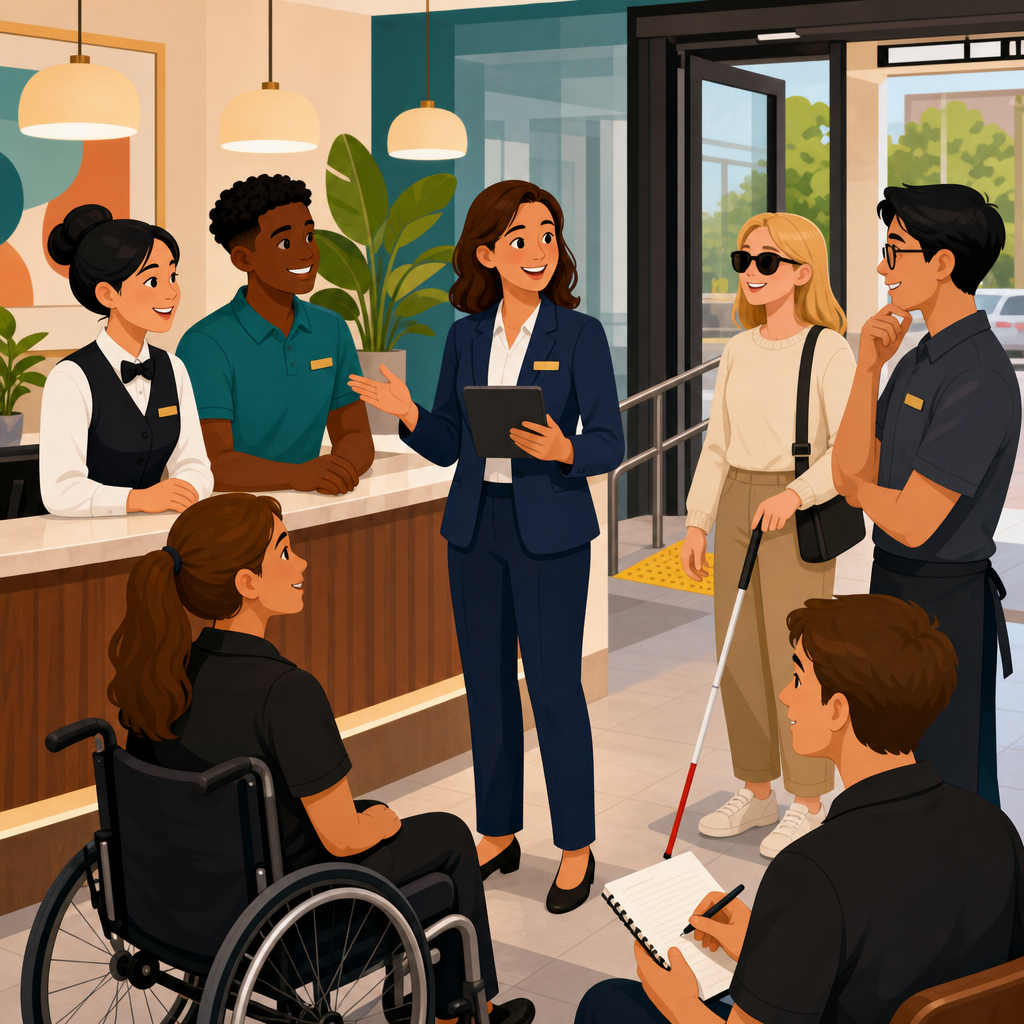
An effective ADA training program for hospitality brands starts with role mapping. Front desk, reservations, housekeeping, food and beverage, events, spa, valet, engineering, security, and general management all face different accessibility scenarios. Training should begin with a common foundation: disability etiquette, core ADA concepts, service animal rules, effective communication, reasonable modifications, and escalation paths. Then each department needs targeted modules. Reservations teams should learn accessible room inventory controls and feature descriptions. Restaurant hosts should practice table selection and queue management. Housekeeping should understand how to preserve accessible room layouts and avoid moving essential equipment.
Scenario-based practice is the most reliable method. A short annual video is not enough. Staff need examples drawn from actual operations: a guest requests a shower chair that was never returned to storage, a diner asks for menu information in large print, a conference participant needs captioning for a breakout session added at the last minute, or a guest with low vision wants orientation to the property. Supervisors should run tabletop exercises and live walk-throughs in the physical space. When employees rehearse decisions in context, recall improves and fear drops. That is especially important in high-turnover environments such as restaurants and select-service hotels.
| Department | Training priority | Operational example |
|---|---|---|
| Reservations | Accessible inventory accuracy | Explain whether a room has a roll-in shower, visual alarm, and accessible route to amenities |
| Front desk | Check-in and problem resolution | Protect reserved accessible rooms and escalate immediately if a promised feature is unavailable |
| Food service | Seating and communication | Offer accessible table options without isolating the guest or speaking only to companions |
| Events and banquets | Accommodation fulfillment | Confirm captioning, aisle spacing, stage access, and dietary communication before event day |
| Housekeeping and engineering | Room readiness | Keep grab bars, visual devices, door clearances, and furniture placement consistent |
Measurement matters. Brands should test staff knowledge with realistic assessments, mystery shopping, property audits, and complaint trend reviews. The strongest teams track whether accessible rooms are returned to service properly, whether accommodation requests are closed out, and whether guest-facing accessibility statements match actual conditions. Learning management systems such as Workday Learning, Schoox, or Axonify can deliver modules, but managers still need accountability tools at property level. Accessibility becomes real when it is embedded in onboarding, shift huddles, QA reviews, and manager scorecards.
Training topics every hotel, restaurant, and resort should cover
Every hospitality training program should cover disability etiquette first. Employees should address the guest directly, not a companion or interpreter. They should ask before providing assistance, use plain respectful language, and avoid assumptions about what a person can do. Service animal rules are another universal topic. Staff may generally ask only whether the dog is required because of a disability and what work or task the dog has been trained to perform. They should not request documentation, demand demonstrations, or charge pet fees for service animals.
Accessible lodging operations require special depth. Reservation and front desk teams need to understand room type protections, feature-level descriptions, and room assignment protocols. They should know how to describe communication features for deaf or hard-of-hearing guests, how to coordinate portable equipment, and how to document maintenance issues that affect accessibility. In food service, teams should learn seating flexibility, menu accessibility, queue management, and communication techniques for guests with hearing, speech, cognitive, or visual disabilities. For buffets and self-service areas, staff should know when assistance is appropriate and how to provide it without taking control away from the guest.
Events, meetings, and entertainment spaces need additional modules because the risk profile is broader. Staff should understand accessible registration, seating layouts, stage and podium access, assistive listening availability, captioning workflows, emergency egress communication, and restroom routing. Pools, spas, fitness centers, and transportation services also deserve tailored training. If a property offers a shuttle, valet, beach access program, or excursion booking desk, guest access obligations extend into those experiences. The hub approach works best here: one enterprise framework, then detailed guidance for lodging, restaurants, events, recreation, digital channels, and emergency response.
Using audits, standards, and cross-functional ownership
Training works only when brands pair it with operational truth. That means auditing what exists, comparing it to applicable standards, and teaching staff from the actual findings. A brand standard that says “all accessible rooms include compliant clearances” is meaningless if furniture placement blocks turning space after every deep clean. I recommend quarterly property walk-throughs led jointly by operations, facilities, and guest experience teams, with disabled users included whenever possible. Nothing sharpens training like seeing a reservation path fail, testing a bathroom transfer space, or trying to navigate banquet seating during a live setup.
Recognized references help keep training accurate. Teams should align content with ADA Title III regulations, the 2010 ADA Standards for Accessible Design, Department of Justice guidance on service animals and effective communication, and web accessibility practices based on WCAG. Larger brands often add internal design standards, procurement requirements, and complaint response protocols. Cross-functional ownership is essential because no single department controls the whole guest journey. Legal can interpret risk, facilities can address physical barriers, digital teams can improve booking and content accessibility, and operations can standardize front-line behavior. Without that shared ownership, training becomes a one-time HR exercise instead of a living operational system.
Finally, hospitality brands should treat guest feedback as compliance intelligence. Complaints, accessibility requests, public reviews, and social posts reveal where training is failing in practice. If multiple guests report inaccessible breakfast layouts, confusion about pool lifts, or missing captioning at events, that is a training signal, not just an isolated service issue. Review patterns by property and department, refresh scripts and SOPs, and close the loop with managers. Real ADA compliance is never achieved by posting a policy and moving on. It is built through disciplined training, accurate information, regular audits, and a culture that understands access as part of excellent hospitality. If your brand operates in hospitality and food service, use this hub as the starting point, then build role-specific guidance for every guest touchpoint.
Frequently Asked Questions
1. Why is ADA compliance in hospitality primarily a staff training issue and not just a facilities issue?
Many hospitality brands focus first on physical accessibility features such as ramps, elevators, accessible restrooms, pool lifts, parking spaces, lowered counters, and guest room layouts. Those features matter, but they are only the starting point. In real operations, ADA compliance is experienced through people. A hotel can have a compliant room, but if the front desk agent does not know how to prioritize an accessible room request, explain available features accurately, or handle a service animal appropriately, the guest still faces barriers. A restaurant may have an accessible entrance, but if a host refuses to adjust seating for a wheelchair user or a server does not know how to communicate respectfully with a deaf guest, equal access breaks down.
That is why staff training is central. Employees are the ones making dozens of access-related decisions every day: how to respond to accommodation requests, how to assist without patronizing, how to communicate with guests who have mobility, sensory, cognitive, or speech disabilities, and how to escalate issues when needed. In hospitality, the law sets a baseline, but the actual guest experience is shaped by frontline behavior. Training turns compliance from a static checklist into a repeatable service standard.
Strong ADA training also helps reduce inconsistency across roles and shifts. Front desk teams, servers, bartenders, managers, housekeepers, concierge staff, event coordinators, and maintenance teams all interact with accessibility in different ways. Without training, responses are often improvised, which increases legal risk and damages trust. With training, teams learn how to apply ADA principles in real scenarios, not just in theory. That is what makes compliance practical, defensible, and guest-centered.
2. What should hospitality staff be trained to know about ADA requirements in everyday guest interactions?
At a minimum, staff should understand that the ADA is about equal access, nondiscrimination, and effective communication. In daily operations, that means employees need to know how to welcome and serve guests with disabilities without creating unnecessary obstacles. Training should cover respectful communication, person-first or identity-first language preferences when appropriate, how to offer assistance without making assumptions, and how to avoid treating a guest as incapable or burdensome. Employees should know that the goal is not special treatment, but equal opportunity to use the property, services, amenities, dining spaces, event areas, and reservation systems.
Hospitality staff should also be trained on specific operational topics. These include handling accessible room reservations correctly, maintaining accessibility features in usable condition, understanding seating flexibility in restaurants and cafés, recognizing obligations around service animals, and knowing when modifications to standard policies may be required to provide access. Teams should know the difference between being helpful and being intrusive. For example, employees should ask before providing physical assistance, speak directly to the guest rather than a companion, and avoid asking unnecessary medical questions.
Effective communication is another major topic. Staff should know how to interact with guests who are deaf, hard of hearing, blind, have low vision, have speech disabilities, or have cognitive disabilities. That may include using writing tools, reading menu items aloud upon request, describing pathways or room features clearly, allowing extra time during check-in, or connecting the guest with available auxiliary aids or communication support. Managers should be trained on the more sensitive judgment calls, including when an accommodation request can be fulfilled immediately, when an alternative solution is appropriate, and when legal or corporate guidance is needed. The more practical and scenario-based the training is, the more likely staff are to respond confidently and lawfully in live guest situations.
3. How should hospitality brands train employees to handle service animals and accommodation requests correctly?
Service animal issues are one of the most common areas where hospitality staff make mistakes, so training needs to be precise and role-specific. Employees should understand that a service animal is not the same as a pet and that guests with service animals generally must be allowed into areas where the public is permitted. Staff should be trained on the limited questions that may be appropriate when the need for the service animal is not obvious, and just as importantly, on the questions they should not ask. They should not request documentation, demand proof of training, or ask about the person’s diagnosis or disability details.
Training should also address common real-world situations. For example, restaurant staff may worry about health code issues, hotel staff may be uncertain about no-pet policies, and housekeepers may not know how to coordinate room servicing when a service animal is present. Clear internal guidance helps avoid awkward, inconsistent, or unlawful responses. Employees should know how to remain calm, respectful, and fact-based if another guest complains or expresses allergies or fear. The solution is not to exclude the guest with the service animal, but to look for practical accommodations for all involved whenever possible.
Accommodation requests more broadly should be treated as part of normal service, not as exceptions that frustrate the operation. Staff should be trained to listen carefully, clarify what access barrier the guest is encountering, and focus on reasonable solutions within their authority. In a hotel, that may involve confirming accessible room features, adjusting check-in procedures, or coordinating alternate access routes. In a resort or event setting, it may mean changing seating layouts, providing accessible transportation support, or ensuring participation in activities. Good training teaches employees to respond with confidence instead of defensiveness. It also gives them escalation paths, so if a request is complex, they know exactly which manager or department should take over without delaying the guest experience.
4. What are the best ways to make ADA training practical for hotels, restaurants, resorts, and cafés?
The most effective ADA training is not a one-time legal lecture or a generic online module that employees click through and forget. Hospitality brands get better results when training is tied directly to job functions and actual guest scenarios. Front desk agents should practice handling accessible reservations, late-arrival room disputes, communication requests, and transportation questions. Restaurant teams should rehearse accessible seating conversations, menu communication, service animal interactions, and line management. Housekeepers should learn how to preserve accessible room setups and avoid moving mobility-related items. Event staff should train on route access, stage access, registration flow, and guest support during crowded or time-sensitive events.
Scenario-based role play is especially valuable because it builds judgment, tone, and confidence. Employees should practice what to say, what not to say, and when to involve a supervisor. Short training moments built into pre-shift meetings can be more effective than relying only on annual compliance sessions. Brands should also create written standards, quick-reference guides, and decision trees that are easy to use on the floor. If an employee has to guess during a live interaction, training has not gone far enough.
Another best practice is to connect ADA training to service quality rather than treating it as a legal burden. When teams understand that accessibility is part of excellent hospitality, they are more likely to take it seriously and apply it consistently. Leadership involvement matters here. Managers should model respectful behavior, coach in real time, and correct mistakes without delay. It is also smart to audit training through mystery shops, accessibility reviews, guest feedback, and incident tracking. If the same errors keep happening, the issue is usually not policy alone, but a gap in reinforcement, clarity, or accountability.
5. How can hospitality brands measure whether their ADA staff training is actually working?
ADA training should be measured the same way strong operators measure any important service standard: through behavior, consistency, guest outcomes, and risk reduction. Completion rates alone do not prove anything. A brand needs to know whether employees can apply the training under real conditions. One of the best ways to assess this is through direct observation. Managers can evaluate how staff handle check-in interactions, seating requests, service animal situations, accessible route questions, and communication support needs. If employees hesitate, provide conflicting answers, or escalate issues that should be handled easily, that signals a training problem.
Guest feedback is another key indicator. Brands should watch for comments related to accessibility in surveys, reviews, complaint logs, and direct follow-up conversations. Not every guest will use legal terminology, so it helps to look for practical themes such as difficulty getting accurate room information, being denied seating flexibility, poor communication, embarrassment during service, or staff seeming confused about disability-related requests. Accessibility complaints should be categorized and reviewed just like safety incidents or service recovery issues. Patterns matter more than isolated anecdotes.
Operational audits also help determine whether training is translating into compliance. This can include testing reservation accuracy for accessible rooms, reviewing incident reports involving accommodations, checking whether accessible features are kept usable, and evaluating whether staff know current procedures. Some brands also use mock scenarios, manager spot checks, or third-party assessments to identify blind spots. Most importantly, measurement should lead to action. If training reveals weak points in certain departments or shifts, the response should be targeted coaching, refreshed scripts, policy clarification, and stronger manager oversight. Real ADA compliance is not achieved when a training module is assigned. It is achieved when staff repeatedly respond in ways that create equal access for guests in everyday situations.