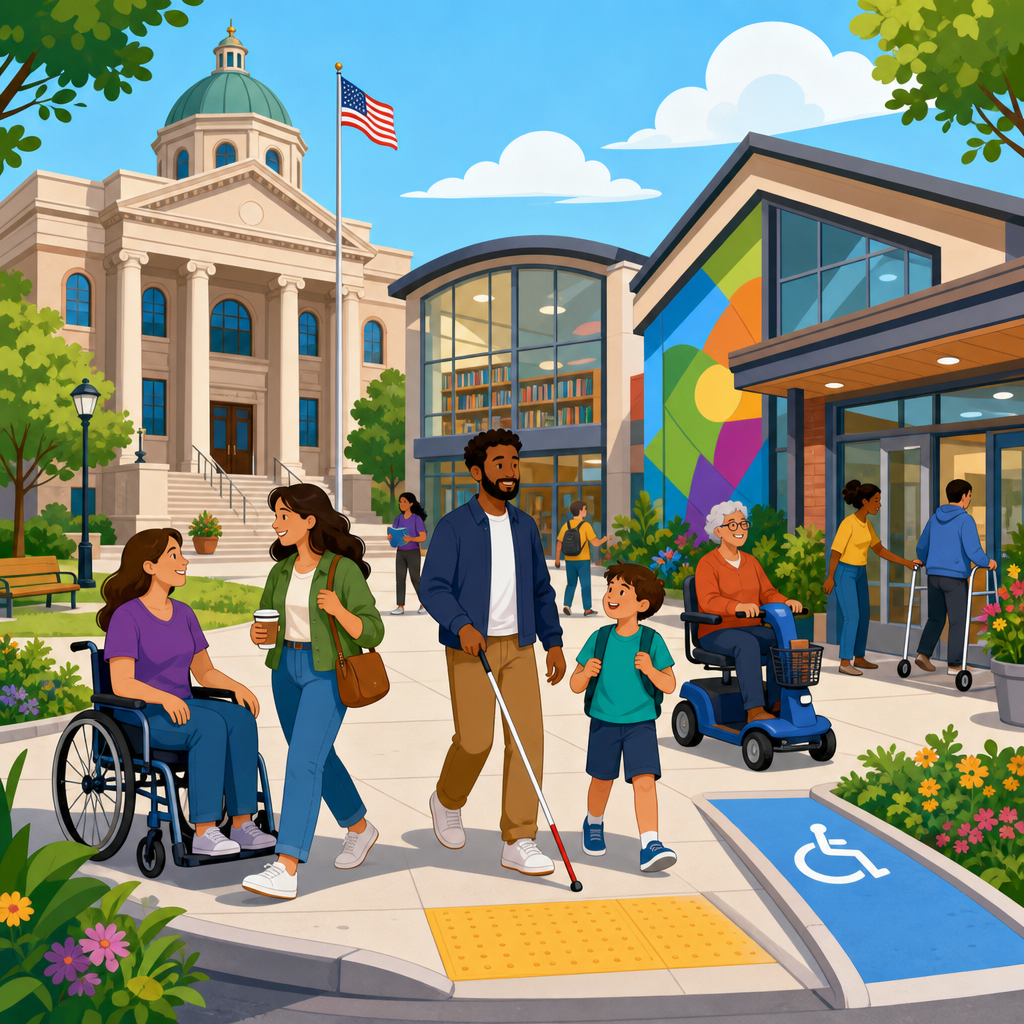
City halls, libraries, and community centers are among the most visible public facilities in any community, and they carry some of the clearest accessibility obligations under the Americans with Disabilities Act. When I audit municipal buildings, I start with a simple question: can a resident with a mobility, vision, hearing, cognitive, or speech disability use the facility independently, safely, and with dignity? That question frames this ADA guide for city halls, libraries, and community centers because compliance is not limited to ramps, signs, or parking stalls. It includes programs, policies, communication methods, digital services, emergency procedures, and maintenance practices that shape the daily experience of public participation.
For public spaces and government, the ADA works alongside Section 504 of the Rehabilitation Act, the 2010 ADA Standards for Accessible Design, and, in many cases, state and local building codes that incorporate ICC A117.1 accessibility criteria. Title II of the ADA applies to state and local government entities, including municipal buildings, public libraries, recreation centers, hearing rooms, permit counters, classrooms, and multipurpose spaces. The core rule is equal access to services, programs, and activities. That means a city cannot treat accessibility as a side project handled only during construction. If residents attend council meetings, apply for permits, borrow materials, use restrooms, reserve rooms, join classes, or access public computers, those touchpoints must be accessible in practice, not just on paper.
This matters because these facilities are civic gateways. City halls connect people to voting information, licensing, records, tax payments, and public comment. Libraries provide education, internet access, job support, research assistance, and community programming. Community centers host recreation, after-school events, public health services, senior activities, and emergency response operations. When accessibility breaks down, the impact is not abstract. Residents miss hearings, cannot complete forms, are excluded from classes, or rely on staff workarounds that compromise privacy and independence. A strong accessibility program reduces legal risk, but more importantly, it improves public trust, service reach, and operational consistency across the entire Public Spaces & Government environment.
What ADA compliance means in public facilities
ADA compliance for municipal and community facilities means providing both physical access and effective communication while operating programs in the most integrated setting appropriate. In practical terms, that includes accessible routes from site arrival points, compliant entrances, usable service counters, accessible restrooms, clear circulation space, assistive listening where required, readable signage, and policies that allow reasonable modifications unless they would fundamentally alter a program. I have seen buildings with excellent ramps but inaccessible public comment procedures, and newer libraries with compliant toilet rooms but websites that post scanned PDFs unreadable by screen readers. Both situations create barriers.
Program access is especially important for older buildings. Under Title II, not every existing facility must be made fully compliant in the same way a new building must meet current scoping and technical standards. However, the government entity must ensure that each service, program, or activity, when viewed in its entirety, is readily accessible to and usable by people with disabilities. That can involve structural changes, relocation of services to accessible spaces, reassignment of activities, or acquisition of equipment. Still, relying indefinitely on alternate arrangements is risky when permanent barrier removal is readily achievable within a capital planning cycle.
Municipal operators should distinguish among new construction, alterations, and existing conditions. New construction and altered areas generally must comply with the 2010 Standards. Existing elements may trigger barrier removal, program access review, or maintenance obligations. A common mistake is assuming grandfathered conditions excuse all upgrades. They do not. If a city renovates a hearing room, check accessible seating dispersion, witness stand access, assistive listening coverage, route widths, door maneuvering clearances, and speaking locations. If a library reconfigures stacks, maintain required clear floor space and turning space. If a community center adds self-service kiosks, evaluate reach ranges, tactile controls, screen reader compatibility, and speech output.
Key building elements for city halls, libraries, and community centers
The highest-risk physical barriers tend to appear at arrival, entry, service points, restrooms, and assembly spaces. Start outside. Accessible parking must include the correct number of van and standard spaces, access aisles, compliant slopes, proper signage, and an accessible route that does not force users behind parked cars or through loading zones. Curb ramps need detectable warnings where they enter vehicular ways, and route surfaces must be stable, firm, and slip resistant. In winter climates, snow removal plans matter as much as striping because blocked curb ramps and inaccessible routes create immediate noncompliance.
At entrances, verify door width, threshold height, opening force where applicable, hardware operability, and maneuvering clearances. Historic city halls often fail at heavy vestibule doors and steep entry walks. Libraries may have power-operated doors, but the activation buttons are frequently mounted too far from the door or into obstructed clear space. Once inside, service counters should offer an accessible transaction surface, and queuing paths should accommodate mobility devices. Public meeting rooms need wheelchair seating integrated with general seating, not isolated at the back. Stages or raised speaking platforms used for civic participation should have a compliant accessible route when they are part of the program.
Restrooms deserve line-by-line review because small dimensional errors produce major usability problems. Check turning space, toilet centerlines, grab bar placement, lavatory knee clearance, mirror height, dispenser reach, and door swing conflicts. In libraries and community centers, family or assisted-use toilet rooms can support caregivers and users who need additional privacy, but they do not replace required accessible fixtures in sex-segregated restrooms. Drinking fountains, bottle fillers, and public telephones, if provided, also require proper approach and operable parts. Signage should combine visual characters and Grade 2 Braille where required, with mounting locations that remain consistent throughout the building.
Program access, policies, and communication accommodations
Many ADA failures in government facilities are operational rather than architectural. Effective communication requires auxiliary aids and services when needed to ensure that communication with people with disabilities is as effective as communication with others. Depending on the context, that may include qualified sign language interpreters, CART captioning, assistive listening systems, large print, Braille, accessible electronic documents, plain-language materials, or staff assistance with forms. Public entities should have a clear request process, but they should not make it burdensome or require excessive notice when the need is predictable.
City council meetings, planning hearings, library lectures, and recreation classes all involve communication access. If a hearing room has an audio amplification system, assistive listening is generally required in assembly areas under the ADA Standards. For hybrid meetings, access extends to the virtual platform. Live captions, screen-reader-friendly agendas, and accessible registration forms are now baseline expectations. I recommend testing every public process from the resident’s perspective: finding the event online, requesting an accommodation, entering the building, hearing the discussion, making public comment, and receiving follow-up materials in an accessible format.
Service animal policies, mobility device use, and reasonable modification procedures should be documented and staff trained regularly. Libraries also need circulation and collection policies that support accessible formats and retrieval assistance without segregating patrons. Community centers should review membership rules, locker room procedures, and class participation criteria to avoid unnecessary eligibility barriers. The Department of Justice has repeatedly emphasized that staff behavior can either remove or create barriers. A compliant building still fails the public if front-desk staff refuse to read a form aloud, mishandle an interpreter request, or direct a wheelchair user to a freight entrance when the main entrance can be made accessible.
Digital access, documents, and self-service technology
For city halls, libraries, and community centers, digital accessibility is part of public access, not a separate IT issue. Residents now interact with government through websites, online calendars, permit applications, event registrations, room reservations, digital library platforms, and emergency announcements. If these systems are inaccessible, the program itself becomes inaccessible. The safest benchmark is conformance with WCAG 2.1 AA for web content, along with procurement requirements that evaluate vendor accessibility documentation, testing results, and remediation commitments before purchase or renewal.
Common failures include image-only PDFs, unlabeled form fields, low-contrast text, keyboard traps, inaccessible CAPTCHA, and video content without captions or transcripts. Public libraries face added complexity because they license third-party databases, e-book apps, and self-check systems. Community centers often use recreation management software that processes waivers, registrations, and payments. City halls may post minutes, budgets, zoning maps, and public notices in formats that screen readers cannot interpret. Accessibility must therefore be built into content workflows. Staff who upload agendas or flyers need training on heading structure, alt text, table markup, descriptive link text, and OCR verification.
| Facility Area | Common ADA Risk | Practical Fix |
|---|---|---|
| City hall meetings | No captions or assistive listening | Add CART, maintain hearing loop or receivers, publish accessible agendas |
| Library services | Inaccessible PDFs and self-check kiosks | Use tagged documents, test kiosks for speech output and reach ranges |
| Community center programs | Registration forms and waiver portals fail keyboard use | Require WCAG-based vendor remediation and manual testing before launch |
| Public counters | Counter too high or no writing surface | Provide accessible transaction section with clear floor space |
| Restrooms | Grab bars, clearances, or dispensers installed incorrectly | Audit dimensions against 2010 Standards and correct field conditions |
Self-service devices deserve special attention because they are increasingly common in public spaces and government workflows. Payment kiosks, visitor check-in tablets, catalog stations, printing systems, and room-booking screens must be reachable, understandable, and operable by users with varied disabilities. In procurement reviews, I ask vendors for a current accessibility conformance report, then verify key functions with real testing. A kiosk that technically supports speech output but hides the headphone jack or times out too quickly is still a barrier in practice. Build accessibility into contracts, acceptance testing, and service-level agreements.
Planning, auditing, and maintaining compliance over time
The most effective municipal accessibility programs treat ADA compliance as an ongoing management system. Start with a documented self-evaluation covering facilities, programs, communications, websites, emergency procedures, and procurement. Public entities with fifty or more employees are generally expected to designate at least one responsible employee to coordinate ADA efforts and adopt grievance procedures. A transition plan for physical barriers remains a best practice because it converts scattered deficiencies into a prioritized capital roadmap with budgets, deadlines, and named accountability. Without that structure, obvious barriers can persist for years while staff assume someone else is handling them.
Audits should combine plan review, field measurements, user-journey testing, and policy review. I typically map representative tasks such as attending a council meeting, obtaining a license, using a public computer, registering for a class, checking out materials, and evacuating during an alarm. This approach reveals barriers that isolated checklist reviews miss. For example, a compliant accessible entrance does not solve anything if the wayfinding to the hearing room lacks tactile signage, the registration table blocks circulation, and the speaker podium has no accessible route. Likewise, a library may have accessible workstations but no staff procedure for assisting patrons with inaccessible third-party databases.
Maintenance is nonnegotiable. Accessible features must remain operable. That includes repairing power doors, replacing Braille signs after renovations, restriping parking, recalibrating door closers, keeping accessible routes free of furniture, and preserving transfer space around fixtures. Temporary barriers count. I routinely see folded chairs stored in corridor clear widths, lobby displays blocking tactile signs, and recycling bins pushed into restroom maneuvering space. Training custodial, events, IT, and frontline teams is as important as training facilities staff because accessibility can be undone by everyday decisions. When municipalities embed checks into work orders, event setup guides, and procurement approvals, compliance becomes durable instead of reactive.
How this Public Spaces & Government hub should guide your next steps
This ADA guide for city halls, libraries, and community centers is the central reference point for the broader Public Spaces & Government topic because these facilities share the same fundamental duty: deliver civic services without disability-based barriers. The practical path is clear. Review governing standards, audit high-impact user journeys, fix physical barriers at arrival, entry, service, restroom, and assembly locations, strengthen communication access, and require accessible digital systems from every vendor and department. When municipalities do this well, compliance stops being a narrow facilities issue and becomes a service quality standard that improves resident participation across every program.
The biggest benefit is not merely avoiding complaints or enforcement. It is creating public spaces where more people can vote, learn, speak, work, gather, and receive services independently. In my experience, the strongest outcomes come when city managers, library directors, parks teams, clerks, IT staff, and facilities personnel share one accessibility playbook and review it regularly. Use this hub as your starting framework, then build site-specific checklists and action plans for each building and service. The sooner you identify barriers and assign fixes, the faster your public spaces become usable for everyone.
Frequently Asked Questions
What ADA requirements apply to city halls, libraries, and community centers?
City halls, libraries, and community centers are generally covered by Title II of the Americans with Disabilities Act because they are operated by state or local governments. That means these facilities must ensure that programs, services, and activities are accessible to people with disabilities, not just in theory, but in day-to-day use. In practice, compliance includes both the physical building and the way services are delivered. Entrances, parking, routes, restrooms, service counters, meeting rooms, reading areas, computer stations, elevators, signage, alarms, and emergency procedures all matter. So do communication accommodations such as auxiliary aids for people who are deaf, hard of hearing, blind, or have speech disabilities.
It is also important to understand that ADA obligations for public entities are broader than simply following a building code checklist. A city may have an older building that predates current standards, but if residents cannot effectively access essential government or community services, the municipality still has a legal duty to address those barriers. Depending on the situation, that can mean structural changes, policy adjustments, staff assistance, relocation of a program to an accessible area, or providing alternate methods of communication. Libraries and community centers must likewise ensure that public programs, classes, events, and civic participation opportunities are available to people with disabilities in an integrated and equitable way.
How can municipal buildings evaluate whether they are truly accessible?
The most effective approach is to look beyond minimum technical compliance and assess whether a resident with a mobility, vision, hearing, cognitive, or speech disability can use the building independently, safely, and with dignity. Start with the full visitor journey: arriving by car, paratransit, public transit, or on foot; locating an accessible entrance; opening doors; navigating hallways and elevators; finding restrooms; reaching service desks; participating in meetings or events; and exiting during an emergency. Accessibility problems often show up in transitions between spaces, not just in isolated features. For example, a compliant parking space does little good if the curb ramp is missing, the entrance has heavy manual doors, or the check-in counter is too high to use.
A strong evaluation should include a facility audit, staff interviews, policy review, and real-world usability testing. Auditors typically review parking, exterior routes, ramps, door hardware, interior circulation, accessible seating, toilet rooms, signage, acoustics, lighting, service counters, and emergency notification systems. They also examine operational issues such as how accommodation requests are handled, whether assistive listening systems are maintained, whether accessible entrances are kept unlocked during public hours, and whether temporary barriers like furniture or storage block routes. Municipalities should document barriers, prioritize corrections based on risk and program impact, and create a phased transition plan where needed. Involving people with disabilities in the review process often reveals practical issues that are easy to miss in a purely technical inspection.
Are older city halls and historic public buildings exempt from ADA compliance?
No. Older and historic public buildings are not exempt from ADA responsibilities simply because they were built before modern accessibility standards. Public entities still must provide access to programs, services, and activities. However, the way they achieve accessibility may vary depending on the building’s age, structural limitations, and historic significance. In a historic city hall, for example, the solution may involve carefully designed modifications that preserve important architectural features while improving access. If a full structural alteration would threaten or destroy historic significance, the city may need to use alternative methods, but those alternatives still must provide meaningful access to the public service involved.
That distinction is critical. The ADA does not allow a municipality to point to age or historic character as a blanket reason for inaccessibility. If residents cannot attend public meetings, pay bills, apply for permits, use records services, or participate in civic processes because of access barriers, the city must take action. Sometimes that means installing ramps, lifts, accessible door hardware, signage, or restroom upgrades. Other times it may mean relocating a public-facing service to an accessible floor or room, offering equivalent services in an accessible location, or improving digital and communication access while longer-term renovations are planned. The key question is whether people with disabilities can actually use the service in a comparable and dignified way, not whether the building is old enough to avoid responsibility.
What accessibility features are most often overlooked in libraries and community centers?
Many facilities focus on obvious items like ramps and accessible parking but overlook features that strongly affect independent use. In libraries, common problem areas include shelving layouts that create narrow paths, self-checkout stations with screens or controls that are difficult to reach or use nonvisually, public computers without assistive technology, inaccessible study rooms, and event spaces without wheelchair seating integration or assistive listening systems. In community centers, issues often include inaccessible registration counters, poor wayfinding, doors with excessive opening force, multipurpose rooms packed with movable furniture, inaccessible stages or speaking areas, and locker rooms or restrooms that technically exist but are difficult to use in practice.
Communication access is another area that is frequently underestimated. A building may have an accessible entrance but still exclude patrons if meeting announcements are only posted visually, staff do not know how to arrange interpreters or captioning, alarms rely only on sound, or printed materials are not available in accessible formats when needed. Cognitive accessibility also matters. Clear signage, plain-language directions, consistent room numbering, good lighting, and intuitive layouts can make a major difference for visitors with intellectual, developmental, neurological, or memory-related disabilities. The best facilities treat accessibility as part of the overall user experience, not as a narrow construction issue. That means checking how spaces function during real classes, public meetings, youth programs, performances, computer sessions, and community events.
What should city leaders do if their facility is not fully ADA compliant?
The first step is not to wait for a complaint. If barriers are identified, city leaders should document them, assess how they affect access to public programs, and begin a prioritized corrective action plan. Issues that block access to core services, emergency egress, public meetings, voting-related functions, restrooms, or primary entrances should typically move to the front of the list. Some fixes are low-cost and operational, such as adjusting furniture layouts, repairing door closers, replacing inaccessible hardware, improving signage, keeping accessible routes clear, retraining staff, or changing how services are delivered. Other issues may require capital planning, design work, and phased renovation.
Municipalities should also review their ADA policies, designate responsible personnel, and make it easy for residents to request accommodations or report barriers. A well-managed response includes clear timelines, budget planning, communication with the public, and follow-through. If a barrier cannot be removed immediately, the city should provide an effective interim solution rather than simply acknowledging the problem. For example, if an upper-floor meeting room is inaccessible, move the meeting to an accessible location now while longer-term building improvements are developed. The most defensible and community-centered approach is proactive: conduct regular audits, maintain accessibility features, train frontline staff, and treat accessibility as an ongoing public service obligation. That not only reduces legal risk, but also builds trust and ensures that all residents can participate fully in civic and community life.