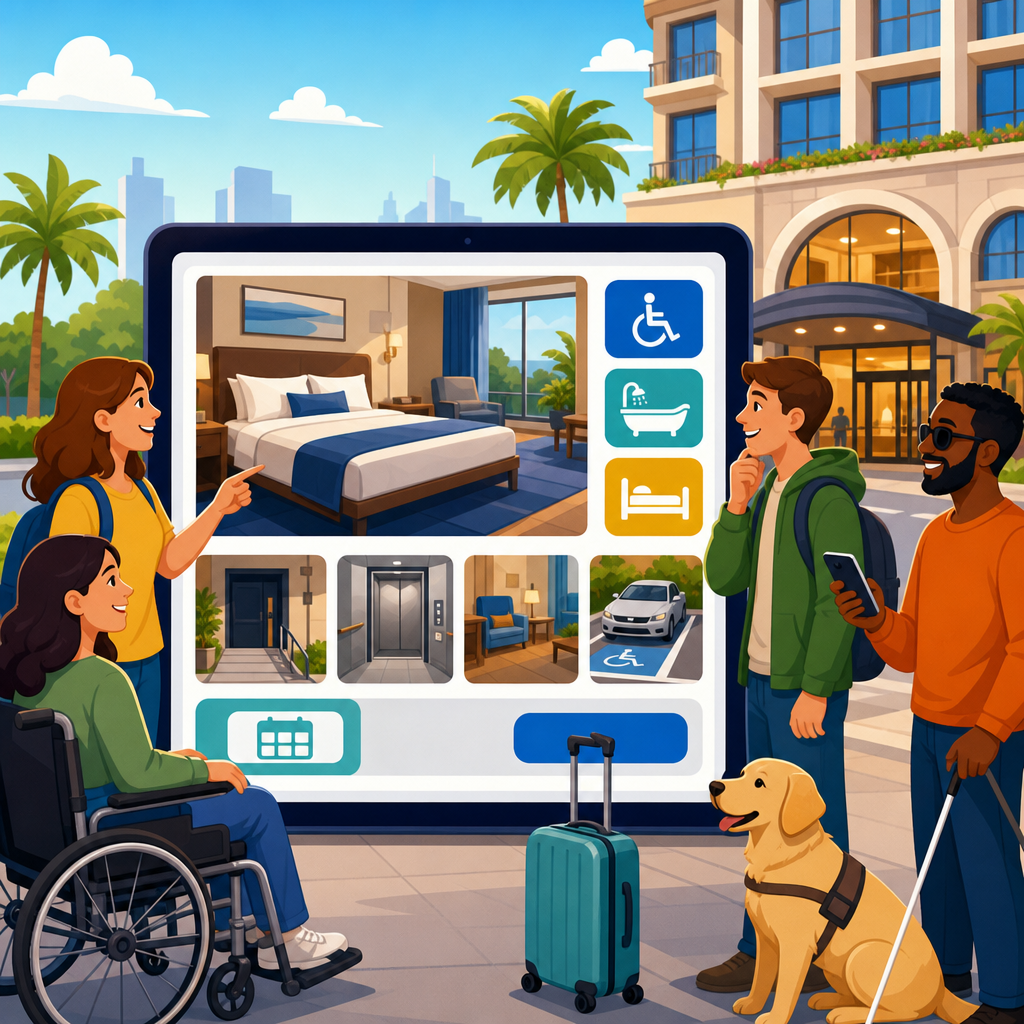
Hotel reservation accessibility determines whether travelers with disabilities can independently find room information, compare options, request needed features, and complete a booking without barriers. In hospitality, accessibility is not limited to ramps, elevators, or compliant guest rooms. It includes the full reservation journey: website navigation, mobile usability, accurate room descriptions, booking engine forms, phone support, confirmation messages, and post-booking communication. When any part of that journey fails, guests lose time, confidence, and in many cases equal access to travel.
For hotels, resorts, inns, and vacation properties, this topic matters because reservations are the commercial front door. If a guest cannot tell whether a roll-in shower is actually available, whether a hearing-accessible room includes visual alarms, or whether online forms work with a screen reader, the property has already created friction before arrival. In my work reviewing lodging websites and booking flows, the most common failure is not the absence of accessibility features on-site. It is the absence of clear, searchable, bookable information about those features.
Accessibility in reservations generally means that guests must be able to do three things. First, they must be able to find accessibility information easily, without digging through PDFs or calling multiple departments. Second, they must be able to understand the information because the descriptions are specific, complete, and consistent across the website, third-party listings, and confirmations. Third, they must be able to reserve accessible rooms and services with substantially equivalent convenience to other guests. That standard is practical, measurable, and closely aligned with recognized expectations for digital accessibility and nondiscriminatory lodging practices.
As a hub page for hospitality and food service accessibility guidance, this article focuses on hotel reservations because they affect every downstream service, from dining access and transportation to check-in and emergency procedures. A strong reservation experience reduces complaints, abandoned bookings, and front-desk conflict. More importantly, it respects guests as customers who should not have to negotiate for basic information. The sections below explain what guests must be able to find and book, where hotels typically fail, and how hospitality teams can build a reservation process that works in real situations.
What hotel guests must be able to find before they book
Guests need enough information to decide whether a property meets their access needs without making assumptions. At minimum, that includes accessible entrance routes, parking details, elevator availability, service animal policies, public-area access, and room-specific features. For guest rooms, the information must go beyond a generic accessible label. Travelers need to know bed height when relevant, clear floor space, bathtub versus roll-in shower, presence of grab bars, toilet height, handheld showerhead, visual notification devices, closed-caption-capable televisions, accessible door hardware, and whether there is an accessible route to the room itself.
Plain language is essential. “ADA room” is not a sufficient description because it tells a guest almost nothing about usability. A wheelchair user may need a true roll-in shower, while another guest may prioritize a transfer shower and lower closet rods. A Deaf traveler may need visible alarms and notification devices for the door and phone. A guest with low vision may need strong contrast, tactile controls, and an uncluttered path of travel. If the booking page does not specify these features, the guest cannot make an informed decision.
Searchability matters as much as content. Accessibility details should be available from the main navigation, room pages, FAQs, and booking engine, not buried in a compliance statement. The information should also be machine-readable where possible so that search engines, maps, and travel assistants can surface it accurately. Hotels that publish detailed room attributes often see fewer calls because guests can self-qualify the property. That is efficient for staff and far less stressful for travelers planning around mobility devices, medication schedules, or personal care support.
What guests must be able to book directly and independently
Guests must be able to reserve accessible rooms during the same booking process used for standard rooms, assuming those rooms are available. The core principle is equivalent convenience. If standard rooms can be booked online in minutes, accessible rooms should not require a separate phone call, a manual request form, or a wait for staff approval. Holding accessible inventory outside the main booking flow often creates uncertainty and can expose the hotel to complaints because the guest cannot tell what is actually available in real time.
Independence is especially important. Many travelers do not want to disclose medical details just to reserve a room with needed features. A booking engine should allow a guest to filter for accessibility features, view accurate room types, compare rates, and complete payment without assistance. Any required forms must work with keyboard navigation, screen readers, voice input, zoom, and mobile devices. Error messages should be programmatically associated with fields and explained clearly. Timeouts should be adjustable or long enough to avoid forcing a rushed purchase.
Reservation systems also need to preserve the guest’s selected accessibility features through confirmation and property management workflows. One common operational failure is that the booking engine displays an accessible room correctly, but the confirmation email strips the details, or the property management system abbreviates the room type so front-desk staff miss the distinction. That gap creates preventable service failures at check-in. The selected accessible room and any related request should remain visible from the website cart through confirmation, pre-arrival messaging, and front-desk assignment screens.
Core reservation information hotels should publish
| Information area | What guests need to know | Good example | Common failure |
|---|---|---|---|
| Accessible room type | Specific room name and whether it is mobility or hearing accessible | “King Room, Mobility Accessible, Roll-In Shower” | Labeling every option only as “Accessible Room” |
| Bathroom features | Roll-in shower, transfer shower, tub, grab bars, seat, handheld sprayer | Full bathroom feature list on room page | No bathroom detail until after booking |
| Communication features | Visual alarms, notification devices, caption-capable TV, TTY availability if applicable | Listed under room amenities and hotel policies | Assuming hearing access is implied but never stated |
| Property access | Accessible parking, route from entrance, elevator, restaurant and pool access | Dedicated accessibility page linked from booking flow | Only describing guestrooms and not shared spaces |
| Booking support | Accessible phone, email, or chat assistance when needed | Support options with response times and relay-friendly language | Posting a number that goes unanswered after hours |
This information should appear consistently across direct channels and distribution partners. If a brand site says a room has a roll-in shower but an online travel agency uses older data showing a bathtub, the guest has to choose which source to trust. In practice, they often leave. Consistency requires disciplined content management between the central reservation system, property management system, channel manager, and third-party listings.
Digital accessibility requirements in the booking journey
The reservation path must be usable with assistive technology from start to finish. That means semantic headings, clear form labels, sufficient color contrast, visible focus indicators, descriptive link text, keyboard operability, and alt text for meaningful images. Booking engines often fail on interactive calendars, rate comparison widgets, modal windows, and CAPTCHA tools. I routinely see date pickers that trap keyboard users, pop-ups that are not announced to screen readers, and session timers that erase progress without warning.
Hotels should test booking flows against recognized web accessibility standards and with real assistive technologies. Automated scanners such as axe, WAVE, and Lighthouse are useful for catching obvious issues, but they do not replace manual testing. A practical test set includes keyboard-only navigation, NVDA with Firefox, JAWS with Chrome, VoiceOver on iPhone Safari, and zoom at 200 percent. On mobile, touch target size and orientation flexibility matter because many guests complete bookings on phones while traveling.
Accessibility extends to content assets around the booking process. PDFs for meeting packages, restaurant menus, spa policies, and parking instructions should be tagged properly or replaced with accessible web pages. Videos should include captions. Maps should have text alternatives describing entrances and routes. If the booking engine uses third-party widgets for chat, loyalty enrollment, or payment, those vendors must also be evaluated. A hotel cannot create an accessible front page and then hand the guest to an inaccessible checkout.
Operational accuracy: inventory, confirmations, and staff handoff
Accurate accessibility content is worthless if inventory controls are weak. Hotels must manage accessible room inventory carefully so those rooms remain available to guests who need them until standard release rules apply. Overbooking, room moves for convenience, or assigning accessible rooms to other guests without necessity can trigger serious failures. The goal is not just to sell the room. It is to preserve the promised features and ensure the room is ready, inspected, and not blocked by housekeeping carts, maintenance equipment, or misplaced furniture.
Confirmation messages should restate the booked room type and any confirmed access features in unambiguous language. A vague email saying “special request noted” is not enough when the guest selected a mobility-accessible king with roll-in shower. Pre-arrival communication should give guests a direct path to verify details without repeating their needs to multiple agents. Good systems also flag key information for front desk, housekeeping, engineering, and food and beverage teams when relevant, such as refrigerator needs for medication or reachable dining seating preferences.
Training is part of reservation accessibility. Agents need to understand the difference between hearing-accessible and mobility-accessible rooms, know the actual property layout, and avoid making promises based on guesswork. I have seen well-meaning staff describe a shower as roll-in when it had a raised lip, which can make the room unusable for some guests. A property-specific access reference, updated with photos and measurements where appropriate, helps staff answer accurately and consistently.
Hospitality and food service touchpoints beyond the room
Because this page anchors hospitality and food service guidance, reservation accessibility must cover more than sleeping rooms. Guests often need to know whether breakfast areas have accessible routes, whether bars have lowered service points or table service options, whether banquet rooms can be reached without stairs, and whether room service ordering works by phone and digitally. If a resort requires shuttle transport between lodging, dining, and recreation, the reservation experience should disclose accessible vehicle availability and any advance notice requirements.
Restaurants inside hotels create another layer of access planning. A traveler may choose a property based on the ability to dine on-site without navigating steep streets or inaccessible neighborhood options. Reservation content should note whether menus are available in accessible digital formats, whether allergens can be discussed before arrival, and whether there are quiet seating options for neurodivergent guests when feasible. None of these details replace compliance obligations, but they materially affect whether a guest can use the property with dignity and confidence.
Events and group bookings need the same rigor. Wedding blocks, conferences, and tour operators often reserve room allotments without preserving enough accessible inventory or without communicating access features to attendees. The fix is process discipline: identify accessible room demand early, map room types accurately in the contract, publish request deadlines, and confirm shared-space access for meals, registration desks, stages, and restrooms. Hospitality succeeds when accessibility is treated as standard operating procedure, not a last-minute accommodation conversation.
How hotels can improve and what guests should look for
Hotels improve reservation accessibility fastest when they audit the full guest journey, not just the website homepage. Start with accessibility content, then test discovery, filtering, booking, confirmation, modification, cancellation, and pre-arrival communication. Review direct channels and third-party listings side by side. Check whether staff scripts match on-site reality. Measure call drivers related to accessible rooms because repeated questions usually point to missing or unclear content. Then assign ownership across marketing, revenue management, operations, and IT, since reservation accessibility crosses all four functions.
Guests evaluating a property should look for specificity, consistency, and independence. Specificity means detailed room and bathroom features, not generic labels. Consistency means the same descriptions appear on the website, booking engine, and confirmation. Independence means the guest can complete the reservation without special handling unless they choose to ask for help. When those three signals are present, the hotel is usually operating from a mature accessibility process rather than improvising one booking at a time.
For hospitality brands, the benefit is straightforward: better access information produces better bookings. Guests arrive with realistic expectations, staff spend less time repairing preventable errors, and properties build trust that supports repeat stays and positive reviews. If you manage hotels or food service operations, review your reservation journey now, publish precise accessibility details, and make every essential feature searchable, understandable, and bookable.
Frequently Asked Questions
What does hotel reservation accessibility actually include?
Hotel reservation accessibility covers the entire process a guest uses to research, choose, and book a stay, not just the physical accessibility features available at the property. A guest with a disability must be able to independently navigate the hotel’s website or app, understand room options, identify accessibility features, compare rates, complete forms, submit requests, receive confirmations, and communicate with the hotel before arrival. If any part of that process creates a barrier, the reservation experience is not fully accessible.
In practical terms, this means the booking experience should work for guests who use screen readers, keyboard navigation, voice control, magnification tools, captions, or other assistive technology. Room descriptions should clearly explain features such as roll-in showers, tub grab bars, bed height, doorway width, visual alarms, hearing-accessible devices, elevator access, and accessible parking. Booking forms should have properly labeled fields, clear error messages, and enough time to complete each step. Confirmation emails and follow-up communication should also be readable and usable, so guests can verify what they booked and contact the hotel if they need clarification. Accessibility is about giving guests reliable information and a usable path to complete the reservation with confidence.
Why are accurate room descriptions so important in accessible hotel reservations?
Accurate room descriptions are essential because travelers with disabilities often depend on specific features that directly affect whether a room will work for them. General phrases like “accessible room available” are usually not enough. Guests need to know what is actually accessible in that room and in the surrounding areas of the property. For example, a guest may need a roll-in shower rather than a tub with grab bars, a visual notification device for the door and phone, step-free access from parking to check-in, or enough turning space for a wheelchair. Without clear details, the guest may be forced to call for basic information or may book a room that does not meet their needs.
Detailed and truthful descriptions also reduce confusion, complaints, and last-minute problems for the hotel. When hotels explain accessibility features clearly at the point of reservation, guests can make informed decisions without guessing. Good descriptions should identify the exact accessible elements in the room, specify whether accessibility features are guaranteed in that room type, and explain any limits that could affect use, such as whether only certain floors are elevator-served or whether the bathroom layout varies by room. This level of transparency supports independent booking and helps build trust, which is especially important for guests who cannot risk arriving to discover that the room is unusable for them.
What barriers commonly prevent guests with disabilities from completing a hotel booking online?
Many accessibility barriers appear in the digital reservation process long before a guest reaches the hotel. Common problems include menus that cannot be accessed by keyboard, buttons that are not labeled for screen readers, poor color contrast, text that cannot be resized, images with no meaningful alternative text, and booking calendars that are difficult or impossible to use with assistive technology. Guests may also encounter forms that time out too quickly, error messages that do not explain what needs to be fixed, pop-ups that trap keyboard focus, or CAPTCHA tools that are inaccessible without an alternative option. On mobile devices, small touch targets, inconsistent layouts, and gestures that require fine motor control can create additional obstacles.
Another major barrier is missing or scattered accessibility information. Even if the booking engine technically works, guests may still be unable to complete a reservation independently if they cannot easily find which rooms have which features, whether those features can be selected during booking, or how to request accommodations. Inaccessible PDFs, uncaptioned videos, poorly formatted confirmation emails, and phone numbers that are difficult to locate or use can all interrupt the reservation journey. A truly accessible booking experience removes these points of friction so guests can move from search to confirmation without needing extra help for tasks other travelers can complete on their own.
How should hotels handle requests for accessible features during the reservation process?
Hotels should make the request process clear, easy to use, and integrated into the booking experience rather than treating it as an afterthought. Guests should be able to identify accessible room types and features while browsing availability, not only after payment or only by calling the property. If the hotel offers mobility-accessible rooms, hearing-accessible rooms, or other accessible configurations, those options should be visible during selection and described in plain language. If additional features can be requested, such as a shower chair, visual alert device, lowered bed, or refrigerator for medication, the request process should explain what can be provided, how to ask for it, and whether it is guaranteed or subject to availability.
After the booking is made, hotels should confirm accessible requests in writing and provide a reliable contact method for follow-up. Confirmation messages should restate the room type selected and list any requested accessibility features or accommodations so the guest has a clear record. Staff should be trained to review these requests carefully, avoid vague assurances, and communicate proactively if clarification is needed. This matters because guests are often coordinating transportation, medical equipment, service animals, or personal assistance around the room they reserved. A well-designed reservation process does more than collect requests; it helps ensure that the information is documented accurately and carried through to arrival.
What should guests be able to do independently when a hotel reservation system is accessible?
When a hotel reservation system is accessible, guests with disabilities should be able to complete the same essential tasks as any other traveler without unnecessary barriers or special intervention. That includes searching dates, reviewing rates, comparing room types, understanding accessibility features, selecting the room that matches their needs, entering personal and payment information, requesting additional accommodations, and receiving a usable confirmation. They should also be able to access customer support if needed, but support should not be the only path to complete a booking that could otherwise be done online.
Independence is a key measure of whether reservation accessibility is working. Guests should not have to rely on guesswork, repeated phone calls, or third-party assistance to find out whether a room has the features they need. They should be able to trust the information presented, use the website or mobile booking engine with assistive technology, and understand what will happen next after the reservation is submitted. Post-booking communication should remain accessible as well, including confirmation emails, modification options, cancellation details, check-in instructions, and pre-arrival messages. When hotels support this full journey, they are not only improving compliance and usability, but also delivering the dignity, predictability, and equal access that accessible hospitality requires.