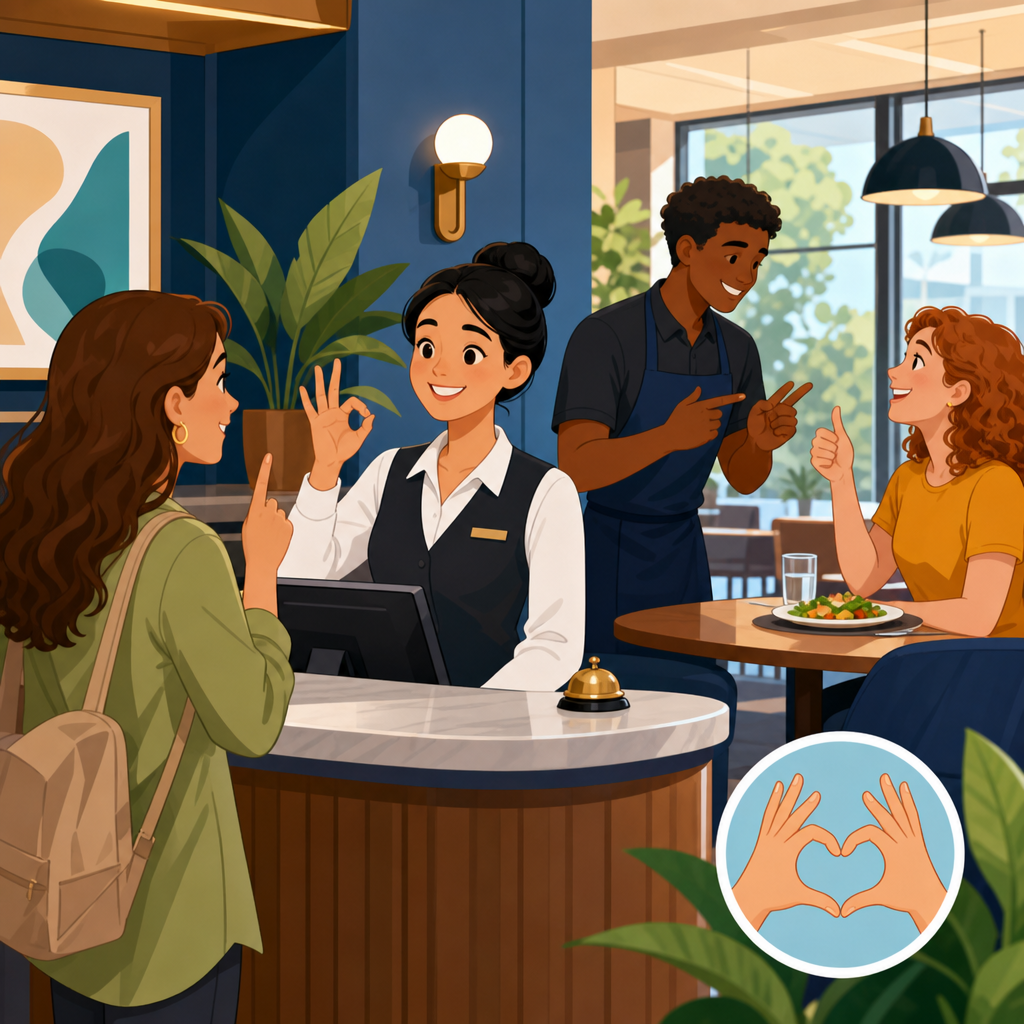
Effective communication for deaf guests in lodging and food service is a core hospitality skill, not a niche accommodation, because every stay, meal, check-in, safety briefing, and payment interaction depends on clear exchange of information. In practical terms, deaf guests include people who are culturally Deaf and use sign language, hard of hearing travelers who rely on hearing aids or cochlear implants, late-deafened adults who prefer speechreading, and guests with fluctuating hearing loss who need communication support in noisy spaces. Hospitality and food service covers hotels, resorts, vacation rentals, restaurants, bars, cafés, catering venues, room service, banquets, and event operations. I have worked with front desk teams, restaurant managers, and service staff on access planning, and the same lesson repeats: communication breakdowns usually happen in routine moments, not unusual emergencies. A missed wake-up call, an unheard table announcement, or unclear allergy discussion can damage trust faster than a delayed check-in. This matters for guest satisfaction, legal compliance, reputation, and revenue. It also matters because accessible service improves operations for everyone. When staff use visual confirmations, plain language, and predictable service steps, all guests benefit, including nonnative speakers, older adults, and tired business travelers.
For this hub page, the goal is to explain what effective communication looks like across the full hospitality and food service journey, from reservation to departure, and from menu review to payment. The essential principle is simple: do not force one communication method. Ask the guest’s preference, confirm understanding, and provide information in more than one format. In the United States, the Americans with Disabilities Act sets a baseline expectation for effective communication in public accommodations, while many global operators also align practices with local disability law and accessibility standards. Compliance matters, but operational competence matters more. A property can technically own assistive devices and still fail a guest if staff do not know when to offer them, how to explain options, or how to document needs between shifts. The strongest hospitality programs build communication access into training, service design, procurement, signage, digital systems, and emergency planning, so access is reliable instead of improvised.
What effective communication means in hotels and accommodations
In lodging, effective communication means that a deaf guest can independently receive the same essential information as any other guest, at the same time, with comparable accuracy and privacy. At check-in, that includes reservation details, rates, incidental holds, breakfast hours, Wi-Fi instructions, parking rules, amenity access, and emergency procedures. During the stay, it includes housekeeping coordination, maintenance visits, room changes, wake-up alternatives, package delivery notices, and evacuation alerts. At checkout, it includes folio review, dispute resolution, and transportation coordination. I have seen properties solve most friction by standardizing a small set of habits: greeting the guest face to face, keeping hands away from the mouth, using a screen or notepad for key details, confirming room numbers visually, and never shouting as a substitute for clarity. Shouting does not improve speechreading and often makes communication worse.
Hotels should also separate communication access from assumptions about technology. Not every deaf traveler uses sign language, and not every hard of hearing guest wants amplification. Some prefer texting, some prefer a pen and paper, some prefer typed chat at the front desk, and some want a qualified sign language interpreter for complex discussions. Good hotels ask, “What is the best way to communicate with you during your stay?” and then record that preference in the property management system so every department can act on it. If the guest needs visual alerting devices for door knocks, phone calls, or alarms, those should be offered proactively when available and installed before arrival whenever possible. Access that appears only after repeated requests is poor service.
Front desk, reservations, and pre-arrival planning
The reservation stage is where many access failures begin, because communication needs are not collected clearly or transmitted reliably. Booking engines should include an open text field for accessibility requests and a visible contact option beyond voice calls, such as email, SMS, or web chat. Third-party travel agency listings should state how to request accessible communication support, since many guests never visit the hotel’s own website before arrival. Reservation agents need scripts that distinguish room accessibility features from communication access. A roll-in shower request is not the same as a visual alarm request, and both may be needed. Agents should confirm the exact support requested, repeat it back in writing, and add notes that operational teams will actually see.
Pre-arrival communication is the best time to remove uncertainty. A short email or message before check-in can confirm transportation instructions, check-in hours, visual alert device availability, breakfast format, and the easiest way to contact the property on arrival. This is especially important in resorts, large conference hotels, and airport properties where wayfinding is complex. If a shuttle pickup requires hearing a verbal announcement, the process is inaccessible unless an equivalent visual or text-based method exists. In my experience, teams that map the guest journey before arrival identify hidden barriers quickly, such as intercom-only gates, phone-only late check-in procedures, or valet desks that call names aloud without visual display.
Restaurant communication, menus, and order accuracy
In food service, effective communication is measured by order accuracy, pace, safety, and dignity. A deaf guest should be able to review the menu, ask questions, communicate allergies, understand specials, and receive the correct bill without relying on companions to interpret. Restaurants often fail here because the environment is noisy, lighting is poor, and service scripts assume hearing. The easiest improvements are operational: seat guests in well-lit areas when requested, face the guest when speaking, provide printed or digital specials instead of reciting them only once, and use handheld order confirmation when needed. If the kitchen eighty-sixes an item, the replacement conversation should happen directly with the guest in a visible, calm way, not shouted from a distance.
Menus deserve special attention because they are a communication tool, not just a design object. Plain-language descriptions, clear ingredient labeling, and standardized allergy protocols help deaf guests ask precise questions and reduce back-and-forth. Quick-service counters and coffee shops should display order status visually rather than only calling names. Number systems, text alerts, or screen-based pickup queues work well and also reduce crowding. In full-service dining, servers should know how to pause naturally while a guest reads lips or types a question, and they should confirm modifiers one by one for complex orders. That extra thirty seconds prevents remakes, refunds, and safety incidents.
Tools, accommodations, and when to use each option
Hospitality managers often ask which tools matter most. The answer depends on the interaction, but several options consistently deliver value when staff know how to use them.
| Tool or practice | Best use in hospitality | Operational note |
|---|---|---|
| Text chat or SMS | Pre-arrival questions, housekeeping requests, late check-in updates | Use secure, monitored channels with response time standards |
| Pen and paper or typed notes | Quick front desk exchanges, maintenance visits, billing clarification | Reliable backup when technology fails |
| Visual alerting devices | Door knocks, phone signals, alarm notifications in guestrooms | Test before arrival and document deployment |
| Captioned television and media | Guestroom entertainment, bar screens, conference content | Keep captions enabled where appropriate and staff trained |
| Qualified interpreter or remote interpreting | Complex, lengthy, sensitive, or high-stakes conversations | Do not rely on companions for legal, medical, or dispute matters |
| Digital order displays | Quick-service pickup, café queues, banquet stations | Improves speed and reduces missed calls for all guests |
No single tool solves every situation. Remote interpreting can be excellent for a detailed complaint resolution or event briefing, but it is unnecessary for simple directions if typed communication works. Visual alarm systems are essential in sleeping rooms, yet they do nothing for a noisy breakfast buffet where staff only announce table readiness verbally. The best programs match the accommodation to the task and train managers on escalation: simple exchange first, richer support for complex matters, and immediate access solutions during emergencies.
Staff training, service standards, and culture
Training is where policies become actual guest experience. Staff do not need to be fluent in sign language to provide strong service, but they do need a repeatable service standard. I recommend training every department on five basics: gain attention appropriately with a wave or gentle visual cue, face the guest in good light, speak naturally without exaggeration, confirm key details in writing, and ask for the guest’s preferred communication method. Then add role-specific practice. Front desk agents should rehearse check-in and payment clarification. Servers should practice allergy conversations and order confirmation. Housekeeping should know how to enter a room respectfully when a guest may not hear a knock. Security should know how to communicate during incidents without escalating fear.
Culture matters as much as technique. When managers treat access as an exception, line staff become hesitant and guests feel like a burden. When managers treat accessible communication as standard service quality, staff adapt quickly. Mystery shops, service recovery reviews, and onboarding checklists should include communication access scenarios. Properties with strong results usually have one operational owner, often the rooms division manager or guest experience leader, who audits devices, updates procedures, and tracks complaints or compliments related to access. What gets measured improves.
Safety, emergencies, events, and group service
Emergency communication is the area where accessible design cannot be optional. Deaf guests must be able to receive evacuation instructions, shelter guidance, and urgent room notifications without depending on luck or another guest. In lodging, that means functioning visual alarms in accessible rooms, staff procedures for knocking and entering during emergencies, and documented plans for communicating route changes or all-clear messages. In restaurants and event venues, managers need visual methods for announcing closures, severe weather procedures, or evacuation routes. A PA system alone is insufficient if critical safety information is audio only.
Meetings, banquets, weddings, and conferences introduce additional complexity because communication extends beyond one-to-one service. Registration desks should support text-based questions, event apps should carry schedule changes in writing, and audiovisual teams should be prepared for captions on presentations and videos. If interpreters are requested, sightlines matter. A brilliantly qualified interpreter placed behind a pillar is functionally useless. Banquet service also needs coordination so timing cues are not delivered only verbally to deaf attendees. I have seen conference teams fix this with simple production run sheets, caption checks before doors open, and a single communications lead who ensures changes reach interpreters, front-of-house staff, and the guest simultaneously.
Technology, complaints, and building a reliable access program
Technology can greatly improve communication, but only when properties choose tools that fit operations. Property management systems should store communication preferences in a way that appears at check-in and on service dashboards. Customer relationship tools can trigger pre-arrival messages and document completed accommodations. Restaurants can use QR menus, kiosk ordering, and visual pickup boards, but those tools must be usable, maintained, and backed by staff support. Broken tablets, unmonitored messaging numbers, and inaccessible apps create false confidence. The operational question is not “Do we have technology?” but “Can a guest use it successfully at the moment it matters?”
Complaint handling is another test of competence. If a deaf guest reports a service failure, move quickly to the guest’s preferred communication channel, document facts clearly, and resolve the issue without making the guest repeat the problem to multiple employees. Service recovery may involve correcting charges, replacing inaccessible equipment, retraining staff, or revising a procedure that caused the breakdown. The strongest organizations analyze patterns. If several guests miss room service calls, the issue is not individual confusion; it is a flawed process. If pickup names are repeatedly missed at a café, implement a visual queue. Durable improvement comes from fixing systems, not apologizing better.
Effective communication for deaf guests in hospitality and food service comes down to preparation, flexibility, and execution. Hotels, restaurants, bars, cafés, resorts, and event venues do not need perfect conditions to deliver accessible service, but they do need consistent standards across reservations, arrival, dining, guestroom service, events, and emergencies. Ask each guest how they prefer to communicate. Provide information visually as well as verbally. Match the accommodation to the task, from simple note writing to qualified interpreting for complex situations. Train every department, test every device, and remove hidden barriers in booking, wayfinding, ordering, and safety procedures.
As the hub for Hospitality & Food Service within Industry-Specific Guides, this article establishes the operating model that supporting pages can explore in detail, including hotel front desk protocols, accessible restaurant ordering, banquet and event communication, and emergency planning for deaf guests. The main benefit is straightforward: when communication is clear, guests are safer, more independent, and more likely to return, while operators reduce errors, complaints, and reputational risk. Review your current guest journey this week, identify three moments where service depends on hearing, and redesign those moments with visual, written, or interpreted alternatives. That is how accessible hospitality becomes dependable hospitality.
Frequently Asked Questions
Why is effective communication with deaf guests considered a core hospitality skill rather than a special accommodation?
Effective communication with deaf guests is a basic hospitality competency because nearly every part of the guest experience depends on exchanging accurate information. From making a reservation and confirming arrival details to explaining room features, reviewing menu options, discussing allergens, handling payment, and sharing emergency procedures, communication affects safety, comfort, and service quality. Treating deaf communication needs as rare or optional creates unnecessary barriers in interactions that are routine for every hotel, restaurant, café, bar, or catering environment.
It is also important to remember that deaf guests are not a single, uniform group. Some are culturally Deaf and primarily use sign language. Others are hard of hearing and may use hearing aids or cochlear implants. Some guests are late-deafened and rely more on speechreading, written communication, or captioning. Others may have fluctuating hearing loss and need flexibility depending on the setting, background noise, lighting, and fatigue level. Because communication preferences vary, staff should avoid assumptions and instead ask, politely and directly, what method works best for the guest.
When hospitality teams approach communication access as part of standard service, they reduce misunderstandings, improve guest satisfaction, and strengthen trust. A clear, respectful exchange can prevent errors in room assignments, meal preparation, wake-up requests, transportation arrangements, billing questions, and safety instructions. In short, effective communication with deaf guests is not an extra courtesy layered onto hospitality; it is one of the skills that defines good hospitality in the first place.
What are the best communication methods staff can use when assisting deaf or hard of hearing guests?
The best method is the one the guest prefers, which is why the first step should always be to ask how they would like to communicate. In many cases, simple strategies are highly effective: facing the guest directly, keeping your mouth visible for speechreading, speaking naturally without exaggeration, reducing background noise when possible, and using short written notes or a phone or tablet for typed communication. Good lighting matters as well, especially at reception desks, host stands, and payment counters where visual cues are essential.
Staff should understand that shouting is usually not helpful and can actually distort speech. Similarly, talking while turning away, covering the mouth, chewing gum, or standing in dim light can make communication significantly harder. If a guest uses sign language, staff should not pretend to understand when they do not. Instead, they can use clear gestures, writing, visual aids, or interpretation services if available. For guests who use hearing devices, minimizing competing sound from music, kitchen noise, blenders, crowd chatter, or televisions can make a major difference in comprehension.
Visual communication tools are especially valuable in lodging and food service. These may include printed check-in instructions, menu descriptions, allergen charts, room service order forms, digital tablets, visual paging systems, captioned televisions, text-based messaging, and clear signage for amenities and exits. During longer or more complex exchanges, such as explaining hotel policies, event details, or banquet changes, breaking information into small parts and confirming understanding helps prevent confusion. The goal is not to force one communication style, but to create a flexible environment where accurate information is easy to access.
How can hotels and restaurants make check-in, ordering, and payment easier for deaf guests?
These high-contact moments become much smoother when businesses design them with visual clarity and predictability in mind. At check-in, staff can provide key information in written form, including room number, Wi-Fi details, breakfast hours, check-out time, amenities, parking instructions, and emergency procedures. If the guest has questions, a notepad, tablet, or chat-based front desk system can support a quick back-and-forth without stress. Hotels can also make arrival easier by allowing communication preferences to be noted in the reservation system so the team is prepared before the guest reaches the desk.
In restaurants and other food service settings, ordering is more accessible when menus are easy to read, staff can point to items, specials are written out rather than delivered only verbally, and allergy or ingredient information is available visually. Staff should face the guest when discussing substitutions, timing, and order confirmation. If the space is loud, it may help to move the exchange slightly away from speakers, espresso machines, or open kitchen noise. For table service, visual check-ins work well: a server can approach within the guest’s line of sight, make eye contact, and use simple gestures or brief written notes if needed.
Payment interactions should be handled with the same care. Display the total clearly on the terminal, indicate where to tap, insert, or sign, and visually confirm whether the transaction was approved. If there is an issue with the card, a refund, or an added charge such as parking or service fees, explain it in writing rather than relying on spoken comments the guest may miss. These changes are not complicated, but they have a major impact because they reduce friction in the exact moments when guests most need clarity, confidence, and speed.
What should staff do during emergencies, safety briefings, or urgent service situations involving deaf guests?
Emergency communication must never depend on sound alone. Alarms, shouted announcements, or verbal instructions are not enough if a guest cannot hear them clearly. Hotels and food service venues should have visual systems in place, such as flashing alarm devices where appropriate, text alerts, digital messaging, clearly posted evacuation maps, and staff procedures for direct visual notification. In guest rooms, accessible alerting devices can be critical for fire alarms, door knocks, and phone calls. In restaurants or event spaces, staff should know how to quickly gain a deaf guest’s attention respectfully and direct them using visible gestures and written information if time allows.
During any safety briefing or urgent operational issue, communication should be simple, direct, and visual. Staff can point to exits, show maps, use printed emergency cards, or type concise instructions on a device. Avoid long, rushed explanations that depend on lipreading under pressure. If an evacuation or shelter instruction is needed, the staff member should stay within the guest’s view, confirm understanding, and if possible guide them physically through the route using standard safety procedures. The priority is to ensure the guest receives the same timely and accurate safety information as everyone else.
Preparation matters more than improvisation. Teams should be trained before an emergency happens so they know where accessible communication tools are kept, how to use text-based systems, what visual signage is available, and how to document a guest’s communication preferences when appropriate. The same principles apply to urgent but non-emergency service issues, such as room changes, kitchen mistakes involving allergens, transport delays, or maintenance problems. In all of these situations, fast visual communication protects both guest safety and service quality.
How can hospitality businesses train staff to communicate respectfully and confidently with deaf guests?
Training should begin with a mindset shift: deaf accessibility is part of everyday service excellence, not a rare exception. Staff need practical instruction on deaf awareness, communication diversity, and respectful etiquette. That includes understanding the difference between Deaf, deaf, and hard of hearing experiences; recognizing that not all deaf guests use sign language; and learning to ask, “What is the best way for us to communicate with you?” This single question helps staff move away from assumptions and toward guest-centered service.
Role-specific training is especially effective. Front desk teams should practice written check-in, explaining policies visually, and documenting communication preferences. Restaurant staff should rehearse order confirmation, allergen communication, and payment guidance in noisy settings. Managers should know how to arrange interpretation or accessibility support when needed, update service protocols, and respond to complaints about communication barriers. Across all roles, employees should learn core habits such as facing the guest, maintaining eye contact, keeping hands away from the mouth, using plain language, and confirming understanding without being patronizing.
Businesses can strengthen training further by using scripts, visual tools, and refreshers built into onboarding and ongoing coaching. Simple resources like communication cards, laminated emergency instructions, captioned staff training videos, and accessible technology guides help turn abstract inclusion goals into repeatable daily practice. It is also valuable to gather feedback from deaf guests and, when possible, consult deaf professionals or trainers. The most successful hospitality teams are not those who claim to know everything already; they are the teams that stay prepared, adaptable, respectful, and committed to clear communication in every guest interaction.