Drinking fountain accessibility sits at the center of usable public plumbing design because a fountain that technically dispenses water but cannot be reached, approached, or operated by everyone fails the purpose of the fixture. In Chapter 6 of ADA Accessibility Standards, drinking fountains, water coolers, toilet rooms, bathing facilities, sinks, and related plumbing elements are addressed as part of a larger system: equitable access to basic health, hygiene, and daily building use. When I review facilities for compliance, drinking fountains are one of the most frequently misunderstood items because teams focus on mounting height alone and miss clear floor space, knee and toe clearance, spout location, controls, and circulation around the unit. The result is a fountain that looks compliant on a plan set yet creates a barrier in the field. This hub article explains the core requirements and design logic behind Chapter 6, with special attention to drinking fountain accessibility, dual heights, clearances, and the practical decisions architects, contractors, facility managers, and owners need to make early.
Chapter 6 matters because plumbing fixtures are used constantly, by nearly every occupant, and often in moments when convenience and dignity matter most. A person using a wheelchair needs a forward approach with adequate knee and toe clearance. A person who has low vision may rely on cane-detectable elements and consistent fixture placement. A person with limited hand strength needs controls that can be activated without tight grasping, pinching, or twisting of the wrist. In schools, hospitals, offices, stadiums, airports, and multifamily common areas, these details shape whether a building serves the public or excludes part of it. The standards are also interdependent. A compliant drinking fountain still fails in practice if it sits in a corridor pinch point, protrudes too far into circulation, or lacks the required accessible route.
For this sub-pillar topic, Chapter 6 is best understood as a coordinated set of rules governing drinking fountains, water closets, toilet compartments, urinals, lavatories, sinks, showers, bathtubs, grab bars, accessories, and the clearances that make each fixture usable. The sections are technical, but the principle is simple: users must be able to approach, reach, transfer, maneuver, operate, and exit safely. In the case of drinking fountains, one of the defining concepts is the requirement to serve both wheelchair users and standing users, typically through two different fixture heights or a combination hi-lo unit. Another defining concept is that compliance is based on dimensions measured to specific points, not rough approximations. A half inch can matter. So can the shape of a bowl, the position of a bubbler, or the projection of an apron into the path of travel.
This article provides a comprehensive hub-level overview of Chapter 6 while anchoring the discussion in drinking fountain accessibility. It covers what dual heights mean, how clearances function, which dimensions are most often missed, how related Chapter 6 fixtures connect, and what project teams should verify during design, installation, and final inspection. If you are building out a compliance library, this page should act as the starting point for every deeper article on accessible plumbing elements and facilities.
Understanding drinking fountain accessibility requirements
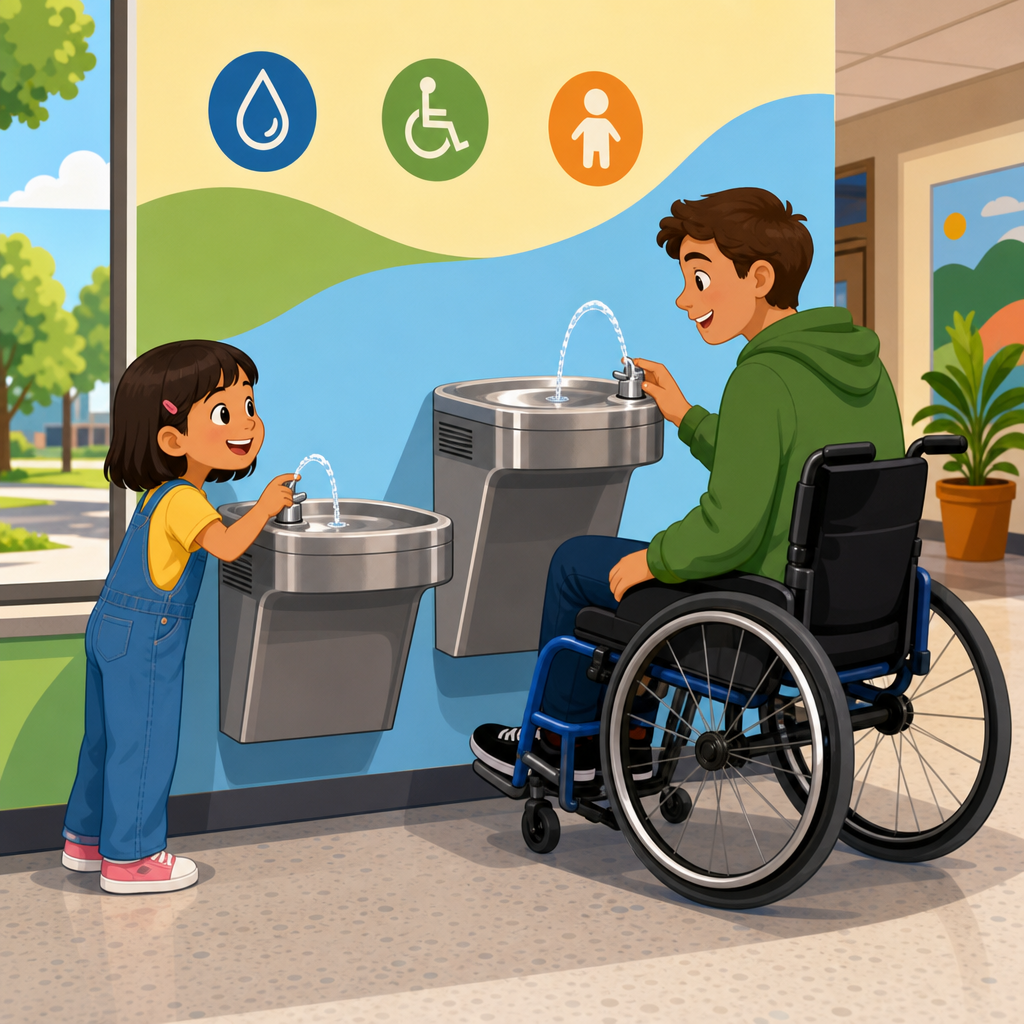
Accessible drinking fountains are governed by a combination of technical criteria and scoping logic. The technical side addresses the dimensions and operability of the fixture itself. The scoping side determines how many accessible fountains are required and what type must be provided. In practice, a standard accessible installation provides one unit for wheelchair users and one unit for standing persons. Many manufacturers meet this with a hi-lo paired fixture, where one side is lower and designed for forward approach while the other side is mounted higher for users who have difficulty bending. This dual-height concept is the reason many people refer to “ADA drinking fountain height requirements,” but height is only one component.
For wheelchair access, the fountain must provide clear floor space positioned for a forward approach, along with knee and toe clearance under the unit. The lower unit can be no higher than 36 inches to the spout outlet, measured from the finish floor or ground. The controls must be located on or near the front of the unit or the side close to the front edge so they can be reached from that forward position. Water must flow in a direction that allows a user to drink without placing the mouth directly on the bubbler. In field reviews, the most common defects are a spout set back too far, controls mounted beyond reach, and insufficient knee clearance caused by casework, insulation covers, or wall conditions that were not coordinated with the fixture shop drawings.
For standing persons, the drinking fountain must have a spout outlet no higher than 43 inches above the floor or ground. This requirement exists because a single low unit does not serve all users well. Many ambulatory users, including some people with back, balance, or mobility limitations, cannot comfortably bend to a low fountain. Providing both conditions is not a luxury; it is part of equivalent access. In schools and transportation facilities, the difference in usability between a true dual-height installation and a single compromise fixture is obvious within minutes of occupancy.
Another requirement that regularly affects layouts is the rule on protruding objects. If a fountain is wall-mounted and projects into circulation paths, it must not create a hazard for people who are blind or have low vision. Where the leading edge is above cane-detection range, the projection is limited unless guards, alcoves, or recessed installations are used. This is why many compliant projects recess drinking fountains into wall niches or add side panels. The fixture can satisfy spout and clearance dimensions yet still violate circulation safety if projection is not addressed.
Dual heights, spout placement, and control operation
Dual-height drinking fountain design is straightforward in concept but precise in execution. The wheelchair-accessible unit typically has the lower spout, open knee space, and front-mounted controls. The standing unit is higher, often with a bottle filler integrated above or between the bowls. Designers should verify manufacturer cut sheets carefully because some bottle filler combinations are excellent for hydration goals but do not solve fountain accessibility by themselves. A bottle filler is not a substitute for a drinking fountain for all users, especially if the controls or bottle placement require reaching that exceeds accessible limits.
Spout placement is one of the most technical details in Chapter 6. The spout for the accessible fountain must be located at the front of the unit and water must flow in a nearly parallel direction to the front edge. This geometry lets a user approach closely and drink from the stream without strain. If the bubbler sits too far back in the bowl, users may need to lean excessively, which defeats the purpose of the knee space below. I have seen projects pass rough inspection and fail final usability because the selected model had a decorative basin profile that technically fit the wall but pushed the water source too far from the front rim.
Control operation is equally important. The controls must be operable with one hand and cannot require tight grasping, pinching, or twisting of the wrist. Force limits also matter. Push bars and electronic sensor activations are common compliant solutions, but they still need correct placement. If a side-mounted push bar is too far back, a seated user may not be able to activate it while positioned for drinking. This is why mockups or full-size dimension checks are worth the effort on schools, civic buildings, and healthcare projects where fountains see heavy use.
| Drinking Fountain Feature | Wheelchair-Accessible Unit | Standing Person Unit | Common Field Mistake |
|---|---|---|---|
| Spout height | Maximum 36 inches above finish floor | Maximum 43 inches above finish floor | Measured to wrong point on fixture |
| Approach | Forward approach required | Accessible access still needed | Clear floor space blocked by trim or walls |
| Knee and toe clearance | Required beneath unit | Not the defining feature | Insulation cover or framing reduces clearance |
| Controls | Reachable from accessible position | Operable without tight grasping | Side control mounted too far back |
| Projection into circulation | Must avoid protruding object hazard | Same rule applies | No alcove or cane-detectable guard |
In renovations, dual-height compliance often requires more than replacing the fountain. Plumbing rough-ins, wall backing, electrical service for refrigerated units and sensors, and corridor width all affect whether a compliant hi-lo unit will fit. When existing conditions are tight, recessed cabinets or relocated fixtures may be necessary. Early coordination avoids costly change orders and prevents the common mistake of selecting an accessible model that cannot physically maintain circulation clearances once installed.
Clear floor space, knee clearance, and circulation safety
Clearances are where Chapter 6 becomes most practical. A drinking fountain can have the correct spout height and still be unusable if a person cannot pull into position. The accessible clear floor space must be stable, firm, and slip resistant, and it must connect to an accessible route. For a wheelchair-accessible fountain, the required approach is forward, which means the user moves directly toward the front of the fixture. That, in turn, requires knee and toe clearance beneath the fountain. Designers should always verify finished conditions, not just nominal dimensions, because wall finishes, protective panels, and fixture skirts can reduce usable space.
Knee and toe clearance dimensions matter because they determine whether a wheelchair footrest and knees can fit under the unit. Pipe protection is also essential where exposed surfaces could contact legs. However, protective panels and insulation wraps must be installed without shrinking required clearances. This is a classic construction-phase issue. Mechanical trades may protect piping correctly from a burn hazard yet create a noncompliant condition if the wrap or cover intrudes too far into the knee space. A coordinated detail on the drawings is the best prevention.
Circulation safety goes beyond the user at the fountain. In corridors and open public areas, drinking fountains often become protruding objects if they extend too far from the wall. People who use canes detect hazards near the floor, not at chest level. If the leading edge of the fountain is high enough to escape cane detection, it can become a collision risk. Recessing the unit, adding side wings, placing it in an alcove, or using barriers that are detectable below are standard strategies. These are not aesthetic add-ons; they are compliance measures that improve safety for all occupants.
This same clearance logic appears throughout Chapter 6. Toilet rooms need turning space and maneuvering room at doors. Lavatories need knee clearance and insulated pipes. Shower compartments require transfer or roll-in dimensions that support real use, not just code diagrams. Once teams understand that accessible plumbing design is fundamentally about approach and operation within actual human movement, the chapter becomes easier to apply consistently.
How drinking fountains fit within Chapter 6 plumbing elements
Chapter 6 is broader than fountains, and that broader context matters on hub pages like this one because most projects address several plumbing elements at once. Water closets must be positioned with precise centerline relationships to side walls or partitions, with grab bars mounted in the correct locations and lengths. Toilet compartments for wheelchair access differ from ambulatory accessible compartments, and both may be required depending on project type and fixture count. Urinals, where provided as accessible, must meet rim height and clear floor space requirements. Lavatories and sinks need appropriate height, knee and toe clearance, reachable faucets, and protected supply and drain lines.
Bathing facilities add another layer. Transfer showers, roll-in showers, and accessible bathtubs each have detailed dimensional and hardware requirements, including controls, seats, hand showers, and grab bars. In hospitality and healthcare work, these details often drive room layouts from the earliest design phases. Accessories such as mirrors, soap dispensers, hand dryers, towel dispensers, and coat hooks also interact with Chapter 6 spaces because they must be within reach ranges and cannot obstruct required clearances. An otherwise compliant lavatory can be undermined by a paper towel dispenser placed directly in the approach space.
From a project management standpoint, Chapter 6 should be reviewed as a package rather than fixture by fixture in isolation. On many jobs, I create a plumbing accessibility matrix that lists every restroom, break room, locker room, shower, and hydration point with the applicable requirements and manufacturer selections. This catches conflicts early. For example, a break room sink may meet mounting height but fail because base cabinetry removes knee clearance. A toilet room may include the correct grab bars but fail because the door swing compromises maneuvering clearance. The same disciplined review benefits drinking fountain accessibility. When teams link fixture data, wall sections, elevations, and route analysis, compliance becomes predictable instead of reactive.
Design, specification, and inspection best practices
The most reliable way to achieve drinking fountain accessibility is to treat compliance as a sequence: scope the correct number and type of fixtures, select tested models, coordinate surrounding construction, and verify dimensions after installation. During design, start with the applicable standards and manufacturer technical sheets, not generic family content. Confirm spout heights, control locations, knee clearance diagrams, rough-in dimensions, and projection from the wall. If the unit includes refrigeration, filtration, or bottle filling components, check how those features affect depth, electrical needs, and maintenance access.
During specification, name acceptable manufacturers and require submittals that show accessibility criteria clearly. Elkay, Haws, Oasis, and Murdock all publish detailed accessible options, but no manufacturer line is automatically compliant in every configuration. Accessories, trim packages, louvers, and mounting conditions can change dimensions. It is also wise to specify field verification before rough-in, particularly in renovation work where wall thicknesses and existing piping may differ from record drawings.
Inspection should include tape-measure verification at finish stage, not just visual approval. Measure spout outlet height, front edge relationships, control reach, knee clearance, and projection into circulation. Test operability with one hand. Confirm the clear floor space is not blocked by trash receptacles, signage stands, or movable furniture. In occupied buildings, maintenance practices matter as much as initial installation. I regularly see compliant fountains turned into barriers by janitorial carts parked in front, replacement bottle fillers mounted without considering reach ranges, or retrofit filters that alter access panels and depth.
Documentation also matters. Keep shop drawings, approved submittals, inspection photos, and field dimension records. These support turnover, future alterations, and risk management if questions arise later. For facility owners managing multiple sites, a standardized Chapter 6 audit checklist is one of the best investments available. It creates consistency across campuses, helps prioritize corrections, and reduces the chance that a well-intentioned renovation introduces new barriers.
Key takeaways for compliant, user-centered plumbing design
Drinking fountain accessibility is a small slice of Chapter 6, but it reveals how accessible plumbing design actually works. Compliance depends on people being able to approach the fixture, fit into the space, reach the controls, use the water stream comfortably, and move through the surrounding area safely. That is why dual heights, clear floor space, knee and toe clearance, spout placement, operable controls, and protruding object limits all matter together. A fountain is not accessible because it carries an accessible label; it is accessible when the installed condition supports real use.
As the hub for Chapter 6: Plumbing Elements and Facilities, this page should guide your review of every related fixture category, from water closets and toilet compartments to lavatories, showers, bathtubs, urinals, and accessories. The same discipline applies across them all: read the dimensions carefully, coordinate details across trades, and inspect the finished work in the field. Small deviations create real barriers, while careful execution produces spaces that are safer, more durable, and more welcoming for everyone.
If you are planning a new facility, renovating an existing one, or building an internal compliance library, use this article as the starting point for a fixture-by-fixture Chapter 6 review. Then audit your current drinking fountains first. They are visible, heavily used, and often the fastest place to find both compliance gaps and meaningful accessibility improvements.
Frequently Asked Questions
What does ADA accessibility require for drinking fountains, and why are dual-height units so important?
ADA accessibility for drinking fountains is not just about providing water somewhere in a building. It is about making sure the fixture can actually be approached, reached, and used by people with different mobility needs. Under ADA Accessibility Standards, drinking fountains are typically addressed through scoping and technical requirements that work together. In practice, this often means providing two types of access: one fountain for wheelchair users and one fountain for standing users, unless a compliant combination unit is installed that serves both. This is why dual-height configurations are so common in schools, offices, healthcare settings, transportation facilities, and other public buildings.
A wheelchair-accessible drinking fountain generally must allow a forward approach, include compliant knee and toe clearance below, place the spout and controls within accessible reach ranges, and keep the water flow located so the user can drink comfortably without obstruction. A standing-person unit, by contrast, is intended for people who cannot comfortably bend low enough to use the lower unit. The point of the dual-height requirement is to recognize that one mounting height does not serve everyone equally well. A single fountain that is too high excludes wheelchair users. A single fountain that is too low may be difficult for many standing users, including older adults or people with back, balance, or joint limitations.
That is why accessibility reviewers look beyond whether a fountain is present at all. They evaluate whether the installation supports real use. If a fixture has the proper water connection but lacks the required clear floor space, has a protruding body that creates a hazard, or places controls in a location a seated user cannot reach, it may still fail accessibility expectations. Dual-height drinking fountain design matters because it reflects the broader ADA goal: public plumbing should not merely exist; it should function equitably for the people who rely on it every day.
What clearances are required around an accessible drinking fountain?
Clearances are one of the most commonly misunderstood parts of drinking fountain accessibility because many installations look acceptable at first glance but become noncompliant when approach space and circulation are measured. For a wheelchair-accessible fountain, clear floor space must be provided so a user can position directly in front of the fixture for a forward approach. That space must be usable, not blocked by doors, trash receptacles, wall guards, casework, or decorative elements. If an alcove, corridor, or recessed niche is too tight, the fountain may technically fit but still be difficult or impossible to use independently.
Knee and toe clearance are equally critical. The lower fountain needs open space below so a wheelchair user can roll forward under the fixture far enough to reach the controls and water stream comfortably. If the apron is mounted too low, the drain piping is exposed and unprotected, or cabinetry and supports intrude into the required space, the fountain stops functioning as intended. This is why inspectors often review not only the fountain itself but also insulation, shrouds, mounting conditions, and any accessories installed nearby.
Another major clearance issue involves protruding object rules. If a wall-mounted drinking fountain extends too far into a circulation path and its leading edge is above cane-detectable range, it may create a hazard for blind or low-vision occupants. Designers often address this by recessing the fountain into an alcove or adding cane-detectable barriers where permitted and appropriate. In other words, accessibility is not only about the person drinking from the unit; it is also about everyone moving safely around it. Good clearance planning ensures the fountain works as a fixture and coexists safely within the larger path of travel.
How high should accessible drinking fountains be mounted?
Mounting height is a central factor in drinking fountain compliance, but it should never be evaluated in isolation. The lower, wheelchair-accessible fountain must have a rim or spout outlet no higher than the maximum allowed by ADA standards, and it must be paired with appropriate knee clearance, clear floor space, and operable controls. A standing-person fountain is mounted higher to better serve users who have difficulty stooping or reaching down. Together, these heights are intended to provide practical access across a broad range of users rather than forcing everyone to use a single compromise installation.
What often causes problems in the field is that contractors or facility teams focus only on one visible dimension, such as the top edge of the fountain, while overlooking related measurements that determine actual usability. For example, if the fountain is mounted at a compliant height but the spout location is poorly placed, the user may not be able to position close enough to drink. If the controls are too far back or require twisting, pinching, or strong grasping, the fixture may still be inaccessible. Similarly, if protective shrouds or trim pieces reduce knee space below the unit, a correct mounting height will not fix the overall problem.
The best approach is to treat mounting height as one part of a complete accessibility layout. Product submittals, rough-in dimensions, wall conditions, and final installation measurements should all be coordinated. Manufacturers often publish ADA-oriented installation guides, but those guides must still be checked against the specific project conditions and applicable standards. In accessibility work, a few inches in the wrong place can make the difference between true usability and a fixture that only appears compliant from a distance.
Do bottle fillers change ADA requirements for drinking fountains?
Bottle fillers are increasingly common, especially in newer schools, gyms, airports, and office buildings, but they do not automatically replace the need for accessible drinking fountains. A bottle filler is valuable for hygiene, convenience, and sustainability, yet accessibility rules still focus on whether people can directly obtain drinking water from a compliant fixture. In many cases, a bottle filler is considered a supplemental feature rather than a substitute for the required drinking fountain access. That means designers and owners should be careful not to assume that adding a bottle-filling station alone satisfies the accessibility obligation.
When bottle fillers are integrated into bi-level fountain units, the overall installation must still comply with reach ranges, operable parts rules, protruding object limits, and clearances for the drinking fountain components themselves. The bottle filler opening, sensor, or push control cannot create new barriers, and the unit as a whole cannot project dangerously into circulation space. It is also important to verify that the bottle filler placement does not interfere with the lower fountain user’s approach or reduce required knee and toe clearance.
From a practical standpoint, integrated units can be an excellent solution when selected carefully. They allow a facility to meet user expectations while preserving floor space and consolidating plumbing connections. However, not every combination product is automatically compliant in every setting. Installation height, wall depth, recess options, and surrounding circulation all matter. The safest course is to evaluate the complete assembly, not just the product label. A bottle filler can enhance an accessible hydration station, but it should never undermine the basic requirement that people be able to drink water directly and independently.
What are the most common drinking fountain accessibility mistakes during design and installation?
The most common mistakes tend to happen when teams treat accessibility as a checklist item instead of a coordinated design requirement. One frequent issue is specifying a compliant fountain but installing it in a noncompliant location. A corridor may be too narrow, a nearby door swing may overlap the approach space, or a fountain may project into circulation in a way that creates a protruding object hazard. In these cases, the product may be correct, but the installation still fails. Accessibility depends on the whole condition, not just the equipment model number.
Another repeated problem is failing to protect or properly place piping beneath the accessible unit. Exposed drain or supply lines can interfere with knee clearance or present a burn and abrasion risk if not insulated or enclosed. Similarly, contractors sometimes mount units based on finish floor assumptions that change later, resulting in final heights that are off by enough to matter. Even small discrepancies can trigger compliance concerns once tile thickness, wall panels, or shroud dimensions are added to the field condition.
Teams also commonly overlook operability. Controls must be usable without tight grasping, pinching, or twisting of the wrist, and they must require limited force. A fountain may appear accessible until someone actually tries to activate it from a seated position. The same is true for water flow location and stream direction. If the stream is too low, too high, or too close to the back guard, the fixture may be awkward or impossible to use as intended.
Finally, a major mistake is skipping final verification. Accessible plumbing fixtures should be measured and observed after installation, not just approved from drawings. Field conditions, substitutions, and mounting tolerances can all affect compliance. The most reliable projects build accessibility review into design, submittal approval, rough-in coordination, and punch-list inspection. That process helps avoid expensive corrections and, more importantly, ensures the drinking fountain truly serves everyone who needs it.