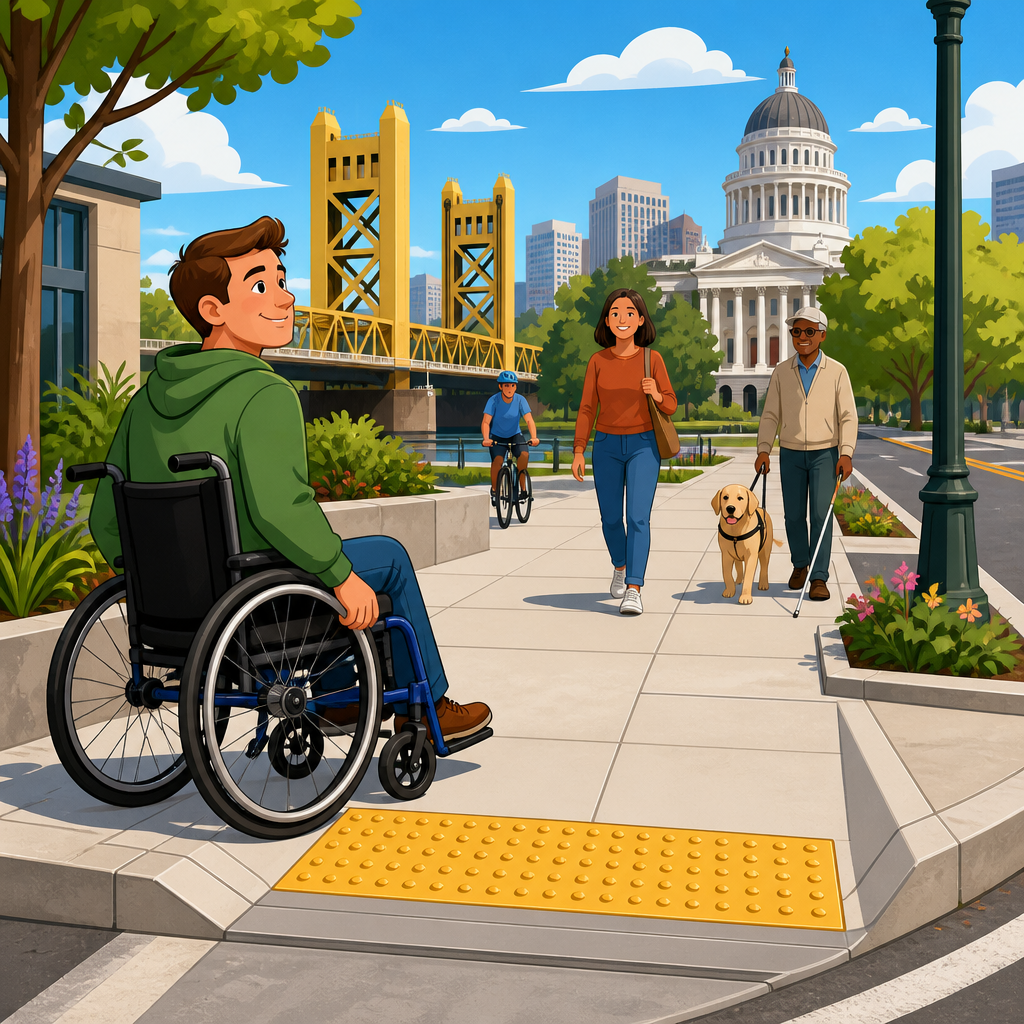
Barden v. City of Sacramento is one of the most important accessibility cases in American municipal law because it established that public sidewalks are not a minor amenity but a core part of how people access government programs, services, and civic life. In practical terms, the case asked a simple question with enormous consequences: when a city alters streets, curbs, and pedestrian routes, must it make those sidewalks usable for people with disabilities? The answer shaped how cities plan public works, allocate capital budgets, and evaluate compliance under the Americans with Disabilities Act. For anyone studying key legal cases in ADA history, this decision belongs near the center because it connects civil rights doctrine to the concrete design of everyday public space.
The case arose in Sacramento, California, after residents with mobility disabilities challenged the condition of city sidewalks during public street improvement work. They argued that missing curb ramps, broken pavement, excessive cross slopes, and other barriers prevented safe travel and denied meaningful access to the city’s services and activities. The legal dispute turned on Title II of the ADA, which governs state and local governments, along with Section 504 of the Rehabilitation Act, which prohibits disability discrimination by recipients of federal financial assistance. Those statutes do not regulate sidewalks in the abstract; they require public entities to operate programs so they are accessible when viewed in their entirety, while also meeting specific design obligations during new construction and alterations.
That distinction matters. A city does not have to rebuild every sidewalk overnight, but when it alters facilities, accessibility obligations become immediate and technical. In my work reviewing ADA transition plans and curb ramp inventories, I have seen how often agencies misunderstand this point. They treat sidewalks as peripheral infrastructure, separate from transportation planning or unrelated to access to public services. Barden corrected that misconception. It recognized pedestrian rights of way as part of a public entity’s programmatic obligations, which means sidewalks are legally tied to access to courts, schools, transit, parks, and government offices. Once you see sidewalks through that lens, accessibility is not decorative compliance; it is a civil rights requirement.
This article serves as a hub for key legal cases in ADA history, using Barden v. City of Sacramento as the anchor because it shows how precedent travels from broad statutory language into operational duties for public agencies. To understand the case fully, it helps to define several terms. An alteration is a change that affects usability, such as street resurfacing tied to curb work or intersection upgrades. A curb ramp is the sloped transition between sidewalk and street required at pedestrian crossings. A transition plan is the document public entities use to identify barriers and schedule corrective work. Program access is the Title II standard requiring meaningful access to public services, even when older facilities are not yet fully rebuilt. These concepts appear repeatedly across ADA litigation and enforcement.
What Barden v. City of Sacramento decided
The central holding associated with Barden is that sidewalks can qualify as a service, program, or activity of a public entity under Title II. That phrase matters because Title II’s anti-discrimination rule applies broadly to anything a local government operates. Sacramento argued, in substance, that sidewalks were not covered in the way plaintiffs claimed. The plaintiffs argued that inaccessible pedestrian routes excluded them from ordinary civic participation. The Ninth Circuit agreed that the ADA reaches sidewalk accessibility in this context, allowing the claim to proceed. When the Supreme Court later denied certiorari, the appellate ruling remained in place and became highly influential, especially for western states within the Ninth Circuit and beyond.
Lawyers and accessibility consultants often mention Barden alongside Tennessee v. Lane and Olmstead v. L.C. because all three cases deal with what equal access means in lived experience, not just abstract policy. Barden’s contribution was physical mobility in the public right of way. The case did not invent curb ramp requirements; federal accessibility rules already addressed them. What it did was make clear that municipal pedestrian networks fall within the ADA’s reach. That legal framing changed negotiations, settlement agreements, and engineering practices. After Barden, a city could not plausibly argue that sidewalk barriers were outside the civil rights conversation simply because they sat outdoors or were maintained through public works instead of a social service department.
Why sidewalks are legally tied to public services
Sidewalk accessibility matters because local government is experienced spatially. A resident does not access a city program only once they cross the threshold of a building. They access it along the route to the bus stop, through the curb ramp at the corner, across the intersection with detectable warnings, and onto the path leading to the library, city hall, clinic, or park. If that route is broken, too steep, or blocked, the service is functionally out of reach. That is why courts and federal agencies analyze pedestrian circulation as part of meaningful access.
The Department of Justice has long interpreted Title II to require accessible features in new construction and alterations, and the Department of Transportation has reinforced similar principles in transportation rights of way. Technical standards evolved from UFAS and the 1991 ADA Standards to the 2010 ADA Standards, while Public Rights-of-Way Accessibility Guidelines, though historically in draft form for many years, heavily influenced best practices. In daily compliance work, agencies commonly use curb ramp slope limits, minimum clear width, landing requirements, counter slope controls, and detectable warning placement as design checkpoints. Barden did not replace those technical rules; it gave them stronger legal consequence in the municipal setting.
A useful comparison is a city that renovates a courthouse entrance but leaves steps as the only path. Most people immediately understand that as an access failure. Sidewalks present the same issue across a wider network. A missing curb ramp at one corner can isolate an entire block. A utility pole in the middle of a narrow walkway can eliminate passage for a wheelchair user. Uplifted pavement can create a fall hazard for someone using a cane or walker. These are not minor maintenance defects. In aggregate, they determine whether residents can travel independently and safely to the services their taxes support.
How Barden fits within key legal cases in ADA history
As a hub for key legal cases in ADA history, this article should place Barden within the larger doctrine. Southeastern Community College v. Davis, decided before the ADA under Section 504, established that disability law does not require fundamental alteration of a program, a concept still relevant when public entities claim that requested changes are too disruptive. Alexander v. Choate clarified that equal access is not satisfied by neutral rules that leave disabled people without meaningful benefit in practice. Olmstead v. L.C. recognized unjustified segregation as discrimination, expanding the idea that access must be real, not formal. Tennessee v. Lane held that access to courts is a fundamental right and supported Title II enforcement against states in that context. PGA Tour, Inc. v. Martin explained that reasonable modifications may be necessary to avoid discrimination. Each case adds a layer: meaningful access, modification, integration, and enforceability. Barden brings those principles into city infrastructure.
Other cases also matter for public rights of way. Frame v. City of Arlington later addressed sidewalk accessibility and standing, reinforcing that inaccessible sidewalks can injure people by denying safe passage. Kirola v. City and County of San Francisco involved broad municipal accessibility claims and highlighted the evidentiary burden plaintiffs face when challenging systemwide barriers. Settlement agreements involving Los Angeles, New York, and San Francisco have also functioned like practical precedent by forcing cities to inventory curb ramps, commit to schedules, and spend substantial sums on remediation. If you are building a research path through ADA precedent, Barden is the bridge between textbook doctrine and street-level implementation.
Real-world effects on city planning, budgets, and construction
After Barden, cities had stronger incentives to integrate accessibility into pavement management, capital improvement programs, and permitting. Instead of treating curb ramps as optional add-ons, agencies increasingly tied them to resurfacing projects, signal upgrades, and corridor reconstructions. In practice, that means public works directors, city attorneys, ADA coordinators, transportation engineers, and risk managers all need to coordinate. I have seen the most successful jurisdictions create a single asset inventory that links sidewalk condition, crossing geometry, complaint history, and project timing. That approach reduces the expensive pattern of discovering accessibility barriers after design is complete.
The budget impact is real, but so is the cost of neglect. Deferred accessibility work often becomes more expensive because reconstruction after complaint or litigation requires emergency reprioritization, outside consulting, and legal oversight. By contrast, adding compliant curb ramps during scheduled alteration work is usually far cheaper than retrofitting later. Cities also face exposure from trip-and-fall claims, federal investigations, and class actions when they lack a coherent transition plan. Accessibility planning is therefore both a civil rights obligation and a basic risk management practice.
| Area | Before strong sidewalk enforcement | After Barden-style compliance focus |
|---|---|---|
| Project design | Curb ramps considered late or omitted during resurfacing | Accessibility reviewed at scoping, design, and inspection stages |
| Budgeting | Reactive spending after complaints or litigation | Planned capital allocation tied to transition plans and asset inventories |
| Data | Fragmented records in public works, engineering, and legal offices | Systemwide inventories of sidewalks, ramps, barriers, and priority routes |
| Public engagement | Complaint driven with limited disability input | Formal grievance procedures and consultation with disability communities |
| Legal posture | Sidewalks treated as maintenance issues only | Sidewalks treated as part of access to programs, services, and activities |
Technical compliance issues cities cannot ignore
Barden is often cited in legal writing, but its operational significance shows up in field measurements. Common sidewalk barriers include excessive running slope where a route mirrors steep street grades without proper landings, cross slope that pushes wheelchair users toward traffic, missing or misaligned curb ramps, insufficient clear width, abrupt vertical changes, inaccessible pedestrian push buttons, and lack of detectable warnings at blended transitions. Construction tolerances matter. A ramp that looks acceptable to a casual observer may still violate standards if the counter slope creates a wheel catch or if the landing lacks enough maneuvering space.
Maintenance is equally important. ADA compliance is not only about initial installation. Tree-root heave, asphalt overlays, utility cuts, and temporary traffic control can turn an accessible route into a barrier. The best municipal programs train inspectors, use standardized details, and require contractors to protect pedestrian access during construction. Agencies that rely solely on complaints miss a large share of barriers because many disabled residents stop reporting after repeated inaction. A disciplined inspection program produces better results than a passive hotline.
Another frequent issue is prioritization. Federal law allows some flexibility for existing facilities under program access, but that does not justify vague promises. Strong transition plans identify barriers, set priorities such as government buildings, transit routes, schools, and medical facilities, assign responsibility, estimate costs, and specify timelines. The plan should also identify the official responsible for implementation and describe the grievance process. Those are not bureaucratic extras. They are signals that a city understands accessibility as an ongoing duty rather than a one-time project.
Lessons for plaintiffs, advocates, and public agencies
For plaintiffs and advocates, Barden shows the value of framing sidewalk barriers as exclusion from civic participation, not merely inconvenience. The strongest cases document how inaccessible routes prevent attendance at hearings, use of transit, access to parks, or travel to public buildings. Photographs, measurements, route mapping, and personal narratives work best when paired with legal theory. For public agencies, the case teaches that defensive arguments about departmental boundaries rarely succeed. Residents experience the city as one system, and courts increasingly do as well.
The broader lesson across key legal cases in ADA history is that accessibility disputes rarely stay narrow. A case about one corner ramp often reveals procurement failures, outdated standard drawings, missing self-evaluations, and weak interdepartmental governance. Agencies that respond strategically use litigation pressure to modernize specifications, digitize inventories, and embed accessibility review into every alteration project. That is the durable legacy of Barden. It moved sidewalk accessibility from the margins of public works to the center of municipal civil rights compliance.
Barden v. City of Sacramento remains essential reading because it explains, in concrete legal terms, why an accessible city begins with the pedestrian network. Sidewalks are not incidental infrastructure. They are the routes through which residents reach public programs, services, transportation, and civic participation. By recognizing that connection, the case influenced how courts, advocates, and local governments evaluate disability access under Title II and Section 504. It also gave practical force to technical standards governing curb ramps, crossings, width, slope, and maintenance.
As a hub for key legal cases in ADA history, this topic points in two directions. One direction is doctrinal: cases such as Alexander v. Choate, Olmstead, Tennessee v. Lane, PGA Tour v. Martin, and Frame v. City of Arlington explain meaningful access, reasonable modification, integration, and enforceability. The other direction is operational: transition plans, asset inventories, construction details, grievance procedures, and capital budgeting determine whether legal rights become usable streets. Barden sits at the intersection of both, which is why it continues to shape settlements, engineering manuals, and municipal policy.
The main takeaway is straightforward. If a city alters streets and sidewalks, accessibility cannot be deferred, fragmented, or treated as optional maintenance. It must be planned, funded, measured, and enforced as part of equal access. Use this article as your starting point for deeper research into related ADA precedents, then review the companion case pages in this legal series to build a complete understanding of how disability rights law changed American public space.
Frequently Asked Questions
What was Barden v. City of Sacramento about, and why is it considered such an important accessibility case?
Barden v. City of Sacramento was a landmark disability rights case about whether public sidewalks fall within a city’s obligations under the Americans with Disabilities Act, especially when the city alters streets, curbs, and pedestrian routes. The plaintiffs argued that Sacramento had made public improvements without ensuring that sidewalks, curb ramps, and related pedestrian pathways were accessible to people with mobility disabilities. At its core, the case was not just about concrete, curbs, or street design. It was about whether people with disabilities could meaningfully travel through their communities and reach government buildings, public transportation, businesses, schools, and other civic destinations.
The case became highly influential because it helped establish that sidewalks are not merely optional features or minor amenities. They are a central part of how the public accesses government programs, services, and activities. That framing mattered enormously. If sidewalks are essential to civic participation, then inaccessible pedestrian routes can function as a serious legal barrier under federal disability law. Barden pushed courts and municipalities to recognize that accessibility is not limited to the entrance of a public building. It extends to the route a person must take to get there.
Its importance also lies in its practical impact. After Barden, cities across the country had stronger notice that sidewalk accessibility had to be built into infrastructure planning, street alteration projects, and public works decisions. The case helped reinforce the idea that accessibility obligations are part of mainstream municipal governance, not an afterthought. For lawyers, planners, advocates, and public agencies, Barden remains a key reference point because it connected disability rights principles to the day-to-day realities of transportation, land use, and local government operations.
How did the case change the legal understanding of sidewalks under the ADA?
Barden helped shape the legal understanding that sidewalks can be covered by Title II of the ADA because they are part of the way public entities deliver access to their programs, services, and activities. Before that issue was clarified through litigation, some municipalities treated sidewalks as outside the heart of disability access law, or at least as something less urgent than building entrances or interior accommodations. The case challenged that narrow view by emphasizing that access to public life begins long before a person reaches the door of a city building.
The legal significance of the case is that it linked pedestrian infrastructure to equal access. If a city offers public services, holds public meetings, operates parks, maintains transportation networks, and provides access to civic institutions, then people with disabilities must be able to use the public right-of-way to reach those opportunities. A sidewalk without curb ramps, with dangerous cross-slopes, or with barriers that make travel impossible can effectively exclude disabled residents from participation. Barden helped courts and public entities understand that exclusion can occur through outdoor infrastructure just as much as through inaccessible architecture inside a facility.
In broader terms, the case reinforced a functional interpretation of the ADA. Rather than asking only whether a sidewalk is a standalone “program,” the more important question became whether inaccessible pedestrian routes deny meaningful access to public life. That is why Barden continues to matter. It supports the principle that civil rights protections must address the real-world systems people rely on every day. In municipal law, that means sidewalks, curb cuts, crossings, and pedestrian routes are part of the accessibility conversation in a legally serious way.
Did Barden v. City of Sacramento require cities to make every sidewalk accessible immediately?
No. Barden did not create a simple rule that every sidewalk in a city had to be rebuilt overnight. Like many ADA cases involving public entities, the practical obligations depend on context, including whether a city is newly constructing facilities, altering existing infrastructure, or addressing barriers through broader transition planning and program access requirements. What Barden did make clear is that cities cannot ignore accessibility when they undertake public works that affect pedestrian routes. When streets, curbs, and sidewalks are altered, accessibility obligations are triggered in meaningful ways.
This distinction is important because municipal infrastructure systems are extensive, expensive, and often decades old. Federal disability law generally recognizes that public entities may address existing barriers over time, but it does not permit them to continue making alterations in a way that leaves inaccessible conditions in place where accessibility improvements are required. In other words, a city is not excused from compliance simply because its sidewalk network is large or because upgrades cost money. Accessibility must be integrated into planning, budgeting, design, and construction decisions.
In practice, the case increased pressure on cities to adopt transition plans, prioritize curb ramp installation, evaluate barriers in the public right-of-way, and coordinate compliance with resurfacing, redevelopment, and capital improvement projects. It also gave advocates and residents a stronger legal basis to challenge piecemeal public works that overlooked disabled pedestrians. So while Barden did not impose an instant citywide reconstruction mandate, it did establish that accessibility cannot be postponed indefinitely whenever municipalities alter the pedestrian environment.
Why are sidewalks and curb ramps so important to access government programs, services, and civic life?
Sidewalks and curb ramps are essential because they are the connective tissue of public life. A person may have a legal right to enter city hall, attend a public hearing, visit a library, use a park, board transit, or access a courthouse, but those rights can become meaningless if the route to get there is blocked by inaccessible sidewalks, missing curb cuts, steep transitions, broken pavement, or impassable barriers. Accessibility is not only about the final destination. It is about the entire chain of travel.
For people who use wheelchairs, walkers, scooters, canes, or who have other mobility limitations, an inaccessible sidewalk can create risks ranging from inconvenience to complete exclusion. A missing curb ramp may force someone into the street. Excessive slopes or uneven surfaces can make a route unsafe or impossible. Obstructions can prevent independent travel entirely. These are not minor design flaws. They directly affect a person’s ability to work, vote, attend school, participate in community events, and interact with local government on equal terms.
Barden is so often discussed because it captured this larger principle clearly: pedestrian infrastructure is a gateway to public participation. When cities maintain accessible sidewalks, they are not simply meeting a technical engineering standard. They are supporting equal citizenship. That includes independence, safety, dignity, and the practical ability to move through the community without facing barriers that others do not encounter. In that sense, sidewalk accessibility is both an infrastructure issue and a civil rights issue.
What is the lasting legacy of Barden v. City of Sacramento for cities, planners, and disability rights advocates today?
The lasting legacy of Barden is that it helped move sidewalk accessibility from the margins of municipal policy to the center of legal compliance and public planning. Today, cities are expected to think more systematically about accessibility in street redesign, resurfacing projects, curb ramp programs, redevelopment efforts, and pedestrian safety initiatives. The case remains a powerful reminder that accessibility obligations apply to the public right-of-way and that disabled residents must be included in the basic design of community infrastructure.
For planners and public works departments, Barden underscores the importance of proactive compliance rather than reactive fixes. That means conducting accessibility assessments, maintaining ADA transition plans, setting priorities based on barriers and public need, coordinating disability access improvements with capital projects, and involving affected communities in decision-making. It also means recognizing that accessibility should be addressed at the earliest stages of project development, when design choices are being made, rather than treated as a late-stage add-on.
For disability rights advocates, the case remains an important legal and strategic foundation. It affirms that exclusion often happens through ordinary systems that many people take for granted, such as sidewalks and crossings. By framing inaccessible pedestrian routes as barriers to government programs and civic participation, Barden strengthened the broader movement to make cities usable by everyone. Its legacy continues in modern debates over complete streets, pedestrian safety, equitable infrastructure investment, and inclusive urban design. In short, Barden helped establish a durable principle: if a city builds and alters the pathways of public life, those pathways must be accessible.


