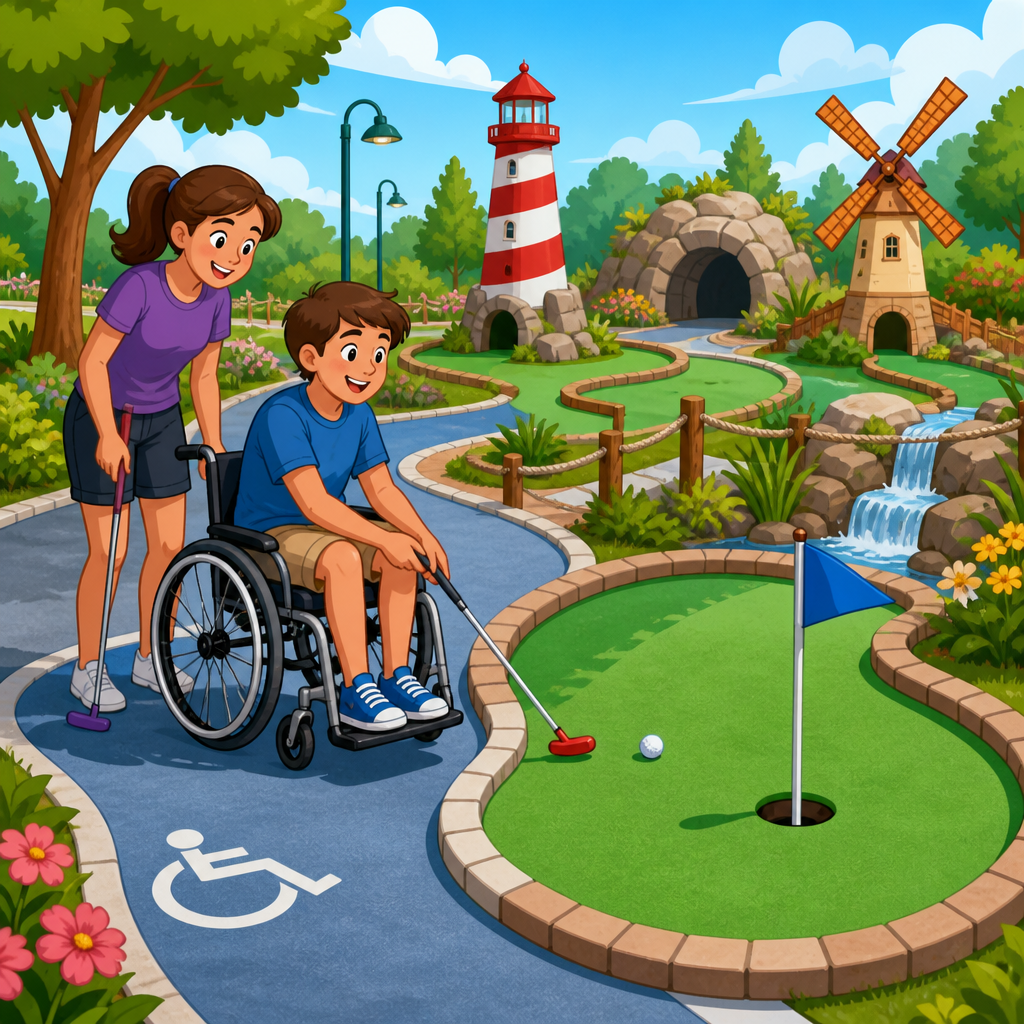
Miniature golf accessibility is governed by ADA Accessibility Standards that require at least 50 percent of the holes on a miniature golf course to be located on an accessible route, and that core rule shapes how owners, designers, inspectors, and families evaluate recreation access. In practice, that means a 36-hole facility must place at least 18 holes on an accessible route, while an 18-hole course must connect at least 9. This requirement matters because miniature golf is not just a leisure amenity; it is a public accommodation at resorts, family entertainment centers, amusement venues, parks, and mixed-use developments, where equal participation is a legal obligation and a business necessity.
When I review recreation projects, miniature golf is one of the most misunderstood facility types because owners often assume accessibility means adding a ramp at the entrance and widening the path to the snack bar. The standards are more specific. An accessible route is a continuous unobstructed path connecting accessible elements and spaces, and in miniature golf that route must serve the required number of holes. The route must meet technical criteria for width, slope, surface stability, and changes in level, just like other accessible circulation paths. Designers also need to think about maneuvering clearances, transfer points where applicable, and the overall play sequence, because access is not meaningful if a guest can reach a tee area but cannot participate in the game alongside companions.
This article serves as a hub for recreation and sports facilities under ADA Accessibility Standards. Miniature golf is the lead question, but the same compliance mindset applies across swimming pools, play areas, saunas, team seating, exercise rooms, and fishing piers. The central issue is always the same: can a person with mobility, visual, hearing, or other disabilities use the facility in a way that is integrated, predictable, and substantially equivalent to the experience offered to everyone else? Understanding the miniature golf rule provides a strong entry point because it combines route design, scoping, technical compliance, and operational judgment in one highly visible example.
The ADA rule for miniature golf accessible routes
The direct answer is simple: at least half of the holes must be on an accessible route. This scoping requirement appears in the accessibility standards for miniature golf facilities and applies to newly constructed and altered courses covered by the ADA. The rule does not say every hole must be accessible, and it does not allow an owner to cluster all accessible holes in an isolated area if that layout undermines the integrated play experience. The accessible holes must be connected by an accessible route, and the design should let players with disabilities participate with their group rather than be diverted to a separate experience.
That 50 percent threshold reflects a balance between usability and the practical realities of miniature golf design, where steep grades, bridges, water features, caves, and tightly themed obstacles can make full accessibility difficult. Still, the standard is not a suggestion. If a facility offers 27 holes, at least 14 must be on an accessible route because compliance is based on at least 50 percent, rounded up when needed to meet the minimum. If there are two 18-hole courses at one site, the analysis depends on how the facility is organized and marketed, so owners should not assume one accessible 18-hole track automatically resolves access across the entire property.
In enforcement and plan review, the first questions are straightforward: how many total holes are provided, which holes are on the accessible route, and does the route itself comply technically? Those questions should be answered on the site plan, not left for field interpretation. Clear documentation reduces change orders and prevents a common failure I have seen repeatedly: attractive concept drawings that ignore the turning space, cross slope, and landing dimensions a wheelchair user actually needs at the tee and along the route.
What counts as an accessible route on a miniature golf course
An accessible route is more than a paved walkway near the holes. Under ADA Accessibility Standards, it is the usable path that connects arrival points and required accessible elements, including the required number of holes. It must generally provide at least 36 inches of clear width, subject to limited exceptions, and it must comply with rules governing running slope, cross slope, surface firmness and stability, and changes in level. If the route functions as a ramp, additional ramp provisions apply, including maximum slope, handrails where required, and landings. Loose gravel, abrupt lips, and decorative stepping stones are common reasons miniature golf paths fail inspection.
At each accessible hole, the player must be able to approach, enter, and use the playing area. That includes space to position a wheelchair or other mobility device and make a stroke. The exact geometry can vary, but the route cannot dead-end in a way that traps the user or requires unsafe backing over a steep grade. Designers often focus heavily on route width yet overlook cross slope. On curved paths around water or rockwork, the side-to-side tilt can exceed allowable limits even when the route looks flat to the eye. That is why detailed grading and field verification matter.
Accessible route planning should also account for restrooms, parking, ticketing, food service, and spectator areas. A technically compliant route to nine holes does not solve the whole facility if the accessible parking is remote, the service counter is too high, or the restroom doors require excessive force. Recreation access works as a chain, and the weakest link often determines whether a guest can complete the visit comfortably and independently.
How the 50 percent rule is applied in real projects
Owners usually want a simple counting method, and the basic math is uncomplicated. Count the total number of holes in the facility or course at issue, divide by two, and ensure that at least that number is served by an accessible route. The harder question is deciding which holes should be accessible. In my experience, the best designs distribute accessible holes throughout the sequence so guests can play with their group for a meaningful portion of the round. Making holes 1 through 9 accessible on an 18-hole course is often more practical than scattering isolated compliant holes that are hard to connect.
Facilities with multiple themed courses require careful analysis because the user experience and site layout affect compliance strategy. A resort may advertise two separate 18-hole adventures: one jungle course and one pirate course. If the jungle course contains no accessible holes and all 18 accessible holes are on the pirate course, that may create an inequitable experience even if the total number meets 50 percent across 36 holes. Regulators and courts typically look beyond arithmetic to actual usability and integration. The safer approach is to provide accessible holes within each distinct course whenever feasible.
| Total Holes | Minimum Holes on Accessible Route | Practical Design Note |
|---|---|---|
| 9 | 5 | Round up to exceed 50 percent and keep early holes accessible |
| 18 | 9 | Place accessible holes in sequence to support full-group play |
| 27 | 14 | Document routing clearly on plans to avoid counting disputes |
| 36 | 18 | Distribute accessible play across distinct courses where possible |
Alteration projects can be especially complex. If an owner renovates only selected holes, changes circulation, or rebuilds one half of a course, the altered area must comply to the maximum extent feasible, and path-of-travel obligations may also be triggered depending on the scope and cost of work. That is why accessibility should be addressed during programming, not after a permit comment forces redesign. Retrofitting bridges, ramps, and retaining walls into a themed miniature golf environment is usually far more expensive than solving access in schematic design.
Common compliance mistakes at miniature golf facilities
The most common error is assuming accessibility can be achieved by providing a route to the start area only. That fails because the standards focus on the holes themselves, not merely admission to the attraction. Another frequent mistake is relying on routes that are technically too steep. Designers sometimes create a path that feels manageable on foot but exceeds allowable slope over short runs or at transitions. Without detailed spot elevations and field measurement, these defects are easy to miss until final inspection.
A second recurring issue is inaccessible surface material. Artificial turf systems, rubberized coatings, textured concrete, and decorative pavers can all work, but they must be installed to remain stable, firm, and slip resistant in actual use conditions. Seams that lift, drain grates that catch wheels, and settlement at edges can all break compliance after opening day. Maintenance matters as much as initial construction. A course that was compliant when built may become inaccessible if roots heave the path or patching creates abrupt level changes.
Operational practices can also undermine access. I have seen facilities store ropes, signs, and maintenance carts directly on the accessible route, reducing clear width below the required minimum. I have also seen staff direct wheelchair users to skip inaccessible holes without offering an integrated play option, effectively treating accessibility as an afterthought. Training front-line staff is critical. They should know which holes are accessible, where the accessible restrooms are located, and how to assist without segregation or patronizing behavior.
Miniature golf within the broader recreation and sports facilities landscape
Miniature golf is one piece of a larger accessibility framework for recreation and sports facilities. The ADA Accessibility Standards address swimming pools and spas, play areas, amusement rides, boating facilities, fishing piers, golf courses, exercise machines, shooting facilities, team and player seating, and more. Each facility type has its own scoping rules and technical requirements, but the organizing principle is consistent: people with disabilities must be able to participate in the primary activity, not merely observe it from the sidelines.
For example, swimming pools may require accessible means of entry such as pool lifts or sloped entries, while play areas are evaluated by the number of elevated and ground-level play components connected by accessible routes. In boating facilities, boarding piers and gangways present slope and transition challenges similar to miniature golf bridges and ramps. In exercise rooms, clear floor space, equipment reach ranges, and accessible circulation are the recurring issues. Looking across all these facility types helps owners understand that compliance is not a single checkbox; it is a design discipline that integrates site planning, architecture, operations, and maintenance.
This is why a recreation and sports facilities hub is useful for owners and design teams. Someone researching miniature golf accessibility is often also planning a pool deck, arcade, snack bar, party room, or playground within the same family entertainment complex. The smartest strategy is to review the project as one connected environment, identifying every regulated element early. That approach reduces fragmented fixes and supports a more inclusive guest experience from parking arrival to the last activity of the visit.
Design, documentation, and inspection best practices
The most reliable miniature golf compliance process starts with a code matrix. Before design development, identify the total number of holes, the exact holes on the accessible route, route dimensions, slope strategy, landing locations, tee access, restroom connections, and any site constraints. Tie those decisions to civil grading, structural details for bridges or ramps, and landscape specifications. If the project includes dramatic theming, make sure decorative elements do not encroach on the clear width or create headroom hazards. This level of coordination prevents the common conflict where art direction and accessibility collide late in construction.
Field verification is equally important. I recommend checking slopes with a digital level after rough grading, again after hardscape installation, and again before opening. Small deviations compound quickly on winding paths. A cross slope that creeps above the limit near a retaining edge can make a route unusable even if every other segment is perfect. Inspection should also include clear floor space at playable positions, edge protection where needed, transitions between materials, and the operability of gates or doors along the route.
Documentation protects owners after opening. Keep as-built plans, product data for surface materials, maintenance logs, and records of any accessibility reviews. If a complaint arises, good records show that compliance was addressed systematically rather than casually. More importantly, they support ongoing upkeep. Recreation facilities experience wear, moisture, settlement, and heavy foot traffic, so accessibility must be monitored as part of normal asset management, not treated as a one-time permitting exercise.
Key takeaways for owners, designers, and operators
The answer to the title question is clear: at least 50 percent of miniature golf holes must be on an accessible route. That rule is the starting point, not the finish line. The route itself must comply technically, the playable holes must be usable in real life, and the overall guest experience should remain integrated with companions rather than separated into a lesser option. Counting holes correctly, distributing access thoughtfully, and coordinating grading, surfaces, and clearances early are the most effective ways to avoid expensive redesign and legal exposure.
As a hub within ADA Accessibility Standards for recreation and sports facilities, miniature golf also points to a broader lesson. Pools, play areas, boating facilities, exercise rooms, and sports venues all require the same disciplined approach: understand the scoping rule, apply the technical criteria, and verify conditions in the field. Compliance works best when owners treat accessibility as core infrastructure that improves customer reach, operational consistency, and public trust. Inclusive recreation is not a niche feature; it is the expected baseline for modern public-facing facilities.
If you manage, design, renovate, or inspect a recreation property, use this article as your starting map. Review every attraction, calculate required accessible elements, and document the accessible route before construction begins. Then move outward to the rest of the recreation and sports facilities standards so the entire site works together. A careful accessibility review today prevents disputes tomorrow and creates a facility more people can actually enjoy.
Frequently Asked Questions
How many miniature golf holes must be on an accessible route under ADA standards?
Under the ADA Accessibility Standards, at least 50 percent of the holes on a miniature golf course must be located on an accessible route. That is the core rule most owners, designers, inspectors, and families need to understand first. In simple terms, the accessible route must connect at least half of the holes so that players with disabilities can participate in a meaningful portion of the course experience. For example, if a facility has 18 holes, at least 9 must be on an accessible route. If a facility has 36 holes, at least 18 must be connected by an accessible route. This is the minimum baseline for compliance, not a recommendation or a best-effort target. The rule is intended to make miniature golf more inclusive by ensuring that accessibility is built into the layout itself, rather than treated as an afterthought.
What does “accessible route” mean on a miniature golf course?
An accessible route is more than just a path near the holes. In ADA terms, it is a continuous route that allows people with disabilities, including wheelchair users and others with mobility limitations, to travel to and use the required accessible holes. That means the route must meet applicable accessibility criteria for things like width, slope, surface stability, and changes in level. On a miniature golf course, this is especially important because courses often include decorative landscaping, bridges, steps, elevation changes, and tight turns that can create barriers. A compliant accessible route should let a player move from one required accessible hole to another without encountering obstacles that prevent independent access. In practical design and inspection work, the question is not just whether someone can get near the attraction, but whether they can actually reach the required holes through a route that satisfies ADA accessibility requirements.
How do you calculate the required number of accessible holes for different course sizes?
The calculation is straightforward because the ADA standard uses a 50 percent rule. You start with the total number of holes on the miniature golf course and determine at least half of that number. For an 18-hole course, the minimum is 9 accessible-route holes. For a 36-hole facility, the minimum is 18. For any other course size, the same principle applies: at least half of the holes must be on an accessible route. This matters during planning, renovations, and compliance reviews because owners cannot simply make a token number of holes accessible and assume that is enough. The accessible holes should also be intentionally integrated into the course so the experience is practical and meaningful for users. When evaluating a facility, it is important to look at the total hole count and confirm that the required minimum is actually connected by a compliant accessible route, rather than relying on estimates or informal assumptions.
Does the ADA require every miniature golf hole to be accessible?
No. The ADA Accessibility Standards for miniature golf do not generally require every single hole to be on an accessible route. The specific minimum requirement is that at least 50 percent of the holes be located on an accessible route. That said, many facilities choose to exceed the minimum where site conditions, budget, and design flexibility allow. Going beyond the minimum can improve usability, reduce confusion for guests, and create a more inclusive recreational environment for families and groups who want to stay together during play. From a legal and practical perspective, though, the key compliance threshold is the 50 percent minimum. Owners should be careful not to confuse “not all holes are required” with “any partial access is acceptable.” The ADA sets a measurable standard, and anything less than half the holes on an accessible route may create compliance problems. In short, full-course accessibility may be ideal in some projects, but the legal rule centers on making at least half the holes accessible by route.
Why is the 50 percent accessible-route rule so important for miniature golf facilities and guests?
The 50 percent rule is important because miniature golf is not just a leisure activity; it is a shared social and recreational experience that should be meaningfully available to people with disabilities. The ADA standard recognizes that access in recreation has real value for participation, family outings, school trips, tourism, and community life. Requiring at least half the holes to be on an accessible route helps ensure that access is substantial rather than symbolic. For facility owners and operators, this rule affects design decisions, renovation priorities, compliance evaluations, and risk management. For architects and contractors, it shapes how course circulation is planned around slopes, obstacles, and themed features. For families and guests, it provides a clearer expectation that a person with a mobility disability can play a significant portion of the course instead of being excluded after only one or two holes. That is why the requirement matters so much: it turns accessibility into a functional part of the miniature golf experience rather than a minimal gesture.