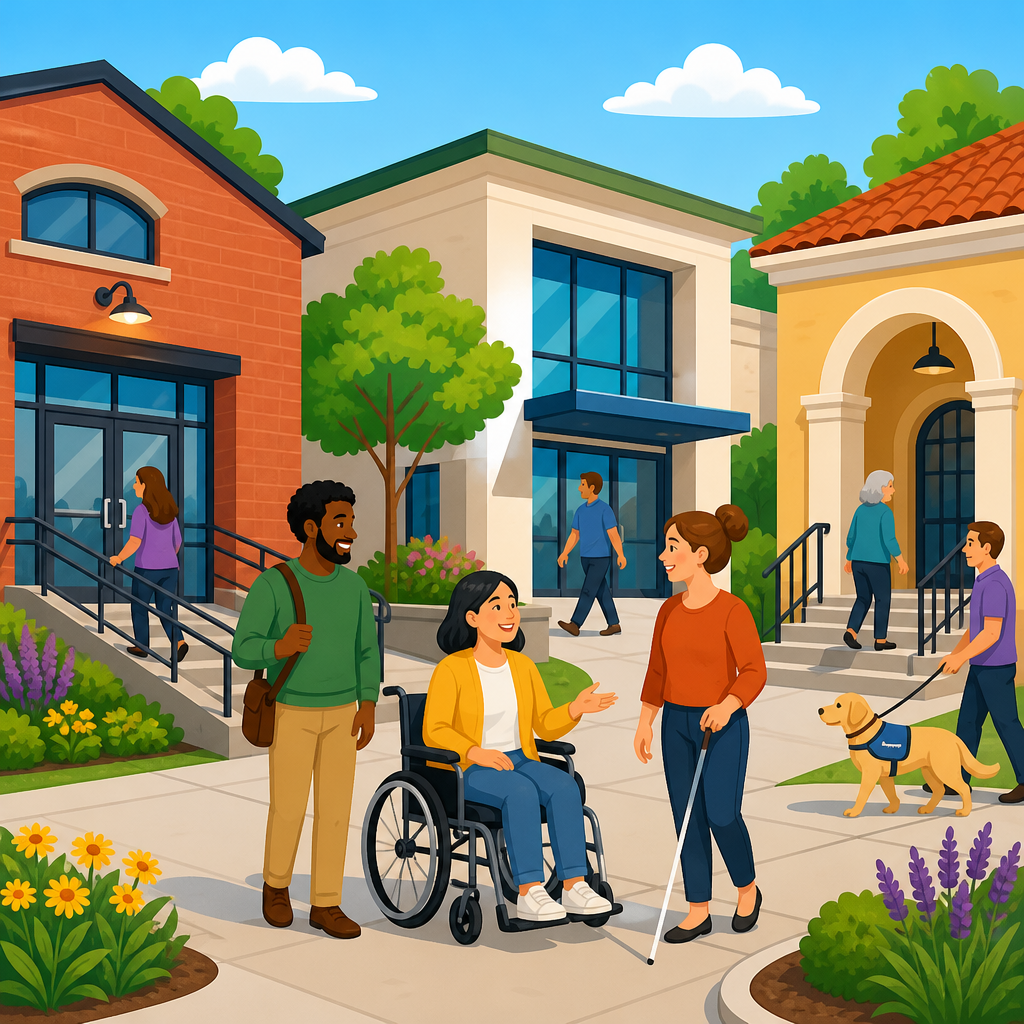
Program accessibility under Title II means a public entity must operate each service, program, or activity so people with disabilities can use it, even when every building in the system is not fully identical or retrofitted in exactly the same way. That principle surprises many city managers, school administrators, transit officials, and even property staff because accessibility discussions often focus on door widths, ramps, toilets, and parking counts at a single site rather than the legal standard that governs the program as a whole.
Title II of the Americans with Disabilities Act applies to state and local governments, their departments, agencies, special purpose districts, and instrumentalities. It covers public schools, colleges, courts, police departments, parks departments, libraries, public hospitals, transit systems, election offices, and city-owned facilities. The Department of Justice regulates most public entities under 28 C.F.R. Part 35, while the Department of Transportation regulates public transportation systems under related rules. In practice, Title II requires nondiscrimination, effective communication, reasonable modification of policies where needed, and accessible facilities, but it does not demand that every old building become a mirror-image accessible duplicate of every other building.
The key term is program accessibility. For existing facilities, a public entity does not necessarily have to make every structure fully accessible if the program, when viewed in its entirety, is readily accessible to and usable by individuals with disabilities. That is the controlling idea for many legacy campuses and municipal portfolios. It matters because governments operate from inherited real estate: century-old courthouses, split-level recreation centers, branch libraries with narrow sites, schools built before modern standards, and utility buildings serving specialized functions. I have worked through these questions with facility teams and counsel, and the most common mistake is treating Title II as a room-by-room sameness mandate instead of a service-delivery obligation tied to real public use.
This hub article explains how Title II works for public entities, why every building does not have to be identical, where that flexibility stops, and how agencies should plan compliance across facilities, policies, communications, and digital services. If you manage public property, approve capital projects, oversee operations, or advise on ADA risk, understanding this distinction helps you make better decisions, prioritize upgrades, and avoid both under-compliance and unnecessary spending.
What Title II Requires From Public Entities
Title II prohibits disability discrimination by public entities in all services, programs, and activities. That includes obvious public-facing services such as permitting, policing, public meetings, recreation, library access, and voting, but it also includes less visible functions like complaint intake, benefits administration, online forms, emergency management, and after-school programming. The obligation is broad because access is not limited to buildings. It includes policies, communication methods, staff practices, transportation, websites, and contracted operations carried out on the entity’s behalf.
For facilities, the legal analysis starts with three different buckets. Existing facilities are buildings or site elements built before applicable accessibility standards took effect and not altered in a way that triggers current technical compliance requirements. Altered facilities must comply with accessibility standards to the maximum extent feasible within the scope of alteration. New construction must comply fully with the applicable design standards, typically the 2010 ADA Standards for Accessible Design, along with any applicable state accessibility code. That distinction is critical because the flexibility associated with program accessibility mainly concerns existing facilities, not new construction and not altered elements that are required to comply.
Public entities also have administrative duties. Many must complete a self-evaluation, develop a transition plan if structural changes are needed, designate an ADA coordinator if they employ fifty or more people, and adopt grievance procedures. These are not paperwork formalities. A current self-evaluation and transition plan help an agency defend prioritization decisions, identify barriers, document alternatives, and sequence capital improvements logically. When I review municipal portfolios, agencies with updated plans usually make faster, less expensive corrections because they understand where barriers affect actual public programs most directly.
Why Every Building Does Not Have to Be Identical
The phrase “every building does not have to be identical” captures a practical truth rooted in regulation. Under Title II, a city with ten neighborhood recreation buildings is not required to rebuild all ten at once so each contains the same accessible route, toilet room layout, locker room, and program space inventory, provided residents with disabilities can access the recreation program in its entirety. If one branch library occupies a constrained historic building with entry steps, the municipality may achieve access by relocating key library services to an accessible branch, delivering materials, modifying policy, or making targeted alterations, so long as the overall service remains readily accessible and the approach does not segregate users unnecessarily.
That flexibility exists because public systems operate as networks. Courts, school districts, park systems, and county health departments often deliver one program across multiple facilities with different ages, sites, and structural limitations. The law recognizes that equal access does not always require identical bricks-and-mortar conditions everywhere. It requires meaningful access to the program without imposing unnecessary exclusion, delay, or inferior treatment. A person using a wheelchair does not need every police substation to be architecturally cloned; they need the policing and public-safety functions available to them effectively, promptly, and with dignity.
Still, non-identical does not mean inaccessible. An entity cannot leave all accessible features concentrated in one remote location if that arrangement denies practical access. It cannot rely on staff carrying people up steps, temporary fixes that routinely fail, or ad hoc workarounds that depend on finding the right employee. Program accessibility is judged by actual usability. If the only accessible community meeting room is booked infrequently, lacks accessible restrooms, or is outside normal transit routes, the program may still be inaccessible in reality even if a theoretical alternative exists on paper.
How Program Accessibility Is Evaluated in Practice
The core question is whether the service, program, or activity, when viewed in its entirety, is readily accessible to and usable by individuals with disabilities. Agencies should break that down into operational questions. Where does the public begin the process? Can they arrive independently from accessible parking, transit stops, or sidewalks? Can they enter, receive service, communicate effectively, use restrooms if needed, and exit safely? If the primary site is inaccessible, is the alternative equally timely, equally integrated, and available through ordinary procedures rather than special pleading?
Consider a city parks department that offers pottery classes in three recreation centers. One center is fully accessible, one has an accessible entrance but inaccessible kiln room, and one sits on a steep site with major barriers. The department may still provide an accessible pottery program if class registration, scheduling, equipment, restroom access, and instruction are all available at the accessible site and participants are not charged more or denied equivalent opportunities. But if the inaccessible centers host the only evening classes, advanced instruction, or children’s sessions, the program as a whole may fail because people with disabilities are excluded from meaningful portions of what the public receives.
Public entities should evaluate not only fixed architecture but also frequency, geography, and independence. A county may have one accessible tax office, yet residents in distant communities could face long travel times if all local satellite offices remain inaccessible. A school district may centralize certain services in an accessible administration building, but parents still need accessible routes to individual schools for conferences, performances, and disciplinary meetings. Practical access depends on where and how the program operates, not simply whether one compliant room exists somewhere in the system.
Where the Flexibility Stops
Program accessibility is not a loophole for avoiding capital work. New buildings must comply. Alterations trigger compliance within the altered scope and, for certain paths of travel, can require related accessibility upgrades. Public entities also must make reasonable modifications to policies, furnish auxiliary aids and services for effective communication, and avoid methods of administration that defeat access. If a city renovates a permit counter, installs new restrooms, or rebuilds a plaza, claiming that another accessible building exists elsewhere will not excuse noncompliant work at the altered site.
There are also services that must be accessible in the place where they are offered because relocation would change the nature of the service or create unequal treatment. Court proceedings, voting, emergency sheltering, arrest processing, public hearings, and in-person educational programs often require accessible locations for the actual event, not a substitute at another time or place. Historic facilities receive some consideration, but public entities still must provide program access through methods that preserve historic significance where possible. Structural impracticability, undue financial and administrative burdens, and fundamental alteration defenses are narrow and fact specific, and they require senior-level analysis and documented reasoning rather than casual invocation.
Common Compliance Methods Public Entities Use
In existing facilities, agencies can achieve program accessibility through structural changes, policy changes, reassignment of services, home visits, curbside service, relocation of classes or meetings, accessible equipment, and coordinated scheduling. The correct method depends on the service. A library may use branch redistribution and digital holds pickup. A parks department may move registration and inclusive programming to accessible centers while planning phased renovations. A city hall may relocate marriage licensing from an upper floor to an accessible counter on the first floor until renovation occurs.
| Public program | Common barrier | Typical compliant response |
|---|---|---|
| Public meetings | Inaccessible hearing room | Move meeting to accessible room with captioning and assistive listening |
| Parks recreation | Barrier at one center | Offer equivalent classes at accessible sites and upgrade priority barriers |
| Library service | Historic branch entrance steps | Provide accessible branch service, material delivery, and planned entrance solution |
| Permitting counter | High service desk only | Install lowered counter and maintain accessible route and transaction space |
| Voting | Polling site with stairs | Select accessible polling place or provide equally private accessible voting method |
Good compliance strategy usually mixes short-term operational fixes with long-term capital improvements. That balance matters because temporary relocation can maintain service, but repeated reliance on temporary measures often signals an unresolved barrier. The strongest public entities track complaint data, service demand, facility condition, and capital planning in one place. They know which barriers affect high-volume programs, which fixes are low cost and high impact, and where full renovation is unavoidable.
Public Buildings, Digital Services, and Communication Access
Title II compliance now extends far beyond front doors. Many public programs start online, and inaccessible digital systems can block access as completely as stairs. Online bill payment, permit applications, court information, library catalogs, agenda packets, emergency alerts, GIS maps, and school portals must be accessible to people using screen readers, keyboard navigation, captioning, and other assistive technology. The Department of Justice has adopted web and mobile accessibility requirements for state and local governments that align with WCAG 2.1 Level AA in most cases, making digital accessibility a core Title II issue rather than an optional best practice.
Effective communication is equally central. Public entities must provide appropriate auxiliary aids and services where needed, such as qualified sign language interpreters, CART captioning, accessible electronic documents, braille or large print materials, and communication supports for people with speech disabilities. The correct aid depends on context and the individual’s normal method of communication. In my experience, agencies reduce complaints sharply when they build interpreter procurement, captioning workflows, accessible PDF standards, and website governance into ordinary operations instead of treating each request as an exception.
This is why the “not every building must be identical” concept should never be read narrowly. Program accessibility across Title II means access to the full user journey: finding the service, understanding instructions, registering, attending, participating, paying, receiving documents, and appealing decisions. A perfectly ramped entrance does not solve an inaccessible online form, and a compliant website does not cure a hearing room without assistive listening. Public entities need an integrated accessibility model.
How Agencies Should Build a Defensible Title II Plan
A strong Title II hub strategy begins with inventory and prioritization. Identify all services, programs, and activities; map where they occur; and note whether the public must appear in person. Assess facilities against the 2010 ADA Standards and applicable state code, but also review travel paths, signage, furniture clearances, service counters, alarms, parking, playgrounds, and maintenance conditions. Then layer on communications and digital systems, because many high-risk failures occur outside construction documents.
Next, classify barriers by severity and public impact. An inaccessible council chamber, police lobby, voting location, or courtroom is usually higher priority than a rarely used storage mezzanine. Create interim operational measures with deadlines, assign responsibility to departments, and document when a service is relocated, modified, or supplemented. Budgeting should connect accessibility work to capital improvement plans, bond measures, and routine maintenance cycles. When agencies replace doors, repave lots, renovate toilet rooms, or update websites, they should fold accessibility requirements into scope immediately rather than revisiting the issue later at greater cost.
Training is the final multiplier. Front-line staff need scripts for accommodation requests. Project managers need to understand when alterations trigger technical compliance. Procurement teams must require accessible technology and documents. Leadership should review complaint trends and transition-plan progress at least annually. If your organization oversees Title II public entities, use this article as the central hub, then drill deeper into facility standards, self-evaluation, transition planning, digital accessibility, effective communication, transportation, schools, parks, voting, and law-enforcement settings. Start with a current inventory, fix the highest-impact barriers first, and treat accessibility as an operational system, not a one-time construction task.
Frequently Asked Questions
What does “program accessibility” under Title II actually mean?
Program accessibility under Title II of the Americans with Disabilities Act means a public entity must ensure that each of its services, programs, and activities, when viewed in its entirety, is accessible to people with disabilities. This is an important distinction. The law does not always require every individual building, room, entrance, or facility in a public system to be made identical or fully altered in the same way. Instead, the focus is on whether people with disabilities can actually access and participate in the public entity’s offerings in a meaningful, integrated, and usable way.
For example, a city parks department may operate multiple recreation centers, libraries, or community meeting spaces. Title II looks at whether residents with disabilities can use the department’s programs overall, not whether every single building has precisely the same accessibility features. If one older building has barriers, the entity may still comply if the program offered there is accessible through another location, through relocation of services, through structural changes where necessary, or through other effective methods that provide genuine access.
This standard often surprises officials because accessibility is frequently discussed in terms of individual architectural elements such as ramps, parking, restroom layouts, service counters, and door hardware. Those features still matter, especially in new construction and alterations, but Title II’s program accessibility requirement for existing facilities is broader and more functional. The central question is whether the public entity has organized and operated its services so that people with disabilities are not excluded, denied benefits, or forced into inferior participation.
Why doesn’t Title II require every public building to be exactly the same or fully retrofitted?
Title II recognizes a practical reality: many public entities operate large systems of older facilities built long before modern accessibility standards existed. Requiring every existing building to be immediately rebuilt to the same design standard would often be financially and operationally unrealistic. That is why the law uses a system-wide access standard for existing facilities. It allows public entities flexibility in how they achieve access, so long as the result is that people with disabilities can use the entity’s programs and services.
This does not mean accessibility can be ignored, delayed indefinitely, or treated as optional. It means the law permits different compliance methods. A school district, for instance, may not need to retrofit every historic building in exactly the same way if students, parents, staff, and members of the public can access the district’s programs through accessible locations, reassigned services, physical modifications where needed, or other effective measures. Likewise, a transit agency or city department may distribute accessibility improvements strategically across a system rather than duplicate every feature at every site.
The phrase “every building does not have to be identical” is really about legal flexibility, not lower expectations. Public entities still must provide equal opportunity and avoid unnecessary segregation or inconvenience. They cannot rely on inaccessible sites if doing so leaves people with disabilities with less access, fewer options, delayed service, or a lower-quality experience. The law allows different buildings to play different roles, but the public entity remains responsible for ensuring the overall program is truly accessible.
How can a public entity comply if some of its older buildings still have barriers?
A public entity can comply in several ways, depending on the nature of the barriers and the program involved. Structural changes are one option, but they are not the only option for existing facilities under Title II. The entity might relocate a class, hearing, meeting, clinic, recreation activity, or administrative service to an accessible building. It might reassign services to accessible rooms on the ground floor, install signage directing users to accessible entrances, modify policies and procedures, or use accessible satellite sites to ensure people with disabilities can participate.
Other common approaches include adding curb ramps, adjusting door hardware, improving restroom access, installing platform lifts or elevators where appropriate, redesigning service counters, or reconfiguring routes within a facility. In some situations, staff assistance and auxiliary aids may also be part of the solution, although they are usually not a substitute for removing architectural barriers when physical access is necessary. The right approach depends on the program, the frequency of use, the population served, and whether the method provides equivalent and dependable access.
The key is that access must be real, not theoretical. If a city says a service is “available upon request” but residents with mobility disabilities face delays, confusing procedures, or separate treatment every time they try to use it, that may not satisfy Title II. Likewise, if an accessible alternative exists only occasionally or at a distant location with reduced hours, the entity may still have a compliance problem. Public entities should evaluate their services from the user’s perspective and document how their chosen methods provide timely, integrated, and effective access.
Does program accessibility mean a person with a disability can always be sent to a different location?
No. While relocation can be a lawful and useful compliance strategy in some circumstances, it is not a blanket answer to every accessibility issue. Title II requires public entities to provide access in the most integrated setting appropriate and to avoid unnecessary separation of people with disabilities from others. Sending someone to another location may be acceptable if that alternative genuinely provides equal access to the same program or service, but it may be inappropriate if it imposes extra burdens, stigma, delay, or reduced participation.
Consider a city that offers the same permitting service at multiple municipal buildings. If one older site is inaccessible, directing visitors to a nearby accessible office with the same hours, staffing, technology, and authority may be workable. On the other hand, if the alternative office is far away, open fewer hours, lacks decision-making staff, or does not offer the same level of service, the relocation may not provide meaningful equality. The same analysis applies in schools, courts, transit hubs, libraries, and recreation programs.
Context matters. Some services are inherently tied to a specific location, such as a public hearing in a council chamber, a performance in an auditorium, or a community meeting advertised for a particular neighborhood school. In those situations, the entity may need to move the event to an accessible venue, modify the facility, or otherwise ensure the designated activity is accessible. Program accessibility is not just about whether some version of the service exists somewhere in the system. It is about whether the actual public program, as offered, is accessible in a fair, dependable, and dignified way.
What should city managers, school administrators, and facility staff do to evaluate compliance?
The best starting point is to assess accessibility at the program level, not just the building-element level. That means identifying all major services, programs, and activities the entity provides, where they are delivered, who uses them, and what barriers might prevent people with disabilities from participating. A facility survey is helpful, but it should be paired with an operational review. Officials should ask practical questions: Can the public enter the site? Reach the service counter? Use the restroom during a long event? Attend meetings? Participate in classes, sports, hearings, or performances? Use transportation connections? Obtain information in accessible formats?
From there, public entities should prioritize improvements based on actual public use, legal risk, and the importance of the services involved. They should develop a plan that may include physical modifications, relocation of certain activities, policy updates, staff training, procurement changes, and procedures for handling accommodation requests. It is also wise to review websites, registration systems, notices, and communications, because program access involves more than bricks and mortar. A person who cannot register for a program online or receive effective communication may still be excluded even if the building itself is accessible.
Finally, administrators should document decisions carefully and revisit them regularly. Buildings, programs, and community expectations change over time. What worked years ago may no longer provide equal access today. Listening to disability-related complaints, consulting users with disabilities, and working with qualified accessibility professionals can help public entities avoid a narrow compliance mindset. The goal is not to prove that every building matches every other building. The goal is to ensure that people with disabilities can actually use public services fully, consistently, and without unnecessary barriers across the system.


