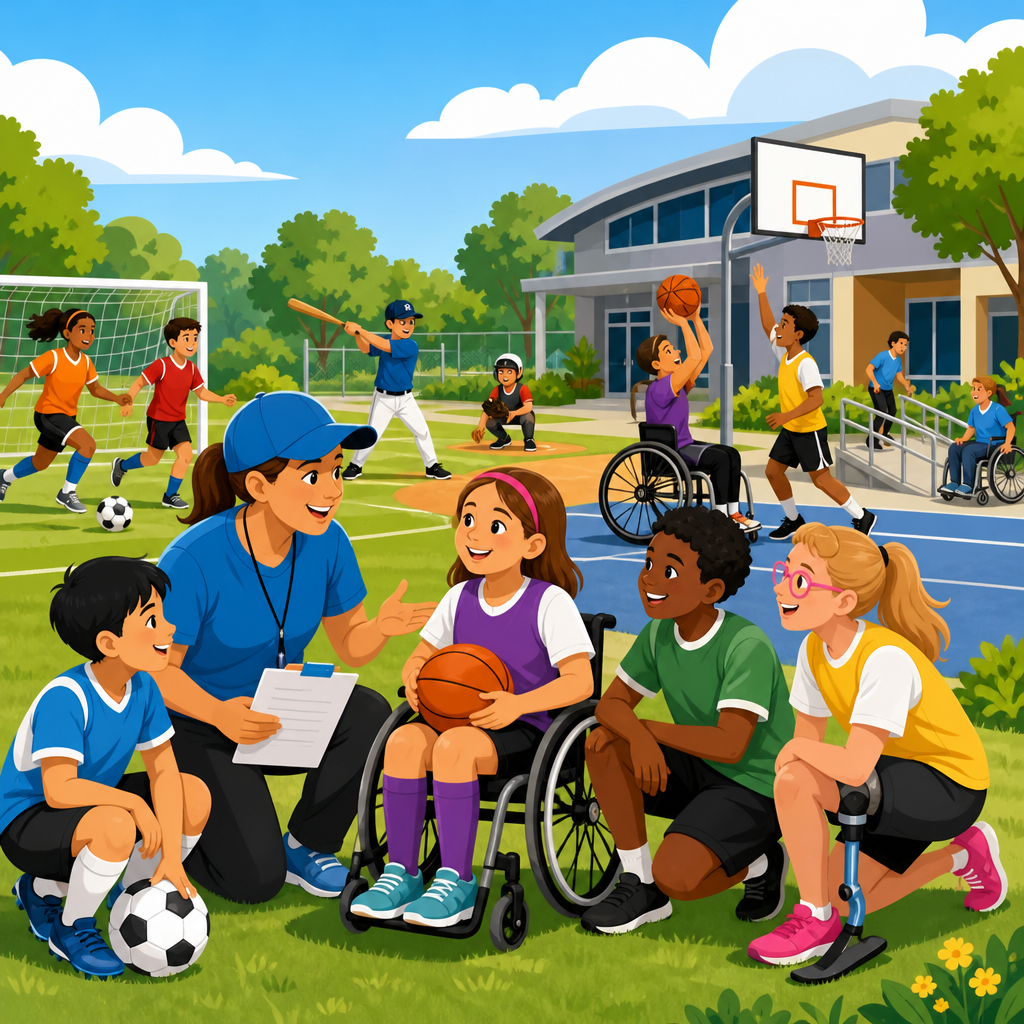
Accessible community sports leagues create structured, welcoming opportunities for children, teens, adults, and older residents with disabilities to participate in recreation close to home. In parks and recreation systems, accessibility means more than meeting minimum legal requirements. It means removing physical, communication, sensory, financial, and procedural barriers from the first website visit through the final whistle of a season. Adaptive sports refers to modifying equipment, rules, instruction, or environments so participants with physical, sensory, cognitive, or developmental disabilities can compete, learn, and belong alongside peers or in disability-specific formats.
I have worked with municipal recreation departments, youth leagues, and adaptive program partners long enough to see a consistent pattern: participation rises when registration is simple, coaches are trained, and facilities are designed for real use rather than box-checking compliance. This matters because community leagues affect public health, social connection, caregiver relief, and civic trust. The Centers for Disease Control and Prevention has repeatedly documented lower physical activity rates and greater barriers to recreation for people with disabilities, while the Americans with Disabilities Act sets a clear expectation of equal access to public programs. For local governments and nonprofit operators, accessible league design is therefore both a service obligation and a practical strategy for stronger participation.
This hub article explains how parks, recreation, and adaptive sports programs build access across three core areas: registration, coaching, and facilities. It also addresses transportation, communication, funding, safety planning, and partnerships because those pieces determine whether an inclusive promise becomes a working program. Use this page as a starting point for policy decisions, staff training, program audits, and future planning across the full parks and recreation portfolio.
Registration systems that reduce friction from the start
Accessible registration begins before a family creates an account. League pages should clearly state who the program serves, available accommodations, age divisions, equipment requirements, skill expectations, location details, transportation options, and a named contact person. Vague language such as “special needs welcome” creates uncertainty and often discourages sign-ups. Specific language works better: “Wheelchair basketball division with sport chairs available,” “baseball buddy support permitted,” or “sensory-friendly swim team practices with visual schedules and reduced whistle use.”
Digital access is essential. Registration portals should support keyboard navigation, alt text, logical heading structure, sufficient color contrast, readable form labels, and compatibility with screen readers. Many agencies use systems such as ActiveNet, CivicRec, RecDesk, or CommunityPass; each can be configured well or poorly. In my experience, the most common failure point is not the software itself but unchecked custom forms, unlabeled PDF attachments, and waiver workflows that require printing. If a parent must call because the online process is inaccessible, the program has already introduced an avoidable barrier.
Good forms collect only necessary information and separate medical needs from participation preferences. Ask what accommodations support success: extra transition time, visual instructions, one-to-one aide, noise reduction, communication device access, or transfer support. Avoid making diagnosis the centerpiece of eligibility unless a sanctioning body requires it. Functional information is usually more useful to coaches and program leads than a label alone.
Financial access belongs inside registration design, not as an afterthought. Sliding scale fees, scholarships, sibling discounts, and adaptive equipment loan programs should be visible on the program page. Hidden aid processes reduce uptake because families worry about stigma or assume they will not qualify. When agencies simplify fee assistance and explain timelines clearly, enrollment becomes more equitable.
Coaching practices that turn inclusion into participation
Accessible community sports leagues succeed or fail on the quality of coaching. A great facility cannot compensate for a coach who does not know how to cue a drill, adapt a scrimmage, or manage sensory overload. Coaches need practical training, not only inspiration. At minimum, every league should cover disability awareness, person-first or identity-first language preferences, behavior support, communication methods, emergency response, transfer safety, and sport-specific adaptation.
Effective coaches use universal design principles in ordinary language. They present instructions in multiple formats, demonstrate skills visually, break tasks into steps, and offer more than one way to participate. In youth soccer, for example, a coach might enlarge target zones, reduce defender pressure, allow a trap before a pass, or use brightly colored cones for players with low vision. In community tennis, a program can introduce shorter courts, slower balls, and seated play options without lowering expectations for effort or teamwork.
Consistency matters. Participants and caregivers trust leagues when practice routines are predictable, schedules are honored, and expectations are clearly posted. I have seen simple tools improve retention dramatically: picture schedules on clipboards, colored wristbands for groups, quiet break spaces, and coach check-in scripts that ask each athlete how they are doing that day. These are low-cost interventions with outsized impact.
Volunteer management is just as important. Many leagues rely on parents, high school helpers, or college interns, but informal staffing can create uneven experiences. Build role descriptions, background checks, orientation modules, and supervision plans. Pair new volunteers with experienced adaptive recreation staff. If a league uses peer buddies, define what buddies do and do not do. They are not substitutes for trained aides when a participant needs dedicated support.
| Area | Common Barrier | Practical Fix | Real-World Example |
|---|---|---|---|
| Registration | Inaccessible online forms | Screen-reader tested portal with labeled fields | Municipal swim league adds accessible account creation and accommodation checkboxes |
| Coaching | One teaching style for all athletes | Visual demos, step-by-step cues, modified drills | Youth basketball coach uses color-coded stations and shorter rotations |
| Facilities | Program space reachable but not usable | Accessible routes, benches, transfer areas, quiet rooms | Baseball complex adds paved path to dugout and sensory retreat room |
| Equipment | No adaptive gear on site | Loan inventory and maintenance schedule | Parks department keeps sport wheelchairs and beeper balls for league use |
| Communication | Families unclear about supports | Plain-language guides and named inclusion contact | League handbook explains accommodations, weather policy, and assistance process |
Coach certification should align with the sport and the setting. National Alliance for Youth Sports training, NFHS courses, CPR and first aid, concussion recognition, SafeSport where appropriate, and disability-specific modules from adaptive sports organizations create a strong baseline. For wheelchair sports, staff must understand chair fitting, pushing mechanics, skin protection, and court traffic patterns. For aquatics, instructors need transfer procedures, seizure response protocols, and familiarity with flotation adaptations. Competence builds safety and confidence for everyone involved.
Facilities, fields, and equipment that work in practice
Accessible facilities are defined by usability, not by a ramp at the entrance. A family evaluates the full journey: parking, curb cuts, drop-off zones, gates, pathways, restrooms, spectator seating, dugouts, team benches, fountains, concessions, and emergency exits. The 2010 ADA Standards for Accessible Design provide the legal baseline, but successful leagues go further by observing how athletes actually move through spaces during arrival, practice, games, breaks, and departure.
Outdoor sports complexes often fail on surfaces and routes. Crushed stone paths, soft turf transitions, narrow gate openings, and inaccessible player areas can make a nominally accessible site unusable. A wheelchair user may reach the field perimeter but not the bench. A child with limited stamina may have no shaded rest area between parking and play space. The fix is usually not dramatic architecture. It is continuous accessible routes, stable surfaces, companion seating, accessible team areas, and restrooms near the program zone.
Indoor facilities need the same operational lens. Gymnasiums should have clear circulation space around courts, adjustable hoops where feasible, and storage systems that allow quick access to adaptive equipment. Natatoriums need sloped entries or pool lifts, transfer walls where appropriate, non-slip paths, and private changing options. Ice arenas should evaluate dasher gate widths, sled hockey storage, and locker room bench heights. Even acoustics matter; echo-heavy rooms can overwhelm athletes with sensory sensitivities or hearing devices.
Equipment planning deserves a line item in the budget. Adaptive gear is not optional if the sport depends on it. Examples include sports wheelchairs, gait trainers for fitness-based leagues, beeper balls for blind baseball, visual timers, tactile floor markings, communication boards, lighter bats, grip supports, and noise-reducing headsets. Because specialized gear can be expensive, many agencies build loan closets, seek manufacturer demos, or partner with hospitals, school districts, and regional adaptive sports nonprofits.
Operations, safety, transportation, and communication
League access extends beyond the field of play. Transportation is one of the biggest participation barriers in parks and recreation, especially for evening programs and families juggling care schedules. Public transit proximity, paratransit coordination, drop-off management, and staggered start times can determine who attends. Some communities cluster adaptive programs at central sites, but centralization can also increase travel burdens. A better approach is often a hub-and-spoke model: maintain specialized programs at equipped centers while distributing inclusive league options across neighborhood parks.
Emergency planning must be individualized and operational. Standard action plans should account for mobility devices, medication timing, seizure protocols, communication supports, allergies, elopement risk, and weather shelter procedures. Staff should know who carries radios, where backup batteries are stored for communication devices, how to clear accessible routes, and who can authorize a modified activity if conditions change. Documentation matters, but rehearsal matters more. Run tabletop exercises before the season and site walk-throughs with coaches.
Communication with families should be plain, timely, and consistent across email, text, print, and phone channels. Share schedules early, define cancellation rules, and explain what to bring in concrete terms. Photos or short videos of arrival points, locker rooms, and activity spaces can reduce anxiety for first-time participants. Bilingual communication and interpretation services expand reach in many districts, and they should be planned, not improvised.
Data helps improve service quality. Track registration completion rates, waitlists, accommodation requests, attendance, injuries, scholarship use, and return enrollment. Review whether participants with disabilities are concentrated in a few offerings or represented across the full recreation portfolio. When a program has low uptake, ask whether the issue is demand, timing, marketing, or barriers hidden in operations. Good decisions come from service data plus direct feedback from athletes and caregivers.
Partnerships, funding, and long-term program growth
No local league builds a strong adaptive sports ecosystem alone. The most effective parks and recreation agencies coordinate with schools, therapeutic recreation departments, Veterans Affairs programs, Special Olympics chapters, hospital rehab teams, disability service organizations, and sport-specific governing bodies. These partners provide referrals, coaching pipelines, equipment access, classification expertise, and volunteer support. They also help agencies avoid duplicating services where a strong community provider already exists.
Funding usually comes from multiple sources. Municipal general funds may cover staffing and field time, while grants support equipment, scholarships, or pilot leagues. Common sources include state recreation grants, local foundations, hospital community benefit programs, and corporate sponsorships tied to health and inclusion goals. Capital upgrades can sometimes be bundled into park renovation projects rather than funded as stand-alone accessibility efforts, which often makes them easier to approve.
For long-term growth, agencies should treat adaptive sports as a permanent service line, not a seasonal initiative dependent on one champion. Put accessibility goals into strategic plans, recreation master plans, capital improvement schedules, and procurement standards. Write inclusion expectations into vendor contracts and coaching handbooks. Build succession plans so knowledge survives staff turnover. This hub supports that broader system by connecting registration design, coach development, facility planning, and operations into one practical framework for parks, recreation, and adaptive sports.
Accessible community sports leagues work when access is built into every decision, not added after complaints. Registration must be easy to find, easy to complete, and clear about accommodations and costs. Coaching must be trained, structured, and flexible enough to support different bodies, communication styles, and learning needs. Facilities must be usable from parking lot to bench area, with equipment and restrooms that match real participant needs rather than minimum assumptions.
For parks and recreation leaders, the main benefit is straightforward: stronger access produces higher participation, safer operations, better family trust, and more durable community value. It also creates a better system for everyone. Visual schedules help new athletes. Clear routes help grandparents and strollers. Better communication reduces confusion for all families. Inclusion is not a narrow compliance exercise. It is a practical design standard for high-quality public recreation.
Use this hub to audit your current leagues, identify service gaps, and prioritize the next improvements in Parks, Recreation & Adaptive Sports. Review your registration flow, coach training plan, facility checklist, and partner network this season. Then turn accessibility from a stated goal into a dependable community experience.
Frequently Asked Questions
What makes a community sports league truly accessible, beyond basic ADA compliance?
A truly accessible community sports league goes well beyond checking legal boxes. ADA compliance is an important foundation, but real accessibility means designing the entire participant experience so people with disabilities can join, communicate, travel, play, and belong with as few barriers as possible. That starts long before anyone steps onto a field or into a gym. It includes an easy-to-navigate website, registration materials in plain language, alternative formats such as large print or screen-reader-friendly forms, and clear contact information for accommodation requests. It also means staff respond promptly and respectfully when families or participants ask questions about support needs.
In practice, accessibility covers several areas at once. Physical access includes parking, sidewalks, entrances, restrooms, locker rooms, team benches, spectator seating, and routes between activity spaces. Communication access may involve captioned videos, visual schedules, translated materials, assistive listening systems, and coaches trained to give instructions in multiple ways. Sensory access can include quieter spaces, predictable routines, reduced glare or noise where possible, and advance information about what participants should expect. Financial access matters too, because fees, uniforms, transportation costs, and equipment expenses can exclude people just as effectively as stairs or narrow doorways. Scholarship options, equipment-sharing programs, and transparent pricing all support inclusion.
Procedural access is another major piece. If registration forms are confusing, deadlines are rigid, or medical clearance rules are unclear, families may give up before participation even begins. Accessible leagues simplify paperwork, explain policies clearly, and offer flexible ways to submit forms and request modifications. Most importantly, an accessible league builds a culture of inclusion. Coaches, officials, volunteers, and administrators are trained to welcome participants with different abilities, focus on strengths, and adjust activities without stigma. When accessibility is treated as a core service principle rather than an exception, leagues become more usable, more equitable, and more enjoyable for everyone in the community.
How should registration be designed so children, teens, adults, and older residents with disabilities can enroll without unnecessary barriers?
Accessible registration should be straightforward, flexible, and supportive from the first click or phone call. The process works best when people can register online, by phone, in person, and, when needed, with assistance from staff. Online forms should be mobile-friendly, keyboard navigable, compatible with screen readers, and written in clear language rather than bureaucratic jargon. Families and participants should be able to find essential details quickly, including program dates, skill expectations, costs, transportation options, facility accessibility features, and who to contact for accommodations. If a person has to search through multiple pages just to learn whether a league can meet their needs, the registration process is not truly accessible.
Good registration forms ask only for information that is relevant and useful. Instead of requiring participants to disclose a diagnosis in ways that feel intrusive, leagues can ask practical questions such as what supports help the participant succeed, whether adaptive equipment is used, whether communication modifications are helpful, and whether there are medical or safety considerations staff should know. This keeps the process focused on participation rather than labels. It is also important to explain how personal information will be used and protected so families and adult participants feel comfortable sharing necessary details.
Accessible registration should also build in flexibility. Deadlines may need to account for transportation planning, care schedules, or time needed to coordinate support services. Payment plans, scholarships, and reduced-fee options should be visible rather than hidden. Confirmation emails or printed receipts should summarize what comes next, including orientation dates, equipment needs, and accommodation contacts. Many successful parks and recreation systems also offer pre-season intake conversations so staff can match participants with appropriate league structures, coaching approaches, and facility supports. When registration is inclusive by design, leagues reduce confusion, improve trust, and create a much smoother path into community sports.
What should coaches know about working effectively in accessible and adaptive community sports leagues?
Coaches in accessible community sports leagues need more than sport-specific knowledge. They need practical inclusion skills, strong communication habits, and the ability to adapt instruction so participants with different abilities can engage meaningfully and safely. A good coach understands that adaptive sports and inclusive recreation are not about lowering expectations. They are about adjusting equipment, rules, pacing, drills, and teaching methods so athletes can develop skills, confidence, fitness, and teamwork. That might mean using larger or lighter balls, creating visual markers, shortening distances, offering seated and standing options, or modifying game formats to emphasize participation and success.
Effective coaches communicate clearly and consistently. They demonstrate drills visually, give concise verbal cues, check for understanding, and break complex skills into smaller steps. They also recognize that athletes process information differently. Some players benefit from repetition, visual schedules, peer modeling, or one-on-one support before joining full group activities. Others may need sensory breaks, extra transition time, or alternative ways to respond. The most successful coaches plan for these differences from the beginning instead of improvising only when problems arise. Training in disability awareness, behavior support, de-escalation, and person-centered coaching can make a major difference in both athlete experience and staff confidence.
Just as important, coaches help shape team culture. They set the tone for respect, patience, and belonging. That includes using strength-based language, discouraging exclusionary behavior, and making sure every participant has a meaningful role in practice and competition. Coaches should also communicate with families and adult participants regularly about goals, concerns, fatigue, transportation issues, and support strategies that work well. In community settings, success is not measured only by wins and losses. It is measured by participation, skill growth, enjoyment, retention, social connection, and the athlete’s sense of independence and pride. Coaches who understand that broader mission are essential to making accessible leagues successful.
What facility features matter most for accessible community sports programs and leagues?
Accessible facilities are a major part of whether a league is truly usable. The most important features start with basic arrival and entry: accessible parking spaces, curb cuts, smooth paths of travel, automatic or easy-to-open doors, and clear signage that helps participants and families move through the site confidently. Once inside or on the grounds, people need accessible restrooms, locker rooms or changing spaces, drinking fountains, seating areas, and routes between all major activity areas. If a participant can enter the building but cannot independently reach the court, field, restroom, or team area, the facility is only partially accessible.
Program-specific features matter just as much. For gyms and indoor centers, that may include wide circulation space for wheelchairs or walkers, accessible team benches, contrasting floor markings, acoustics that support hearing and comprehension, and lighting that reduces glare. For outdoor complexes, accessible surfaces, stable paths to dugouts or sidelines, shaded waiting areas, and spectator seating integrated with accessible routes are especially important. Aquatic facilities may need pool lifts, sloped entries, transfer walls, accessible changing rooms, and enough deck space for mobility devices. Multi-use recreation environments should also consider quiet areas or low-stimulation spaces for participants who need a sensory break during practices and games.
Facilities should be assessed from the user perspective, not just from a construction checklist. That means asking practical questions: Can a parent pushing a sports wheelchair get from parking to check-in without obstacles? Can an athlete with low vision find the right entrance and navigate independently? Is there a safe place to store adaptive equipment? Are emergency procedures inclusive of people with mobility, communication, sensory, or cognitive disabilities? The strongest parks and recreation systems conduct regular accessibility reviews, involve people with disabilities in planning, and prioritize improvements that affect daily use. Well-designed facilities support not only compliance, but confidence, dignity, and full participation throughout the season.
How can parks and recreation departments make community sports leagues more affordable and welcoming for participants with disabilities and their families?
Affordability and welcome are closely connected. A program may advertise inclusion, but if costs are too high or support systems are unclear, many residents will still be excluded. Parks and recreation departments can improve access by reviewing the full cost of participation, not just the registration fee. Families may also be paying for uniforms, adaptive equipment, transportation, personal support, medical documentation, and missed work time for caregiving. Departments that want genuine inclusion often provide scholarships, sliding-scale fees, installment payment options, fee waivers, and equipment lending libraries. Some also partner with schools, nonprofits, hospitals, or local sponsors to offset costs for adaptive gear and transportation.
Creating a welcoming environment also requires intentional outreach. Information about leagues should be distributed through disability organizations, schools, senior centers, therapeutic recreation networks, healthcare providers, and community groups, not just through standard recreation channels. Marketing materials should show participants with disabilities as active community members, not as an afterthought. Staff should be trained to answer questions confidently and respectfully, without making people feel like accommodations are unusual or burdensome. A simple, supportive conversation can make the difference between someone trying a program and deciding it is not meant for them.
Retention matters as much as initial enrollment. Departments should gather feedback during and after each season, ask participants what barriers they encountered, and use that information to improve future offerings. Orientation sessions, buddy systems, family guides, transportation information, and clear communication about what to expect can reduce anxiety for first-time participants. For adults and older residents, scheduling, pace of play, health considerations, and social connection may be just as important as competition. When leagues combine affordability,


