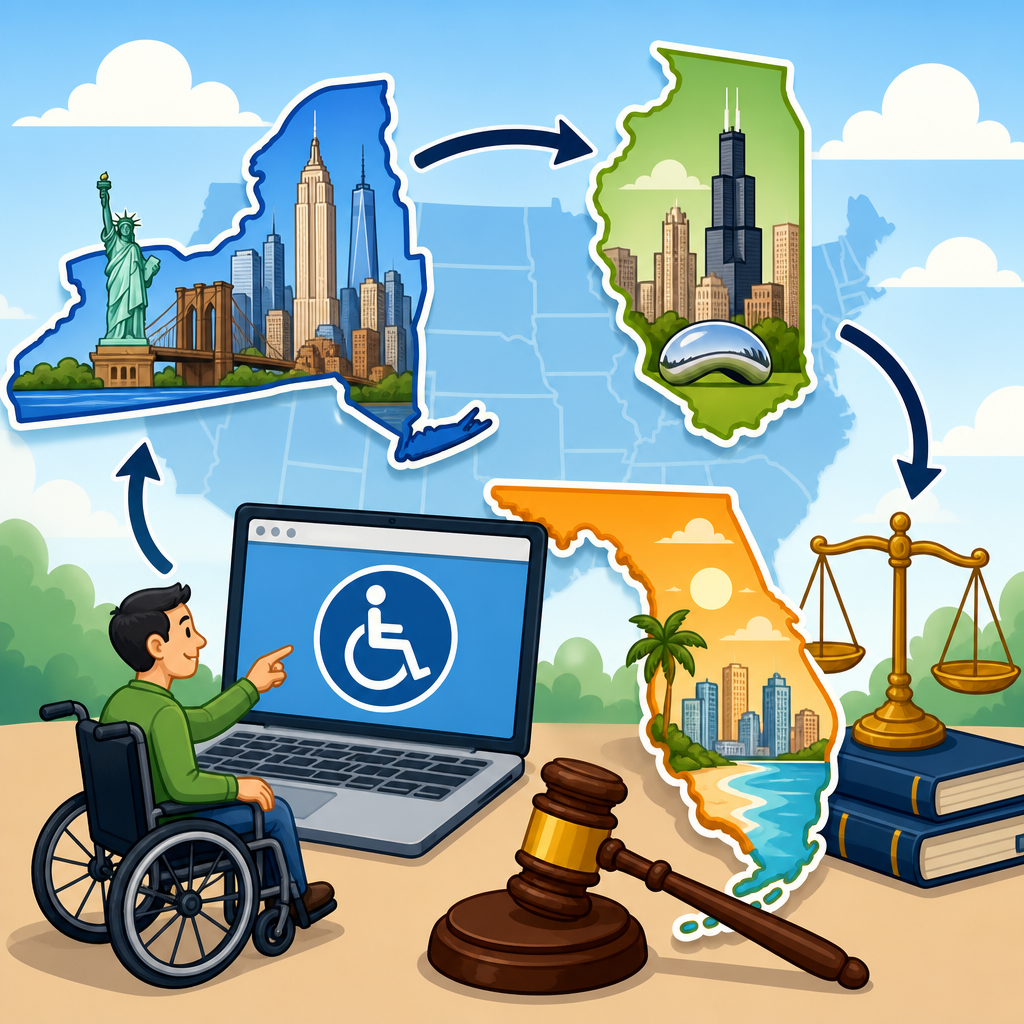
The New York-Florida-Illinois pattern in ADA web litigation defines where most private website accessibility lawsuits are filed, how plaintiffs’ firms build repeatable case strategies, and why businesses across the country feel the impact regardless of where they operate. In practice, this pattern refers to the concentration of Americans with Disabilities Act Title III claims in a small number of federal districts, especially courts in New York, Florida, and Illinois, where judges have produced a substantial body of decisions on whether websites and mobile apps must be accessible to blind, low-vision, deaf, and mobility-impaired users. I have tracked these filings for years, and the pattern is consistent: a retailer based in Texas, a hotel group in Arizona, or a restaurant chain in California may still face a demand letter or complaint shaped by precedent from Manhattan, Miami, or Chicago.
Understanding this litigation pattern matters because website accessibility is no longer a narrow compliance issue handled by technical teams after launch. It is a legal, operational, and brand-risk issue. Title III of the ADA prohibits disability discrimination by places of public accommodation, and courts have increasingly been asked whether that duty extends to websites, mobile apps, online booking tools, digital menus, patient portals, and e-commerce checkout flows. The answer has not been uniform nationwide, which is exactly why the New York-Florida-Illinois pattern matters. These three states have become practical battlegrounds for unresolved questions about standing, mootness, nexus theories, intent to return, serial plaintiffs, and the role of the Web Content Accessibility Guidelines, usually version 2.0 AA or 2.1 AA, as the de facto technical benchmark.
This article serves as a hub for recent ADA litigations and emerging trends. It explains why filings cluster where they do, what legal theories dominate, which industries are most exposed, how courts have treated recurring defenses, and what case patterns signal for the next wave of claims. The larger lesson is straightforward: businesses should stop treating accessibility as a one-time remediation project. In the current litigation environment, the more durable approach is governance, testing, documentation, and continuous monitoring tied to recognized standards and real user barriers. That is the difference between reacting to a complaint and being able to show a court, a plaintiff, or an insurer that accessibility has been taken seriously.
Why New York, Florida, and Illinois dominate ADA web filings
Three factors explain the concentration of ADA website lawsuits in these states: favorable procedural law for plaintiffs, dense target markets, and a mature plaintiffs’ bar. New York, particularly the Southern and Eastern Districts, has seen extraordinary filing volume because it combines high business density with judges familiar with accessibility pleadings. Florida, especially the Southern District, has long been active in disability access litigation generally, and web claims fit into an existing enforcement model. Illinois, with the Northern District centered on Chicago, became a significant venue because regional businesses, national chains, and consumer-facing service providers create a broad defendant pool.
Serial litigation is central to this pattern. A relatively small group of law firms and individual plaintiffs account for a large share of filings. That does not automatically make claims weak. Courts regularly acknowledge that repeat plaintiffs can serve an enforcement function where regulatory enforcement is limited. But serial filings do influence litigation economics. Complaints are often standardized, allege common barriers such as missing alternative text, unlabeled form fields, keyboard traps, inaccessible PDFs, and checkout obstacles, and seek injunctive relief plus attorneys’ fees. The predictable structure lowers filing friction and raises settlement pressure.
These states also sit at the center of national commerce. A company does not need a storefront in Manhattan, Miami, or Chicago to become a target. If its site is accessible in those markets and allegedly prevents a resident plaintiff from obtaining goods, booking services, or learning about locations, litigation may follow. I have seen organizations underestimate this reach because they focus only on their headquarters or primary customer geography. In digital accessibility cases, the relevant market is often wherever the website is available and the plaintiff can plausibly allege attempted use.
The legal theories driving recent ADA website cases
The core legal debate has been whether Title III covers standalone websites, only websites connected to physical places, or both. Some courts apply a nexus approach, requiring a sufficient connection between the website and a physical place of public accommodation such as a store, hotel, restaurant, bank branch, or medical office. Under that view, an inaccessible website is actionable when it impedes access to the goods and services of the physical location. Other courts read Title III more broadly and are more willing to recognize digital barriers even when the online service itself is central.
Recent ADA litigations also turn on standing. Plaintiffs generally must show they encountered a barrier, suffered an injury, and face a real likelihood of future harm, often framed as an intent to return to the site. In New York and Florida especially, pleadings frequently include details about the plaintiff’s disability, assistive technology, attempted transactions, and reasons for returning, such as ongoing interest in the products or nearby travel plans. Defendants often challenge these allegations as formulaic. Courts vary in how much specificity they require, but many will not dismiss a complaint solely because the plaintiff has filed numerous similar actions.
Mootness is another recurring defense. Businesses sometimes remediate after receiving a demand letter and then argue the case should be dismissed because the barriers no longer exist. That strategy can work, but only when remediation is complete, verified, and unlikely to recur. Courts are skeptical of vague promises. A defendant needs evidence: accessibility audits, code fixes, retesting, policies, vendor controls, and where possible a declaration explaining what changed. In my experience, incomplete remediation is the most expensive outcome because it funds both technical work and litigation without reliably ending either.
| Issue | Typical Plaintiff Position | Typical Defense Position | What Courts Often Examine |
|---|---|---|---|
| Coverage | Website blocks equal access to goods or services | Title III does not reach this digital experience | Nexus to a physical location, nature of service offered |
| Standing | User encountered barriers and intends to return | No concrete injury or genuine future intent | Specific attempted use, geography, product interest, travel plans |
| Mootness | Barriers may persist or recur | Site has been remediated fully | Audit evidence, retesting, governance, ongoing monitoring |
| Standard | WCAG 2.0 or 2.1 AA reflects accessibility expectations | No formal DOJ regulation mandates that exact version | Whether the site is usable by assistive technology in practice |
Industries under the heaviest pressure and the barriers most often alleged
Retail, hospitality, food service, healthcare, banking, education, and real estate have been frequent targets because their websites are transaction-heavy and time-sensitive. Hotels face claims over booking engines that screen-reader users cannot navigate independently. Restaurants are sued over inaccessible online ordering and menu PDFs. Healthcare providers see complaints involving patient forms, scheduling flows, and telehealth portals. Retailers remain especially exposed because product discovery, filtering, carts, payment fields, and account creation create many possible failure points.
The alleged barriers themselves are strikingly consistent across complaints. Missing alternative text prevents screen-reader users from understanding images, buttons, and promotional content. Improper heading structure makes pages hard to navigate by landmarks. Unlabeled form controls block checkout, reservation, and sign-up flows. Keyboard inaccessibility affects users who cannot operate a mouse. Color contrast failures reduce readability for low-vision users. Auto-advancing carousels, pop-ups without focus management, inaccessible CAPTCHA tools, and noncompliant third-party plugins repeatedly appear in pleadings. PDFs remain a major source of risk because organizations often publish menus, statements, admission forms, and policy documents without tagging them for assistive technology.
A practical point many executives miss is that plaintiffs usually do not need to prove every page is inaccessible. A few barriers affecting core functionality can support a complaint. If a blind customer cannot add an item to cart, complete a hotel reservation, refill a prescription, or submit a lead form, the business problem is already severe. That is why automated scans alone are not enough. Tools such as axe, WAVE, Lighthouse, and Siteimprove can identify recurring code-level defects, but they do not replace manual keyboard testing, screen-reader review with JAWS, NVDA, or VoiceOver, and structured user-journey validation.
Case trends shaping the next phase of litigation
Several trends now define recent ADA litigations and emerging trends. First, mobile apps are increasingly paired with website claims. If a brand channels key services through an app, plaintiffs examine whether account access, payments, loyalty programs, or booking tools work with assistive technology. Second, courts are seeing more claims aimed at digital documents, kiosks, and integrated third-party systems, reflecting the reality that customer journeys are no longer confined to a single website. Third, plaintiffs are becoming more precise in describing barriers, sometimes attaching screenshots, assistive-technology outputs, or page-specific examples to survive early dismissal challenges.
Another trend is the growing operational role of governance evidence. When cases settle, remediation timelines, periodic audits, employee training, consultant involvement, and executive oversight often appear in consent terms or negotiated commitments. That shift matters because it changes accessibility from a one-off development ticket into a repeatable compliance program. Companies with procurement language for vendors, release checklists, design-system controls, and issue-tracking logs are in a stronger position than companies that begin testing only after a demand arrives.
There is also a wider regulatory context. The Department of Justice has long maintained that the ADA applies to web accessibility, even though comprehensive Title III website regulations were not issued for many years. More recently, federal action on digital accessibility in public-sector contexts has reinforced the expectation that recognized technical standards guide compliance. Courts know this. Plaintiffs know this. Insurers, private equity buyers, and enterprise customers know it too. The result is that accessibility due diligence is becoming part of transactions, vendor reviews, and risk assessments, not just litigation response.
How businesses should respond to the New York-Florida-Illinois pattern
The most effective response is not panic and not cosmetic fixes. It is a documented accessibility program built around recognized standards, testing, prioritization, and maintenance. Start with an inventory of public-facing digital assets: websites, subdomains, booking engines, payment portals, PDFs, mobile apps, and embedded third-party widgets. Then test high-risk user journeys first: search, navigation, registration, scheduling, checkout, account access, support, and document download. Use WCAG 2.1 AA as the working benchmark unless a contract, decree, or sector rule requires a different target.
Next, create remediation governance. Assign ownership across legal, product, engineering, design, content, and procurement. Require issue severity ratings, fix deadlines, and retesting before release. Build accessibility into design systems so buttons, forms, modals, and navigation components are compliant by default. Train content teams on headings, links, alt text, transcripts, and accessible document creation. Where third-party tools are unavoidable, obtain accessibility conformance reports, test them independently, and negotiate remediation obligations. I have seen organizations cut risk dramatically simply by replacing inaccessible plugins and retiring PDF-dependent workflows.
Finally, keep records. If litigation comes, contemporaneous evidence matters. Save audit reports, roadmaps, vendor correspondence, policy updates, bug tickets, and retest results. Those records support early assessment, help outside counsel evaluate mootness and settlement posture, and demonstrate that accessibility is being managed in good faith. The New York-Florida-Illinois pattern shows that web accessibility claims are concentrated, sophisticated, and unlikely to disappear. Businesses that treat this hub issue seriously can reduce legal exposure while improving usability for every customer. Review your digital estate now, fix the journeys that matter most, and turn accessibility into an operating discipline rather than a recurring lawsuit trigger.
Frequently Asked Questions
What does the “New York-Florida-Illinois pattern” mean in ADA web litigation?
The “New York-Florida-Illinois pattern” refers to the heavy concentration of private ADA Title III website accessibility lawsuits in a relatively small number of federal courts, especially in districts located in New York, Florida, and Illinois. Although businesses throughout the United States may be sued over alleged website accessibility barriers, the bulk of these cases has historically been filed in a few jurisdictions where plaintiffs’ firms are especially active, judges have issued influential rulings, and procedural conditions are viewed as favorable for repeat litigation. In practical terms, this means that a company headquartered in one state may still feel legal pressure shaped by decisions, tactics, and filing trends emerging from courts in another.
This pattern matters because ADA web litigation is not spread evenly across the country. Instead, it often follows a repeatable model: a limited group of plaintiffs and law firms identify sites with common accessibility defects, file large numbers of cases in familiar districts, and rely on established legal arguments about whether websites qualify as places of public accommodation or are sufficiently connected to physical businesses. Over time, that clustering creates a body of local precedent and a predictable litigation environment. As a result, the “pattern” is not just geographic; it also describes a repeatable enforcement system that shapes compliance expectations nationwide.
Why are so many ADA website accessibility lawsuits filed in New York, Florida, and Illinois?
These states, and more specifically certain federal districts within them, have become central filing venues because they combine several factors that make repeated litigation more practical. First, they have seen a sustained presence of plaintiffs’ firms that focus heavily on ADA accessibility claims and have developed efficient intake, investigation, pleading, and settlement processes. Second, courts in these areas have generated meaningful rulings on standing, website accessibility obligations, and the relationship between digital services and Title III, giving litigants a more predictable framework than they might find elsewhere. Third, large commercial markets in these states create a broad pool of potential defendants, from retailers and restaurants to hospitality, healthcare, and e-commerce brands.
Another reason is procedural familiarity. Lawyers who repeatedly file in the same courts learn judicial preferences, motion practice trends, and settlement dynamics. That experience lowers the cost and uncertainty of bringing additional cases. In some districts, plaintiffs may also perceive a more receptive environment for claims based on allegations such as missing alt text, keyboard navigation barriers, inaccessible forms, or incompatibility with screen readers. Even when the defendant is not physically located in New York, Florida, or Illinois, businesses with sufficient ties to those jurisdictions, or with nationwide online operations, may still become targets. That is why these states have played an outsized role in shaping the ADA web litigation landscape.
How do plaintiffs’ firms use repeatable strategies in ADA web litigation?
Plaintiffs’ firms often approach ADA website cases with a highly standardized process. They may begin by identifying business categories that frequently rely on public-facing websites, such as retail, hospitality, food service, financial services, education, or healthcare. From there, they use manual testing, automated scanning tools, or a combination of both to flag common accessibility issues. Typical allegations include unlabeled buttons, empty links, poor heading structure, inaccessible checkout processes, missing alternative text for images, low color contrast, and forms that cannot be completed with assistive technology. Once those issues are documented, the firm can adapt a familiar complaint template to the specific defendant and file quickly.
The repeatability of these cases comes from the fact that many websites share similar design frameworks, third-party plugins, and development oversights. A legal team that has handled hundreds of cases can efficiently evaluate claims, draft demand letters, negotiate settlements, and monitor remediation commitments. In many instances, the goal is injunctive relief requiring accessibility improvements, along with attorney’s fees and costs. Because Title III does not generally provide private plaintiffs with damages in federal court, the economics of these cases often center on volume, efficiency, and quick resolution. This model has made ADA web litigation particularly scalable in the districts where courts and litigants are already accustomed to these arguments.
Why should businesses outside New York, Florida, and Illinois care about this litigation pattern?
Businesses outside these three states should care because the effects of concentrated litigation do not stay confined to the jurisdictions where cases are filed. A company may be based in Texas, California, Colorado, or any other state and still face accessibility demands or litigation influenced by legal theories developed in New York, Florida, or Illinois. If the company operates a public-facing website, serves customers nationally, or has any business presence connected to those jurisdictions, it may still become a target. Even when a lawsuit is never filed, demand-letter campaigns often reflect the same patterns, using the threat of litigation in known filing venues to push for rapid settlements and remediation commitments.
There is also a broader operational reason to pay attention. Litigation concentration shapes national expectations for website accessibility, particularly around compliance programs, testing standards, vendor management, and documentation. Businesses are increasingly expected to treat digital accessibility as an ongoing compliance function rather than a one-time technical fix. In that sense, the New York-Florida-Illinois pattern acts as a market signal: plaintiffs’ counsel have shown where enforcement is active, what website defects are most likely to trigger claims, and which industries are most frequently targeted. For companies anywhere in the country, understanding that pattern can help with risk assessment, budgeting, and proactive remediation before a complaint or demand letter arrives.
What can businesses do to reduce the risk of ADA website accessibility lawsuits?
The most effective step is to adopt a proactive accessibility program instead of waiting to respond after receiving a demand letter or complaint. That typically starts with a qualified accessibility audit using both automated tools and human testing, including testing by users familiar with assistive technologies such as screen readers and keyboard-only navigation. Businesses should prioritize fixing barriers in core user journeys like account creation, product browsing, booking, checkout, contact forms, and location information. Many organizations use the Web Content Accessibility Guidelines, commonly WCAG 2.1 AA or newer versions where appropriate, as their operational benchmark, even though the ADA itself does not list a single technical standard in the statute.
Risk reduction also depends on governance, not just coding. Companies should create an accessibility policy, assign internal responsibility, train developers and content teams, review third-party software and integrations, and keep records of audits, remediation work, and ongoing monitoring. An accessibility statement on the website can also help by showing commitment and providing a way for users to report problems, though it is not a substitute for actual compliance work. Just as important, businesses should coordinate legal and technical teams so they can evaluate jurisdictional exposure, prepare response protocols, and make informed decisions if a claim is asserted. In the current litigation environment, the strongest defense is often a well-documented, continuous accessibility effort that demonstrates good-faith attention to equal access.


