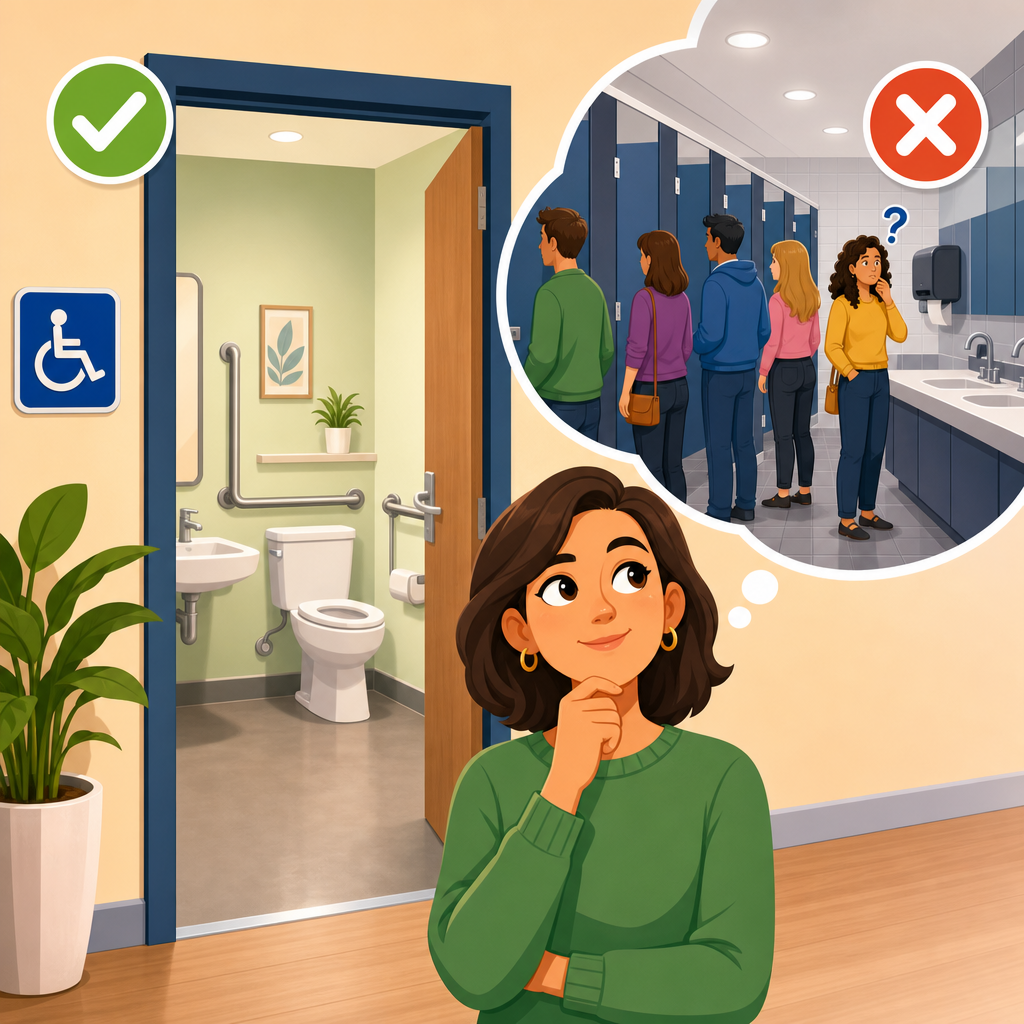
Single-user restrooms are often easier to make ADA compliant because the room serves one occupant at a time, the circulation path is simpler, and fixture counts are lower, but compliance still depends on exact dimensions, clearances, operable parts, and installation details required under Chapter 6: Plumbing Elements and Facilities. In practice, I have found that owners assume a small restroom is automatically compliant, then discover late in construction that a lavatory projects too far, the door swing blocks turning space, or grab bars were anchored in the wrong location. That is why this question matters. Accessibility failures create legal risk, delay certificate of occupancy, and exclude customers, patients, staff, and visitors who rely on predictable restroom access.
To answer the title directly: yes, single-user restrooms are usually easier than multi-user toilet rooms to design, review, and renovate for accessibility, but they are not forgiving. The standards still require a compliant accessible route, maneuvering clearances at doors, adequate turning space, properly located toilet centerlines, grab bars, accessible lavatories, mirrors, dispensers, coat hooks, and clear floor space. Chapter 6 governs plumbing elements and facilities such as drinking fountains, water closets, urinals, bathtubs, showers, sinks, and saunas, while closely interacting with reach ranges, protruding object rules, door requirements, and common circulation provisions found elsewhere in the standards.
For building owners, architects, contractors, and facility managers, this hub page explains how Chapter 6 works as a system. It defines the core terms, answers the most common compliance questions, and shows where single-user restrooms offer practical advantages. It also frames the tradeoffs. A single-user layout can reduce fixture coordination, but a tight footprint can make turning space, latch-side clearance, and plumbing protection harder to achieve. Understanding these issues early leads to cleaner plans, fewer field corrections, and restrooms that are genuinely usable rather than merely close on paper.
Why single-user restrooms often simplify ADA compliance
A single-user restroom typically contains one toilet and one lavatory inside a room used by one person or one assisted user group at a time. Compared with a multi-user restroom, the number of required accessible elements is lower, privacy is better, and the layout can be organized around one clear turning area instead of multiple fixture approaches. In renovations, this matters because existing walls, structural columns, plumbing stacks, and corridor constraints rarely allow ideal geometry. A single-user room gives the design team more freedom to satisfy clearances without also coordinating accessible stalls, ambulatory stalls, banks of lavatories, urinals, and circulation aisles between several users.
The biggest advantage is predictability. In a compliant single-user room, one accessible route enters the room, one turning space is preserved, and each required fixture can overlap with allowed clear floor space more efficiently. Many jurisdictions also permit a unisex or all-gender single-user restroom strategy that improves access for caregivers, parents assisting children, and people who need attendant support. Where a facility is altering an older building, converting two undersized sex-segregated rooms into one or more compliant single-user rooms is often the fastest path to practical accessibility, especially when existing chase locations make wider group restrooms expensive.
That said, easier does not mean optional or approximate. Designers still must verify technical criteria from Chapter 6 and related sections. The common mistakes I see are doors swinging into required maneuvering clearance, accessories mounted above maximum reach range, insulated piping omitted beneath lavatories, and toilet paper dispensers installed where they interfere with side transfer. These are small details with large consequences because accessibility is measured at the point of use. If one feature blocks another, the room may fail even though each item looked acceptable in isolation.
Chapter 6 scope: what plumbing elements and facilities must address
Chapter 6 covers the plumbing components people interact with directly. For a restroom hub article, the most important categories are water closets and toilet compartments, urinals, lavatories and sinks, mirrors, drinking fountains, bathtubs, showers, washing machines, saunas and steam rooms, and related clear floor spaces and operable parts. Some projects also trigger family or assisted-use rooms, locker room showers, and transient lodging bathing rooms. The governing logic is consistent: every required accessible plumbing element must be approached, reached, and used safely by people with mobility limitations, limited reach, and in many cases visual or dexterity impairments.
In a single-user restroom, the focus usually centers on the water closet, lavatory, accessories, and the door. But a complete Chapter 6 review should also include whether the room lies on an accessible route, whether signage is correctly mounted, whether thresholds comply, whether the mirror reflective surface is low enough, and whether soap, towel, and hand-dryer controls are within reach range. If the room includes a shower, adult changing station, or combination bathing fixture, the technical demands increase quickly. The standards are interconnected, so Chapter 6 cannot be read in isolation from clearances, reach ranges, and operable hardware requirements.
For owners building a sub-pillar library under ADA Accessibility Standards, Chapter 6 is the hub because it links most often to practical questions people search every day: How much space does an ADA restroom need? What is the grab bar height? Can a door swing into a restroom? How high can a mirror be? When is a drinking fountain compliant? Those questions seem simple, but correct answers depend on fixture type, room configuration, and whether the element is altered, newly constructed, or technically infeasible to modify fully.
Key dimensions that determine whether a single-user restroom is compliant
The most important dimensions are not the overall room size listed in a rule of thumb, but the required usable spaces around each element. A wheelchair turning space is generally a 60-inch diameter circle or a T-shaped turning space. A compliant water closet needs clear floor space for side transfer, a centerline typically 16 to 18 inches from the adjacent side wall, grab bars on the side and rear walls, and seat height within the required range. A lavatory needs knee and toe clearance below, a rim or counter surface no higher than 34 inches above the finish floor, and insulated or otherwise protected pipes and surfaces to prevent contact burns or abrasion.
Doors are often the deciding factor. The door must provide sufficient clear width, usually 32 inches minimum clear opening, and maneuvering clearance on the pull and push sides as required. In small rooms, an in-swinging door can consume the turning circle or clear floor space at the toilet. That does not automatically make the room noncompliant, because some overlap is permitted depending on the condition, but careless layouts fail frequently. Pocket doors and outswing doors can help, yet each introduces hardware, privacy, and life safety considerations that must be coordinated with code and user expectations.
| Element | Typical compliance checkpoint | Why it matters in single-user rooms |
|---|---|---|
| Door opening | 32-inch minimum clear width | Narrow openings erase accessibility before the user reaches fixtures |
| Turning space | 60-inch circle or compliant T-turn | Small footprints fail here first during renovations |
| Water closet | 16 to 18 inches from side wall to centerline | Transfer position depends on precise placement |
| Lavatory height | 34 inches maximum above finish floor | Countertops are often installed too high by default millwork details |
| Mirror | Reflective surface 40 inches maximum to bottom edge | Common decorative mirrors are frequently mounted too high |
| Accessories | Within reach range and operable without tight grasping | Paper towels and soap are common inspection failures |
These measurements illustrate why single-user restrooms can be easier. There are fewer fixtures competing for the same floor area. However, the tolerance for error is slim. A toilet shifted by one inch, a lavatory trap left uninsulated, or a paper towel dispenser mounted a few inches too high can undermine a room that otherwise seems correct. The best approach is to dimension accessibility features directly on plans and confirm them again in the field before finishes are complete.
Fixture-by-fixture guidance under Chapter 6
Water closets anchor most restroom reviews. In single-user rooms, the toilet is commonly placed beside a side wall to allow transfer from a wheelchair. The side grab bar and rear grab bar must be installed at the correct height and length, and the flush control should be located on the open side where it is easier to reach. Toilet paper dispensers deserve special attention because they are often installed by subcontractors after inspections of rough framing. If placed too far forward, too high, or behind the grab bar in a way that requires awkward reach, they can make the setup unusable.
Lavatories and sinks must provide forward approach with adequate knee and toe space. Vessel sinks, decorative aprons, and deep cabinetry commonly conflict with these requirements. In healthcare and hospitality work, I regularly advise teams to avoid trendy sink forms unless the manufacturer publishes clear accessible mounting details. Faucets must be operable with one hand and without tight grasping, pinching, or twisting of the wrist, so lever handles, sensor controls, and compliant push controls are usually safer choices than small round knobs. Where hot water is supplied, exposed piping and sharp surfaces under the fixture must be insulated or otherwise configured for protection.
Mirrors, hand dryers, soap dispensers, shelves, and waste receptacles look minor but shape actual usability. Mirrors above lavatories must have the reflecting surface low enough for seated users, while full-length mirrors can satisfy the requirement in some designs. Hand dryers and receptacles cannot protrude into circulation in ways that create hazards for blind or low-vision users. If a trash can is movable, staff placement still matters. A room that was compliant at turnover can become inaccessible after a bulky waste bin, diaper station, or cleaning cart blocks the clear floor space.
Drinking fountains, showers, and bathtubs may not be inside a single-user restroom, but Chapter 6 includes them and many facilities need a coordinated approach. A school or office might solve toilet accessibility in a single-user room yet still fail overall if drinking fountains lack proper spout height, knee clearance, or standing-user options. In gyms, shower compartments require exact seat, control, threshold, and grab bar configurations. For hotels, transient lodging bathing rooms raise additional questions about roll-in showers, transfer showers, and communication between guest room types and bathing fixtures. This hub topic works best when each element is treated as part of one accessible user journey.
Renovation challenges, plan review, and common field mistakes
Existing buildings are where the “single-user restrooms are easier” principle shows its value most clearly. Older properties often have narrow structural bays, cast-iron plumbing stacks, masonry walls, and floor slopes that make large group restrooms difficult to rework. Converting an underperforming room into a compliant single-user restroom can avoid extensive relocation of mains and vents. Still, renovation does not erase standards. The design team must document dimensions carefully, assess whether wall reinforcement supports grab bars, and verify that finished conditions match the drawing set rather than rough framing assumptions.
During plan review, I recommend checking six things before permit submission: turning space, door maneuvering, toilet location, lavatory knee clearance, accessory reach ranges, and any overlap between swing arcs and clear floor areas. Then verify mounting heights in a fixture schedule instead of leaving them to installer habit. In the field, the most common failures are surprisingly repetitive: grab bars mounted from the wrong reference point, dispensers installed by manufacturer preference rather than accessibility dimension, base cabinets added late beneath a sink, and door closers adjusted too aggressively for users with limited strength. None of these issues are expensive to prevent, but all of them are expensive to correct after tile and partition work are complete.
Another frequent challenge is treating ADA compliance as a restroom-only issue. The accessible route from parking, lobby, dining area, patient room, or retail floor to the single-user restroom must also work. If the route includes a level change without compliant ramping, heavy hardware at an intervening door, or inadequate signage, the restroom is functionally inaccessible even if its interior dimensions are perfect. Owners should think in terms of whole-path usability, not isolated fixture compliance. That systems view is what keeps a Chapter 6 review grounded in real human use rather than checklist theater.
Best practices for creating a compliant restroom hub strategy
As a sub-pillar hub under ADA Accessibility Standards, this topic should connect single-user restrooms to detailed pages on water closet clearances, grab bar placement, lavatory requirements, drinking fountain standards, shower and bathtub criteria, reach ranges, door maneuvering clearances, and accessible route rules. That structure helps readers move from overview to technical detail without losing context. It also reflects how projects are actually solved: no one decides a restroom is compliant based on one dimension alone. Teams coordinate room geometry, plumbing rough-in, accessory selection, and final installation as one package.
The practical benefit of single-user restrooms is control. With fewer fixtures and users to coordinate, owners can achieve reliable accessibility more quickly, especially in renovations, tenant improvements, small restaurants, medical offices, and retail spaces. But the main lesson from Chapter 6 is precision. Accessibility succeeds when every required element works together at the same time for the person using the room. If you are planning a new build, remodel, or compliance audit, review each plumbing element against the standards early, detail the dimensions clearly, and inspect the final installation with the same rigor you used in design.
So, are single-user restrooms easier to make ADA compliant? Usually yes, and that is exactly why they are such a powerful solution in many buildings. Their simpler layout reduces coordination problems, supports privacy and assisted use, and often provides the clearest route to compliance in constrained spaces. The opportunity is real, but so is the responsibility to execute every detail correctly. Use this hub as your starting point for Chapter 6, then move into the related fixture-specific guidance your project needs, and verify conditions in the field before opening the doors to the public.
Frequently Asked Questions
Are single-user restrooms actually easier to make ADA compliant than multi-user restrooms?
In many cases, yes. A single-user restroom is often easier to make ADA compliant because the space is designed for one occupant at a time, which simplifies the circulation path and reduces the number of plumbing fixtures, accessories, and turning conflicts that must be coordinated. Designers usually have fewer variables to manage, and owners are not trying to fit multiple toilet compartments, banks of lavatories, and shared approach clearances into one room. That said, “easier” does not mean “automatic.” ADA compliance still depends on meeting specific technical requirements for clear floor space, turning space, door maneuvering clearances, toilet location, grab bar placement, lavatory knee and toe clearance, mirror height, dispenser reach ranges, and operable hardware. A single-user restroom can fail just as easily as a larger restroom if even one critical dimension is missed. In practice, the most common problem is the assumption that a small restroom must be compliant simply because it is private and has only one of everything. The reality is that compliance is determined by exact measurements and installation details, not by restroom type alone.
What are the most common ADA compliance mistakes in single-user restrooms?
The most common mistakes usually involve layout and installation rather than the overall concept. A very typical issue is a lavatory or vanity that projects too far into the circulation path or turning space, leaving the room feeling functional but not technically compliant. Another frequent problem is the toilet being placed too close to an adjacent wall or casework, which affects the required clearance and can throw off grab bar placement. Door swings are another major source of trouble, especially when a swinging door overlaps the required clear floor space at the lavatory or creates maneuvering problems for someone using a wheelchair. Accessories are also often installed incorrectly. Toilet paper dispensers, soap dispensers, paper towel dispensers, hand dryers, mirrors, and coat hooks may all be mounted at heights or locations that do not satisfy reach range and accessibility requirements. Owners and contractors also run into issues with operable parts such as faucets, flush controls, and door hardware if they require tight grasping, pinching, or twisting of the wrist. These are not minor details. A restroom can look finished and high-quality yet still fail ADA review because the dimensions, clearances, or mounting heights were not coordinated carefully from the beginning.
Does a small single-user restroom need the same ADA clearances and dimensional requirements as a larger restroom?
Yes. The fact that a restroom is small does not reduce the obligation to comply with the applicable ADA requirements. A compact room still needs proper turning space or another compliant maneuvering strategy where permitted, clear floor space at fixtures, compliant door clearances, and correctly located plumbing elements and accessories. The toilet still has to be positioned correctly in relation to side walls, rear walls, and grab bars. The lavatory still needs the required clearances below and in front, along with appropriately located controls and insulated or otherwise protected pipes where required. Mirrors and dispensers still need to be mounted within the proper accessible ranges. In other words, the room’s size is not an excuse for reduced accessibility. If anything, smaller rooms require more precision because there is less tolerance for error. An inch or two of misplacement can have a major effect when space is tight. That is why single-user restroom design should be approached with the same level of technical rigor as any other accessible restroom, even if the layout appears simple at first glance.
Which features should owners and designers pay closest attention to when planning an ADA-compliant single-user restroom?
The most important features to coordinate early are the door, the toilet area, the lavatory, and the accessory locations. The door affects nearly everything because its swing, width, hardware, and maneuvering clearances can determine whether the room functions accessibly in practice. The toilet area must be laid out carefully so the centerline, side clearance, rear clearance, and grab bar locations all work together as required. The lavatory needs more than just a wheelchair-approachable sink; it also needs proper knee and toe clearance, compliant faucet controls, and enough surrounding space so the user can approach and use it without obstruction. Accessories should never be treated as afterthoughts. A paper towel dispenser, hand dryer, mirror, waste receptacle, or coat hook placed in the wrong spot can reduce clear floor space, protrude into circulation, or fall outside accessible reach ranges. Signage, thresholds, and floor conditions also deserve attention. Even where the primary fixture layout is compliant, details such as a high threshold, difficult latch, or poorly placed trash can can create barriers. The best results come from designing the entire room as a coordinated accessible environment rather than checking off individual fixture requirements one by one.
When is the best time to verify ADA compliance for a single-user restroom?
The best time is as early as possible, ideally during schematic design and definitely before construction begins. ADA problems in single-user restrooms are much less expensive to fix on paper than in the field. Once walls are framed, plumbing rough-ins are set, tile is installed, and accessories are ordered, even a small correction can become costly and disruptive. Early review allows the design team to confirm that the room size, fixture locations, wall backing for grab bars, door configuration, and accessory mounting strategy all work together. A second check should happen during construction document review so that dimensions and mounting heights are clearly shown and not left to interpretation. Then, a final field verification is highly recommended before the project is considered complete. This is where many hidden problems are caught, such as a dispenser installed too high, a mirror mounted incorrectly, a sink apron that reduces knee clearance, or a door closer that requires too much force. In real projects, late-stage discoveries are common because people assume a single-user restroom is straightforward. It is straightforward compared with more complex restroom types, but only when the details are verified carefully at every stage.