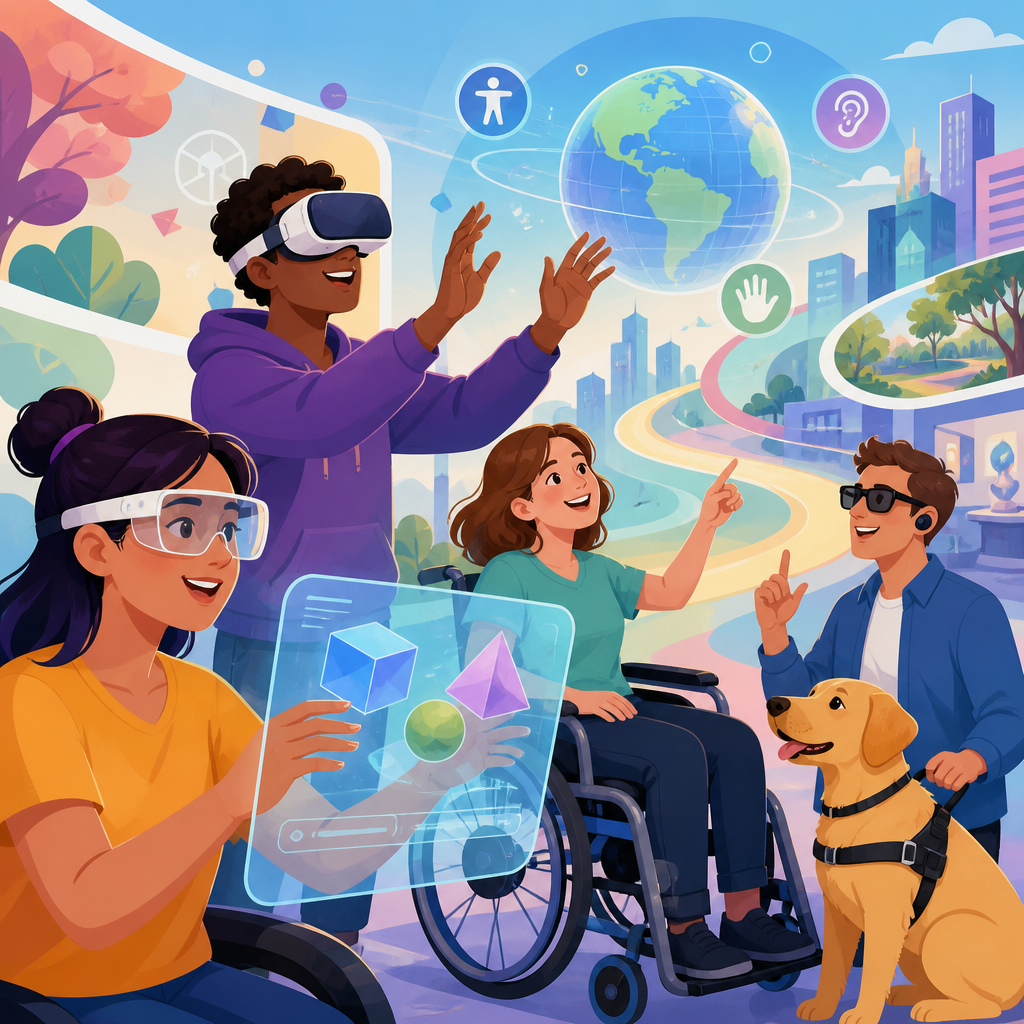
Augmented reality, virtual reality, and mixed reality are moving from novelty to infrastructure, and accessibility policy is struggling to keep pace with that shift. In practical terms, AR overlays digital content onto the physical world, VR replaces the physical environment with a simulated one, and mixed reality blends both so virtual objects can respond to real spaces and user movement. Across product teams, public agencies, universities, retailers, and healthcare systems, these technologies are now used for training, customer service, navigation, education, and entertainment. That matters because when immersive systems become a normal way to work, learn, shop, or receive services, barriers inside those systems become civil rights issues rather than design preferences.
The accessibility policy conversation sits within a broader set of ADA developments in technology and accessibility. In my work reviewing digital products against accessibility requirements, I have seen the same pattern repeat: innovation arrives first, standards mature later, and enforcement eventually catches organizations that assumed emerging technology was exempt. The Americans with Disabilities Act does not list AR headsets or VR platforms by name, but its core principle is durable: covered entities cannot exclude people with disabilities from goods, services, programs, or activities. Courts, regulators, and accessibility practitioners increasingly apply that principle to digital environments, especially when those environments are gateways to employment, education, commerce, healthcare, or government services.
For leaders tracking updates and developments, the policy direction is clear even when the technical details are still evolving. Regulators are leaning toward functional accessibility rather than device-specific loopholes. If a museum uses AR to deliver exhibit interpretation, a retailer uses virtual try-on for online shopping, or an employer uses VR for mandatory training, those experiences must be usable by people with disabilities or have an equivalent accessible path. Accessibility in immersive technology therefore includes sensory, mobility, cognitive, speech, and vestibular considerations, plus compatibility with assistive technologies, captions, audio description, alternative inputs, readable interfaces, safe locomotion, and options that reduce motion, flashing, and overload.
This hub article explains where accessibility policy is heading for AR, VR, and mixed reality, and how ADA developments in technology and accessibility are shaping decisions now. It also serves as the central reference point for related articles on procurement, technical standards, litigation trends, education technology, workplace tools, and public accommodations. The goal is simple: give decision-makers, designers, and compliance teams a clear framework for understanding the risks, the standards that already matter, and the practical steps that reduce exposure while improving inclusion.
Why immersive technology now falls squarely inside accessibility obligations
The first policy trend is expansion by function. Accessibility obligations increasingly attach to what a system does, not whether it looks like a website. If an immersive application performs a core business or public function, policymakers will treat it as part of the digital service stack. That conclusion follows the same path taken with mobile apps, kiosks, streaming media, and online forms. At first, each was argued to be separate from traditional accessibility rules. Over time, regulators and courts focused on user outcomes instead. Can a blind customer complete the transaction? Can a deaf employee access training? Can a person with limited mobility use the interface without unreasonable effort?
That functional approach is reinforced by existing standards and enforcement patterns. The Web Content Accessibility Guidelines remain the most widely cited technical benchmark in digital accessibility policy, even though they were written for web content rather than fully immersive environments. Organizations also look to platform guidance from Apple, Google, Microsoft, and Meta, along with XR-specific research from the W3C Immersive Captions Community Group and academic labs studying motion comfort, multimodal interaction, and spatial audio accessibility. In procurement, Section 508 refresh language, EN 301 549, and vendor accessibility conformance reports often shape requirements before a lawsuit ever appears.
Real-world examples make the direction unmistakable. Universities are using VR labs for nursing simulations and industrial safety training. Employers are adopting immersive onboarding and hazard response scenarios. Retailers deploy AR product visualization for furniture, cosmetics, and eyewear. Cities and transit operators are piloting wayfinding overlays. In each case, excluding disabled users can block access to an otherwise essential service. That is why accessibility teams increasingly insist that immersive experiences be reviewed during product selection, contract drafting, usability testing, and launch governance, rather than treated as experimental side projects.
The policy sources shaping AR, VR, and mixed reality accessibility
No single statute currently offers a complete rulebook for immersive accessibility, but several policy sources are converging. In the United States, the ADA remains the central civil rights framework for public accommodations, state and local government services, and employment. Section 504 applies to federally funded programs, and Section 508 shapes federal procurement and often influences state and higher education purchasing. The Department of Justice has repeatedly emphasized that accessibility duties apply to digital services, and its recent web accessibility rulemaking for public entities confirms a strong regulatory appetite for measurable digital compliance baselines.
International standards are also influencing American practice. EN 301 549 has become a practical procurement anchor because it translates accessibility requirements into testable statements across information and communication technology. ISO standards on ergonomics, human-system interaction, and software quality contribute terminology and methods, even when they are not disability-specific. The XR Access initiative, W3C work on adaptable interfaces, and platform accessibility APIs are helping define what “reasonable accessibility” looks like in spatial computing. In practice, policy often forms through this layered ecosystem: civil rights law establishes the obligation, technical standards define expected methods, and enforcement clarifies consequences.
Organizations should pay close attention to contracts, grants, and accreditation requirements as well. I have seen accessibility risk emerge less from headline lawsuits than from procurement disputes, student complaints, employee accommodation failures, and delayed deployments caused by inaccessible vendor tools. A hospital may buy a VR rehabilitation platform with strong clinical promise, then discover that setup requires tiny visual controls inaccessible to low-vision therapists. A manufacturer may license headset training software, then face accommodation requests from workers who cannot tolerate motion-heavy simulations. These are policy problems because they affect equal access in regulated settings.
Core accessibility issues policymakers are likely to prioritize
Policy is heading toward a predictable set of priority barriers because those barriers repeatedly appear in testing. Captions and transcripts for spoken content are foundational, especially in training, education, and customer support. Audio description or equivalent nonvisual cues matter when critical information is presented spatially or visually. Input flexibility is equally important: users may need voice, switch control, eye tracking, keyboard support, one-handed operation, or seated use. Interfaces must allow text resizing where possible, sufficient contrast, clear focus indication, and readable language. Time limits, complex gestures, and forced fine motor precision are consistent failure points.
Immersive systems add concerns that traditional web policy did not fully address. Motion sickness, balance, and vestibular triggers are not edge cases; they are central usability constraints in VR. Safe locomotion options such as teleport, snap turning, reduced acceleration, and seated modes should be standard. Mixed reality raises field-of-view, occlusion, and depth-perception issues that can affect users with low vision or cognitive disabilities. Spatial audio can improve orientation for some users while creating confusion for others if controls are missing. Policymakers will increasingly expect settings that let users tailor the sensory experience rather than accept a single default mode.
| Policy concern | Typical barrier in immersive tech | Practical mitigation |
|---|---|---|
| Hearing access | Uncaptioned dialogue, alerts, and multiplayer speech | Closed captions, speaker labels, transcripts, visual alerts |
| Vision access | Critical information only shown spatially or with low contrast | Audio cues, high contrast modes, scalable text, object labeling |
| Mobility access | Two-handed gestures, standing-only interaction, reach requirements | Seated mode, remappable controls, one-handed alternatives, voice input |
| Cognitive access | Overstimulating scenes, unclear tasks, dense instructions | Step-by-step guidance, simplified UI, pause controls, repeat prompts |
| Vestibular safety | Smooth locomotion, camera shake, rapid acceleration | Teleport movement, snap turn, comfort vignette, motion reduction settings |
These priorities matter because they are testable and consequential. When an immersive system lacks them, exclusion is often immediate. A deaf student misses required instruction. A worker with limited dexterity cannot complete mandatory onboarding. A user with vestibular sensitivity cannot remain in the experience long enough to access a public service. As standards mature, these barriers will become easier to cite, easier to reproduce, and harder for organizations to defend.
How enforcement and litigation are likely to evolve
Accessibility enforcement for immersive technology will probably follow the route already taken by websites and apps: first complaints and demand letters, then targeted settlements, then broader governance expectations. Plaintiffs’ firms generally pursue the places where inaccessible design intersects with routine public use. That means consumer commerce, education, employment, healthcare, entertainment, and government services are the most likely pressure points. If immersive experiences remain optional marketing extras, risk is lower. Once they become primary or required channels, risk rises sharply because denial of access becomes easier to demonstrate.
Employment is especially significant. Under Title I, employers must provide reasonable accommodation and avoid qualification standards that screen out disabled workers unless job related and consistent with business necessity. If an employer adopts VR-only safety training or performance assessment without accessible alternatives, the compliance problem is obvious. Public entities and schools face similar exposure when immersive tools become part of instruction, orientation, or service delivery. The strongest claims often do not hinge on futuristic arguments. They hinge on ordinary facts: a required task, a disabled user, a blocked pathway, and a feasible alternative that was not provided.
Expect documentation to become more important. Organizations that can show accessibility review in procurement, user testing with disabled participants, issue tracking, and remediation plans will be in a stronger position than those relying on vendor assurances alone. In audits I have participated in, the most damaging sentence is usually, “We assumed the platform handled accessibility.” Policy is moving away from assumption and toward evidence. If immersive content is central to service delivery, teams should be ready to explain what standard they used, what barriers they found, what alternatives exist, and how users can request support.
Design and procurement practices that align with where policy is heading
The most effective response is to treat immersive accessibility as a lifecycle requirement, not a patch. Start in procurement. Ask vendors for accessibility conformance reports, testing methodologies, known limitations, roadmap commitments, and documentation for captions, alternative inputs, comfort settings, and assistive technology compatibility. Require remediation timelines in contracts. For custom builds, include accessibility acceptance criteria in statements of work. If a vendor says no standard exists, that is not a green light; it is a signal to define measurable functional requirements based on user needs and established digital accessibility principles.
During design and development, teams should map user journeys by disability scenario as rigorously as they map business requirements. I advise clients to test every critical flow in at least four ways: without audio, without precise hand tracking, in seated mode, and with reduced motion. That simple exercise exposes many failures early. Add disabled participants to formative and summative testing, because simulated testing by nondisabled staff misses real friction. Document alternatives for every critical task. If a virtual lab cannot be made fully accessible yet, the equivalent path must be meaningful, timely, and not academically or professionally inferior.
Governance completes the picture. Publish an accessibility statement for immersive products, train support staff to handle accommodation requests, and maintain a remediation backlog with ownership and deadlines. Link immersive accessibility work to broader ADA developments in technology and accessibility across websites, mobile apps, kiosks, documents, and AI systems. Organizations that build one governance model across all digital channels move faster and defend decisions better than those creating separate silos for each technology wave.
What this means for the broader ADA technology landscape
AR, VR, and mixed reality are not isolated compliance topics; they are the next chapter in digital accessibility policy. The same legal and operational logic shaping websites, apps, self-service kiosks, AI interfaces, and connected devices is now extending into spatial computing. For organizations following updates and developments, the takeaway is straightforward: immersive experiences will increasingly be judged by whether disabled people can use them effectively, safely, and with substantially equivalent independence. Waiting for a perfect immersive-specific rulebook is a losing strategy because obligations are already emerging through existing law, procurement standards, platform guidance, and user complaints.
This hub should anchor your work on ADA developments in technology and accessibility. The key themes are consistent across the subtopic: assess by function, design for multiple disabilities, demand evidence from vendors, and document your process. Teams that act now will avoid rework, reduce legal risk, and deliver better products for everyone. Use this page as your starting point, then review the connected articles on standards, audits, procurement, litigation, education, and workplace technology to build an accessibility program that can keep pace with immersive change.
Frequently Asked Questions
What makes accessibility policy for AR, VR, and mixed reality so challenging right now?
Accessibility policy is struggling because immersive technologies are evolving faster than the rules and standards meant to govern them. Traditional accessibility frameworks were largely written for websites, software interfaces, documents, kiosks, and mobile apps with familiar inputs like keyboards, touchscreens, and screen readers. AR, VR, and mixed reality introduce entirely different interaction models, including head tracking, hand gestures, spatial audio, eye gaze, body movement, environmental scanning, and persistent 3D content layered into real spaces. That creates policy questions that older compliance models were not designed to answer clearly.
Another challenge is that these technologies no longer sit at the edge of innovation. They are increasingly being used in education, healthcare, retail, workforce training, public services, manufacturing, and entertainment. Once immersive tools start shaping how people learn, shop, access care, or complete jobs, accessibility becomes a civil rights, procurement, and risk-management issue rather than just a design preference. Policymakers and organizations are now being pushed to decide whether existing laws apply as-is, whether current technical standards can be adapted, or whether entirely new guidance is needed.
There is also a practical enforcement problem. Many immersive systems combine hardware, operating systems, software platforms, sensors, cloud services, and third-party content. When a user encounters a barrier, responsibility may be split across multiple vendors. Policy is therefore heading toward broader accountability: not just asking whether an app is accessible, but whether the full experience is perceivable, operable, understandable, and robust for people with disabilities across devices and contexts.
How are existing accessibility laws likely to apply to AR, VR, and mixed reality experiences?
In many cases, organizations should expect existing accessibility obligations to apply even if the technology feels new. Laws and regulations generally focus on equal access to services, programs, employment, education, and public accommodations, not just on older technical formats. That means if an AR shopping tool, a VR training module, or a mixed reality classroom environment becomes part of how an organization delivers important information or services, it will likely fall under the same broad accessibility expectations that already apply elsewhere.
What is changing is the interpretation. Regulators, courts, procurement officers, and institutional compliance teams are increasingly looking beyond simple web-page accessibility and asking whether immersive experiences create barriers for people with visual, auditory, cognitive, speech, or mobility disabilities. For example, if a VR onboarding experience is required for employees, an employer may need to provide equivalent access, accommodations, or a more accessible alternative. If a university uses immersive coursework, students with disabilities may need accessible participation options rather than being excluded by default.
Policy direction is therefore moving toward functional equivalence and outcome-based access. Even where immersive-specific rules are still immature, the safer assumption is that organizations cannot avoid accessibility duties simply by adopting a new interface category. Teams should treat AR, VR, and mixed reality as part of their broader compliance landscape, alongside digital accessibility, disability rights obligations, procurement standards, and user safety responsibilities.
What accessibility features and design practices are likely to become expected in immersive experiences?
Baseline expectations are expanding quickly. In immersive environments, accessibility is likely to include alternatives for visual, auditory, motor, and cognitive interaction from the start. That can mean captions for spoken content, transcripts for audio-based experiences, visual alternatives for sound cues, adjustable text size and contrast, simplified interfaces, customizable timing, and clear navigation aids within 3D space. It may also include seated and standing modes, one-handed controls, reduced-motion settings, sensitivity adjustments, and support for assistive technologies where technically possible.
For AR and mixed reality in particular, accessibility may also depend on how digital content behaves in physical environments. Developers may need to ensure overlays are legible against changing backgrounds, not dependent on precise color perception, and not positioned in ways that are hard to reach, track, or interpret. In VR, expectations often center on comfort and control: minimizing motion-triggered discomfort, avoiding unnecessary sensory overload, and giving users multiple ways to complete actions without requiring exact gestures or rapid physical movement.
The larger policy trend is that accessibility will increasingly be treated as a core quality attribute, not an add-on. Organizations are being pushed to document accessible user journeys, provide user controls, test with disabled participants, and define what “equivalent access” means in immersive contexts. As standards mature, features that are now considered advanced may become baseline requirements in purchasing, public-sector adoption, and enterprise deployment.
How should organizations prepare for future accessibility policy if formal standards for XR are still developing?
The smartest approach is not to wait for perfect rules. Organizations should begin by applying established accessibility principles to immersive products now, while also monitoring emerging standards, regulatory guidance, and case law. That means building cross-functional governance involving legal, accessibility, design, engineering, procurement, and security teams. If AR, VR, or mixed reality is being evaluated for training, customer engagement, education, healthcare delivery, or public service access, accessibility should be part of vendor review and program planning from the beginning.
Procurement is especially important. Buyers should ask vendors specific questions about captioning, input alternatives, compatibility with assistive technologies, motion sensitivity options, user customization, and testing with people with disabilities. They should also request accessibility documentation, roadmaps, and remediation commitments. Even if no single XR-specific standard is universally controlling yet, contract language can reduce risk and create leverage for improvement.
Internally, organizations should pilot responsibly. Run accessibility reviews early, include disabled users in research and testing, and maintain alternative access paths when an immersive experience cannot yet be made fully inclusive. Teams should also document decisions carefully, especially in regulated sectors. Future policy is likely to reward organizations that can show good-faith efforts, measurable accessibility practices, and a clear process for identifying and removing barriers as immersive systems scale.
Where is accessibility policy for AR, VR, and mixed reality most likely heading over the next few years?
The direction is toward clearer expectations, broader coverage, and less tolerance for treating immersive technology as exempt from mainstream accessibility rules. Policymakers and standards bodies are likely to focus on adapting existing digital accessibility concepts to 3D, spatial, and multimodal environments rather than starting from scratch. In practice, that means more guidance on how to evaluate immersive interfaces, more procurement requirements, and more pressure on large platforms and institutional adopters to demonstrate inclusive design.
We are also likely to see accessibility policy become more integrated with product safety, consumer protection, education access, workplace accommodation, and public-sector technology governance. Immersive systems can affect orientation, attention, privacy, physical comfort, and situational awareness, so accessibility will increasingly be discussed alongside human factors and risk management. That is especially important when these tools are used in healthcare, employment, or essential public services, where exclusion can have serious consequences.
Perhaps most importantly, policy is heading toward a more realistic understanding of access: not every user will interact with immersive technology in the same way, and compliance cannot rest on one default user profile. The future likely includes stronger expectations for flexibility, personalization, and equivalent pathways. Organizations that assume accessibility is only a future issue are likely to fall behind. Those that build inclusive XR practices now will be better positioned for compliance, procurement success, user trust, and long-term adoption.


