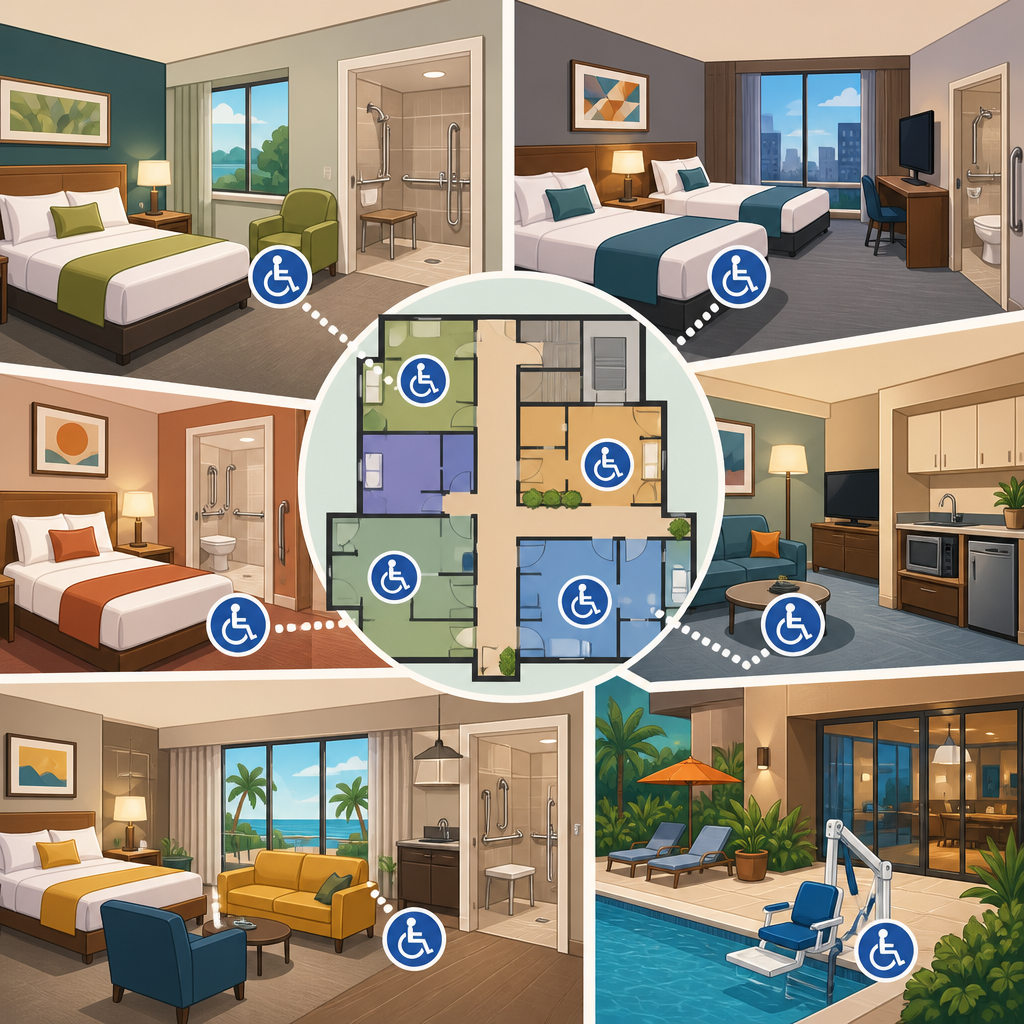
Dispersing accessible guest rooms across room types and amenities is a core requirement in lodging accessibility, and it affects hotel design, renovation planning, reservation systems, and daily operations. In ADA Accessibility Standards for lodging, dispersion means guests with disabilities must have choices comparable to other guests, not a narrow set of rooms placed in one corner of the property. In practice, that includes offering accessible options across price categories, bed configurations, views, floor levels, and special features such as concierge access, kitchens, patios, or club lounges when those features are available to other guests. I have worked with hotel teams during new construction reviews and property improvement plans, and this is one of the most commonly misunderstood parts of lodging compliance because many operators focus only on room counts and overlook room variety.
The topic matters because an accessible hotel room is not a single product. A business traveler may need a mobility accessible king near meeting space, a family may need a hearing accessible suite with a roll-in shower and kitchenette, and a resort guest may want an accessible room with the same oceanfront experience sold at a premium to everyone else. If accessibility is concentrated only in standard rooms with the least desirable attributes, the property effectively limits equal access even if it technically provides the minimum number of rooms. The ADA Standards address this by linking accessible guest rooms to dispersion among classes of sleeping accommodations and by requiring comparable choices, while reservation rules under federal regulations reinforce the obligation to describe and hold those rooms accurately for guests who need them.
For a lodging and guest rooms compliance strategy, this page serves as a hub: it explains what dispersion means, how room types and amenities should be evaluated, where common mistakes occur, and how hotel owners can build a practical audit process that connects design standards with booking and operations.
What dispersing accessible guest rooms means in lodging
Dispersing accessible guest rooms means more than placing required accessible rooms throughout a building. The controlling idea is comparable choice. If a hotel offers multiple classes of guest rooms, the accessible inventory should be available in those classes to the extent required by the standards. A class can be defined by factors such as room type, size, bed count, view, pricing tier, floor location, or special amenity package. For example, if a property has standard queens, deluxe kings, one-bedroom suites, and executive-level rooms, the accessible room mix should not exist only in standard queens. Guests who need accessibility must be able to reserve room types similar to those offered to guests without disabilities.
This requirement is especially important in larger properties where inventory segmentation drives revenue. Urban full-service hotels often separate rooms by club access, skyline view, corner layout, or premium bath features. Resorts may separate by beach access, balcony size, casita location, or villa format. Extended-stay hotels distinguish between studios and larger suites with kitchens. In each case, the accessibility review must start with the room taxonomy used by the property itself, because that taxonomy reflects what the market is buying. If the hotel treats two rooms as different products for rate and merchandising purposes, accessibility analysis should usually treat them as distinct classes as well.
The standards also distinguish between mobility features and communication features. Some rooms provide mobility accessibility, such as accessible routes, maneuvering clearances, compliant bathrooms, and roll-in showers or accessible tubs. Others provide communication accessibility, such as visible notification devices for fire alarm, door knock, and incoming telephone or doorbell alerts. In real projects, I advise teams to map both categories separately. A property may satisfy one count while failing the other, especially after partial renovations or inconsistent room conversions.
How room types, classes, and amenities should be evaluated
Hotels often ask a simple question: what exactly counts as a different room type for dispersion purposes? The most reliable answer is functional and market based. If the room is sold, priced, or described differently because it offers a distinct experience, layout, or amenity, it should be reviewed as a separate category. Bed type is a common example. A property that sells kings, double queens, and accessible suites cannot place all mobility accessible inventory in double queens and claim compliance for all guests. Families, couples, and solo travelers choose rooms differently, and accessible guests must have similar options.
Amenities also matter when they create premium experiences. Club-level access, private balconies, wet bars, kitchenettes, fireplaces, connecting-room capability, and premium views can all affect dispersion analysis. Consider a ski resort with slope-side rooms and standard village-view rooms. If only village-view rooms are accessible, a guest using a wheelchair is denied the same lodging choice central to that resort’s value proposition. The same principle applies at conference hotels where executive-floor inventory includes lounge access and quieter layouts for business travelers. Accessibility cannot be confined to the least marketable stock.
Properties should also examine floor locations and travel distances. A hotel may technically disperse accessible rooms among categories yet still place them far from key amenities such as elevators, pools, or meeting rooms. That can create operational friction and guest dissatisfaction even when the room itself meets dimensional requirements. Best practice is to review room assignment patterns alongside physical compliance. I have seen front desks repeatedly hold back certain accessible rooms because housekeeping access was easier or because maintenance preferred one stack of bathrooms. Over time, those informal practices can undermine the original design intent.
| Room classification factor | Why it matters for dispersion | Example of a compliant approach |
|---|---|---|
| Bed configuration | Different travelers need different sleeping arrangements | Accessible kings and accessible double queens are both available |
| Pricing tier | Guests must have choices across rate bands | Accessible rooms appear in standard and premium categories |
| View or location | Premium views are a distinct lodging product | Oceanfront accessible rooms are offered, not only parking-lot views |
| Suite type | Larger layouts serve families and longer stays | One-bedroom accessible suites include the same kitchen package |
| Special amenities | Amenity packages shape the guest experience | Club-level accessible rooms include lounge access and compliant routes |
Design standards that shape accessible guest room distribution
The ADA Standards establish minimum numbers of accessible sleeping rooms and communication feature rooms based on total guest room counts, with additional rules for rooms with roll-in showers. Those numeric scoping requirements are only the starting point. The design side then determines whether each accessible room actually functions within its assigned class. Clear floor space, door maneuvering clearances, accessible hardware, bathroom turning space, shower controls, grab bars, lavatory knee clearance, and operable parts all influence whether a room can truly represent a category offered to the public.
Bathtub rooms and roll-in shower rooms deserve special attention. Many properties meet the required number of mobility rooms but cluster all roll-in showers in one room type, often the least expensive category. That can create a mismatch for guests who specifically need a roll-in shower and also need a suite, a premium location, or multiple beds. During plan review, I recommend checking not just total counts but the intersection of counts and categories: how many accessible kings have tubs, how many have roll-in showers, how many accessible suites exist, and whether hearing-accessible features are paired appropriately across those options.
Alterations add another layer. Existing hotels undergoing renovations may trigger accessibility obligations in the altered rooms, affected paths of travel, and related elements. Teams sometimes convert a few standard rooms into accessible rooms because plumbing lines are convenient, then stop there. That approach may satisfy construction logistics but fail to create appropriate dispersion. A sound renovation strategy starts with an inventory matrix before drawings are finalized. Once bathroom stacks, FF&E schedules, and brand prototypes are set, changing room distribution becomes far more expensive.
Reservation systems, inventory controls, and guest communication
Physical compliance does not solve dispersion if the booking system hides accessible choices or mislabels features. Federal lodging reservation rules require hotels to identify accessible features in enough detail for a guest to assess whether a room meets individual needs and to hold accessible rooms for those who need them until other rooms of that type have been rented. In practice, that means the property management system, central reservation platform, brand website, and third-party channels must use consistent room names and feature descriptions.
A common failure point is collapsing multiple accessible room products into one generic label such as “Accessible Room.” That label tells the guest almost nothing. A better listing states the bed type, bathing option, communication features, and key amenities, for example: “Deluxe King Mobility Accessible with Roll-In Shower and Visual Alarms” or “One-Bedroom Suite Hearing Accessible with Tub and Kitchen.” The description should also note important attributes such as balcony accessibility, patio thresholds, accessible route to the lounge, or transfer space at the bed if those details affect usability.
Revenue management can also distort accessibility if room type controls are not carefully built. I have seen premium accessible rooms downgraded in the system because staff feared they would go unsold, which caused accessible guests to lose equal access to premium inventory and created false scarcity in standard categories. Training should cover room blocking, out-of-order procedures, oversell protections, and upgrade practices. Front desk staff should never move an accessible booking to a nonaccessible room without informed guest agreement, and “complimentary upgrade” logic should not override accessibility needs.
Common compliance mistakes in hotels and resorts
The most frequent mistake is treating accessibility as a count exercise instead of a choice exercise. A hotel may proudly report that it has the required number of accessible rooms, yet every one of those rooms is a standard room with a courtyard view and two beds. That inventory may work for some guests, but it does not provide comparable choices to a guest who wants a premium king, suite, or view category. The problem is usually created upstream, when architects, owners, and brands review scoping tables without comparing them to the room mix sold by the property.
Another mistake is failing to align accessible features with the amenity itself. For example, a resort may advertise accessible guest rooms in a tower where the spa, adults-only pool, or club lounge is not on an accessible route, undermining the value of that room category. Similarly, an accessible villa with a kitchenette may still be unusable if upper cabinets, appliance controls, or dining clearances were not properly designed. Compliance cannot stop at the guest room door; it must extend through the features that define the stay.
Communication breakdowns are also common. Marketing may show photos of a balcony room while reservations assign an accessible room with no equivalent outdoor access. Housekeeping may stage furniture in ways that reduce required clearances. Maintenance may replace compliant shower heads, grab bars, or door closers with nonmatching parts that affect usability. These are not minor issues. In complaints and settlement work, the gap between documented design intent and actual operating condition appears again and again, especially in franchised hotels where responsibilities are split among owner, manager, and brand.
How to audit and improve lodging guest room accessibility
The most effective audit starts with a room inventory matrix listing every sellable category, number of rooms in that category, accessibility type, bathing fixture, communication features, and major amenities. Then compare that matrix to the property’s public booking taxonomy. Any category sold at a distinct rate or with a distinct description should be visible in the accessibility review. Next, verify each representative room in the field. Measure bathroom clearances, bed heights, route widths, threshold conditions, and reach ranges; test visual alarms and notification devices; and confirm signage and door hardware. Photos tied to room numbers are essential because accessible inventory often drifts over time.
After the physical audit, review digital and operational controls. Check website descriptions, CRS and PMS room codes, OTA listings, pre-arrival scripts, maintenance standards, and staff training. I recommend running test reservations for at least three scenarios: a guest who needs a roll-in shower, a guest who needs hearing features, and a guest who wants a premium amenity such as a suite or view while also needing accessibility. If the reservation path breaks in any of those scenarios, the property does not have a complete compliance strategy.
For owners and operators building an ADA Accessibility Standards hub around lodging and guest rooms, the practical takeaway is clear: accessible room dispersion is about equal choice, not isolated compliance. Review room classes the way guests shop for them, distribute accessible inventory across meaningful categories and amenities, align bathrooms and communication features with those categories, and make sure reservation systems present that inventory accurately. Hotels that do this well reduce complaint risk, improve guest trust, and create a better product for everyone. Use this page as the starting point for deeper reviews of guest room scoping, suites, bathrooms, roll-in showers, communication features, and reservation compliance across your property portfolio.
Frequently Asked Questions
What does it mean to disperse accessible guest rooms across room types and amenities?
Dispersing accessible guest rooms means a lodging property cannot limit accessibility to just one small cluster of rooms or one basic room category. Instead, accessible rooms must be offered in a way that gives guests with disabilities choices that are comparable to those available to other guests. In practical terms, that means accessible accommodations should be spread across different room classes, price points, bed configurations, views, locations within the property, and amenity packages to the extent those features are provided in the hotel.
For example, if a hotel offers standard king rooms, double-queen rooms, suites, rooms with balconies, high-floor rooms, premium-view rooms, and club-level rooms, accessibility should not be limited only to a few standard first-floor units. The goal is equivalent opportunity. A guest who needs an accessible room should still be able to choose among different experiences in roughly the same way another guest can. Dispersion is therefore about more than counting rooms. It is about preserving meaningful consumer choice and avoiding a situation where accessibility is technically present but functionally restrictive.
Why is room dispersion such an important ADA issue for hotels and other lodging properties?
Room dispersion is important because the ADA standards for lodging are designed to ensure equal access, not merely minimal compliance. If accessible rooms are concentrated in one area, one room type, or one pricing tier, guests with disabilities may be denied the same range of options other guests enjoy. That can affect comfort, privacy, family travel arrangements, budget decisions, and the overall guest experience.
Consider a property where all accessible rooms are near service areas, all are double-queen rooms, or all are in the lowest-priced category. Even if the hotel has the correct number of accessible rooms overall, guests who need those rooms would still have fewer choices about how they stay. They might be unable to book a premium room, a suite for a family trip, a king room for business travel, or a room with the same amenities associated with a particular rate plan. The ADA approach recognizes that equal access includes comparable options in lodging inventory, not just a doorway that meets clearance requirements.
This is also a major operational and business issue. Properties that fail to disperse accessible rooms often run into problems in renovations, online booking systems, inventory controls, and guest complaints. By planning for proper dispersion early, hotels reduce compliance risk while improving the experience for a wider range of travelers.
How should hotels apply dispersion across price categories, bed types, and special amenities?
Hotels should look at the full range of room offerings and ask whether accessible guests have substantially similar choices. That usually starts with room type analysis. If a property offers both king and double-queen rooms, accessible versions should not be limited to just one bed type where the inventory mix requires broader choice. The same principle applies to suites, extended-stay units, connecting rooms, specialty rooms, and other distinct categories offered to the public.
Price category is another major factor. If the property has economy, mid-tier, and premium room classes, accessible rooms should be represented across those levels rather than concentrated only in the least expensive category. Likewise, if the hotel sells rooms based on amenities such as enhanced views, balconies, patios, club access, kitchenettes, fireplaces, or higher floors, accessible options should be included among those offerings when feasible and when those features are part of the hotel’s inventory structure.
Dispersion does not require identical duplication of every single feature in exact proportion in every circumstance, but it does require a thoughtful distribution that gives guests with disabilities comparable choices. Hotels should evaluate inventory patterns, public-facing marketing categories, and how guests actually shop for rooms. If a room distinction affects how a room is priced, promoted, or selected, it should usually be considered in the dispersion analysis.
How does accessible room dispersion affect reservation systems and front desk operations?
Dispersion has direct consequences for how room inventory is built and managed in reservation systems. A hotel cannot effectively offer dispersed accessible rooms if its property management system or booking engine lumps all accessible rooms into a single generic category. Each accessible room should be mapped accurately to its actual room type and features so guests can identify and reserve accommodations that match both their accessibility needs and their travel preferences.
That means reservation platforms should describe accessible features clearly and distinguish among mobility-accessible and communication-accessible options where applicable. The system should also allow staff and guests to see whether an accessible room is a king, double-queen, suite, premium-view room, or other category. Without that level of detail, a hotel may unintentionally undermine dispersion even if the physical rooms themselves were designed correctly.
At the operational level, front desk and reservations staff need training to understand that accessible rooms are not interchangeable placeholders. Reassigning a guest to a different accessible room type without considering bed layout, amenity level, location, or communication features can create access barriers and service failures. Good operations depend on preserving the integrity of dispersed inventory, honoring reservations accurately, and avoiding the common mistake of treating accessibility as separate from the hotel’s broader room-merchandising structure.
What should hotels consider during new construction, renovations, or room conversions to maintain proper dispersion?
During design and renovation planning, hotels should address dispersion at the earliest programming stage, not after room layouts are already fixed. Teams should review the property’s room matrix and intentionally place accessible rooms across the relevant room types, pricing bands, and amenity groupings. Waiting until late in the process often leads to accessible rooms being squeezed into the easiest locations rather than distributed in a way that supports comparable guest choice.
Renovations require especially careful analysis because older properties often have accessibility concentrated in limited areas or in outdated room categories. When rooms are being reclassified, combined, upgraded, or converted into suites or specialty products, the hotel should reassess whether accessible inventory remains properly dispersed afterward. A renovation can accidentally create noncompliance if premium rooms are added or rebranded without preserving accessible options in those categories.
Hotels should also coordinate architecture, interior design, operations, revenue management, and IT teams. Dispersion is not just a construction issue. It affects room coding, online descriptions, sales strategy, and inventory control. A strong compliance approach includes documenting how accessible rooms are distributed, checking that reservation systems reflect that distribution correctly, and reviewing room assignment practices after reopening. In short, dispersion should be treated as an ongoing lodging-accessibility strategy rather than a one-time checklist item.