Booking an accessible hotel room should not feel like guessing, yet many travelers still arrive unsure whether they reserved the right type of space for their needs. The difference between mobility-accessible and communication-accessible hotel rooms matters because each room type is designed around a distinct set of accessibility barriers, and choosing the wrong one can affect safety, comfort, independence, and even whether a trip is workable at all.
In hotel accessibility, “mobility-accessible” generally refers to guest rooms and bathrooms designed for people who use wheelchairs, scooters, walkers, canes, prosthetics, or who otherwise need features that improve physical access. “Communication-accessible” refers to rooms equipped for guests who are deaf, hard of hearing, or who have speech-related communication needs, typically through visual notification devices, telephone amplifiers, text-capable or TTY-compatible equipment, and alert systems tied to the door, phone, and alarms.
I have worked with lodging operators, reservation teams, and accessibility auditors long enough to know that confusion often starts at booking. A traveler sees “accessible room,” assumes it covers all needs, and only later learns that a roll-in shower, lowered peephole, visual fire alarm, or notification device was not included. That confusion is common because hotels often compress several room attributes into short listing labels, while guests may have layered access requirements that span both mobility and communication.
For anyone researching ADA accessibility standards for lodging and guest rooms, this distinction is foundational. Hotels in the United States generally align room features with federal accessibility rules for transient lodging, but inventory can vary by property age, renovation history, brand standards, and room configuration. Some rooms are mobility accessible only. Some are communication accessible only. Some combine both. Understanding what each category usually includes helps travelers ask better questions, helps hotel teams describe inventory accurately, and helps property owners avoid costly service failures and complaints.
What a mobility-accessible hotel room includes
A mobility-accessible hotel room is built to reduce physical barriers in sleeping areas, routes, entries, controls, and bathrooms. The exact features depend on room type and whether the bathroom includes a roll-in shower, transfer shower, or accessible tub, but the purpose is consistent: make the room usable for a guest with limited mobility without requiring unsafe transfers, excessive reaching, or assistance for basic tasks.
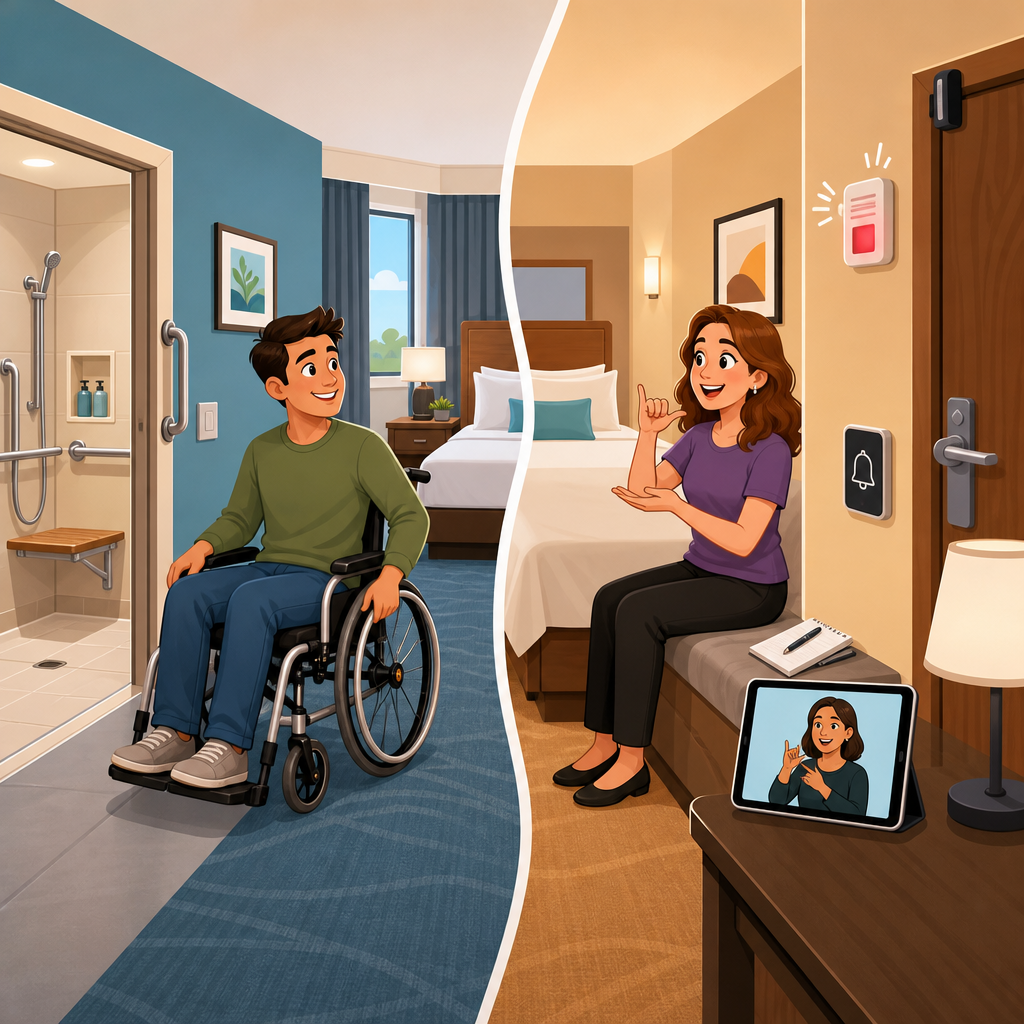
In practice, that usually means wider clear floor space, an accessible route into and through the room, hardware that can be used without tight grasping or twisting, and bathroom layouts that support turning, transfer, and approach. Common features include lower light switches and thermostats, lever door handles, beds with maneuvering clearance, accessible closet rods or shelving, and peepholes or door latches placed within reachable height ranges. In bathrooms, look for grab bars, reinforced walls, accessible lavatories, and one of the required bathing options. A roll-in shower allows direct wheelchair entry. A transfer shower is smaller and assumes the guest can transfer onto a seat. An accessible tub may work well for guests who need grab bars but prefer bathing to showering.
These distinctions matter in real use. I have seen travelers reserve a “hearing accessible” room when what they actually needed was a roll-in shower after spinal surgery. I have also seen guests who use walkers do perfectly well in a room labeled mobility accessible with an accessible tub rather than a roll-in shower. Mobility needs are not one-size-fits-all, so the room subtype is often as important as the accessible label itself.
What a communication-accessible hotel room includes
A communication-accessible hotel room is designed for guests who need alerts and in-room communication tools in visual or amplified formats rather than standard audible formats alone. The central issue is not floor space or fixture height. It is whether the guest can reliably receive important information such as someone knocking at the door, the telephone ringing, or a fire alarm activating.
Typical communication features include visible notification devices for the doorbell or door knock, visible alerts for incoming telephone calls, and visible fire alarm notification appliances. Rooms may also include telephones with volume control, TTY availability, or other compatible communication equipment depending on the property’s systems and brand requirements. Some hotels can provide portable alert kits with a bed shaker, visual signaler, and telephone or door notifier, while others have hardwired systems installed in designated rooms.
The best way to think about a communication-accessible room is this: it translates critical room events into formats a deaf or hard of hearing guest can detect independently. That independence is the real benefit. Without it, a guest can miss housekeeping, room service, emergency information, or an overnight alarm. In an emergency, that is not a convenience issue; it is a life-safety issue.
Key differences at a glance
The simplest difference is that mobility-accessible hotel rooms address physical access, while communication-accessible hotel rooms address alerting and information access. A guest using a wheelchair may not need visual alarms. A deaf guest may not need a roll-in shower. Many travelers need only one category, but some need both, and booking systems do not always make that obvious.
| Room type | Primary need addressed | Typical features | Best for |
|---|---|---|---|
| Mobility-accessible | Physical movement and bathroom access | Accessible route, maneuvering clearances, grab bars, lower controls, roll-in shower, transfer shower, or accessible tub | Wheelchair users, walker users, guests with limited balance, strength, or reach |
| Communication-accessible | Alerting and information access | Visual fire alarm, visual door notification, visual phone alert, amplified phone, compatible communication devices | Deaf or hard of hearing guests and others needing non-audible alerts |
| Both mobility and communication accessible | Combined physical and alerting access | Mobility features plus visual and amplified communication features | Guests with overlapping needs or companions sharing one accessible room |
When comparing room options, the bathroom is usually the deciding factor for mobility users, while the alarm and notification system is usually the deciding factor for communication access. That is why travelers should read every room attribute, not just the first accessibility label they see.
How ADA lodging standards shape hotel room types
Hotels do not invent these categories from scratch. In the United States, accessible lodging inventory is generally driven by federal design standards that specify how many accessible guest rooms must be provided, what dispersion is required among room classes, and which features belong in mobility and communication rooms. Properties must also consider reservation practices, including how accessible features are identified and held for people who need them.
For mobility-accessible rooms, standards focus on clearances, routes, operable parts, and bathing fixtures. For communication-accessible rooms, standards focus on visible alarms, notification devices, and usable telephones. Those requirements are technical, but the outcome for travelers is practical: the room should be independently usable by the guest it was designed to serve.
There are limits, however. Compliance does not mean every accessible room fits every disability. A guest who can transfer independently may find a transfer shower completely adequate. A power wheelchair user may need a roll-in shower and more turning space. A deaf traveler may be fine with a built-in visual alarm but still need confirmation that the door notification system is functioning. ADA-based room categories provide a framework, not a guarantee that every individual preference is met.
Common room features in lodging and guest rooms
As a hub for lodging and guest room accessibility, it helps to understand the broader feature set travelers often compare across hotels. In sleeping areas, common accessible elements include bed height that permits transfer, route clearance around one side of the bed, accessible drapery controls, reachable outlets, and hardware that can be operated with a closed fist. In bathrooms, guests usually compare shower type, shower seat configuration, handheld shower spray, toilet clearance, sink knee clearance, mirror height, and grab bar placement.
In communication-accessible rooms, travelers should verify whether visual alerts are permanently installed or provided through portable equipment, whether the room phone has amplification, and how emergency alarms are conveyed. For hearing access, one missing device can make the whole room functionally inaccessible. For mobility access, one misplaced vanity, heavy bathroom door, or bathtub threshold can create the same result.
This is also why subtopics under lodging and guest rooms matter. Travelers often need deeper guidance on roll-in versus transfer showers, accessible hotel bathroom layouts, reservation rights, service animal handling in guest rooms, and what to do when an assigned accessible room is unavailable. A strong hub article should connect these questions because no single room label answers them all.
Booking the right accessible room without surprises
The best booking strategy is to match the room features to the functional tasks you need to perform. Start with direct questions. Do you need to enter the shower in a wheelchair, transfer onto a seat, hear or see the fire alarm, receive a visual door knock alert, or reach controls from a seated position? Once those needs are clear, compare them against the room description and confirm with the property before arrival.
When I advise travelers, I recommend asking for the exact bathroom type, whether the room is mobility accessible, communication accessible, or both, and whether any alert devices are built in or portable. Request photos if the website language is vague. Ask whether beds are fixed platform beds that limit transfer space. Confirm whether the accessible room is held in the reserved room type and not subject to substitution. These questions prevent most check-in disputes.
Booking direct with the hotel or through a brand site often gives better accessibility detail than an online travel agency, although that is not universal. Third-party platforms may abbreviate room labels or omit crucial subtype information. If you use a third-party site, call the hotel immediately after booking and document the confirmation. That extra step is worth it.
Frequent misunderstandings travelers should avoid
The most common misunderstanding is assuming “accessible” automatically includes both mobility and communication features. It often does not. Another frequent mistake is assuming every mobility-accessible room has a roll-in shower. Many do not. Some have transfer showers or accessible tubs, and those layouts serve different users. Travelers also sometimes assume that a room marked “hearing accessible” will have the same bathroom features as a mobility room. Usually it will not unless both categories are listed.
Hotels make mistakes too. Front desk teams may use brand shorthand without understanding what the feature codes mean. Housekeeping or engineering may remove portable communication kits from inventory circulation. Reservation agents may confuse “accessible bathroom” with “roll-in shower.” None of these errors are rare. The solution is precise language, written confirmation, and inspection at check-in if the room assignment seems inconsistent with the reservation.
Why this distinction improves travel planning
Understanding the difference between mobility-accessible and communication-accessible hotel rooms gives travelers control. It turns a vague search for an “ADA hotel room” into a targeted request based on bathing, sleeping, movement, and alerting needs. It also helps companions, travel planners, case managers, and event coordinators reserve rooms that work the first time rather than trying to solve accessibility failures late at night at the front desk.
For hotels, clear room descriptions reduce complaints, relocations, and refund disputes. For travelers, they reduce stress and improve safety. The key takeaway is simple: mobility-accessible rooms are about physical usability, communication-accessible rooms are about receiving information and alerts, and some guests need both. If you are comparing lodging and guest rooms under ADA accessibility standards, start with that distinction, verify the exact features, and book only after the room matches how you actually live and travel. Use this hub as your starting point, then review the related guest room topics that matter most for your next stay.
Frequently Asked Questions
What is the main difference between a mobility-accessible hotel room and a communication-accessible hotel room?
The main difference is the type of access need each room is designed to address. A mobility-accessible hotel room is built for guests who have physical mobility limitations and may use a wheelchair, walker, cane, scooter, or simply need features that make movement easier and safer. These rooms typically include elements such as wider doorways, accessible routes through the room, lower fixtures, grab bars, roll-in showers or accessible tubs, and enough clear floor space to navigate comfortably.
A communication-accessible hotel room, by contrast, is intended for guests who are deaf, hard of hearing, or who benefit from visual or tactile alerts instead of standard audible ones. These rooms often include visual alarm systems, door knock or doorbell notification devices, telephone signalers, and closed-caption-capable televisions. In other words, mobility-accessible rooms focus on physical access to the space, while communication-accessible rooms focus on access to information, alerts, and in-room communication.
This distinction matters because the two room types are not interchangeable. A traveler who needs a roll-in shower and wheelchair clearance may not be helped by a room that only has visual notification devices. Likewise, a guest who relies on visual alarms for safety may not be adequately served by a room that is physically accessible but lacks communication features. Understanding the difference before booking helps ensure the room actually matches the guest’s functional needs, rather than simply carrying the broad label of “accessible.”
What features are usually included in a mobility-accessible hotel room?
A mobility-accessible hotel room usually includes structural and layout features that make it easier for a guest with limited mobility to move independently and use the room safely. Common features include wider entry and bathroom doors, lower peepholes and shelving, accessible light switches and thermostats, and routes through the room that allow enough turning and maneuvering space for a wheelchair or scooter. Beds, desks, and other furniture may also be arranged to improve clearance and usability.
The bathroom is often where the most important mobility-accessible features appear. Depending on the room type, guests may find a roll-in shower, a transfer shower, or an accessible bathtub with grab bars and a seat. Toilets and sinks may be positioned with clear floor space beside or underneath them, and grab bars are generally installed to support transfers and reduce the risk of falls. Shower controls, towel racks, mirrors, and other fixtures are also often placed within reachable ranges.
Not every mobility-accessible room is identical, which is why it is important to look beyond the general category and confirm the specific features offered. For example, one mobility-accessible room may have a roll-in shower, while another may have a tub with grab bars. One may accommodate wheelchair users well but have bed heights that are difficult for some travelers. Because needs vary widely, guests should review the room description carefully and contact the property directly if any feature is essential to safety, comfort, or independence.
What features are typically found in a communication-accessible hotel room?
A communication-accessible hotel room is generally equipped with features that help guests receive alerts and information without relying on sound alone. The most common examples include visual fire alarms, flashing light notification devices for door knocks or doorbells, and incoming telephone call alerts. These features are especially important because they support both everyday convenience and emergency awareness, allowing guests to know when someone is at the door or when an alarm is activated.
Many communication-accessible rooms also include televisions with closed captioning and may offer equipment such as notification kits, visual alert systems, or compatibility with assistive devices depending on the hotel’s setup. Some properties can provide portable communication equipment at check-in, while others have these features permanently installed in designated rooms. The exact setup can vary by hotel brand, property age, and room inventory.
These rooms are not necessarily designed with the same physical access elements found in mobility-accessible rooms. A communication-accessible room may have standard bathroom layouts, standard doorway widths, and no special transfer or shower features unless the room is specifically described as having both communication and mobility accessibility. That is why travelers should verify whether they need communication features only, physical accessibility only, or a combination of both. Clear confirmation before arrival helps avoid a situation where the room technically qualifies as accessible but still does not meet the guest’s actual needs.
Can a hotel room be both mobility-accessible and communication-accessible?
Yes, some hotel rooms include both types of accessibility features. A room can be designed to provide physical access for guests with mobility disabilities while also including visual or tactile communication supports for guests who are deaf or hard of hearing. In practice, that might mean a room has wheelchair-friendly clearances, grab bars, and an accessible shower along with visual fire alarms, flashing door notifications, and telephone alert devices.
This combination is especially important for travelers who have multiple access needs or who are traveling with a companion who has different needs. It can also be useful for guests who want the broadest range of accessibility supports available. However, not every hotel offers every possible combination, and online booking systems do not always make the distinctions easy to understand. Sometimes a room is labeled simply as “accessible,” which can be too vague to rely on without more detail.
The best approach is to confirm the exact features before finalizing the reservation. Look for room descriptions that specifically mention both mobility and communication accessibility, and do not hesitate to call the hotel directly to verify details. Ask targeted questions such as whether the shower is roll-in or transfer style, whether visual alarms are installed in the guest room and bathroom, and whether all listed features are permanently built into that room. That extra step can make a major difference in ensuring the room is truly workable upon arrival.
How can travelers make sure they book the right accessible hotel room for their needs?
The most reliable way to book the right accessible room is to start by identifying the exact features you need, rather than searching only for the word “accessible.” That means thinking in functional terms: Do you need a roll-in shower, space for a wheelchair beside the bed, grab bars near the toilet, visual alarm notifications, closed captioning, or some combination of these? Knowing your must-haves makes it much easier to evaluate room descriptions and avoid assumptions based on broad labels.
Once you have that list, review the hotel’s room details carefully on the booking page. Pay close attention to whether the room is described as mobility-accessible, communication-accessible, or both. If the description is unclear, incomplete, or inconsistent, contact the hotel directly before booking or immediately after making the reservation. Ask specific questions, not general ones. For example, instead of asking whether the room is accessible, ask whether it has a roll-in shower, whether the bathroom door width accommodates a wheelchair, or whether visual notification devices are installed for emergency alarms and door knocks.
It is also smart to request written confirmation of the room type and features whenever possible, especially if those features are essential to your safety or independence. If you are booking through a third-party travel site, follow up directly with the hotel because third-party listings are not always detailed or accurate. Taking these steps helps reduce surprises at check-in and gives you a much better chance of arriving to a room that truly supports your needs. When accessibility features are the difference between a trip working and not working, clarity ahead of time is not just helpful, it is essential.