Public libraries are among the most visible civic institutions in American life, and the Americans with Disabilities Act shapes how they must serve patrons across buildings, technology, programs, and everyday communication. In practice, ADA rights in public libraries cover far more than ramps or accessible parking. They include equal access to library cards, circulation desks, restrooms, websites, e-books, research databases, story times, job workshops, maker spaces, public meetings, and one-to-one help at service counters. For patrons with disabilities, these rights determine whether a library functions as a true public service or as a place with avoidable barriers.
The ADA is a federal civil rights law that prohibits disability discrimination. For public libraries operated by cities, counties, school districts, states, or public universities, the core legal framework is Title II, which applies to state and local government services. Private libraries open to the public may be covered by Title III, but the strongest day-to-day obligations for most community libraries arise under Title II, Section 504 of the Rehabilitation Act when federal funding is involved, and related digital accessibility expectations. I have worked with library teams on access reviews, and the recurring issue is not lack of goodwill. It is failure to translate broad legal duties into repeatable operational standards.
That translation matters because libraries are no longer only rooms full of books. They are employment centers, learning hubs, digital access points, cultural venues, and emergency information channels. A person who cannot hear a program, navigate a catalog with a screen reader, use a self-check machine, reach a hold shelf, or request an accommodation without confusion is being denied meaningful access to a public service. This hub explains how ADA rights apply to technology, programs, communication, and civic participation in public libraries, and it sets the foundation for deeper pages across the wider Public Services & Civic Access topic.
What ADA rights require from public libraries
Public libraries must provide people with disabilities an equal opportunity to benefit from services, programs, and activities. The legal phrase “equal opportunity” is important because it does not always mean identical treatment. It means access that is effective, integrated when appropriate, and delivered in a way that does not impose unnecessary segregation or delay. A library cannot satisfy its obligation by offering a weaker substitute if the regular service can be made accessible through reasonable modification, auxiliary aids and services, or accessible technology.
In operational terms, libraries must make reasonable modifications to policies, practices, and procedures when necessary to avoid discrimination, unless doing so would fundamentally alter the nature of the service. They must also furnish appropriate auxiliary aids and services where needed to ensure effective communication with people who are deaf, hard of hearing, blind, have low vision, have speech disabilities, or process information differently. Existing buildings do not always have to be rebuilt in every detail, but programs offered in those buildings must be accessible when viewed in their entirety. New construction and alterations must meet applicable accessibility standards, typically the 2010 ADA Standards for Accessible Design.
Libraries also must avoid eligibility criteria that screen out people with disabilities unless those criteria are necessary. I have seen this issue arise in computer-use rules, identification requirements for library cards, quiet-room restrictions, and policies about support persons. The best compliance approach is to review every patron-facing rule through one question: does this rule unintentionally block access for a disabled patron, and if so, can the rule be modified without changing the core service? That question should guide staff decisions at service desks, online, and during events.
Accessible library technology and digital services
Technology now mediates a large share of library access, so digital barriers can be as serious as architectural ones. Public libraries commonly provide websites, online catalogs, e-book and audiobook platforms, event registration forms, room reservation systems, public computers, Wi-Fi portals, self-check kiosks, print-release stations, and research databases. If those systems are inaccessible, patrons may be blocked before they ever reach the building. The most reliable benchmark for web content remains the Web Content Accessibility Guidelines, usually WCAG 2.1 AA or the newer WCAG 2.2 AA as a practical target, alongside the Department of Justice rulemaking and procurement obligations that apply to public entities.
In library audits, the most frequent digital failures are predictable: missing alternative text, unlabeled form fields, poor keyboard navigation, low contrast, inaccessible PDFs, CAPTCHA barriers, videos without captions, and vendor platforms that screen readers cannot interpret correctly. A blind patron using NVDA, JAWS, or VoiceOver should be able to search the catalog, place a hold, renew items, and read account notices without needing staff intervention at every step. A deaf patron should be able to understand tutorial videos through accurate captions, not rough auto-captioning left uncorrected. A patron with limited dexterity should be able to use a kiosk without impossible timeouts or touch-only commands.
| Library service | Common barrier | Better ADA-aligned practice |
|---|---|---|
| Online catalog | Buttons unlabeled for screen readers | Accessible labels, keyboard support, tested with assistive technology |
| E-book platform | DRM interface incompatible with text-to-speech | Procure vendors with documented accessibility conformance reports |
| Program registration | Form requires mouse use and has unclear error messages | Accessible forms with visible labels and descriptive validation |
| Public computers | No magnification, screen reader, or adjustable settings | Provide assistive software and staff trained to activate it |
| Video tutorials | No captions or transcripts | Accurate captions and text transcripts for all essential content |
Procurement is where many libraries either prevent or inherit long-term access problems. Accessibility must be part of contracts, pilot testing, and renewals, especially for integrated library systems, discovery layers, and third-party learning platforms. Ask vendors for a current VPAT, but do not stop there. A VPAT is a self-reported accessibility conformance document, not proof of real usability. In my experience, libraries get better results when they pair document review with hands-on testing by staff and disabled users. If a vendor product fails essential tasks, the library should document the problem, request remediation timelines, and provide an accessible alternate path meanwhile.
Programs, events, and equitable participation
ADA rights apply to everything libraries host, from toddler story times and author talks to citizenship classes, tax clinics, gaming nights, and board meetings. The standard is meaningful participation. A library should not wait for conflict before planning access. Registration pages, flyers, and calendar listings should tell patrons how to request accommodations, by when to ask, and whom to contact. That notice should be easy to find and written in plain language. An accommodation process that is hidden, slow, or overly bureaucratic can itself become a barrier.
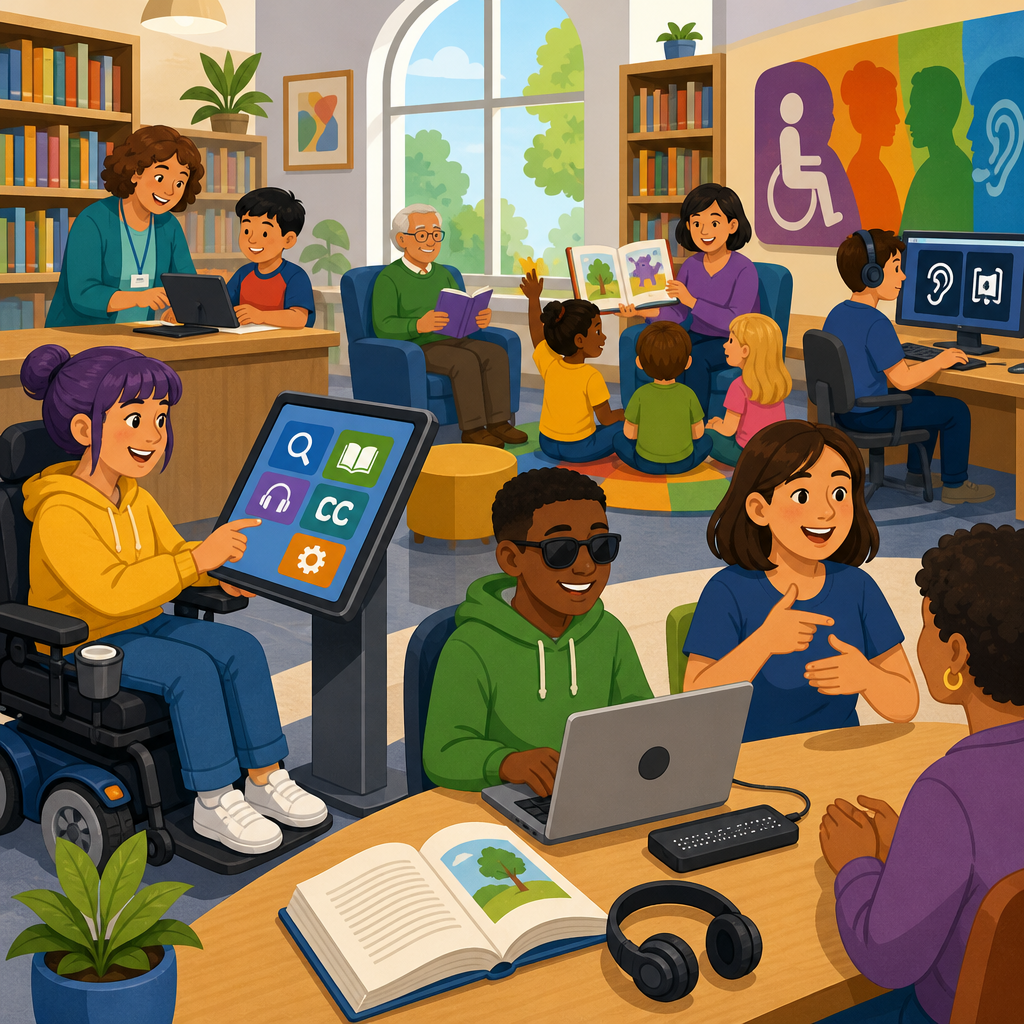
Common accommodations include sign language interpreters, real-time captioning, assistive listening systems, accessible seating locations, scent-aware planning, materials in large print or accessible digital formats, extra time, quiet spaces, and permission for support persons or service animals. Not every request is required in every circumstance, and feasibility depends on context, notice, and the nature of the event. Still, libraries should start from inclusion, not defensiveness. If a workshop is central to civic life, such as a voter education session or public benefits clinic, access planning should be routine rather than exceptional.
Children’s programming deserves special attention. Story times may involve music, movement, visual prompts, and sensory stimulation that work well for many families but overwhelm others. Libraries can broaden access by offering visual schedules, quieter sessions, flexible seating, and staff trained in disability-aware interaction. Teen and adult programs create different issues, such as inaccessible craft stations, microphone use without amplification, or discussion formats that exclude people with speech disabilities. A simple event checklist used before every program often catches these problems early and costs very little to implement.
Communication access at service desks and in library systems
Effective communication is one of the most practical ADA duties in a public library because nearly every service depends on asking, explaining, clarifying, or troubleshooting. The legal standard is that communication with people with disabilities must be as effective as communication with others. That standard applies in person, by phone, by email, through websites, and in printed notices. It is not satisfied by assuming a family member can interpret, by talking only to a companion, or by relying on handwritten notes when a more accurate aid is necessary.
For deaf or hard-of-hearing patrons, appropriate aids may include qualified sign language interpreters, tactile interpreters, oral interpreters, CART captioning, assistive listening systems, captioned media, and text-based communication methods. For blind patrons or those with low vision, access may require screen-readable documents, large print, Braille in limited contexts, audio formats, or staff who can provide information in a nonvisual way. For patrons with cognitive disabilities, communication may be improved through plain language, step-by-step instructions, repetition, visual supports, and reduced environmental distraction. For patrons with speech disabilities, staff should allow extra time and use methods that do not pressure fast verbal responses.
Everyday written communication also matters. Due date notices, policy signs, emergency announcements, room-use agreements, and behavior warnings are all part of library access. I often recommend libraries standardize plain-language templates, review readability, and ensure digital notices work with screen readers. Staff training should include specific scenarios: how to handle a relay call, how to respond when a patron points out an inaccessible PDF, how to arrange an interpreter for a public hearing, and how to document an accommodation request without invading privacy. Good communication systems reduce both exclusion and staff guesswork.
Buildings, spaces, and the path of travel
Although this article focuses on technology, programs, and communication, physical access remains the baseline for civic use of libraries. Parking, curb ramps, entrances, door hardware, restrooms, elevators, service counters, study rooms, shelving clearances, signage, and emergency egress all affect whether patrons can independently use services. Under Title II, public entities must operate each service so that, when viewed in its entirety, it is accessible. That can sometimes be achieved through relocation or policy adjustment in older buildings, but new construction and altered areas must meet current standards.
In practical reviews, I look closely at the full path of travel. An accessible parking space does not solve access if the route to the entrance is steep, the entrance button fails, the circulation counter is too high, and the accessible restroom doubles as a storage room. Library design trends can also create fresh barriers. Lounge furniture that is stylish but low, maker spaces with fixed-height worktables, compact shelving with tight clearances, and security gates with narrow passages often impede use. Accessibility should be checked after installation, not only at the blueprint stage.
Wayfinding deserves more attention than it usually gets. A library can be technically compliant yet still difficult to navigate for patrons with low vision, cognitive disabilities, or anxiety. Clear directional signs, predictable floor layouts, tactile or high-contrast indicators where appropriate, and staff who can give concise route guidance all improve independent access. Emergency planning must include disabled patrons too. If a library hosts large events or public meetings, evacuation procedures, visual alarms, and refuge strategies should be thought through before an incident occurs.
Policy design, staff training, and complaint resolution
The strongest library accessibility programs are built on policy, not improvisation. A written nondiscrimination statement, ADA coordinator contact, grievance procedure, accommodation workflow, procurement standard, and staff training plan create consistency across branches and shifts. Without these systems, patrons often receive different answers depending on who is working. That inconsistency is one of the clearest signs of risk. It also undermines trust, especially for patrons who already expect to be questioned when they request access.
Staff training should be practical and recurring. Frontline employees need scripts and authority to solve common issues, while managers need escalation pathways for interpreter requests, technology failures, policy modifications, and complaints. Training should cover service animals, mobility device access, quiet-room adjustments, alternative format requests, website reporting channels, and respectful disability etiquette. The goal is not to turn librarians into lawyers. It is to make access part of normal service quality. When staff know what to do, patrons spend less time defending their rights and more time using the library.
Complaint resolution is also part of civic access. Libraries should make it easy to report barriers online, by phone, in person, and in accessible formats. Responses should be timely, specific, and documented. If a problem cannot be fixed immediately, the patron should be offered an interim solution. This hub connects naturally to related topics across Public Services & Civic Access, including accessible government websites, voting access, transportation information, parks and recreation programs, and public meeting accommodations. Libraries sit at the center of that ecosystem because they are often the place where people seek information about all the others.
ADA rights in public libraries are ultimately about whether a public institution is prepared to serve the whole public. The law requires equal opportunity, effective communication, reasonable modification, and accessible technology, but those duties become real only when libraries build them into procurement, programming, staffing, and daily operations. Accessible catalogs, captioned events, trained staff, usable complaint channels, and barrier-free paths of travel are not extras. They are core features of lawful and credible public service.
For library leaders, the main benefit of doing this work well is simple: more people can independently read, learn, apply for jobs, attend meetings, and participate in civic life. For patrons, the benefit is dignity and practical access. Start with an accessibility audit of your website, programs, communication practices, and facility routes, then fix the highest-impact barriers first. A public library that plans for disability access is not only complying with the ADA. It is fulfilling its mission.
Frequently Asked Questions
What ADA rights do patrons with disabilities have in public libraries?
Patrons with disabilities have the right to use public library services on an equal basis with everyone else. Under the ADA, that means a library should provide access not only to the building itself, but also to the programs, services, and communication methods that make the library useful in everyday life. In practical terms, equal access can include accessible entrances and service counters, usable restrooms, clear routes through book stacks and meeting rooms, and policies that do not screen out people with disabilities. It also reaches core library functions such as getting a library card, checking out materials, attending classes or story times, using public computers, joining community meetings, and accessing online catalogs, digital collections, and research databases.
The ADA also protects a patron’s right to effective communication and reasonable modifications when needed to participate. Depending on the situation, that may include auxiliary aids and services such as sign language interpreters, captioning, assistive listening systems, accessible electronic documents, screen-reader-compatible web content, or staff assistance with materials and equipment. Libraries generally may not impose unnecessary eligibility criteria, require a person with a disability to accept a lesser service, or charge extra fees for accessibility measures. The central rule is equal opportunity: public libraries must make their services available in ways that are genuinely usable, not merely technically open.
Does the ADA apply to library websites, e-books, databases, and other digital services?
Yes. ADA obligations in public libraries extend beyond the physical building and apply to digital services that patrons increasingly rely on for reading, research, learning, and communication. A library website, online catalog, event registration page, downloadable forms, digital archives, public computer software, third-party research databases, and e-book or audiobook platforms can all affect whether a person with a disability has meaningful access. If a patron can browse events, reserve meeting rooms, renew materials, apply for a card, search the catalog, or read digital content only through inaccessible technology, the library may be denying equal access even if the building itself is accessible.
Accessible digital service usually means that content works with screen readers, keyboard navigation, magnification, speech input, captioning, and other assistive technologies. Images should have text alternatives where appropriate, videos should be captioned, forms should be labeled clearly, PDFs and handouts should be readable by assistive software, and time-limited online processes should not unfairly block people who need more time. Libraries also should pay attention to vendor-provided products, because outsourcing a digital platform does not eliminate ADA responsibilities. If a third-party database or e-book platform is difficult or impossible for some patrons to use, the library should look for accessible alternatives, work with vendors on remediation, and provide an effective way for patrons to obtain the same information or service without delay or stigma.
Are public libraries required to make programs and events accessible?
In general, yes. Public libraries must provide people with disabilities an equal opportunity to participate in programs, classes, workshops, and community events. That includes popular offerings such as children’s story times, computer classes, author talks, job-search workshops, makerspace activities, book clubs, tax help sessions, public forums, and cultural events. Accessibility in programming is broader than choosing an accessible room. It can involve registration procedures, event publicity, seating arrangements, presentation materials, audio and visual content, and whether patrons can ask questions and participate meaningfully alongside others.
Depending on the event and the patron’s needs, accessibility may require modifications or aids such as interpreters, real-time captioning, assistive listening devices, large-print handouts, accessible craft tools, sensory-friendly adjustments, or relocation to an accessible space. Staff should also consider whether program rules unnecessarily exclude patrons with disabilities. For example, a “hands-on” workshop should not be designed in a way that assumes every participant can use materials in only one manner. The ADA does not require libraries to fundamentally alter the nature of a program or to take measures that would create an undue burden, but those exceptions are narrow and fact-specific. In most cases, advance planning, accessible design, and open communication with patrons can prevent barriers before they arise.
What does “effective communication” mean in a public library setting?
Effective communication means the library must communicate with patrons with disabilities as effectively as it communicates with others. In a public library, that principle shows up in everyday interactions as much as in formal events. A patron may need to discuss account issues at a circulation desk, ask a reference librarian for research help, understand a policy notice, follow emergency instructions, attend a board meeting, or participate in a one-to-one technology appointment. If the communication method the library normally uses does not work for that person, the library may need to provide an auxiliary aid or service that does.
The right aid depends on the context. For someone who is deaf or hard of hearing, effective communication might require a qualified interpreter, captioning, written exchanges, or an assistive listening system, depending on the length, complexity, and importance of the communication. For a blind or low-vision patron, it may mean electronic documents compatible with screen readers, large print, audio formats, or staff reading essential information aloud. For patrons with speech, cognitive, or learning disabilities, plain-language communication, extra processing time, or alternative formats may be necessary. Libraries should give primary consideration to the patron’s requested aid in many situations, especially when it involves public entities, and should avoid assumptions that one-size-fits-all communication is enough.
What can a patron do if a public library is not providing accessible services or accommodations?
A good first step is often to raise the issue with library staff, a branch manager, or the library’s ADA coordinator if one is identified. Many access problems can be resolved quickly when the library understands the barrier and the accommodation needed. It helps to be specific: describe the service you were trying to use, the barrier you encountered, when it happened, and what would provide effective access. For example, a patron might explain that an online event registration form is not screen-reader accessible, that a workshop needs captioning, or that a service desk is not reachable from a mobility device. Clear documentation can make informal resolution easier and faster.
If the issue is not resolved, patrons can ask for the library’s grievance or complaint procedure and submit a written complaint. Public libraries, especially larger systems and municipal libraries, may have formal ADA procedures through the library or the local government that operates it. Patrons may also file a complaint with the appropriate government agency or seek legal guidance if the barrier persists. In many cases, the goal is practical correction rather than conflict: fixing a website, moving a program, providing an interpreter, adjusting a policy, or offering an accessible format. But the underlying legal point remains important: people with disabilities do not have to accept exclusion from library services simply because the barrier is digital, procedural, or communication-based rather than architectural.