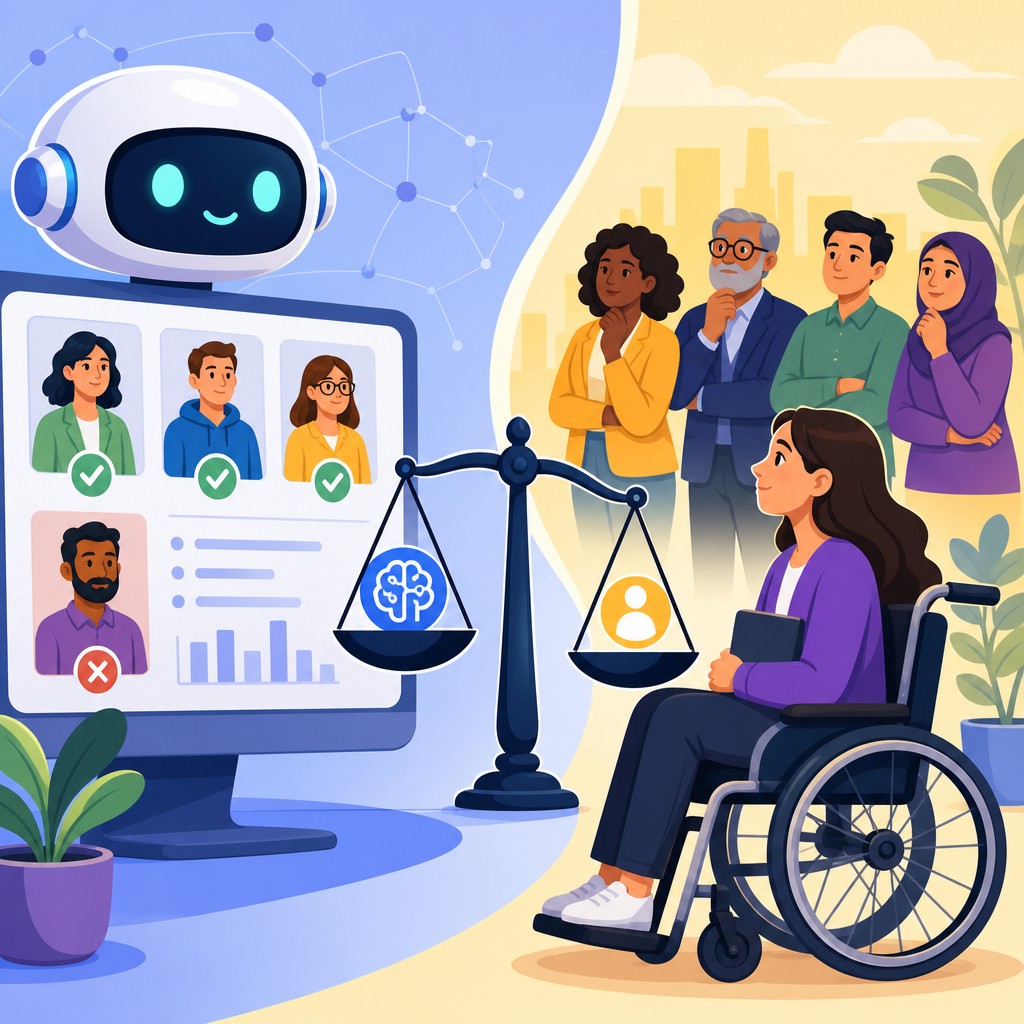
AI hiring platforms and disability discrimination risks now sit at the center of employment law, HR operations, and workplace accessibility. Employers use automated systems to source candidates, screen resumes, rank applicants, score video interviews, and schedule assessments at scale. Those tools promise efficiency, consistency, and lower recruiting costs. They also create serious exposure under the Americans with Disabilities Act, state fair employment laws, and emerging regulations on automated decision systems. In practice, the risk is not abstract. I have seen teams deploy assessment software believing it was neutral, only to discover that time limits, speech analysis, game-based testing, or chatbot interfaces screened out qualified disabled candidates before a human recruiter ever reviewed an application.
To understand the issue, start with definitions. An AI hiring platform is any software that uses rules, statistical models, machine learning, natural language processing, computer vision, or algorithmic scoring to support employment decisions. Disability discrimination risk arises when a tool disproportionately disadvantages applicants with physical, sensory, cognitive, psychiatric, or neurodevelopmental disabilities, or when the employer fails to provide reasonable accommodation during the application process. Accessibility means disabled people can perceive, operate, understand, and robustly interact with the technology. The legal standard is not simply whether a vendor says a platform is accessible. The real question is whether the employer’s hiring process allows qualified individuals with disabilities an equal opportunity to apply, be evaluated fairly, and request accommodation without penalty.
This matters because hiring technology has moved faster than compliance practice. The Equal Employment Opportunity Commission has issued technical guidance warning that employers may violate the ADA when they use algorithmic decision-making tools that screen out disabled people, fail to offer accommodations, or ask disability-related questions improperly. Meanwhile, the Department of Justice has reinforced digital accessibility expectations through web accessibility settlements and guidance that consistently point organizations toward recognized standards such as WCAG 2.1 AA. For companies, this topic belongs within broader ADA developments in technology and accessibility because recruiting systems are often the first digital doorway to employment. If that doorway is inaccessible or biased, the organization’s legal risk, reputational risk, and talent loss begin before onboarding ever starts.
Why AI hiring tools create distinct ADA compliance problems
AI hiring systems can discriminate in several ways, and not all of them look like traditional bias. Some tools create direct barriers through inaccessible design. A blind candidate may not be able to navigate a poorly labeled application portal with a screen reader. A deaf applicant may be required to complete audio-only instructions. A person with limited manual dexterity may struggle with drag-and-drop tasks that have no keyboard alternative. In each case, the issue is not whether the applicant could theoretically do the job. The issue is that the technology blocks equal access to the hiring process itself.
Other problems are embedded in the evaluation logic. Timed cognitive tests can disadvantage candidates with attention disorders, traumatic brain injury, dyslexia, or anxiety-related conditions, especially when extra time is not available as an accommodation. Video interview platforms that analyze facial expression, eye contact, vocal tone, or speech cadence can penalize autistic applicants, people with facial differences, candidates with speech impairments, or individuals whose medications affect presentation. Personality and gamified assessments may correlate disability-linked traits with lower scores even when those traits are irrelevant to job performance. In my experience reviewing vendor claims, the biggest warning sign is when a provider says its model predicts “fit” or “professionalism” but cannot clearly map the score to essential job functions.
The ADA focuses on whether screening criteria are job-related and consistent with business necessity. That standard matters because many AI tools optimize for prediction, not legal defensibility. A model may identify patterns associated with prior successful hires, yet those patterns may reflect historical exclusion, inaccessible workplaces, or subjective manager preferences. If an employer relies on that output without testing for disparate impact on disabled applicants, the company inherits both the model’s assumptions and its flaws. Human review does not automatically cure the problem. A recruiter who sees only ranked lists or red-yellow-green scores may anchor to the system’s recommendation and overlook qualified candidates who need accommodation or whose strengths are not captured by the tool.
Current ADA developments in technology and accessibility affecting hiring
Recent enforcement and guidance have made one principle clear: employers remain responsible for the hiring technology they use, even when a vendor built the platform. The EEOC’s guidance on software, algorithms, and artificial intelligence explains that employers may be liable if a tool “screens out” an individual with a disability where the criterion is not job-related and consistent with business necessity, or where reasonable accommodation was not provided. The agency also warns against disability-related inquiries arising from online assessments that seek medical or mental health information before a conditional offer. That matters for wellness-style questionnaires, personality tools, and chatbot workflows that ask why someone struggles with deadlines, concentration, or social interaction.
Accessibility expectations have also become more concrete. While the ADA does not name a single technical standard for every employment platform, WCAG 2.1 Level AA remains the dominant benchmark in settlements, procurement requirements, and accessibility audits. For hiring teams, that means reviewing page structure, keyboard operability, color contrast, form labels, error identification, captions, transcripts, timing controls, and compatibility with assistive technology. It also means thinking beyond the website. Third-party assessments, one-way video interview tools, skills simulations, and digital identity verification steps can all become accessibility failure points.
State and local rules add another layer. New York City’s law on automated employment decision tools requires bias audits and notices before use, and while it is not disability-specific, it pushes employers toward stronger governance around algorithmic screening. Illinois, Maryland, and other jurisdictions have enacted or proposed laws addressing AI interviews, biometric data, and automated decisions. The practical trend is unmistakable: regulators expect documentation, transparency, and pre-deployment testing. For any organization tracking ADA developments in technology and accessibility, hiring is now one of the clearest areas where accessibility law, algorithmic accountability, and HR compliance intersect.
Where disability discrimination shows up in the hiring funnel
Disability discrimination can enter the process at every stage, often through ordinary configuration choices rather than dramatic system failures. Resume parsers may misread nonstandard formats that some disabled applicants use to improve readability. Chatbots can time out before a user with a cognitive disability finishes responding. Online tests may prohibit assistive technology, copy-paste functionality, or breaks. Remote proctoring software may flag disability-related movements as suspicious behavior. Automated scheduling systems may not provide a clear way to request sign language interpretation, alternative formats, or extended time. Even rejection notices can create risk if they offer no contact method for applicants who encountered technical barriers.
A useful way to assess exposure is to map the candidate journey and ask two direct questions at each step: can a disabled applicant access this stage independently, and if not, is there a prompt, simple, documented accommodation pathway? That exercise usually reveals gaps quickly.
| Hiring stage | Common AI tool | Disability risk | Better practice |
|---|---|---|---|
| Job search | Recommendation engine | Openings not shown based on inferred profile traits | Audit delivery logic and provide searchable listings |
| Application | ATS forms and chatbots | Inaccessible fields, timeout barriers, no accommodation request option | WCAG testing, save-and-return, visible accommodation contact |
| Assessment | Timed tests, games, simulations | Scores depressed by disability-related limits unrelated to job tasks | Validate essential functions, offer alternate formats and extra time |
| Interview | Video analysis and speech scoring | Penalizes atypical speech, affect, or eye contact | Avoid affect scoring and use structured human interviews |
| Selection | Ranking and fit models | Historical bias reproduced in final shortlist | Conduct adverse impact review and document overrides |
These risks are not merely technical defects. They affect who gets seen, who gets scored fairly, and who gets excluded silently. Once a funnel is configured around rigid automation, disabled applicants may never know why they were filtered out, and employers may never realize qualified talent was lost.
What employers should demand from vendors and internal teams
Vendor management is one of the most overlooked controls. Procurement teams often ask whether a platform is secure, integrates with the ATS, and supports reporting, but they do not ask for accessibility conformance reports, validation studies, accommodation workflows, or disability adverse impact testing. A serious review should require a current VPAT or equivalent accessibility documentation, manual testing results with assistive technologies, details on model inputs and outputs, and a clear description of any features that infer traits from voice, face, text, behavior, or response time. If a vendor cannot explain what its score measures in plain language, that is a compliance and governance problem.
Employers should also insist on contractual protections. Those include commitments to remediate accessibility defects promptly, support individualized accommodations, preserve audit logs, notify the employer before material model changes, and cooperate with investigations or legal claims. I also recommend reserving the right to disable high-risk features such as facial analysis, automated “culture fit” scoring, or opaque benchmark rankings. In many cases, the safest decision is not to configure those features at all, because their business value is speculative while their ADA risk is immediate.
Internal governance matters just as much. HR, legal, procurement, IT, accessibility specialists, and data teams should jointly review tools before launch. They should identify essential job functions, define which assessments are truly necessary, and test whether the technology measures those functions directly. For example, if a customer service role requires resolving complaints accurately, a text-based situational judgment exercise may be more defensible than software that grades smiles, tone, and head movement during a recorded interview. Good governance replaces vague proxy measures with job-connected evaluation criteria.
Building an accessible and defensible hiring process
The strongest hiring programs treat accessibility as a design requirement, not an exception process. Start with the application portal. It should support keyboard navigation, screen readers, captions, transcripts, zoom, clear error messages, and mobile accessibility. Every job posting should explain how to request an accommodation, using plain language and a monitored contact channel. That instruction cannot be buried in a policy page. It should appear where candidates encounter tests, interviews, and deadlines.
Next, reduce unnecessary automation. Not every role needs an assessment, and not every assessment needs AI scoring. Structured interviews, work samples, and skills tests tied closely to essential functions are often more predictive and easier to defend than personality screens or facial analytics. When assessments are used, give applicants advance notice about format, timing, technology requirements, and accommodation options. Provide alternatives where appropriate, such as written responses instead of spoken answers, extra time, breaks, captioned instructions, or human-assisted scheduling.
Monitoring completes the process. Employers should track completion rates, accommodation requests, dropout points, and selection outcomes by stage. They should investigate whether disabled candidates are disproportionately failing a particular screen or abandoning an inaccessible step. Periodic accessibility audits and adverse impact reviews are not one-time projects; vendors update interfaces and models constantly. Training is equally important. Recruiters and hiring managers need to know when accommodations are required, how to escalate a technology barrier, and why “the vendor said it was compliant” is not a defense. A defensible process combines accessible design, validated selection methods, documented accommodations, and regular oversight.
Key takeaways for the ADA developments in technology and accessibility hub
AI hiring platforms can improve speed and consistency, but they also create concentrated disability discrimination risk when accessibility, accommodation, and job-related validation are treated as afterthoughts. The core lesson is straightforward. Employers are responsible for the digital hiring experience they offer, including third-party tools. If an application portal is inaccessible, a timed assessment cannot be adjusted, or an algorithm screens out disabled candidates based on proxies unrelated to essential job functions, the organization faces legal, operational, and reputational consequences.
As a hub topic within ADA developments in technology and accessibility, hiring deserves special attention because it is where civil rights obligations meet fast-moving software procurement. The most effective organizations do four things consistently: they test platforms against recognized accessibility standards, they evaluate whether automated criteria are truly job-related, they provide clear accommodation pathways at every stage, and they monitor outcomes instead of trusting vendor assurances. Those practices do more than reduce exposure. They widen access to qualified talent and produce fairer, more reliable hiring decisions.
If your organization uses automated recruiting tools, review the full candidate journey now. Audit accessibility, question every opaque score, and require evidence before relying on any AI-driven screen.
Frequently Asked Questions
How can AI hiring platforms create disability discrimination risks for employers?
AI hiring platforms can create disability discrimination risks when the design, training data, scoring criteria, or deployment of the tool disadvantages applicants with physical, sensory, cognitive, psychiatric, or neurodivergent disabilities. In practice, this often happens when automated systems measure traits that are not truly necessary for the job, such as eye contact, facial expression, speech pace, typing speed, response time, or communication style. A video interview tool may rate an applicant lower because of a speech impairment, limited facial mobility, use of assistive technology, or atypical social presentation. A resume screener may penalize employment gaps tied to medical leave, rehabilitation, or disability-related career interruptions. An online assessment may favor applicants who can complete tasks quickly without accounting for the need for extended time, screen readers, captions, alternative input devices, or other accommodations.
Legal risk increases when employers treat the output of an automated system as neutral or objective without testing whether it has a disparate impact on people with disabilities. Under the Americans with Disabilities Act and many state fair employment laws, employers must avoid screening out qualified individuals with disabilities unless the standard is job-related and consistent with business necessity. They also must provide reasonable accommodations in the application process. If an AI tool functions as a gatekeeper and no accessible alternative exists, the employer may face claims that it failed to accommodate, used an unlawful qualification standard, or relied on technology that disproportionately excluded protected applicants. The core issue is not simply whether AI is used, but whether the employer understands how the tool operates, what it measures, whether those measurements correlate to essential job functions, and whether disabled applicants can participate on equal terms.
What laws and regulations apply when employers use automated hiring tools that may affect applicants with disabilities?
The primary federal law is the Americans with Disabilities Act, which prohibits discrimination against qualified individuals with disabilities in job application procedures, hiring, and other terms of employment. The ADA also requires employers to provide reasonable accommodations unless doing so would create an undue hardship. In the AI hiring context, that means employers cannot rely on an automated screening or assessment tool that unfairly excludes disabled applicants if the exclusion is based on criteria that are not necessary for the job or if the employer fails to offer an accessible process or accommodation. The Equal Employment Opportunity Commission has made clear that employers can be responsible for ADA violations caused by software vendors when the employer uses those tools as part of the hiring process.
State and local laws can create even broader obligations. Many state fair employment statutes mirror or expand on the ADA, sometimes applying to smaller employers, imposing stricter accommodation duties, or allowing wider avenues for enforcement. Some jurisdictions also regulate automated decision tools directly, requiring bias audits, candidate notices, or impact assessments before deployment. Depending on the tool and where applicants live, employers may also face obligations under privacy laws, consumer protection rules, and accessibility standards if the hiring platform collects biometric data, records video or audio, or uses online interfaces that are not accessible to assistive technology users. The practical takeaway is that compliance is no longer limited to general anti-discrimination principles. Employers increasingly need a combined legal strategy that addresses disability rights, algorithmic accountability, accessibility, vendor management, and recordkeeping.
What are the most common warning signs that an AI hiring system may not be accessible or ADA-compliant?
Several red flags suggest an AI hiring system may pose accessibility or disability discrimination concerns. One of the clearest is the absence of a documented accommodation process. If applicants are not told how to request an alternative format, extra time, captioning, screen reader compatibility, human review, or another adjustment, the process may already be out of step with ADA expectations. Another warning sign is when the vendor cannot clearly explain what the system measures, how applicants are scored, what data is collected, or whether the tool has been tested for adverse impact on disabled applicants. Vague claims that the technology is “objective,” “validated,” or “bias-free” should not be accepted at face value.
Additional concerns include assessments that depend heavily on speed, speech patterns, facial movements, eye tracking, mouse movements, game-based performance, or behavioral predictions without proof that those features relate directly to essential job functions. Employers should also be cautious if the tool is not compatible with screen readers, keyboard navigation, captions, alternative input devices, or color-contrast standards. Poorly designed scheduling software, chatbot interfaces, and timed testing platforms can all create barriers even before formal assessment begins. Another major warning sign is the lack of meaningful human oversight. If recruiters or hiring managers automatically reject applicants based on AI rankings without reviewing edge cases, investigating anomalies, or considering accommodation requests, the employer increases the risk that technology-driven errors will go uncorrected. In short, opacity, inflexibility, inaccessible design, and overreliance on automated outputs are all indicators that closer legal and technical review is needed.
What should employers do to reduce disability discrimination risks before implementing an AI hiring platform?
Employers should begin with a structured predeployment review rather than treating procurement as a purely operational or HR decision. That review should involve legal, HR, talent acquisition, IT, accessibility specialists, and, when possible, people with disability inclusion expertise. The employer should identify exactly where the tool will be used in the hiring funnel, what decisions it will influence, what traits it evaluates, and whether those traits are genuinely tied to essential job functions. If the system screens, ranks, or scores candidates, the employer should ask for validation studies, accessibility documentation, bias testing results, and information about whether the tool has been evaluated for adverse impact on disabled applicants. Vendor contracts should require cooperation on audits, accommodation support, data retention rules, and prompt remediation if accessibility or discrimination issues arise.
Operational safeguards are just as important. Employers should provide clear notice to applicants when automated tools are used and explain how to request accommodations or an alternative selection method. Recruiters and hiring managers should be trained not to treat AI output as determinative, especially when a candidate may need an accommodation or when the tool appears to penalize conduct unrelated to job performance. Employers should maintain a process for individualized review, document decisions carefully, and monitor outcomes over time for patterns that suggest exclusion of disabled applicants. Periodic audits should test whether the platform remains accessible and whether score distributions or pass rates reveal disparities. In many organizations, the best risk-reduction strategy is not to ban automation entirely, but to limit its use to functions that can be clearly justified, transparently explained, and effectively supervised by humans.
Can an employer rely on a software vendor’s assurances that its AI hiring tool is unbiased and legally compliant?
No. Vendor assurances may be helpful, but they are not a substitute for the employer’s own diligence and oversight. From an employment law perspective, an employer generally cannot avoid liability by saying that a third-party provider built or managed the tool. If the employer uses the platform to make hiring decisions, it remains responsible for ensuring that the process complies with the ADA and other applicable laws. A vendor may market its product as scientifically validated, fair, or accessibility-ready, yet still be unable to show how disabled applicants were considered in product design, whether real-world testing occurred, or how accommodation requests are handled during use.
Employers should therefore press vendors for concrete evidence, not broad claims. That includes technical documentation, accessibility conformance information, validation materials, adverse impact analyses, data source descriptions, retraining practices, escalation procedures, and an explanation of what human review options exist. Contracts should allocate responsibilities clearly, including who responds to accommodation requests, who fixes accessibility defects, what happens if the tool produces discriminatory outcomes, and whether the employer can suspend use if legal concerns arise. Even with those protections in place, internal monitoring remains essential. The strongest compliance position comes from treating vendor representations as a starting point rather than a final answer. Employers that independently evaluate the tool, document their reasoning, and regularly test outcomes are in a far better position to defend their hiring practices and to create a fairer process for applicants with disabilities.


