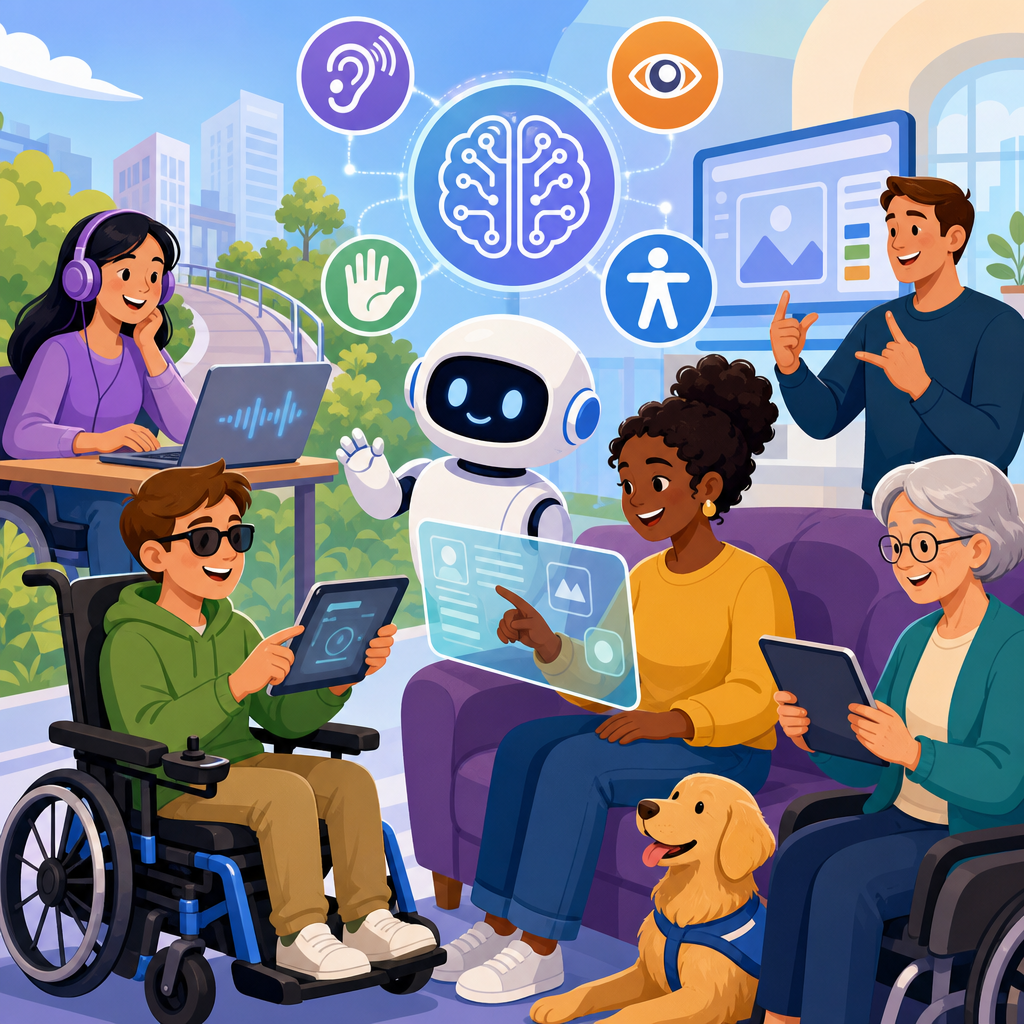
Artificial intelligence is reshaping accessibility at the same time that disability law, technical standards, and product design expectations are evolving, making AI and accessibility one of the most important fronts in recent ADA-related advances. In this context, accessibility means designing digital and physical experiences that people with disabilities can perceive, understand, navigate, and use effectively, while AI refers to systems that recognize patterns, generate content, automate decisions, or adapt interfaces based on data. The ADA remains the core U.S. civil rights law prohibiting disability discrimination, but the practical meaning of compliance is increasingly defined through web regulations, procurement rules, court settlements, assistive technology support, and the adoption of standards such as WCAG 2.1 and the newer WCAG 2.2. Having worked with accessibility programs through audits, remediation projects, and policy reviews, I have seen the same pattern repeatedly: organizations no longer ask whether accessibility matters, they ask how fast they can operationalize it across websites, apps, documents, customer service, kiosks, and AI-driven workflows. This shift matters because AI can remove long-standing barriers, yet it can also create new ones when automation is trained on biased data, labels content poorly, or makes interfaces harder to predict for screen reader, keyboard-only, Deaf, blind, low-vision, neurodivergent, and mobility-impaired users.
Recent ADA-related advances are best understood as a convergence of legal pressure, technical maturity, and market expectation. The Department of Justice has reinforced that the ADA applies to digital experiences, while state laws, structured settlements, and high-profile lawsuits continue to push accessibility from a specialist concern into mainstream governance. At the same time, AI-powered captioning, speech recognition, image description, reading support, and personalized interaction are improving rapidly enough to change what users can reasonably expect from public-facing services. This hub article on future trends and predictions in ADA developments explains where AI is helping, where it is creating compliance risk, what standards and tools matter now, and what organizations should prepare for next. It also connects the broader updates and developments topic to practical decisions leaders must make on procurement, design systems, testing, and oversight, because the future of ADA compliance will be shaped less by one dramatic legal change than by continuous advances in accessible technology, enforcement, and implementation.
How AI Is Expanding Practical Accessibility Under ADA Expectations
The most visible recent advance is that AI has moved accessibility support from niche functionality into everyday product features. Automatic captions in video platforms, live transcription in meeting software, speech-to-text on mobile devices, text simplification tools, reading assistance, and computer-vision-based image description are now common enough that users expect them by default. Microsoft, Google, Apple, Zoom, Adobe, and many enterprise software vendors have embedded these capabilities directly into mainstream products rather than treating them as specialized add-ons. That matters under ADA-related expectations because equal access increasingly depends on whether an organization enables the accessibility capabilities already built into the tools it buys and deploys. In practice, I often find that the problem is not the absence of technology but poor configuration, weak governance, or inaccessible custom layers built on top of accessible platforms.
AI is especially useful when it reduces time-sensitive barriers. Real-time captioning can make virtual hearings, telehealth appointments, classrooms, training sessions, and customer support more usable for Deaf and hard-of-hearing participants. Voice control and predictive text can support users with mobility impairments, repetitive strain injuries, or dyslexia. Object recognition and scene description can help blind and low-vision users interpret visual content faster, especially in mobile contexts. Translation and language modeling can improve comprehension for users with cognitive disabilities when paired with plain language editing. However, these gains are conditional. Auto-captions still struggle with specialized vocabulary, accented speech, multiple speakers, and noisy environments. Auto-generated image descriptions often capture obvious objects but miss context, sentiment, charts, text embedded in images, or legally relevant details. The ADA does not reward automation for its own sake; it rewards outcomes that provide effective communication and equal access.
One of the strongest future trends is the rise of adaptive interfaces that respond to user needs without requiring a disability disclosure every time. A site may increase target sizes, simplify navigation, preserve focus order, switch to low-distraction reading views, or support multimodal input based on user preference settings. Done correctly, this can improve usability for everyone while helping organizations meet accessibility obligations more consistently. Done poorly, it can create hidden state changes, keyboard traps, or unpredictable behavior that breaks assistive technology. The lesson is straightforward: AI should support user agency, not override it.
Legal and Standards Developments Shaping the Next Phase
Recent ADA-related advances cannot be separated from the standards environment. The Department of Justice has made clear through rulemaking and enforcement activity that digital accessibility is an enforceable civil rights issue, and WCAG has become the operational benchmark in most serious compliance programs. WCAG 2.2 adds success criteria such as Focus Appearance, Dragging Movements, Accessible Authentication, and Consistent Help, all highly relevant to AI-enhanced experiences. Accessible authentication is particularly important because many newer fraud-prevention and login systems rely on cognitive tests, image selection, time-based interactions, or device patterns that may exclude disabled users. If AI is used to detect bots or suspicious behavior, organizations must ensure there is an accessible path to complete the same task.
Courts have not created a single universal rule for every website and app scenario, but the direction of travel is unmistakable: digital barriers can trigger legal exposure when they limit access to goods, services, benefits, employment, education, transportation, health care, or public accommodations. Settlements commonly require accessibility audits, remediation schedules, training, vendor controls, user feedback channels, and periodic testing. Looking ahead, I expect more enforcement focused on AI-supported systems used in hiring, tenant screening, education technology, customer verification, and health services, because those are areas where automated decision-making intersects directly with civil rights obligations. The EEOC has already addressed algorithmic fairness in employment contexts, and similar scrutiny will continue across disability-related accommodations.
Another important trend is procurement pressure. Public entities, universities, health systems, and large enterprises increasingly require VPATs based on the ITI template, independent test results, and product accessibility roadmaps before purchasing software. A generic promise that an AI feature is “inclusive” no longer satisfies review teams. Buyers want documented conformance, known exceptions, timelines for fixes, and evidence that accessibility has been tested with assistive technologies such as JAWS, NVDA, VoiceOver, TalkBack, Dragon, switch devices, and screen magnifiers. This is where future ADA developments will become very practical: inaccessible AI products will lose deals before they trigger lawsuits.
Where AI Creates New Accessibility Risks
AI can improve access, but it also introduces distinct failure modes that organizations routinely underestimate. Generative interfaces often stream text dynamically, rewrite content in place, or insert suggestions asynchronously. If these changes are not coded with proper live region behavior, heading structure, focus management, and announcements, screen reader users can lose context immediately. Chat interfaces may appear simple visually while masking complex state changes that are difficult to navigate by keyboard. Predictive systems may suppress user control, auto-submit forms, or rank options opaquely, increasing cognitive load. In accessibility testing, I regularly see teams validate the base page but ignore what happens once the AI assistant opens, updates, or takes over a workflow.
Bias is another major risk. Computer vision systems may identify mobility devices, skin tones, faces, gestures, or sign language inconsistently. Speech recognition may underperform for users with atypical speech patterns, acquired disabilities, or nonstandard pronunciation. Resume screening or assessment tools may penalize applicants whose disability affects communication style, response time, eye movement, or test-taking method. These are not abstract concerns. The National Institute of Standards and Technology has repeatedly documented uneven performance in biometric and recognition systems, and the practical lesson is that disability must be part of model evaluation, not an afterthought.
| AI use case | Accessibility benefit | Primary ADA-related risk | Best practice |
|---|---|---|---|
| Automatic captions | Improves access to live and recorded audio | Errors with names, jargon, and overlapping speakers | Offer human review and downloadable transcripts |
| Image description | Helps explain photos and visual scenes | Misses context, charts, or embedded text | Require human-authored alt text for critical content |
| Chatbots | Provides fast self-service support | Keyboard traps, unlabeled controls, confusing updates | Test focus order, announcements, and escalation paths |
| Voice interfaces | Supports hands-free interaction | Poor recognition of atypical speech | Provide keyboard and text alternatives |
| Automated screening | Speeds evaluation of applications or requests | Disparate impact on disabled users | Audit inputs, outcomes, and accommodation options |
Future Trends and Predictions in ADA Developments
Several future trends are already visible. First, accessibility will shift earlier into AI product development. Instead of remediating interfaces after launch, teams will include accessibility acceptance criteria in design systems, component libraries, prompt patterns, and model evaluation protocols. Second, organizations will move from one-time audits to continuous monitoring. Accessibility scanners such as axe, WAVE, and Accessibility Insights will remain useful, but they will be paired with manual testing, user research, and production telemetry that measures real interaction failures. Third, contracts will become more specific. Vendors will be asked not only whether a feature conforms to WCAG, but how model updates, plugins, and third-party content are tested before release.
Fourth, multimodal accessibility will become a baseline expectation. Users will expect text, speech, captions, transcripts, alt text, summaries, and keyboard access to work together across devices. Fifth, accessible personalization will mature. Rather than hiding controls in separate disability menus, products will save user preferences for contrast, motion reduction, reading level, layout density, input method, and timing. Sixth, regulation will increasingly address automated decision systems that affect essential opportunities. That does not mean every AI tool will face a new ADA rule immediately, but it does mean employers, schools, housing providers, and health organizations will need documented accommodation pathways when automation influences outcomes.
I also expect stronger linkage between accessibility and quality assurance. Today, many organizations still treat accessibility bugs as edge cases. Over the next few years, that approach will become untenable because AI interfaces are too dynamic to fix cheaply after scale. Teams that integrate disabled users into discovery, prototyping, and beta testing will outperform teams relying only on automated checks. In plain terms, the future of ADA developments will reward organizations that design with disabled people rather than merely testing on them.
Building an AI Accessibility Strategy That Holds Up
An effective strategy starts with governance. Assign ownership across legal, product, engineering, procurement, design, content, and support. Define which standards apply, how exceptions are approved, and when human alternatives are required. Inventory all AI-enabled experiences, including plugins, embedded chat tools, document generators, recommendation engines, and third-party widgets. Then prioritize based on user impact and legal exposure: hiring portals, patient systems, payment flows, learning platforms, and customer account access should come before experimental marketing tools. I advise teams to create an accessibility risk register for AI features so that known issues, compensating controls, and remediation deadlines are visible to leadership.
Testing must be both technical and experiential. Use automated tools to catch code issues, but pair them with keyboard testing, screen reader testing, zoom and reflow checks, speech input review, mobile accessibility review, caption accuracy checks, and content plain-language review. Validate with actual user journeys such as applying for a job, booking an appointment, requesting an accommodation, paying a bill, or uploading a document. If an AI assistant summarizes a denial letter, ask whether the summary preserves legally important information. If a chatbot handles accommodation requests, verify that users can reach a human without dead ends. These details determine whether equal access is real.
Training is equally important. Designers need pattern guidance for dynamic updates, error prevention, and accessible prompts. Engineers need repeatable test cases and assistive technology baselines. Content teams need rules for alt text, captions, transcripts, headings, and plain language. Support teams need scripts for escalation and alternative formats. The organizations making the most progress are not the ones with the flashiest AI features; they are the ones that operationalize accessibility as a release requirement and a service standard.
AI and accessibility will define the next chapter of ADA-related advances because the technologies now shaping everyday services can either widen inclusion or automate exclusion at scale. The strongest pattern across legal developments, product changes, and enterprise practice is clear: accessibility is moving upstream into procurement, design, engineering, and governance, while AI is making both the opportunities and the risks more immediate. Automatic captions, image description, voice control, adaptive interfaces, and language support can meaningfully expand access, but only when they are tested against real user needs, supported by clear standards, and backed by human alternatives where automation falls short. WCAG 2.2, DOJ enforcement, vendor documentation, and continuous testing are becoming central reference points for any organization planning future ADA compliance.
For teams following updates and developments in this area, the practical takeaway is simple. Treat this topic as a hub, not a one-time checklist. Monitor changes in standards, evaluate AI features before purchase, test with disabled users, and document how accommodations remain available when automated systems are used. Organizations that do this well will reduce legal risk, improve usability, and serve more people effectively across websites, apps, documents, and support channels. Use this page as the starting point for your broader ADA strategy, then map each subtopic—digital accessibility, procurement, employment tools, education technology, health platforms, and customer service automation—into a concrete action plan for the year ahead.
Frequently Asked Questions
How is AI changing accessibility in ways that matter under the ADA?
AI is changing accessibility by making it easier to create, adapt, and deliver experiences that more people can use, including individuals with vision, hearing, mobility, speech, cognitive, and neurodivergent disabilities. In practical terms, that includes tools such as real-time captioning, automated image descriptions, speech recognition, predictive text, screen reader enhancements, language simplification, conversational assistants, and adaptive interfaces that respond to a user’s needs. These developments matter under the Americans with Disabilities Act because the ADA is fundamentally concerned with equal access, effective communication, and nondiscrimination in places of public accommodation, employment, and state and local government services. As digital services have become central to everyday life, AI-enabled accessibility tools have become increasingly relevant to whether people can participate on equal terms.
What makes this especially important in recent ADA-related developments is that expectations are no longer limited to ramps, elevators, and physical barriers. Businesses, employers, schools, healthcare providers, transportation companies, and government entities are all facing greater scrutiny over whether their websites, apps, kiosks, customer service systems, and digital documents are accessible. AI can help close gaps more quickly than traditional manual methods alone, but it does not replace legal responsibility. If an organization deploys AI to improve accessibility, that can be a meaningful step toward inclusion. If it deploys AI carelessly and creates new barriers, it can increase legal and compliance risk.
In other words, AI is best understood as a powerful accessibility enabler, not an automatic compliance solution. The ADA does not generally require organizations to use AI specifically, but it does require covered entities to provide access and avoid discrimination. That means AI is relevant to the ADA to the extent it helps deliver effective communication, reasonable accommodations, accessible services, and equal participation. The legal and practical takeaway is straightforward: AI can significantly improve accessibility, but organizations still need human oversight, testing with disabled users, and alignment with established accessibility standards.
Can AI tools alone make a website or app ADA compliant?
No. AI tools can assist with accessibility, but they cannot on their own guarantee that a website or app is ADA compliant. This is one of the most important distinctions organizations need to understand. Many AI-driven platforms can identify common accessibility issues, generate alt text, detect color contrast problems, recommend code fixes, caption videos, or provide interface overlays. Those functions can be genuinely useful, especially for speeding up audits, supporting remediation efforts, and improving content at scale. However, ADA accessibility is broader than a checklist and broader than what automation can reliably detect.
For example, an AI system may generate image descriptions, but those descriptions might be too vague, inaccurate, or contextually incomplete to be useful. An automated scan may identify missing labels or heading issues, yet fail to catch confusing navigation, inaccessible workflows, poor keyboard interaction, ambiguous link text, timing barriers, or content that is technically available but not meaningfully understandable. Accessibility also depends on the total user experience. A feature can pass an automated test and still create real-world barriers for someone using a screen reader, voice navigation, switch control, magnification, captions, or other assistive technologies.
That is why recent ADA-related accessibility strategies increasingly emphasize a combination of methods: technical standards such as WCAG, automated testing, manual review, code remediation, usability testing, and direct feedback from people with disabilities. AI can reduce effort and improve consistency, but it should be part of a broader accessibility program rather than treated as a one-click legal shield. Organizations that rely solely on overlays or AI widgets without fixing underlying design and code issues may still face complaints, litigation, and customer dissatisfaction. The strongest approach is to use AI as a support tool within a mature accessibility process that includes policy, training, procurement review, accessible design, ongoing monitoring, and human quality control.
What recent ADA-related advances are most relevant to AI and digital accessibility?
Several recent developments are shaping how organizations think about AI and accessibility. One major trend is the continued recognition that digital accessibility is a serious civil rights and risk management issue, not just a technical preference. Courts, regulators, and plaintiffs have continued to focus on websites, mobile applications, online services, digital forms, and self-service technologies. At the same time, public-sector rules and broader enforcement expectations have increasingly pointed organizations toward recognized technical benchmarks, especially the Web Content Accessibility Guidelines, as practical standards for accessible digital experiences.
Another important advance is the growing expectation that accessibility must be integrated into design and procurement from the beginning rather than addressed only after a complaint. This shift matters for AI because many AI-powered tools are now embedded in customer support, hiring, education, healthcare, transportation, and productivity systems. If those tools are inaccessible or make decisions in ways that disadvantage disabled users, the problem is not just usability; it may implicate ADA obligations relating to equal access, effective communication, or reasonable accommodation. As a result, organizations are increasingly evaluating whether AI systems work with assistive technology, whether outputs are understandable, whether users can correct errors, and whether alternative pathways are available.
There is also growing attention to algorithmic fairness and disability bias. Historically, disability was sometimes overlooked in discussions about AI discrimination, but that is changing. For instance, speech recognition may perform poorly for people with atypical speech, vision systems may misinterpret disability-related movement or assistive devices, and automated assessments may penalize behaviors tied to disability rather than job performance or service eligibility. Recent ADA-related thinking is pushing organizations to examine whether AI systems unintentionally screen out disabled individuals or create barriers that should have been anticipated. In practice, the most relevant advances involve not just better tools, but better governance: accessibility review before deployment, ongoing testing, clear accommodation processes, documentation of known limitations, and meaningful human intervention when AI does not work for a user.
What are the biggest risks of using AI for accessibility without proper oversight?
The biggest risk is assuming that AI-generated accessibility is accurate, complete, and sufficient when it often is not. AI systems can produce errors that are subtle enough to go unnoticed by teams that do not include accessibility experts or disabled users. For example, automated captions may be grammatically correct but wrong in substance, image descriptions may omit the critical detail a user needs, language simplification may remove legal nuance, and chatbot support may be unusable for screen reader users or people with cognitive disabilities. When organizations trust AI outputs without review, they may believe they have improved access while actually introducing confusion, exclusion, or misinformation.
A second major risk is discrimination through design or automation. AI systems used in hiring, customer support, fraud detection, education, benefits access, healthcare triage, or public services can disproportionately burden disabled people if they are not built and tested carefully. A timed verification process may exclude users with motor impairments. Voice-only authentication may fail for users with speech disabilities. Automated interview tools may misread disability-related communication patterns. A kiosk or chatbot may lack a usable nonvisual path. In ADA terms, the issue is not whether the technology is innovative; the issue is whether disabled individuals are being denied equal opportunity, effective communication, or reasonable modifications.
There are also operational and reputational risks. If accessibility issues are discovered only after launch, remediation can become more expensive, legal exposure can increase, and trust can erode among customers, employees, patients, students, or community members. Proper oversight helps prevent these outcomes. That means setting accessibility requirements before purchasing or building AI systems, evaluating outputs for accuracy and usability, testing with assistive technologies, involving disabled users in review, maintaining fallback options, and ensuring staff know how to provide human assistance when AI tools fail. The most responsible use of AI in accessibility is disciplined, transparent, and user-centered. Without that structure, even well-intentioned deployments can create significant ADA-related problems.
How can organizations use AI responsibly to improve accessibility while reducing ADA-related risk?
Organizations can use AI responsibly by treating accessibility as an ongoing governance issue rather than a feature add-on. A strong starting point is to define clear accessibility requirements for any AI-related product, vendor, or internal system. Before implementation, teams should ask practical questions: Does the system work with screen readers and keyboard navigation? Are audio and visual outputs available in accessible alternatives? Can users slow down, review, or correct AI-generated content? Is there a non-AI pathway if the tool fails? Are accommodations easy to request? These questions help connect innovation to real ADA expectations around equal access and effective communication.
Responsible use also requires combining AI efficiency with human judgment. Organizations should use automated tools to accelerate testing and content generation, but they should not stop there. Manual audits, usability reviews, and testing by people with disabilities are essential because they reveal barriers that software alone may miss. It is also wise to document known limitations, train staff on accessibility and accommodation procedures, and establish clear accountability for remediation. If an AI tool is customer-facing, support teams should be prepared to intervene quickly when a user encounters a barrier. If an AI tool affects employment or service eligibility, there should be a process for human review and accessible alternatives.
Finally, organizations should align AI accessibility efforts with broader compliance and design frameworks. That typically means building toward recognized accessibility standards, integrating accessibility into product development life cycles, reviewing vendors carefully, and monitoring systems after launch as content and models change. The most successful organizations view accessibility not as a defensive legal exercise, but as a quality, inclusion, and trust issue. When


