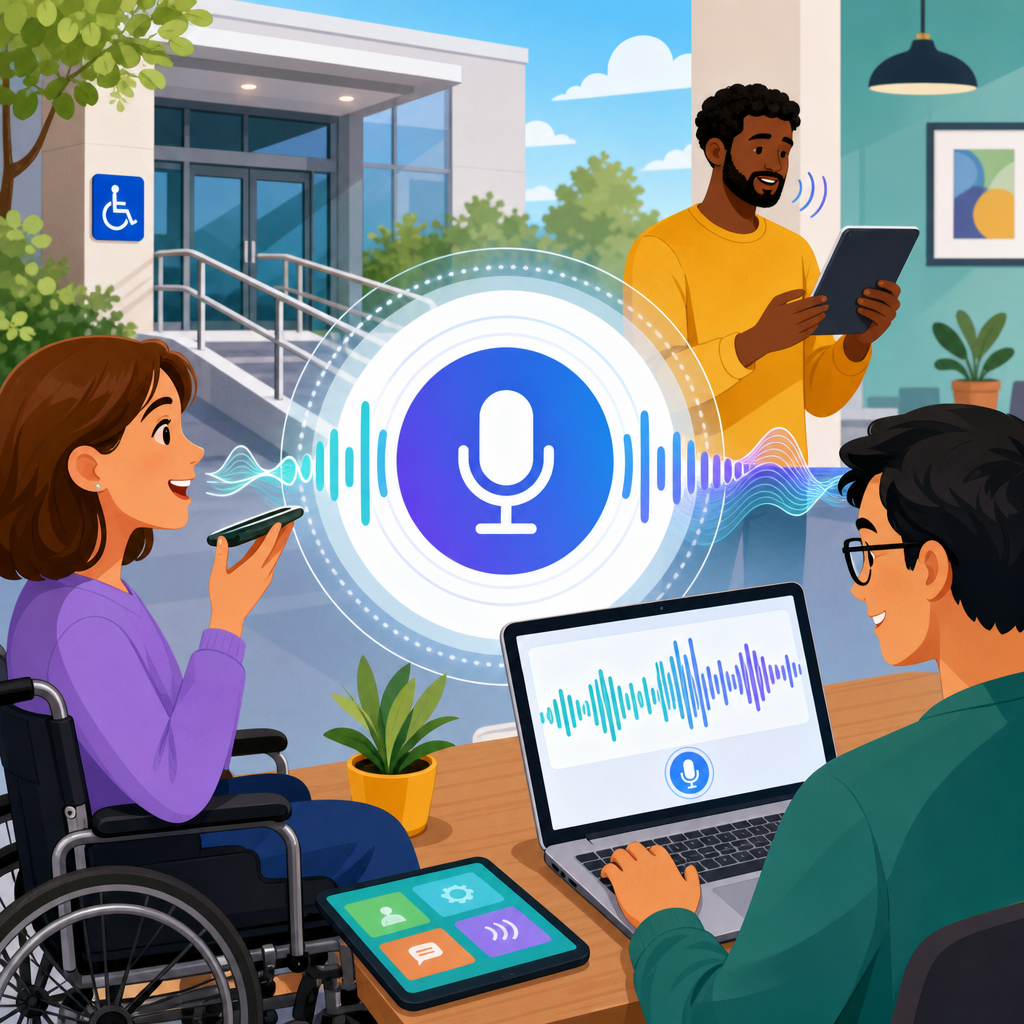
Developments in voice recognition software for ADA compliance are reshaping how organizations meet accessibility obligations, design inclusive services, and plan for the next generation of digital interaction. Voice recognition software converts spoken language into text or commands, while ADA compliance refers to aligning products, services, workplaces, and public accommodations with the Americans with Disabilities Act and related accessibility expectations. In practice, these systems now support dictation, hands-free navigation, captioning workflows, customer service automation, and assistive access for people with mobility, dexterity, speech, hearing, cognitive, and vision-related disabilities. I have seen the change firsthand in enterprise accessibility programs: tools once treated as niche assistive technology are now embedded in operating systems, contact centers, telehealth platforms, classroom tools, and kiosks. That shift matters because compliance is no longer limited to wheelchair ramps and building signage; it increasingly includes websites, apps, software interfaces, communication systems, and everyday digital tasks.
Understanding current developments requires separating several related concepts. Automatic speech recognition identifies spoken words and turns them into text. Natural language understanding interprets meaning and intent. Speaker recognition attempts to identify who is talking, which is a separate biometric function with different privacy implications. Voice control uses speech input to trigger software actions, such as opening forms, selecting buttons, or completing fields. For ADA planning, that distinction is important because a system may transcribe speech accurately yet still fail to provide accessible command navigation, error recovery, confirmation prompts, or compatibility with screen readers and switch devices. Compliance also depends on context. An employer evaluating workplace accommodations under Title I faces different implementation questions than a hospital, university, retailer, or local government designing public-facing services under other ADA obligations.
This hub article covers future trends and predictions in ADA developments through the lens of voice technology because speech interfaces sit at the intersection of usability, accommodation, and mainstream product design. Courts and regulators continue signaling that digital access expectations are rising, even as technical standards and enforcement details evolve. At the same time, large language models, multilingual speech systems, edge processing, ambient assistants, and real-time captioning are changing what users expect from accessible experiences. The organizations that prepare now will be better positioned to reduce legal risk, improve service quality, and support a broader range of users. The sections below explain where voice recognition software is improving, where it still falls short, and what future-ready accessibility teams should monitor as this area of ADA development continues to mature.
Why Voice Recognition Is Becoming Central to ADA Strategy
Voice recognition is becoming central to ADA strategy because it addresses a practical barrier: many digital systems still assume that every user can type, tap, drag, swipe, or use a mouse with precision. For users with repetitive strain injuries, paralysis, tremors, arthritis, low vision, temporary injuries, or fatigue, speech can be the fastest or only realistic input method. In workplace accommodation reviews, I have repeatedly seen voice tools make the difference between an employee struggling through basic documentation tasks and performing independently at a high level. Built-in options such as Apple Voice Control, Windows Voice Access, Android voice input, and Google Assistant have reduced cost barriers, while specialized products such as Dragon Professional remain important for high-volume dictation and command customization.
The legal significance is straightforward. The ADA does not require one specific technology, but it does require effective access and reasonable accommodation where applicable. If a customer cannot complete a transaction because a kiosk accepts touch input only, or an employee cannot navigate a timekeeping platform because controls are not operable by speech, the problem is functional access. Voice recognition can help close that gap, but only when integrated thoughtfully with accessible forms, logical focus order, visible labels, keyboard support, and robust error messaging. A poorly coded interface remains inaccessible even if the speech engine itself is accurate. That is why accessibility teams increasingly evaluate voice usability alongside WCAG conformance, procurement criteria, and product design reviews.
Core Technology Developments Driving the Next Wave
The most important technical development is improved recognition accuracy across noisy environments, accents, and spontaneous speech. Earlier systems worked best with trained voices and careful pacing. Modern models use deep neural networks, transformer architectures, and large multilingual datasets to better handle conversational language, hesitations, punctuation inference, and domain-specific vocabulary. Microsoft Azure Speech, Google Cloud Speech-to-Text, Amazon Transcribe, and OpenAI-powered transcription systems have all pushed the market toward faster, more adaptable performance. On-device processing is also improving. Instead of sending every utterance to the cloud, newer phones and PCs can perform portions of speech recognition locally, reducing latency and helping with privacy-sensitive use cases such as health information, legal dictation, or financial workflows.
Another major shift is context awareness. The next generation of voice interfaces does more than convert audio into text. It predicts likely commands based on application state, identifies form fields, offers correction prompts, and supports multimodal interaction where users speak, view, and confirm actions together. That matters for ADA compliance because accessibility depends on error prevention as much as raw recognition quality. If a user says, “submit accommodation request,” a system should not trigger an irreversible action without confirmation. If a person dictates a medication dosage or financial amount, the interface should expose clear review steps. Future ADA developments will increasingly focus on whether voice-enabled workflows provide equivalent control, transparency, and recoverability compared with keyboard and touch interaction.
Where Standards, Policy, and Risk Are Heading
Future ADA developments around voice recognition software will be shaped by a combination of disability law, web accessibility expectations, procurement standards, and privacy rules. In the United States, WCAG 2.1 and WCAG 2.2 continue to influence what organizations treat as the operational baseline for digital accessibility, even though the ADA itself is principle-based rather than a technical checklist. Section 508 remains influential in public sector procurement, and EN 301 549 affects multinational organizations serving European markets. None of these standards says every product must offer voice control, yet they collectively reinforce a broader expectation: interfaces must be perceivable, operable, understandable, and robust for users relying on different assistive methods.
Enforcement risk is likely to expand from static websites into speech-enabled systems, AI customer service, and hybrid physical-digital environments. Consider self-service kiosks in airports, hospitals, and quick-service restaurants. As vendors add voice input to reduce queues and support hands-free use, they also create new compliance questions about speech clarity, timeout settings, multilingual prompts, privacy in public spaces, and alternatives for users with speech disabilities. Similar issues appear in telehealth, where automatic transcription can improve access but may mis-handle medical terms or nonstandard speech patterns. The safest prediction is that regulators, plaintiffs, and internal audit teams will look less at whether voice features exist and more at whether they work reliably for disabled users across real tasks, not controlled demos.
High-Impact Use Cases Across Industries
Healthcare, education, government, retail, and employment are seeing the fastest practical adoption. In healthcare, clinicians use medical speech recognition to speed charting, while patients benefit from voice navigation in portals, appointment systems, and remote care tools. Nuance Dragon Medical One remains a prominent example because it combines specialty vocabularies with workflow integration, but hospitals still need human review, secure authentication, and accessible patient interfaces. In education, voice tools support students who have dyslexia, mobility limitations, or temporary injuries. Real-time captioning and dictated composition can remove barriers, yet schools must train staff, validate accuracy for diverse speakers, and ensure learning platforms accept speech-based navigation consistently.
Government agencies and public institutions are also under pressure to make service delivery more inclusive. Residents increasingly expect to complete forms, ask questions, and receive updates through conversational channels, not only traditional web pages. Retailers and banks are experimenting with voice-enabled support for account inquiries, ordering, and authentication, but these systems carry obvious risk if they misunderstand intent or expose personal data aloud. In workplaces, voice recognition helps with documentation, coding, customer relationship management updates, and control of standard productivity software. The strongest implementations do not assume speech replaces every other method. They provide parallel pathways, such as keyboard, touch, chat, and human assistance, so employees and customers can choose what works best for their abilities and environment.
| Sector | Leading Voice Use Case | Main Accessibility Benefit | Primary Compliance Risk |
|---|---|---|---|
| Healthcare | Clinical dictation and patient portal navigation | Reduced typing burden and hands-free access | Medical term errors and privacy exposure |
| Education | Dictated writing and lecture captioning | Support for dyslexia and mobility limitations | Uneven accuracy for diverse student speech |
| Government | Service inquiries and form completion | Broader public access to essential services | Complex forms that fail with voice commands |
| Retail and banking | Voice customer service and account tasks | Hands-free convenience for routine actions | Authentication errors and audible disclosure |
| Employment | Workstation control and documentation | Reasonable accommodation for many roles | Incompatibility with legacy enterprise software |
Persistent Limitations Organizations Cannot Ignore
Despite rapid progress, voice recognition software still struggles with accent bias, code-switching, background noise, microphone quality, specialized terminology, and atypical speech. These limitations have direct ADA implications because the people who most need speech access may also be those least well served by generic models. Users with cerebral palsy, ALS, stutters, aphasia, or post-stroke speech differences can experience significantly lower recognition rates. A system that works beautifully for a product demo may fail for the exact population it is meant to support. That is why accessibility validation must include diverse disabled users, not only internal testers reading standard phrases into high-end headsets.
There are also design limits unrelated to recognition accuracy. Many applications still use unlabeled controls, custom widgets, hidden buttons, or timing-dependent interactions that are difficult to trigger by voice. Some enterprise systems require hovering, drag-and-drop actions, or complex shortcut sequences. Others use dynamic content updates that do not announce changes clearly, making speech navigation confusing when combined with screen readers. Privacy is another concern. Continuous listening features can feel intrusive, and cloud transcription can create data retention issues under HIPAA, state privacy laws, union agreements, or internal security policies. Future ADA developments will not reward blind adoption of voice tools. They will reward disciplined implementation that addresses usability, governance, and alternative access methods together.
Predictions for the Next Five Years
Over the next five years, voice recognition software for ADA compliance will become more personalized, more embedded, and more auditable. Personalization will improve because systems will adapt to an individual’s speech patterns, vocabulary, and preferred commands without requiring lengthy training. Embedded deployment will expand because voice input is moving into browsers, operating systems, productivity suites, kiosks, vehicles, wearables, and smart TVs. Auditability will matter more because organizations will need evidence that voice-enabled services are tested, monitored, and corrected when failure patterns appear. Expect procurement questionnaires to ask not just whether voice support exists, but how vendors measure word error rate, handle accessibility defects, and protect voice data.
Another likely trend is convergence between voice interfaces and generative AI assistants. Instead of issuing rigid commands, users will speak naturally: “find my benefits form, complete my address change, and read back anything you are unsure about.” That convenience can dramatically improve access for some users, but only if systems remain predictable and transparent. Accessibility teams should be wary of assistant behavior that paraphrases inaccurately, auto-completes sensitive fields without review, or hides critical steps behind conversational abstractions. The winning pattern will be guided autonomy: flexible natural language input paired with explicit confirmations, editable outputs, clear status updates, and easy escalation to human support. Organizations that adopt that model now will be better prepared for the broader ADA developments shaping digital accessibility policy and user expectations.
For decision-makers, the practical takeaway is simple: treat voice recognition as a core accessibility capability, not a novelty feature. Start with high-value workflows, test with disabled users, align implementation with recognized accessibility standards, and demand measurable performance from vendors. Review captioning, dictation, navigation, privacy, and human fallback as one integrated experience. As future trends in ADA developments continue to unfold, the organizations that pair technical progress with inclusive design discipline will deliver the most resilient results. If this hub topic is relevant to your roadmap, use it as the starting point for deeper reviews of workplace accommodations, digital accessibility audits, AI governance, and assistive technology procurement.
Frequently Asked Questions
1. How is voice recognition software improving ADA compliance today?
Voice recognition software is improving ADA compliance by giving organizations more practical ways to remove communication and interaction barriers across digital platforms, workplaces, customer service environments, and public-facing services. At its core, this technology converts spoken language into text, commands, or system actions, which can make websites, applications, kiosks, documentation workflows, and internal tools more accessible to people who cannot easily use a keyboard, mouse, or touchscreen. That matters in the ADA context because accessibility is not limited to physical spaces; it increasingly includes the usability of digital systems that people rely on for employment, commerce, education, healthcare, and public services.
Recent developments have made voice recognition tools significantly more accurate, responsive, and adaptable than earlier generations. Modern systems are better at understanding natural speech patterns, different accents, industry-specific vocabulary, and conversational commands. Many platforms now include real-time transcription, voice navigation, hands-free form completion, meeting captioning support, and integrations with assistive technology ecosystems. These improvements help organizations create more inclusive user experiences for people with mobility impairments, repetitive strain injuries, certain vision disabilities, some learning disabilities, and other conditions that may affect conventional computer use.
From a compliance perspective, voice recognition software can support accessibility efforts in several ways. It can provide alternative input methods for digital interfaces, improve access to workplace tools as a reasonable accommodation, help generate transcripts for spoken content, and streamline communication support in customer-facing interactions. It is important, however, to understand that voice recognition is usually one part of a broader accessibility strategy rather than a standalone compliance solution. Organizations still need accessible design, keyboard operability, screen reader compatibility, captioning where required, and policies that support individualized accommodations. The real value of today’s voice recognition advances is that they give organizations stronger, more scalable tools to meet accessibility expectations in a way that is both practical and user-centered.
2. Does using voice recognition software automatically make a website, app, or workplace ADA compliant?
No. Voice recognition software does not automatically make a website, app, service, or workplace ADA compliant. It can be an important accessibility feature, but ADA compliance depends on whether the overall experience is accessible, usable, and non-discriminatory for people with disabilities. In other words, adding voice capabilities is helpful, but it does not replace the need for broader accessible design and policy measures.
For example, a website may allow voice commands, but if it still has unlabeled buttons, poor color contrast, inaccessible forms, or navigation that breaks with assistive technologies, it may still present barriers. Similarly, in the workplace, providing voice dictation software to one employee may support a reasonable accommodation, but an employer also has broader obligations related to accessible systems, effective communication, equal access to job functions, and an interactive process for accommodations. The ADA is concerned with real-world accessibility outcomes, not simply whether a business has deployed a specific technology.
A better way to think about voice recognition is as one element in a layered compliance and accessibility framework. Organizations should evaluate whether users can complete key tasks through multiple methods, whether the technology works reliably for people with different speech patterns and disabilities, whether privacy and security needs are addressed, and whether alternative accommodations remain available when voice input is not effective. They should also align their digital accessibility practices with widely recognized technical standards and conduct regular testing with real users where possible. Voice recognition can greatly improve access, but it should be implemented as part of a comprehensive accessibility program rather than treated as a shortcut to compliance.
3. What new developments in voice recognition technology are most relevant for accessibility and inclusion?
Several developments are especially relevant. One of the most important is improved speech recognition accuracy driven by advances in machine learning and natural language processing. Earlier systems often struggled with background noise, varied speech patterns, and specialized vocabulary. Newer systems are better at understanding context, predicting intended words, and adapting to user behavior over time. That improvement can make voice tools more dependable for everyday work, communication, and navigation, which is critical for users who rely on them as a primary access method.
Another major development is the rise of real-time and near-real-time transcription. This is highly valuable in meetings, classrooms, telehealth sessions, customer support interactions, and live events where spoken communication needs to be converted quickly into readable text. While transcription and voice recognition are not identical accessibility functions, they often operate together in modern platforms and contribute to effective communication strategies. For organizations thinking about ADA-related obligations, that means more opportunities to provide timely, scalable communication support across remote and in-person settings.
Customization is also becoming far more sophisticated. Many voice recognition systems can now learn recurring terms, recognize professional jargon, integrate with enterprise software, and support personalized voice commands. This is especially helpful in workplace accommodation settings, where a generic off-the-shelf configuration may not be enough. A legal professional, clinician, engineer, or public sector worker may all need specialized command structures or vocabulary support to perform essential functions efficiently. More adaptable systems make it easier for employers and service providers to tailor access solutions to actual user needs rather than forcing users to conform to rigid tools.
Finally, multimodal design is changing the accessibility conversation. Instead of treating voice as a standalone feature, many organizations are combining voice input with captioning, text output, screen reader support, predictive assistance, and mobile accessibility features. This is a meaningful step forward because disability access is rarely one-size-fits-all. A more inclusive system allows people to move between voice, touch, keyboard, and visual interfaces depending on context and need. That flexibility aligns well with the practical realities of ADA compliance, which often requires organizations to support equitable access through multiple pathways rather than relying on a single method.
4. What should organizations consider before implementing voice recognition software for ADA-related accessibility goals?
Organizations should begin by identifying the actual access barriers they are trying to solve. Voice recognition software is most effective when it is selected in response to specific user needs, job tasks, customer interactions, or digital accessibility gaps. If the goal is to improve workplace accommodations, the organization should evaluate which roles or functions may benefit from dictation, hands-free navigation, or speech-based command tools. If the goal is public-facing accessibility, the focus may be on customer service systems, digital forms, self-service portals, or interactive devices. Starting with a clear use case helps prevent superficial deployment and increases the likelihood that the technology will meaningfully support compliance and inclusion.
Accuracy and usability are essential considerations. Not every system performs equally well across accents, speech disabilities, environmental noise conditions, or technical vocabularies. A tool that works well in a controlled demo may underperform in a busy office, healthcare setting, or public service environment. Organizations should test solutions in realistic conditions and evaluate whether users can complete important tasks independently and efficiently. They should also consider whether the software supports correction workflows, customization, multiple languages where relevant, and integration with existing accessibility tools.
Privacy, confidentiality, and data governance should also be central to the evaluation process. Voice data can include sensitive personal, employment, medical, financial, or legal information. Organizations need to understand how recordings are stored, whether data is used to train third-party models, what security controls are in place, and how retention practices align with internal policies and legal obligations. This is especially important in regulated sectors. Accessibility improvements should not create avoidable privacy risks for the very users they are intended to support.
Training and support are equally important. Even excellent voice recognition software may fail to deliver value if staff and users do not know how to configure it, troubleshoot it, or use it effectively. Employers should ensure that accommodation processes include onboarding, IT support, and room for adjustment over time. Public-facing implementations should be accompanied by clear instructions and alternative access channels. Most importantly, organizations should remember that accessible technology decisions should involve disabled users directly. Feedback from people who will actually rely on the system is often the most reliable indicator of whether a voice solution is advancing ADA-related accessibility goals in practice.
5. What is the future of voice recognition software in ADA compliance and inclusive digital design?
The future of voice recognition software in ADA compliance is likely to be defined by deeper integration, greater personalization, and a stronger connection between accessibility strategy and mainstream product design. Voice is no longer being treated only as a niche assistive feature. It is becoming part of how people interact with phones, computers, vehicles, workplace platforms, smart environments, and customer service systems. As that shift continues, organizations will face increasing pressure to ensure that voice-enabled experiences are designed inclusively from the start rather than retrofitted later in response to complaints or accommodation requests.
One likely development is that voice recognition will become more context-aware and adaptive. Systems will better understand user intent, switch more easily between dictation and command functions, and work across devices without requiring extensive setup. For accessibility, that could mean smoother transitions between home, office, and public service environments; fewer barriers when using different operating systems or applications; and more individualized support for users with complex access needs. At the same time, future compliance conversations will probably focus not just on whether voice features exist, but on whether they are equitable, reliable, and available without excluding people whose speech patterns differ from dominant training data.
Another key trend is that organizations will increasingly be expected to think beyond single-disability solutions. The most effective digital accessibility strategies will combine voice recognition with captions, readable interfaces, keyboard support, screen reader


