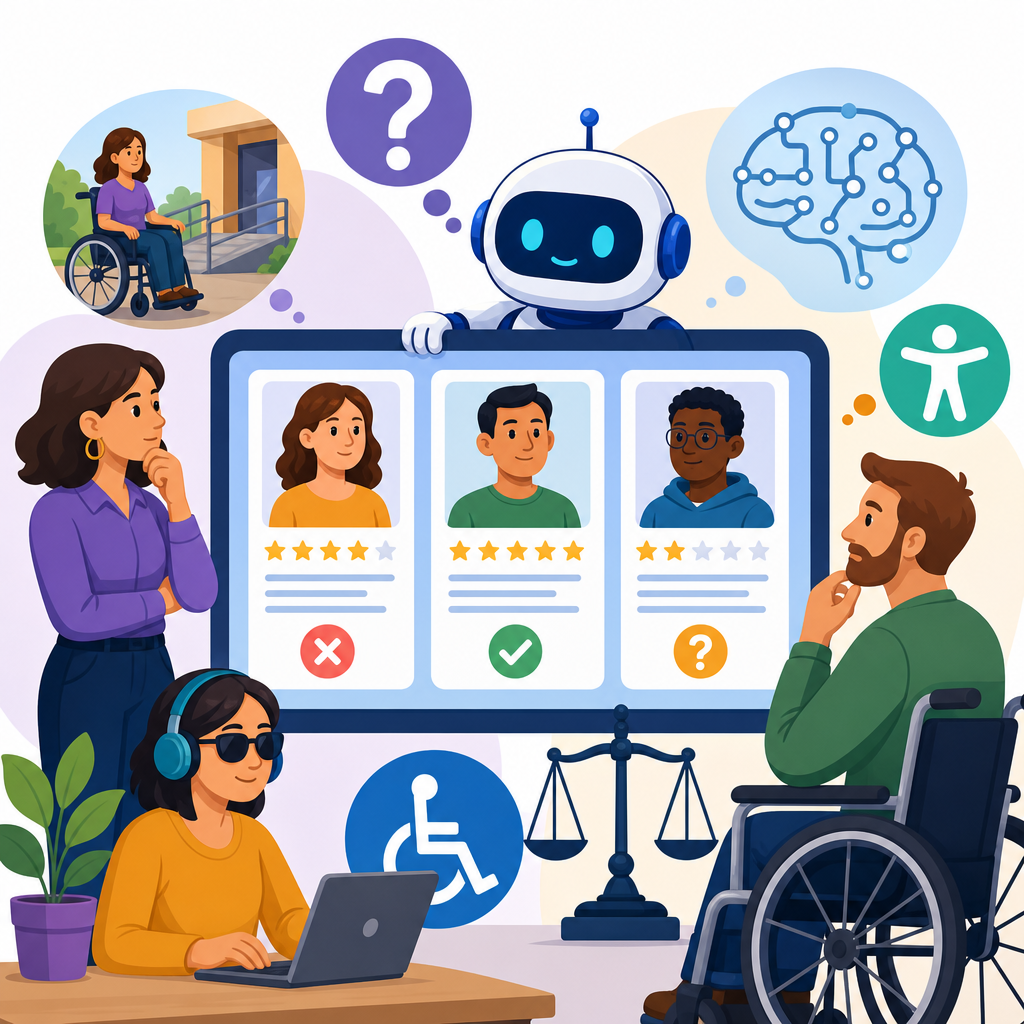
Artificial intelligence now sits inside recruiting software, résumé filters, video interview platforms, game-based assessments, and productivity scoring systems, and that shift has raised urgent ADA questions for employers, vendors, applicants, and workers alike. The Americans with Disabilities Act, or ADA, is the primary federal law barring disability discrimination in employment, including hiring, testing, reasonable accommodation, medical inquiries, and qualification standards. When an AI hiring and screening tool ranks candidates, analyzes speech, measures facial movement, times keystrokes, or predicts job fit from historical data, the central legal issue is straightforward: does the system screen out qualified people with disabilities, and if so, can the employer justify it as job related and consistent with business necessity?
I have worked with teams evaluating hiring technology rollouts, and the pattern is consistent. Leaders often focus on speed, consistency, and cost savings first, then realize too late that an automated filter can quietly replicate inaccessible design or biased assumptions at scale. A timed cognitive game may disadvantage a candidate with a processing disability. A video interview model may misread a person with a speech impairment or facial difference. A keyboard and mouse activity monitor may penalize workers who use assistive technology. None of those outcomes requires malicious intent to create legal risk. Under the ADA, impact matters.
This topic matters because AI is no longer experimental at the edge of hiring. It is embedded across the employment lifecycle, from sourcing and screening to interviews, onboarding, and performance management. The Equal Employment Opportunity Commission has already warned that employers may be responsible when software providers design tools that trigger discrimination. State and local laws are also expanding, with rules on automated employment decision tools, notice, bias auditing, and data governance. For employers, the practical question is not whether to innovate, but how to use AI without turning ordinary efficiency tools into unlawful barriers. For applicants and employees, the question is whether technology is evaluating actual ability to perform the job, with accommodation where needed, rather than measuring disability itself.
To understand AI and ADA compliance, several terms need clear definition. An AI hiring tool is any software that uses data-driven models, rules, machine learning, natural language processing, computer vision, or statistical scoring to assist employment decisions. A screening tool is broader; it includes any assessment, chatbot, ranking engine, digital interview platform, or testing system used to narrow a candidate pool. A reasonable accommodation is a change to the application process, testing format, workplace technology, or job structure that allows a qualified individual with a disability to compete fairly or perform essential functions. Essential functions are the fundamental duties of the job, not every preference listed in a posting.
Where AI hiring tools create ADA risk
AI creates ADA risk in four recurring ways: inaccessible interfaces, disability-correlated proxies, unjustified qualification standards, and unlawful medical inquiry issues. In practice, these often overlap. An online assessment may be inaccessible to screen readers, while also imposing a rigid time limit and scoring patterns associated with neurotypical communication rather than job performance. A résumé parser may reject employment gaps that reflect treatment history. A voice analysis tool may infer enthusiasm, stress, or confidence from vocal characteristics that are shaped by disability. A personality model may assign low scores to candidates who communicate differently, even if the role does not require those exact social signals.
The ADA does not ban technology. It bans discriminatory use of technology. If a tool screens out an individual because of disability, the employer must be prepared to show that the standard being measured is truly necessary for the job and that no reasonable accommodation would enable equal participation. That is a high-stakes inquiry. In my experience, vendors often market tools as objective because they remove human inconsistency. Yet objective formatting does not equal lawful validity. A model can be consistent and still be wrong, inaccessible, or legally indefensible if the measured trait is only loosely connected to essential functions.
Employers should also remember the ADA reaches preemployment testing and application procedures, not just final hiring outcomes. A candidate harmed at the assessment stage may never appear in an adverse impact dashboard if the system prevented completion in the first place. That is why accessibility review, accommodation protocols, and validation evidence must come before deployment, not after complaints arrive.
How the ADA applies across the hiring process
The ADA applies at every stage where AI touches employment decisions. During job advertising, employers should avoid criteria that exclude people with disabilities unless those criteria reflect genuine essential functions. During applications, digital portals must be accessible and applicants must have a clear way to request accommodation. During assessments, the employer must consider whether timing, format, sensory demands, or communication style create unnecessary barriers. During interviews, automated tools that evaluate speech, eye contact, facial expression, or response speed require especially careful scrutiny because those signals can be affected by disability without saying anything useful about job success.
After a conditional offer, the rules on medical examinations and disability-related inquiries become even more important. Some AI systems are marketed as wellness, risk, or fit tools but operate by drawing inferences that look functionally like medical profiling. If a platform attempts to predict mental health status, neurological conditions, fatigue, or stress disorders from biometric or behavioral data, employers risk crossing into prohibited territory. Calling the output a readiness score does not change the substance of what is being inferred. The legal analysis turns on function, not branding.
Another common mistake is treating accommodation as a side process handled manually while the automated system remains fixed. Under the ADA, accommodation must be integrated into the hiring workflow. If a chatbot schedules interviews but cannot process accommodation requests, or if an online test platform has no alternative version, the employer has created friction exactly where equal access is required. A compliant process gives candidates plain-language notice, an easy request channel, timely human review, and an alternative assessment method where appropriate.
Common tool categories and key ADA concerns
Not all AI hiring tools raise the same issues. The best compliance reviews map legal questions to the specific technology in use rather than treating AI as one category.
| Tool type | Typical use | Main ADA concern | Practical safeguard |
|---|---|---|---|
| Résumé ranking | Sorts applicants by keywords, experience, or predicted fit | Penalizing disability-related gaps or nonstandard career paths | Audit feature weighting and allow recruiter override |
| Chatbots | Collects candidate data and screens basic qualifications | Inaccessible interface or no accommodation pathway | Provide accessible design and live human escalation |
| Video interview analysis | Scores speech, expression, tone, or movement | Bias against speech impairments, facial differences, autism, or anxiety | Disable disability-correlated features and offer alternate formats |
| Game-based assessments | Measures cognition, reaction time, or behavioral traits | Time pressure and sensory demands unrelated to essential functions | Validate job relevance and offer extended-time alternatives |
| Keystroke or activity monitoring | Measures productivity or attention | Penalizing assistive technology users or workers needing breaks | Adjust metrics and review accommodations in performance scoring |
This table reflects what I see most often in internal reviews: the legal problem usually begins when the tool measures a proxy for disability rather than a valid job requirement. A recruiter may think a video score captures executive presence, but if the role is back-end data analysis, that metric is difficult to defend. Validation must be role specific, current, and tied to essential functions, not inherited from a generic vendor white paper.
Reasonable accommodation in AI-driven assessments
Reasonable accommodation is the hinge point for most AI and ADA disputes. If a candidate cannot fairly complete a screening tool because of a disability, the employer must consider adjustments unless doing so would impose undue hardship or fundamentally alter what is being measured. In plain terms, if the assessment is trying to test coding ability, the employer may need to change the format, timing, interface, or delivery method so the candidate can demonstrate coding ability without being blocked by unrelated barriers.
Examples are concrete. A blind applicant may need a screen-reader compatible assessment instead of a visual drag-and-drop exercise. A deaf candidate may need captioning or a text-based interview option. An applicant with dyslexia may need extra time on a reading-heavy test where speed is not an essential function. A candidate with PTSD may need an alternative to a game that uses sudden sensory stimuli. An employee being evaluated by productivity software may need metrics adjusted to account for assistive technology or approved break patterns.
The strongest programs avoid making people fight for basic access. They publish accommodation instructions before testing begins, train recruiters to recognize requests even when phrased informally, and maintain documented alternative methods. Delay is its own risk. If the process moves so quickly that accommodation requests become meaningless, the employer may have denied equal opportunity in practice even if the policy sounds compliant on paper.
Validation, documentation, and vendor management
Employers cannot outsource ADA responsibility to software vendors. If a vendor says its model is bias tested, ask what bias was tested, against which populations, with what sample sizes, and whether disability was included. Many vendors have robust analyses for sex or race but little disability-specific evidence because disability data is harder to collect and classify. That gap is exactly why employer diligence matters. A lawful procurement process demands accessibility testing, technical documentation, validation studies, accommodation procedures, data retention rules, and contract terms that require cooperation in investigations or litigation.
Validation should answer a simple question: does the tool predict or measure something genuinely connected to successful performance of essential job functions? The Uniform Guidelines on Employee Selection Procedures are older than modern AI, but their core logic still matters. Selection procedures need evidence of job relevance. For ADA purposes, that evidence becomes critical when a tool screens out people with disabilities. If a trait cannot be tied to business necessity, the employer’s defense weakens quickly.
Documentation should include who approved the tool, what jobs it applies to, what alternatives exist, how accommodation requests are handled, what accessibility standards were used, and how outcomes are monitored. In my experience, organizations with the cleanest records are not always the most technologically advanced. They are the ones that treat governance as part of implementation rather than post-launch cleanup.
Enforcement trends and practical compliance steps
Recent enforcement signals point in one direction: regulators expect employers to evaluate AI tools before they cause harm. The EEOC has issued guidance warning that algorithmic decision-making tools can violate the ADA when they screen out qualified individuals with disabilities or fail to provide reasonable accommodation. The Department of Justice has emphasized accessibility in digital services more broadly, and state regulators are adding rules that can overlap with federal disability law. The result is a layered compliance environment where one flawed tool can create exposure under multiple theories at once.
Practical compliance starts with inventory. List every hiring, assessment, interview, and monitoring system in use, including plug-ins inside larger platforms. Then conduct an ADA-focused impact review: what the tool measures, whether the interface is accessible, what disabilities may be affected, what accommodations are available, and whether the measured criteria are essential and necessary. Next, test the process with people using assistive technology and with realistic accommodation scenarios. Finally, create escalation channels so recruiters and managers can pause automation and route cases to trained humans.
For a sub-pillar hub on AI and ADA, the key takeaway is that disability compliance is not a narrow technical checklist. It is a design, governance, and decision-quality issue. AI hiring and screening tools can help employers manage volume, but they must be built and used around essential functions, accessible processes, and real accommodation pathways. Review your tools now, document the reasoning behind every screening criterion, and make sure a qualified person is never rejected because software measured the wrong thing.
Frequently Asked Questions
1. Why does the ADA apply to AI hiring and screening tools?
The ADA applies because employers cannot avoid their legal obligations by outsourcing hiring, testing, or evaluation decisions to software vendors or automated systems. If an employer uses artificial intelligence in résumé screening, online assessments, video interviews, chatbot interactions, productivity monitoring, or ranking candidates, the ADA still governs how those tools affect applicants and employees with disabilities. In practical terms, that means an employer may be responsible if an AI tool screens out a qualified person because of the way the tool measures speech, facial expressions, reaction time, eye contact, keyboard use, attendance patterns, or other traits that may be connected to a disability.
The law is especially relevant when an AI system functions as a “qualification standard,” an employment test, or a decision-making aid. If the tool tends to exclude individuals with disabilities, the employer must be able to show that the standard being measured is job-related and consistent with business necessity. Even then, the employer may need to provide a reasonable accommodation unless doing so would create an undue hardship. The ADA also restricts disability-related inquiries and medical examinations, which matters when AI tools collect health-linked information, infer mental or physical conditions from behavior, or monitor workers in ways that effectively reveal medical information.
Another important point is that ADA risk can arise even if no one intended to discriminate. A system may be trained on historical hiring data that reflects past bias, or it may rely on interaction patterns that disadvantage people who use assistive technology or who communicate differently because of a disability. That is why employers should treat AI as part of their employment process, not as a neutral black box. The core legal question is not whether the decision was made by a human or by software. The question is whether the process unfairly disadvantages a qualified individual with a disability or denies that person an equal opportunity to compete for a job or succeed at work.
2. What kinds of AI hiring tools can create ADA compliance problems?
A wide range of tools can create ADA issues, especially when they measure abilities or behaviors in a rigid or opaque way. Résumé filters may reject applicants based on gaps in employment, nontraditional career paths, or keyword patterns that do not reflect the qualifications of someone whose disability affected schooling or work history. Timed online tests can disadvantage individuals with vision impairments, mobility limitations, learning disabilities, attention-related conditions, or processing-speed differences if the platform does not allow accommodations such as extra time, screen-reader compatibility, alternative formats, or keyboard navigation.
Video interview tools raise particularly visible concerns. Some platforms analyze tone of voice, facial movement, eye contact, word choice, or pace of speech in an attempt to score communication, confidence, or “fit.” Those measurements may unfairly penalize applicants with speech impairments, deafness or hearing loss, autism, anxiety disorders, neurological conditions, facial differences, or other disabilities that affect presentation style without affecting the person’s ability to perform the essential functions of the job. The same concern can arise with game-based assessments that test reaction time, memory, hand-eye coordination, or pattern recognition in ways that are not truly necessary for the role.
AI can also create ADA problems after hiring. Productivity scoring systems, attendance analytics, keystroke monitoring, error-rate tracking, and workplace surveillance tools may penalize employees who work differently because of a disability or because they are using a reasonable accommodation. For example, an employee using voice-recognition software, taking approved medical breaks, or working at a different pace due to a disability may be inaccurately flagged as underperforming by an algorithm optimized for a narrow idea of “normal” behavior. In each of these situations, the legal risk grows when the employer cannot explain what the tool measures, cannot validate that the criteria are job-related, or has no process for modifying the assessment and providing accommodations.
3. Do employers have to provide reasonable accommodations when using AI-based assessments or screening tools?
Yes. If an employer uses an AI-based test or screening process, it generally must provide reasonable accommodations to qualified applicants and employees with disabilities unless doing so would cause undue hardship. The obligation is not eliminated just because the assessment is automated or administered by a third-party platform. If a candidate needs extra time, an alternative test format, a non-video option, captioning, screen-reader access, keyboard-only navigation, an interpreter, a different method of demonstrating qualifications, or another adjustment because of a disability, the employer should have a clear process for receiving and responding to that request.
This is one of the most important operational issues with AI hiring tools. An employer should not wait until a complaint arises to figure out how accommodations will work. Instead, the process should be built in from the beginning. Job postings and assessment invitations should explain that accommodations are available and provide a simple, accessible way to request them. Vendors should be contractually required to support accommodations, disclose the tool’s accessibility limits, and cooperate in a timely interactive process. If the vendor cannot make the tool accessible or cannot offer a meaningful accommodation, the employer may need to use a different assessment method altogether.
The ADA does not require employers to lower legitimate job standards, but it does require equal access to the application and evaluation process. That means employers should focus on what the candidate actually needs to show: whether they can perform the essential functions of the job, with or without reasonable accommodation. If an AI tool measures traits that are only loosely related to job performance, or measures them in a way that disadvantages people with disabilities, an alternative method may be necessary. The safest approach is to validate the tool carefully, offer accommodations proactively, and ensure that no applicant is screened out simply because the technology was designed around a narrow model of human behavior.
4. Can AI screening tools violate the ADA by making disability-related inquiries or conducting medical examinations?
They can, depending on what the tool collects, infers, or analyzes. The ADA places strict limits on disability-related inquiries and medical examinations, especially before a conditional offer of employment. A disability-related inquiry is generally a question that is likely to elicit information about a disability. A medical examination is a procedure or test that seeks information about an individual’s physical or mental impairments or health. If an AI tool asks questions about medical conditions, treatment, medications, mental health, or functional limitations, that may raise immediate ADA concerns. The same may be true if the tool analyzes biometric, behavioral, or physiological data in a way that effectively reveals health information.
For example, a system that claims to detect stress, depression, fatigue, cognitive decline, intoxication, or emotional stability from voice patterns, facial expressions, eye movements, typing behavior, or wearable-device data could present significant legal risk. Even if the employer never directly asks, “Do you have a disability?,” the technology may be functioning as a proxy for a prohibited medical inquiry or examination. This is especially sensitive in pre-offer hiring stages, where the ADA generally bars employers from seeking medical information before making a conditional job offer.
Employers should be cautious about any AI feature marketed as detecting personality traits, mental state, truthfulness, wellness, or neurological characteristics. Labels like “engagement,” “attention,” or “resilience” do not automatically make the tool safe under the ADA if the underlying analysis is based on health-linked indicators. The best practice is to ask hard questions before deployment: What data is being collected? What inferences are being drawn? Does the tool identify or predict physical or mental conditions? Could it disclose information about disabilities, treatment, or functional limitations? If the answer is yes or even maybe, the employer should pause and get legal review before using it in hiring or employment decisions.
5. What should employers and vendors do to reduce ADA risk when using AI in hiring and employment decisions?
Reducing ADA risk requires more than a general promise that the technology is “fair” or “bias-free.” Employers should start with governance and documentation. They should map exactly where AI is used in the employment lifecycle, identify which tools influence decisions, and determine whether the systems act as tests, ranking mechanisms, monitoring tools, or gatekeepers. From there, they should evaluate whether each tool is accessible, whether it could screen out individuals with disabilities, whether the measured criteria are truly job-related, and whether reasonable accommodations can be provided promptly and effectively.
Vendor management is equally important. Employers should demand meaningful transparency, not just marketing claims. Contracts should address accessibility, accommodation support, audit rights, data use, retention limits, and legal compliance responsibilities. Employers should ask vendors how the model was trained, what traits it measures, whether the tool has been tested for disability-related adverse impact, how individuals using assistive technology perform on it, and what alternative assessment methods are available. If a vendor cannot answer basic questions about accessibility and disability impact, that is a warning sign.
Internal processes matter just as much as technical review. Employers should train recruiters, HR teams, managers, and compliance personnel to recognize when an AI tool may be creating barriers for people with disabilities. They should maintain a straightforward accommodation procedure, provide notice to applicants and employees when automated tools are being used, and ensure that humans can review or override automated outcomes where appropriate. Regular audits are essential, especially after software updates or changes in job criteria. In the end, ADA compliance with AI is not only about avoiding litigation. It is about designing hiring and employment systems that evaluate people fairly, focus on actual job requirements, and do not let automation quietly reproduce discrimination under the appearance


