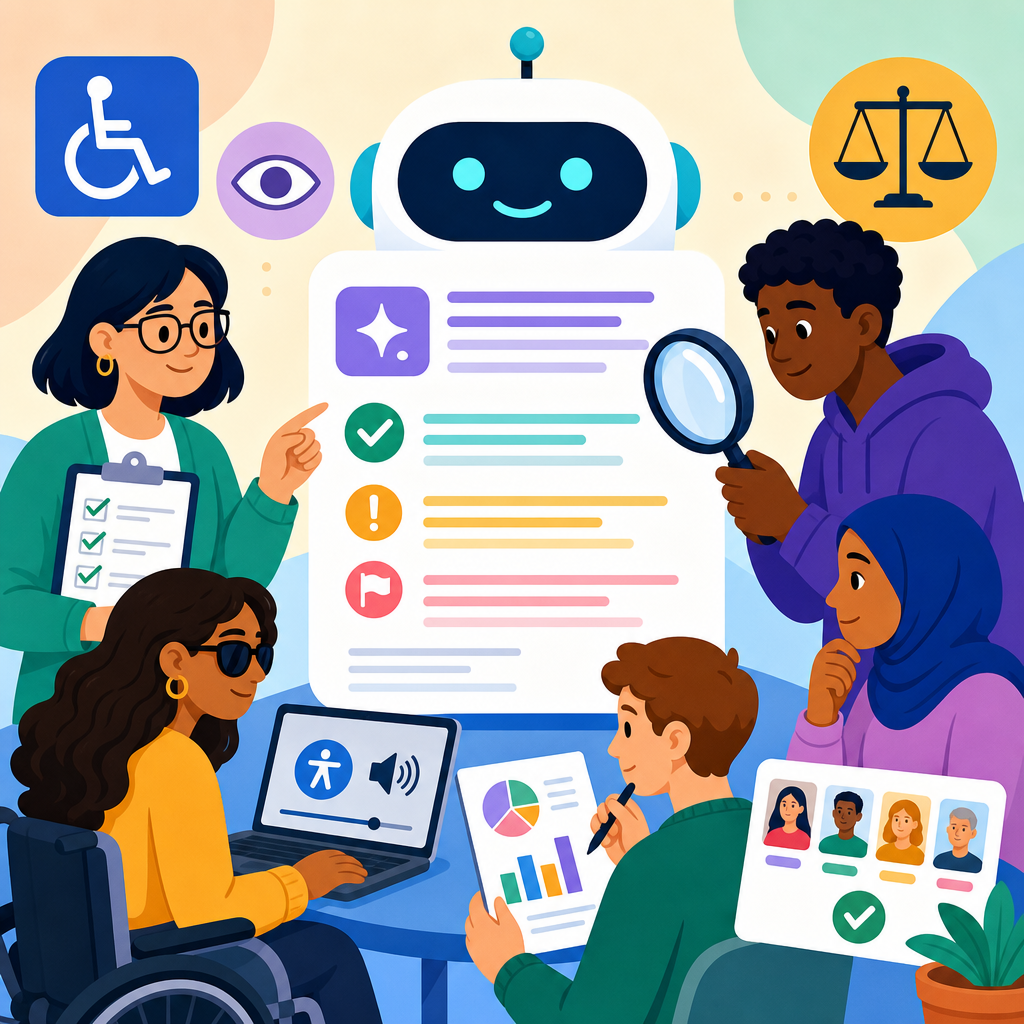
AI summaries now appear in search results, productivity software, customer support tools, legal research platforms, and workplace dashboards, which makes auditing them for accessibility and bias a compliance issue, a product quality issue, and a governance issue at the same time. In this context, an AI summary is a condensed output generated from a larger source set, while accessibility means people with disabilities can perceive, understand, navigate, and use that output, and bias means the summary systematically advantages, excludes, stereotypes, or misrepresents people or protected groups. When the subject is AI and ADA, the core question is practical: does an automated summary create barriers that would not exist if the underlying information were delivered in an accessible, accurate, and equitable way?
I have worked on summary evaluation for internal knowledge systems and public-facing interfaces, and the same pattern appears repeatedly. Teams test factual accuracy, but they often skip screen reader behavior, reading level, omission patterns, disability-related terminology, and whether the summary quietly strips away context that matters for equal access. That gap matters because the Americans with Disabilities Act applies to how people experience services, not just to a company’s intent. If an AI-generated summary hides accommodation details, mistranslates alt text into vague prose, or uses language that stigmatizes disability, the risk is not abstract. It can affect hiring, education, healthcare, travel, banking, and legal information in ways that are measurable and preventable.
This article serves as a hub for AI and ADA work because accessibility and bias cannot be audited in isolation. The legal baseline includes the ADA, Section 504 and Section 508 in many public sector contexts, and the Web Content Accessibility Guidelines as the most widely used technical benchmark for digital accessibility. The technology baseline includes large language models, retrieval systems, prompt templates, ranking logic, and human review workflows. A strong audit connects these layers. It asks whether summaries are perceivable, operable, understandable, and robust for assistive technology users, and whether they preserve meaning across disability status, race, gender, age, language proficiency, and other attributes that shape how people are described and served.
For a hub page, the most useful approach is to give a complete audit framework that teams can apply across products and then expand in supporting articles on procurement, employment tools, education platforms, healthcare communication, public accommodations, and vendor contracting. The goal is not to ban AI summaries. It is to make them usable, defensible, and fair by design.
What an accessibility and bias audit should cover
An audit of AI summaries should examine five layers: source content, model behavior, interface presentation, user impact, and governance controls. Source content matters because summaries inherit defects from inputs. If the original document lacks headings, alt text, captioning, or plain-language accommodation instructions, the model may compress those failures into an even less accessible output. Model behavior matters because prompts, token limits, safety filters, and retrieval choices determine what gets omitted or emphasized. Interface presentation matters because even a well-written summary can become inaccessible if it is injected into a component with poor focus order, unlabeled buttons, insufficient contrast, or no semantic structure. User impact matters because legal exposure and actual harm depend on what a person can or cannot do after reading the summary. Governance controls matter because one-off testing does not catch drift, new failure modes, or vendor updates.
A useful audit starts with task analysis rather than abstract scoring. Identify the user action the summary supports: comparing benefits, understanding a policy, deciding whether a location is accessible, reviewing a medical instruction, or screening a job applicant. Then ask what information is essential for equal access. In one internal audit I ran for a travel workflow, the underlying pages correctly listed step-free entrances and hearing loop availability, but the generated summary routinely foregrounded amenities like parking and dining while dropping accessibility details. Accuracy tests passed because the retained facts were true. The system still failed users with disabilities because the omitted facts were the ones that determined whether the venue was usable.
Bias review should include both representational harm and allocation harm. Representational harm appears when the summary uses outdated or pejorative language, frames disability as tragedy, or collapses different conditions into a single stereotype. Allocation harm appears when the summary changes outcomes, such as steering users away from accommodations, overflagging risk in disability-related cases, or reducing the visibility of eligibility information. For AI and ADA work, both forms matter. A summary that calls a blind applicant “limited” instead of identifying inaccessible testing can influence human decision-makers while also obscuring the actual barrier.
Legal standards and practical benchmarks
The ADA does not prescribe a single technical checklist for AI summaries, but courts and regulators look closely at whether a service is effectively accessible and whether reasonable modifications are available. That is why teams usually map summary audits to established digital accessibility benchmarks. WCAG 2.2 is the practical reference point for web and app experiences, especially around structure, contrast, focus visibility, error prevention, and compatibility with assistive technologies. Section 508 procurement rules incorporate WCAG requirements in federal contexts, while state and higher education environments often add their own standards and grievance processes. If your summary appears in a customer portal, employee HR tool, or student service, you should assume accessibility expectations apply even when the output is dynamically generated.
Bias governance also draws from existing frameworks. The NIST AI Risk Management Framework provides a solid structure for documenting risks, intended use, measurement methods, and ongoing monitoring. EEOC guidance is relevant when summaries touch employment decisions, OCR expectations matter in education and healthcare, and FTC deception principles can matter if a product implies summaries are complete when they routinely omit critical access information. The practical takeaway is simple: document intended use, define prohibited failures, test with disabled users, and maintain evidence that remediation occurs. If a regulator, plaintiff, procurement team, or enterprise customer asks how the product was evaluated, you need more than a model card and a promise of human oversight.
Accessibility and bias benchmarks should be translated into measurable acceptance criteria. “Accessible summary” is too vague. Better criteria include: all summary regions have semantic headings; screen readers announce updates through appropriate live region settings; summaries preserve accommodation instructions present in the source; generated language avoids stigmatizing descriptors unless directly quoted and contextually necessary; multilingual summaries retain disability-specific terms accurately; and confidence or source indicators are available when omission risk is material. These criteria turn policy into engineering and quality assurance work.
How to run the audit from source to interface
Start by building a representative test set. Include documents about transportation access, hiring accommodations, medical instructions, educational supports, public venue features, and legal rights. Balance straightforward examples with edge cases such as scanned PDFs, poorly structured webpages, mixed-language materials, and documents containing identity-first and person-first language preferences. Include records where accessibility details appear deep in the source, because summarizers often privilege introductory text and high-frequency terms. A weak test set produces a false sense of security.
Next, define evaluation dimensions and scoring rules before you look at outputs. I use dimensions for factual accuracy, critical omission, disability terminology, readability, assistive technology compatibility, actionability, and parity across user groups. Critical omission deserves separate treatment because a summary can be factually correct yet unusable. If the source says “ASL interpreters available with 72 hours notice” and the summary says “Accessibility support available,” the wording is not technically false, but it strips away the specific step the user needs. That should fail.
| Audit area | What to test | Common failure | Example remediation |
|---|---|---|---|
| Source fidelity | Whether essential accommodation details survive compression | Interpreter, ramp, caption, or deadline details omitted | Prompt for mandatory retention of access-related facts |
| Language fairness | Whether disability is described accurately and neutrally | Stigmatizing or paternalistic phrasing | Terminology rules plus human review for sensitive domains |
| Interface accessibility | Screen reader, keyboard, contrast, heading, and live region behavior | Summary injected into unlabeled dynamic container | Semantic markup and tested announcement patterns |
| Decision impact | Whether the summary changes eligibility or access outcomes | Accommodation conditions generalized away | Escalate high-risk summaries to manual verification |
| Monitoring | Whether drift and vendor updates trigger retesting | Model update causes new omission patterns | Regression suite with recurring disability-focused cases |
Then test outputs in the actual interface, not just in a spreadsheet. Use NVDA and JAWS on Windows, VoiceOver on Apple devices, keyboard-only navigation, browser zoom at 200 percent, and mobile screen readers where relevant. Check whether users can find the summary, understand what it is based on, move to the source, and complete the intended task. I have seen summaries that looked excellent in plain text exports but became confusing in production because the source link was unlabeled, the heading hierarchy skipped levels, and automatic refreshes caused screen readers to re-announce content unexpectedly.
Finally, compare results across personas and contexts. Does the system summarize disability-related content differently from non-disability content? Does it use hedging language around accommodation rights but confident language around restrictions? Does a Spanish summary preserve “reasonable accommodation” correctly, or does it substitute generic support language? These are the patterns that reveal bias and legal risk.
High-risk use cases for AI and ADA
Some use cases deserve stricter controls because the summary directly affects rights, eligibility, safety, or access to essential services. Employment is one of them. If an AI system summarizes interview notes, accommodation requests, performance records, or leave documentation, any omission or biased phrasing can influence hiring, promotion, discipline, or termination. The EEOC has already signaled concern about algorithmic decision tools and disability discrimination. In practice, that means summaries used in HR should never flatten an accommodation request into a character judgment, such as turning “requested extra time due to dyslexia” into “needs special handling.”
Education is another high-risk setting. Summaries of individualized supports, disability service communications, or classroom policies can remove the exact implementation details a student needs. In one university review pattern I encountered, generated digests often converted “accessible PDF available upon request” into “materials available online,” which sounds adequate but is not the same thing. Healthcare is even more sensitive. Summaries of discharge instructions, benefits notices, or appointment requirements must retain time windows, assistive communication options, and contraindications. A polished but incomplete summary is dangerous.
Public accommodations, travel, finance, and legal information also carry elevated risk. A hotel summary that says “accessible rooms available” without specifying roll-in shower availability, bed transfer space, or hearing-access features can mislead users into making unusable bookings. A bank chatbot summary that omits relay service options or inaccessible identity verification alternatives can block account access. A legal rights summary that compresses nuanced ADA obligations into broad reassurance can deter someone from seeking accommodations they are entitled to request. For these categories, human review, source citations, and escalation paths should be standard, not optional.
Remediation, governance, and continuous monitoring
Once failures are found, remediation should target the actual source of error. If the model omits accessibility details because the prompt rewards brevity above all else, revise the prompt to require retention of accommodation facts, deadlines, contact methods, and exceptions. If failures come from retrieval, adjust ranking features so access-related content is treated as high importance. If the interface is the problem, add semantic structure, visible labels, focus management, and direct links to source material. If the domain is inherently high risk, restrict automation and require reviewer sign-off before publication.
Governance should assign ownership across legal, product, design, accessibility, and machine learning teams. In mature programs, I recommend a summary-specific policy covering intended uses, prohibited uses, test cadence, incident response, vendor obligations, and documentation requirements. Procurement language should require accessibility conformance evidence, model update notices, audit cooperation, and retention of logs needed for investigation. Internally, maintain a regression suite of disability-focused cases and review it after every model, prompt, or UI change. Drift is common. A vendor can improve fluency while worsening omission rates.
Monitoring should mix quantitative and qualitative methods. Track omission frequency for access-critical facts, complaint rates, manual override rates, and task completion for disabled testers. Pair those metrics with periodic expert review and participatory testing by people who use screen readers, magnifiers, voice input, captions, and cognitive accessibility supports. No synthetic benchmark replaces lived experience. Teams that do this well treat accessibility and bias as release criteria, not as post-launch cleanup.
Auditing AI summaries for accessibility and bias is ultimately about preserving equal access when information is compressed by automation. The strongest programs define what information must never be lost, test summaries inside real interfaces with assistive technology, and examine whether wording or omission changes outcomes for disabled users. For AI and ADA work, that means connecting legal obligations, technical standards, model evaluation, and product governance into one repeatable process rather than scattered reviews.
The key takeaway is that accessible, fair summaries do not happen by accident. They require representative test sets, explicit failure criteria, high-risk escalation rules, and ongoing monitoring after every model or interface change. When teams adopt that discipline, they reduce legal exposure, improve user trust, and make services genuinely easier to use for everyone, especially people who are too often excluded by default design decisions. That is the practical value of this hub topic.
If you manage AI-generated summaries in any product, start with one audit this quarter: pick a high-risk workflow, test it with disabled users and assistive technology, document omission patterns, and fix the failures at the source. Then build the rest of your AI and ADA program from that evidence.
Frequently Asked Questions
What does it mean to audit AI summaries for accessibility and bias?
Auditing AI summaries for accessibility and bias means systematically reviewing condensed AI-generated outputs to determine whether people with different abilities can use them effectively and whether the content treats individuals, groups, and viewpoints fairly. In practice, this is not just a copyediting task. It is a structured evaluation of how the summary was produced, what source material influenced it, what information was omitted, how language choices may affect users, and whether the final output creates barriers or harms. Because AI summaries now appear in search interfaces, productivity tools, customer support systems, legal research products, and workplace dashboards, the audit needs to address legal risk, product quality, and governance at the same time.
From an accessibility perspective, the audit asks whether users can perceive, understand, navigate, and act on the summary. That includes checking plain language, heading structure, readability, compatibility with assistive technologies, meaningful link text, visual presentation, and whether the summary relies on color, layout, or shorthand that may exclude users with disabilities. From a bias perspective, the audit examines whether the summary systematically privileges certain sources, erases context, reinforces stereotypes, misrepresents protected groups, or frames uncertainty in misleading ways. A strong audit also looks upstream at training data, prompt design, ranking logic, and source selection, because harmful outputs are often caused by the system pipeline rather than by wording alone.
In short, an accessibility and bias audit evaluates whether an AI summary is usable, understandable, equitable, and trustworthy for real people in real contexts. The goal is not perfection. The goal is to detect risk early, document findings clearly, and improve the system with measurable standards.
Why is auditing AI summaries now considered a compliance, product quality, and governance issue?
AI summaries have moved from experimental features into high-impact environments where users rely on them to make decisions, understand rights, compare options, and complete work. That shift changes the stakes. If a summary in a customer support tool omits an eligibility condition, if a workplace dashboard simplifies performance information in a misleading way, or if a search result summary presents inaccessible text that a screen reader user cannot interpret efficiently, the problem is no longer academic. It affects usability, fairness, trust, and potentially legal obligations.
As a compliance issue, organizations may need to align with accessibility requirements, anti-discrimination expectations, consumer protection rules, procurement standards, and sector-specific obligations. Depending on the context, inaccessible or biased summaries can contribute to exclusion, unequal treatment, or deceptive communication. As a product quality issue, poor summaries create confusion, increase support costs, reduce user confidence, and undermine the usefulness of the feature itself. A summary that is technically fluent but inaccessible or skewed is still a low-quality product outcome.
As a governance issue, AI summaries require accountability. Teams need to know who owns risk decisions, what standards define acceptable performance, how incidents are escalated, and how changes to prompts, models, or source pipelines are reviewed. Governance matters because summaries are often generated automatically at scale, and a small design flaw can produce repeated harm across thousands or millions of outputs. Auditing creates the evidence base for responsible oversight: it helps organizations set thresholds, document tradeoffs, assign remediation tasks, and demonstrate due diligence to internal stakeholders, regulators, customers, and auditors.
What should be included in a practical audit framework for AI summary accessibility and bias?
A practical audit framework should cover the entire summary lifecycle, not just the final text on the screen. Start with purpose and scope: identify where the summaries appear, who uses them, what decisions they influence, and which user groups may face the highest risk if the summary is inaccurate, inaccessible, or unfair. Then define the summary unit being evaluated. For example, are you auditing a search snippet, a case law digest, a support answer, or a workplace status summary? The evaluation criteria should match the function and risk of that use case.
Next, assess source integrity and selection. Review whether the underlying source set is representative, current, credible, and balanced. Bias often begins with the corpus, not the wording of the final summary. Then evaluate summarization behavior: factual retention, omission patterns, uncertainty handling, attribution, framing, and consistency across comparable inputs. For accessibility, review reading level, sentence structure, jargon density, abbreviation handling, semantic structure, keyboard and screen reader compatibility where relevant, and whether the summary can be understood without relying on inaccessible visual cues.
A good framework also includes demographic and contextual testing. Compare outputs across topics involving different protected characteristics, languages, accents, disabilities, and social groups. Test edge cases, contested issues, and ambiguous prompts. Include human review protocols with clear rubrics so evaluators are not relying on intuition alone. Metrics may include error rates, omission severity, accessibility defect categories, readability indicators, source diversity measures, and disparity patterns across groups or topics.
Finally, include governance controls: documentation, versioning, approval workflows, escalation criteria, remediation timelines, and post-release monitoring. An audit framework is most effective when it combines technical checks, user-centered testing, policy review, and operational accountability.
How can teams identify bias in AI summaries without relying only on subjective judgment?
Bias review always involves interpretation, but it should not be reduced to intuition or individual opinion. Teams can make bias auditing much more rigorous by using predefined criteria, comparison testing, and evidence-based review methods. Start by defining what bias means for the specific product. In one setting, the key risk may be stereotyping. In another, it may be selective omission, overgeneralization, unequal sentiment, or overreliance on majority sources. A legal research summary, for example, may need scrutiny for whether it flattens dissenting views or overstates precedent. A workplace tool may need scrutiny for whether it presents behavior differently depending on identity cues.
One effective method is paired or controlled testing. Provide the system with materially similar source sets that differ only in demographic references, social context, or viewpoint distribution, then compare the summaries for tone, completeness, caution level, and implied judgment. You can also examine whether certain groups are more likely to be described with deficit-oriented language, stripped of context, or associated with risk, conflict, or blame. Another useful technique is omission analysis: identify what a reasonable user would need to know from the source material and track whether the system systematically leaves out protections, exceptions, historical context, or minority perspectives.
Quantitative signals can help too. Look for patterns in sentiment, topic prominence, source citation frequency, readability differences, and error rates across categories. But numbers should support, not replace, qualitative review. The strongest audits use a mixed-method approach: structured rubrics, representative test sets, multidisciplinary reviewers, and clear documentation of why a finding was marked as harmful, risky, or acceptable. That approach makes bias findings more repeatable, more defensible, and more useful for remediation.
What are the most effective ways to improve AI summaries after accessibility or bias issues are found?
The most effective improvements target root causes rather than only patching individual outputs. If an audit shows inaccessible wording, repeated omissions, or uneven treatment across groups, the first step is to locate where the problem originates. It may come from source retrieval, ranking, prompt instructions, model limitations, interface design, or post-processing rules. Remediation should be mapped to the actual failure point. For example, if the summary consistently excludes qualifying details, you may need prompt changes that require exceptions and limitations to be preserved. If certain perspectives are underrepresented, the source selection process may need balancing rules or stronger quality controls.
For accessibility, improvements often include simplifying sentence structure, reducing ambiguity, expanding abbreviations, preserving semantic structure, and ensuring compatibility with assistive technologies. If summaries appear in a user interface, teams should also review focus order, headings, labels, contrast, resizing behavior, and whether interactions can be completed without a mouse. User testing with people with disabilities is especially valuable because many accessibility issues are missed by automated checks alone. For bias, remediation may include revising prompts to avoid overconfident generalizations, adding attribution and uncertainty cues, improving source diversity, creating protected-topic review rules, and introducing human oversight for high-risk use cases.
Just as important, teams should validate that the fix actually works. Re-run the audit on the original failure cases and on new test cases to check for regressions or unintended side effects. Document what changed, why it changed, and what performance threshold must be met before release. Over time, organizations should build these lessons into standard operating procedures, model cards, design reviews, and procurement requirements. The goal is continuous improvement: making AI summaries more accessible, more balanced, and more dependable with each iteration.


